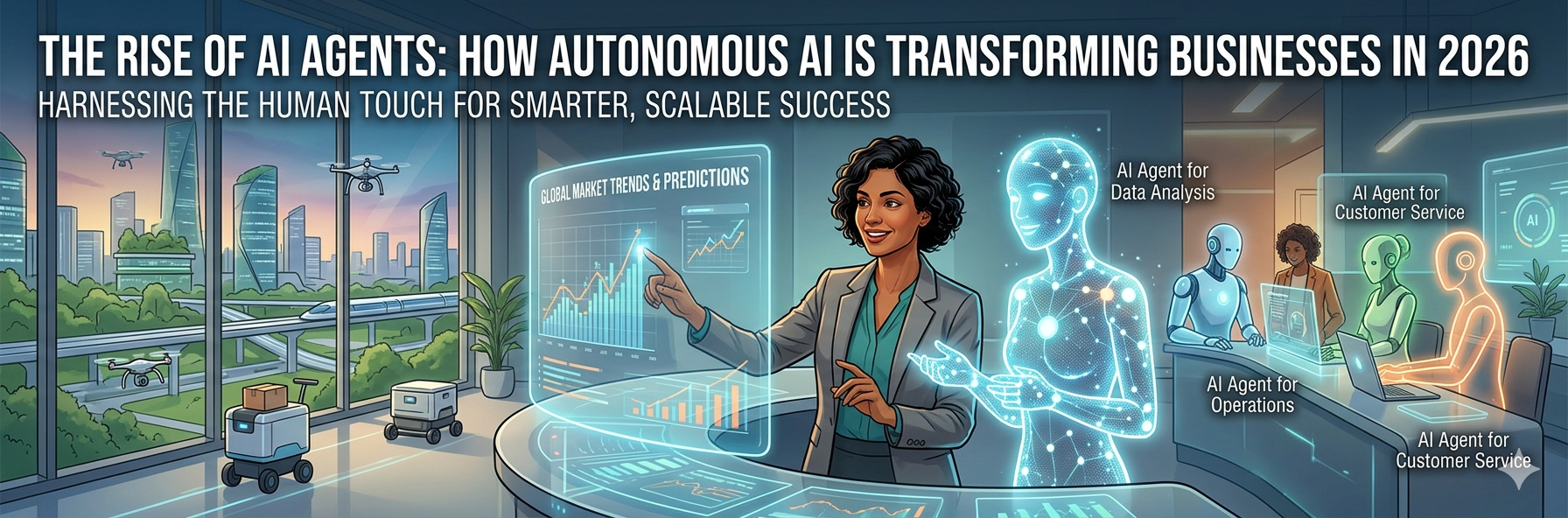
Artificial intelligence is evolving rapidly, and one of the most exciting developments in 2026 is the rise of AI agents. These intelligent systems are designed to perform tasks autonomously, make decisions, and improve processes without constant human intervention. Businesses across industries are now adopting autonomous AI solutions to automate workflows, enhance productivity, and reduce operational costs.
From customer service automation to intelligent data analysis, AI-powered agents are helping organizations work faster and smarter. As companies continue to embrace AI automation and machine learning technologies, AI agents are becoming a key driver of digital transformation. In this blog, we explore how AI agents work, their benefits, real-world applications, and why they are shaping the future of modern businesses.
What Are AI Agents?
AI agents are autonomous software programs that can perceive information, analyze data, make decisions, and take actions to achieve specific goals. Unlike traditional software, these systems can operate with minimal human guidance and continuously learn from data.
-
Machine Learning (ML)
-
Natural Language Processing (NLP)
-
Predictive analytics
-
Workflow automation tools
Types of AI Agents
There are several types of AI agents used in modern AI systems:
-
Simple Reflex Agents – React to specific inputs using predefined rules
-
Model-Based Agents – Use stored information to make smarter decisions
-
Goal-Based Agents – Focus on achieving specific objectives
-
Learning Agents – Continuously improve their performance based on data
-
Multi-Agent Systems – Multiple AI agents working together to solve problems
Key Components of AI Agents
AI agents work through several essential components that allow them to operate intelligently and autonomously. These include perception, which gathers data from the environment; decision-making algorithms that analyze information; learning mechanisms such as machine learning; action modules that execute tasks; and feedback systems that improve performance over time. Together, these components enable AI agents to adapt, automate processes, and solve complex problems efficiently.
| Component | Description |
|---|---|
| Perception System | Collects and processes data from the environment using sensors, APIs, or data inputs to understand what is happening. |
| Decision-Making Engine | Uses algorithms and logic to analyze data and decide the best possible action. |
| Learning Mechanism | Enables the AI agent to improve over time using machine learning and data feedback. |
| Action Module | Executes tasks or commands based on decisions, such as sending responses or performing automated actions. |
| Feedback System | Monitors outcomes and refines performance to make future decisions more accurate and efficient. |
Why AI Agents Are Growing Rapidly in 2026
AI agents are expanding quickly in 2026 because businesses want smarter automation and faster decision-making. Unlike traditional AI tools, agents can perform multi-step tasks and operate autonomously across systems. Companies use them to automate workflows, improve customer service, and analyze data in real time. As integration with enterprise apps grows, AI agents are becoming essential digital coworkers.
| Factor | Explanation |
|---|---|
| Advanced AI Technologies | Improvements in machine learning, natural language processing, and automation tools make AI agents more capable and reliable. |
| Business Automation Needs | Companies want to automate repetitive tasks, reduce costs, and improve productivity. |
| Better Data Processing | AI agents can analyze large volumes of data quickly and provide real-time insights for smarter decisions. |
| Integration with Business Tools | AI agents easily connect with CRM, ERP, and other enterprise platforms to streamline workflows. |
| Improved Customer Experience | Businesses use AI agents for faster support, personalized recommendations, and 24/7 customer service. |
Key Benefits of AI Agents for Businesses
AI agents help businesses automate repetitive tasks, reduce operational costs, and improve efficiency. They analyze data quickly, support faster decision-making, and enhance customer experiences with 24/7 assistance. By streamlining workflows and integrating with business tools, AI agents allow companies to scale operations, increase productivity, and stay competitive in the digital economy.
Increased Productivity
AI agents automate repetitive tasks and administrative work, allowing employees to focus on higher-value activities.
-
Faster task execution
-
Reduced human errors
-
Improved workflow efficiency
Smarter Decision-Making
AI agents analyze massive amounts of business data in real time and provide valuable insights.
-
Identify market trends
-
Optimize operations
-
Improve strategic planning
Cost Optimization
One of the biggest advantages of AI automation is cost reduction. Companies can reduce operational expenses by automating routine tasks and improving process efficiency.
Benefits include:
-
Lower labor costs
-
Faster project completion
-
Reduced operational inefficiencies
Enhanced Customer Experience
AI-powered virtual assistants and chatbots provide faster and more personalized customer support.
-
Answer customer queries instantly
-
Provide personalized product recommendations
-
Deliver 24/7 support services
Real-World Use Cases of AI Agents
AI agents are transforming industries by automating complex tasks and improving decision-making. Businesses use AI agents for customer support automation, data analysis, personalized marketing, and workflow management. In healthcare, they assist with diagnostics, while in finance, they detect fraud. Fixnhour highlights how AI agents also power smart assistants, recommendation systems, and autonomous operations, helping organizations increase efficiency, reduce costs, and enhance customer experiences.
| Use Case | How AI Agents Are Used | Key Benefit |
|---|---|---|
| Customer Support Automation | AI agents handle customer queries through chatbots and virtual assistants. | Faster responses and 24/7 support |
| Personalized Marketing | AI analyzes user behavior to deliver targeted ads and recommendations. | Higher engagement and conversions |
| Healthcare Assistance | AI agents help with diagnostics, patient monitoring, and medical data analysis. | Improved accuracy and patient care |
| Fraud Detection | Financial institutions use AI to detect suspicious transactions in real time. | Better security and risk prevention |
| Workflow Automation | AI agents automate repetitive business tasks and processes. | Increased productivity and reduced costs |
The Future of AI Agents in Business
AI agents are expected to become essential tools for modern businesses. They will automate complex workflows, analyze massive datasets, and make real-time decisions with minimal human intervention. From customer service to supply chain management, AI agents will improve efficiency, reduce operational costs, and enable smarter, data-driven strategies across industries.
| Future Area | How AI Agents Will Help | Business Impact |
|---|---|---|
| Autonomous Operations | AI agents will manage workflows and processes automatically. | Higher productivity |
| Advanced Data Analysis | AI will analyze large datasets to generate insights. | Better decision-making |
| Hyper-Personalized Customer Experience | AI agents will deliver tailored services and recommendations. | Increased customer satisfaction |
| Smart Supply Chain Management | AI will optimize inventory, logistics, and demand forecasting. | Reduced operational costs |
| AI-Powered Collaboration | AI agents will assist teams in project management and communication. | Faster and efficient teamwork |
How Businesses Can Start Using AI Agents
Businesses can start using AI agents by identifying repetitive tasks such as customer support, data analysis, and marketing automation. Start with small pilot projects using AI platforms and integrate them with existing tools like CRM and project management systems. Train teams to collaborate with AI, monitor performance, and gradually scale automation across departments to improve efficiency and productivity.
-
Identify repetitive tasks that can be automated
-
Choose the right AI development platform
-
Train AI models using high-quality data
-
Integrate AI agents with existing business systems
-
Continuously monitor and optimize AI performance
Conclusion
The rise of AI agents marks a major shift in how businesses operate in the digital era. These intelligent systems are transforming industries by automating workflows, improving decision-making, and enhancing customer experiences.
As AI technology continues to evolve, companies that adopt autonomous AI solutions will gain a significant competitive advantage. Businesses that invest in AI agents today will be better positioned to drive innovation, efficiency, and growth in the future, Contact us today to explore powerful AI agent solutions that automate workflows, improve efficiency, and transform your business with advanced AI technology.


