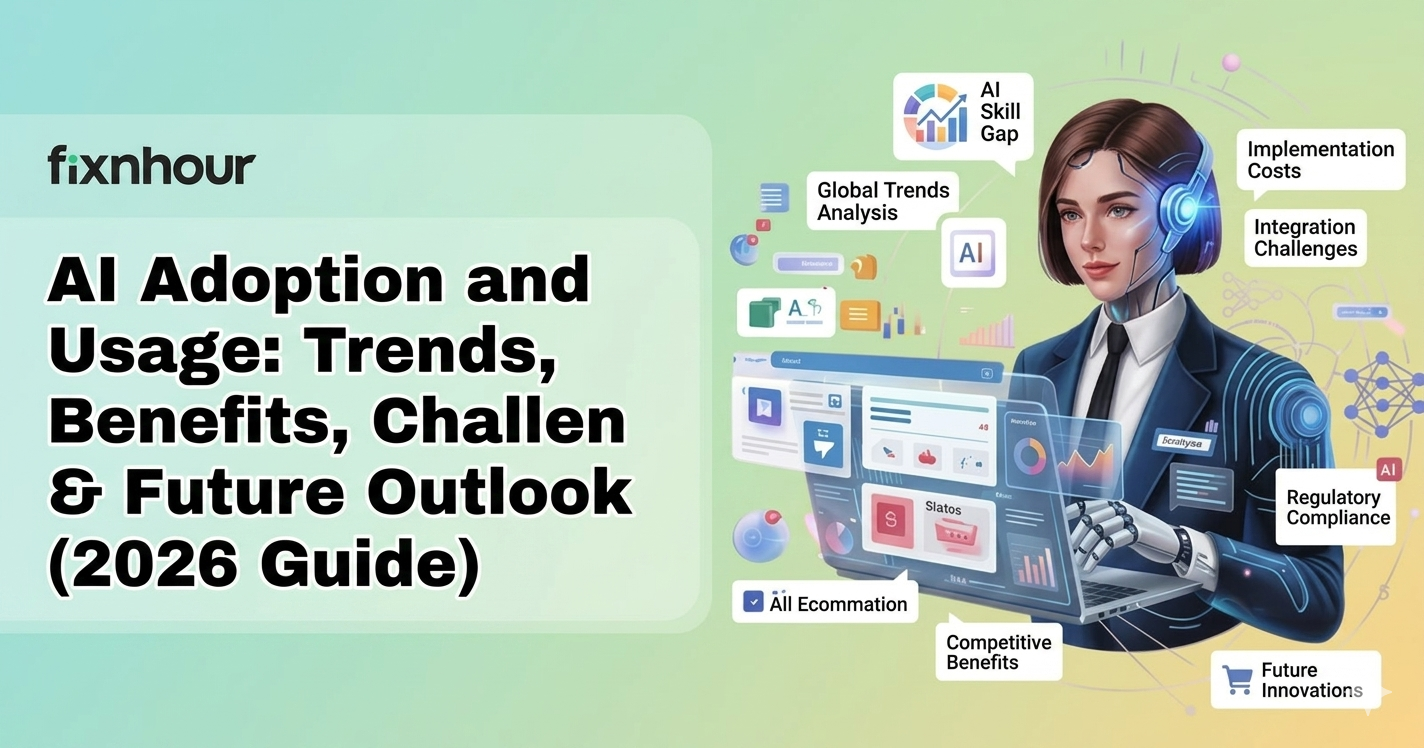
Artificial Intelligence is no longer a futuristic concept it has become a core part of how modern businesses operate, compete, and grow. From personalized recommendations to automated customer support, AI adoption is transforming industries at an unprecedented pace. Companies of all sizes, from startups to global enterprises, are leveraging AI tools to improve efficiency, reduce costs, and deliver smarter user experiences. As technologies like machine learning, natural language processing, and generative AI continue to evolve, the demand for AI-powered solutions is rapidly increasing across sectors like healthcare, finance, e-commerce, and software development.
In 2026, AI usage is not just about innovation—it’s about survival in a highly competitive digital landscape. Businesses that embrace AI are gaining a significant edge through data-driven decision-making, automation, and scalability. However, along with opportunities come challenges such as implementation costs, data privacy concerns, and the need for skilled talent. This guide explores everything you need to know about AI adoption, including current trends, real-world use cases, benefits, challenges, and future predictions to help you stay ahead.
What is AI Adoption and Usage? (Beginner-Friendly Guide)
AI adoption and usage refer to how individuals and businesses integrate artificial intelligence into daily tasks, operations, and decision-making. From automating repetitive work to improving customer experiences, AI helps boost efficiency, accuracy, and innovation. It is widely used across industries like healthcare, finance, marketing, and education.
- Automates repetitive and time-consuming tasks
- Improves decision-making with data insights
- Enhances customer experience and personalization
- Reduces operational costs and errors
- Supports innovation and faster product development
- Enables scalable and efficient business growth
Current AI Adoption Trends in 2026
AI adoption is accelerating globally as businesses recognize its potential to transform operations and customer experiences. The rise of automation, cloud computing, and big data has made AI more accessible than ever before.
Global AI Adoption Statistics
- Over 70% of enterprises are using AI in some capacity
- AI investment is growing rapidly across industries
- Small businesses are increasingly adopting AI tools
Industry-Wise AI Usage Growth
- Healthcare AI adoption – Improving diagnostics and patient care
- AI in Fintech & Banking – Fraud detection and personalized services
- AI in E-commerce & Retail – Product recommendations and demand forecasting
- AI in Manufacturing & Automation – Predictive maintenance and robotics
Rise of Generative AI Tools
Generative AI is one of the biggest trends in 2026, enabling businesses to create content, automate coding, and enhance productivity. It is reshaping marketing, development, and customer engagement.
AI Adoption in Startups vs Enterprises
- Startups adopt AI faster due to flexibility and innovation
- Enterprises focus on scalability and integration
- Both benefit from improved efficiency and insights
Why Businesses Are Adopting AI (Key Benefits)
AI is becoming a competitive necessity rather than an optional investment. Businesses that adopt AI gain measurable advantages in efficiency, cost savings, and innovation.
- Increased operational efficiency through automation
- Cost reduction with automation and reduced manual work
- Enhanced customer experience via chatbots and personalization
- Data-driven decision making using real-time insights
- Competitive advantage in digital transformation
Top Use Cases of AI Across Industries
AI is being applied across nearly every industry, solving complex problems and unlocking new opportunities.
| Industry | Use Case | Description |
|---|---|---|
| Healthcare | Predictive Diagnostics | Early disease detection using AI-powered data analysis |
| Healthcare | Drug Discovery | Accelerates research and development with AI models |
| Marketing | AI Content Generation | Creates blogs, ads, and campaigns efficiently |
| Marketing | Customer Segmentation | Targets the right audience using data insights |
| Finance | Fraud Detection | Identifies suspicious patterns and prevents fraud |
| Finance | Risk Analysis | Helps in smarter and data-driven investment decisions |
| Customer Support | Chatbots & Virtual Assistants | Provides 24/7 automated customer support |
| Customer Support | Faster Response Time | Improves customer satisfaction with quick replies |
| Software & App Development | Code Generation | Speeds up development with AI-assisted coding |
| Software & App Development | Automated Testing | Enhances software quality with AI-based testing |
AI in Healthcare
- Predictive diagnostics for early disease detection
- Drug discovery using AI-driven research
AI in Marketing
- AI content generation for blogs, ads, and campaigns
- Customer segmentation for targeted marketing
AI in Finance
- Fraud detection using pattern recognition
- Risk analysis for smarter investments
AI in Customer Support
- Chatbots & virtual assistants for 24/7 support
- Faster response times and improved satisfaction
AI in Software & App Development
- Code generation to speed up development
- Automated testing for better software quality
Challenges in AI Adoption (Barriers to Growth)
AI adoption faces several challenges that can slow down growth and implementation. High initial costs, lack of skilled professionals, and data privacy concerns are major barriers. Many businesses also struggle with integration into existing systems and ethical issues. Additionally, poor data quality and resistance to change within organizations can limit the full potential of AI technologies.
- High implementation cost for advanced AI systems
- Data privacy and security concerns
- Lack of skilled AI professionals
- Integration with legacy systems
- Ethical concerns and bias in AI
AI Adoption Strategy for Businesses
A clear strategy is essential for successful AI adoption. Without proper planning, businesses may struggle to achieve desired outcomes.
| Category | Aspect | Details |
|---|---|---|
| AI Adoption Strategy | Overview | A clear strategy ensures successful AI implementation and better business outcomes |
| Steps to Implement AI | Identify Goals | Define clear business objectives before adopting AI |
| Choose Tools | Select the right AI tools and platforms based on needs | |
| Talent Acquisition | Build or hire skilled AI professionals | |
| Pilot Projects | Start with small-scale implementations | |
| Scale تدريجيًا | Expand AI usage based on successful results | |
| Best Practices | High-Impact Use Cases | Focus on areas where AI delivers maximum value |
| Data Quality | Ensure clean, accurate, and well-managed data | |
| Performance Monitoring | Continuously track and optimize AI systems | |
| Business Alignment | Align AI initiatives with overall business goals | |
| Build vs Buy | Build AI Solutions | Custom solutions tailored to specific business needs |
| Buy AI Solutions | Ready-made tools for faster deployment | |
| Decision Factors | Choose based on budget, timeline, and expertise |
Steps to Successfully Implement AI
- Identify clear business goals
- Choose the right AI tools and platforms
- Build or hire skilled AI talent
- Start with small pilot projects
- Scale based on results
Best Practices for AI Integration
- Focus on high-impact use cases
- Ensure data quality and governance
- Monitor performance continuously
- Align AI with business objectives
Build vs Buy AI Solutions
- Build: Custom solutions tailored to specific needs
- Buy: Faster deployment with ready-made tools
- Choose based on budget, timeline, and expertise
AI Tools and Technologies Driving Adoption
AI adoption is driven by powerful tools and technologies that simplify development and deployment. Machine learning platforms, natural language processing, and computer vision enable intelligent automation and insights. Cloud-based AI services make solutions scalable and cost-effective, while no-code and low-code tools allow faster implementation. These technologies help businesses innovate, improve efficiency, and stay competitive in a rapidly evolving digital landscape.
- Generative AI platforms for content and automation
- AI-powered chatbots for customer engagement
- Automation tools (RPA) for repetitive tasks
- Cloud AI services for scalability
- No-code & low-code AI platforms for easy implementation
Future of AI Adoption (2026–2030 Predictions)
AI adoption between 2026 and 2030 is expected to grow rapidly across industries, driven by advancements in automation, data analytics, and intelligent systems. Businesses will increasingly rely on AI for decision-making, personalization, and operational efficiency. Emerging technologies like generative AI, autonomous systems, and AI-powered agents will reshape workflows. As adoption rises, focus on ethics, regulation, and responsible AI will also become more important globally.
- Hyper-automation transforming workflows
- AI-powered decision intelligence for smarter strategies
- Growth of autonomous systems like self-driving technology
- Ethical AI and regulations becoming more important
- AI + Web3 + IoT integration driving innovation
How AI Adoption Impacts Jobs and Workforce
AI adoption is reshaping the workforce by automating repetitive tasks and creating demand for new digital and technical skills. While some traditional roles may decline, new opportunities are emerging in AI development, data analysis, and human-AI collaboration. Businesses must focus on reskilling employees and adapting to evolving job roles. Overall, AI enhances productivity, improves efficiency, and transforms how people work across industries.
| Impact Area | Effect on Workforce | Example |
|---|---|---|
| Job Automation | Replaces repetitive and manual tasks | Data entry automation |
| Job Creation | New roles in AI and data fields | AI engineers, data analysts |
| Skill Shift | Demand for advanced digital skills | Machine learning, analytics |
| Productivity | Faster and more efficient work | Automated workflows |
| Collaboration | Human-AI teamwork increases | AI-assisted decision-making |
| Reskilling | Need for continuous learning | Employee training programs |
Conclusion:
AI adoption is no longer optional—it’s a strategic necessity for businesses aiming to thrive in the digital era. From improving efficiency to enabling smarter decision-making, AI offers transformative benefits across industries. However, success depends on having the right strategy, tools, and talent in place.
Ready to adopt AI and transform your business operations? Our experts help you build, integrate, and scale AI solutions tailored to your needs. Stay ahead of the competition with smart technology. Contact us today to start your AI journey and unlock new growth opportunities.
FAQs
Q1. What is AI adoption in business?
Ans. AI adoption in business means using artificial intelligence tools and technologies to improve daily operations, automate repetitive tasks, and make smarter decisions. Companies use AI for data analysis, customer support, marketing, and process automation. It helps reduce manual effort, increase efficiency, and deliver better customer experiences. By adopting AI, businesses can innovate faster, stay competitive in the digital market, and unlock new growth opportunities through intelligent, data-driven strategies.
Q2.How fast is AI growing globally?
Ans. AI is growing at an incredibly fast pace across the world, with businesses and governments investing heavily in AI technologies. From startups to large enterprises, organizations are adopting AI to boost productivity, enhance customer experiences, and gain a competitive advantage. Advancements in machine learning, cloud computing, and automation are accelerating this growth. As AI becomes more accessible and affordable, its adoption is expected to expand rapidly across industries in the coming years.
Q3. What industries use AI the most?
Ans. AI is widely used across several industries, with healthcare, finance, retail, manufacturing, and technology leading the way. These sectors rely heavily on data, making AI ideal for improving efficiency and decision-making. In healthcare, AI supports diagnostics and research. In finance, it helps detect fraud. Retail uses AI for personalization, while manufacturing benefits from automation. Overall, industries that depend on data-driven insights and operational efficiency are the biggest adopters of AI technologies.
Q4. Is AI expensive to implement?
Ans. AI implementation can require a significant initial investment, especially for custom solutions and skilled talent. However, many affordable options like cloud-based AI tools and no-code platforms are now available, making adoption easier for small and medium businesses. Over time, AI helps reduce operational costs, improve productivity, and increase revenue. When planned correctly, the long-term benefits of AI adoption often outweigh the upfront costs, making it a valuable investment.
Q5.What are the risks of AI adoption?
Ans. AI adoption comes with certain risks, including data privacy concerns, biased algorithms, and high implementation costs. Businesses may also face challenges like lack of skilled professionals and difficulty integrating AI into existing systems. Without proper governance, AI can lead to inaccurate decisions or ethical issues. However, these risks can be managed by ensuring high-quality data, following ethical AI practices, and implementing strong security measures and continuous monitoring systems.