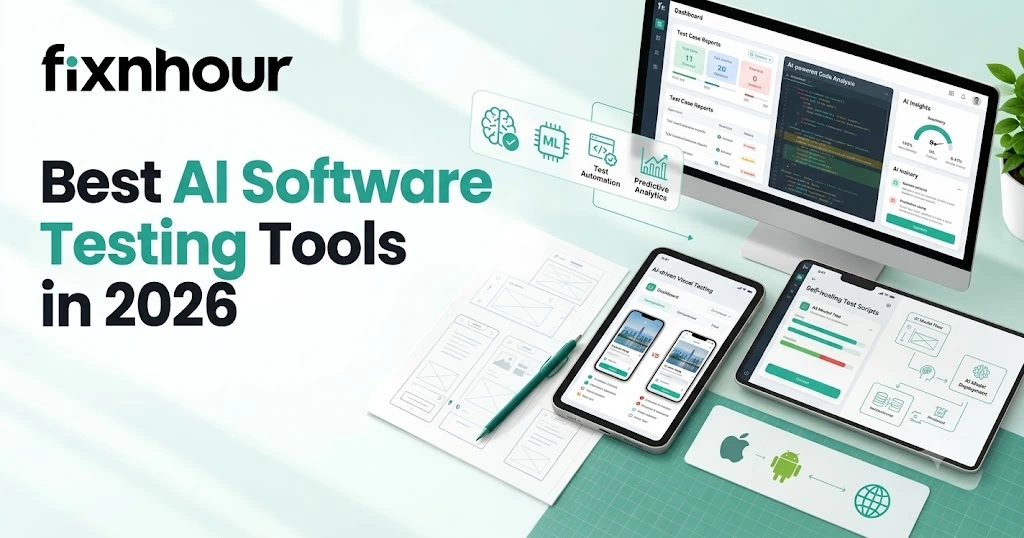
Software testing is no longer limited to writing test cases, running scripts, and manually checking whether an application works as expected. As software becomes more complex and release cycles become shorter, development and QA teams are turning to AI software testing tools to automate repetitive work, identify defects earlier, improve test coverage, and speed up releases. AI-powered testing tools can analyze application behavior, generate or optimize test cases, detect visual differences, identify potential defects, and in some cases automatically repair broken automation scripts. This makes AI test automation particularly useful for teams working with web applications, mobile apps, APIs, cloud platforms, and continuously delivered software.
But with so many AI testing tools available, choosing the right platform can be difficult. Some are designed for codeless automation, while others focus on visual testing, self-healing automation, API testing, or enterprise QA. This guide explores the best AI software testing tools in 2026, their key features, use cases, benefits, limitations, and the factors businesses should consider before choosing an AI-powered testing platform.
Quick Answer
The best AI software testing tools in 2026 include Applitools, Testim, Mabl, Functionize, Tricentis Tosca, Katalon, BrowserStack, ACCELQ, TestCraft, and Virtuoso. The right tool depends on your testing requirements. Applitools is particularly useful for AI-powered visual testing, Testim and Mabl focus strongly on intelligent test automation, Functionize supports AI-driven testing at scale, while Tricentis Tosca and Katalon provide broader enterprise testing capabilities. BrowserStack is valuable for cross-browser and real-device testing. For organizations adopting AI test automation, the best approach is not simply to select the tool with the most AI features. Consider your application technology, testing goals, team skills, integrations, scalability, security requirements, and overall testing budget. Discover the top AI coding tools for developers in the USA in 2026.
Key Takeaways
- AI software testing tools help automate repetitive QA activities and accelerate software releases.
- AI can assist with test case generation, test execution, defect detection, visual validation, and test maintenance.
- Self-healing capabilities can reduce the maintenance burden associated with traditional test automation.
- Different AI testing platforms specialize in different areas, including UI testing, API testing, visual testing, mobile testing, and enterprise QA.
- AI testing does not completely replace human testers. Human judgment remains important for exploratory testing, usability, business logic, and complex scenarios.
- Businesses should evaluate integrations, scalability, security, supported technologies, AI capabilities, and pricing before selecting a platform.
Best AI Software Testing Tools in 2026
The following platforms represent different approaches to AI-powered software testing and test automation. Businesses should evaluate them based on their specific requirements rather than treating one tool as universally best. Discover the top AI coding tools for developers in India in 2026.
|
|
|
|
|
|
|---|---|---|---|---|
|
|
|
|
|
|
|
|
|
|
|
|
|
|
|
|
|
|
|
|
|
|
|
|
|
|
|
|
|
|
|
|
|
|
|
|
|
|
|
|
|
|
|
|
|
|
|
|
|
|
|
|
|
|
|
|
|
|
|
|
1. Applitools — AI-Powered Visual Testing
Applitools is widely associated with AI-powered visual testing and visual validation. Its technology can compare application interfaces and identify visual differences that conventional functional testing may overlook. It is particularly useful for organizations where consistent UI appearance matters across browsers, devices, and application versions.
Best for: Visual testing, UI validation, cross-browser testing, and digital experience quality.
2. Testim — AI Test Automation
Testim focuses on intelligent test automation for web applications. Its platform is designed to help teams create and maintain automated tests while reducing the effort associated with changing application interfaces. Its AI capabilities can assist with test stability and maintenance, making it useful for teams that want to expand automation without constantly rewriting tests.
Best for: Web test automation and teams looking to reduce test maintenance.
3. Mabl — Intelligent Test Automation
Mabl combines test automation with AI-assisted capabilities to help teams test modern web applications and APIs. The platform is designed around continuous testing, making it relevant for organizations following Agile and DevOps practices.
Best for: Continuous testing, web applications, API testing, and integrated QA workflows.
4. Functionize — AI-Powered Software Testing
Functionize uses AI to support automated software testing across enterprise applications. Its approach focuses on making automated testing more scalable and easier to maintain. AI-assisted test creation and execution can help QA teams handle larger testing requirements.
Best for: Enterprise testing, scalable automation, and complex application environments.
5. Tricentis Tosca — AI-Driven Test Automation
Tricentis Tosca is an enterprise-focused testing platform designed to support broad software testing requirements. Its model-based and automation capabilities can be useful for organizations testing complex applications and business-critical workflows.
Best for: Enterprise QA, regression testing, continuous testing, and complex business applications.
6. Katalon — AI-Augmented Testing Platform
Katalon provides a comprehensive testing platform covering web, API, mobile, and desktop testing. Its AI-assisted capabilities are intended to help teams accelerate test creation and improve testing productivity. Because it supports multiple testing areas in one platform, it can be attractive to organizations looking to consolidate QA tools.
Best for: Web, API, mobile, and enterprise software testing.
7. BrowserStack — AI-Powered Testing and Automation
BrowserStack is well known for browser and device testing. It allows development and QA teams to test applications across different browsers, operating systems, and real devices. Its AI-focused capabilities add intelligent assistance to broader testing workflows.
Best for: Cross-browser testing, mobile testing, real-device testing, and web application QA.
8. ACCELQ — AI Test Automation
ACCELQ focuses on codeless and AI-powered test automation. Its platform is designed to allow teams to create automated tests using natural-language-style approaches rather than relying entirely on traditional programming.
Best for: Codeless automation, API testing, web applications, and teams with mixed technical skills.
9. TestCraft — Codeless AI Test Automation
TestCraft focuses on codeless test automation, allowing QA teams to create automated scenarios without extensive programming. This approach can make automation more accessible to manual testers and business-oriented QA professionals.
Best for: Codeless testing and teams transitioning from manual to automated QA.
10. Virtuoso — AI-Powered Test Automation
Virtuoso uses natural-language-based approaches to help teams create automated tests. It is designed to simplify automation while supporting modern web application testing.
Best for: Natural-language test automation and teams seeking lower-code testing workflows.
Key Takeaways
AI software testing is becoming an important part of modern QA and software development. From AI test automation and self-healing tests to visual AI and generative AI test case creation, these technologies can help teams improve testing speed, coverage, and efficiency. The best tool depends on the project. Applitools is a strong option for visual testing, Testim and Mabl focus on intelligent automation, Functionize and Tricentis Tosca are suited to broader enterprise requirements, while Katalon, BrowserStack, ACCELQ, TestCraft, and Virtuoso offer different approaches to automated and AI-assisted testing.
Before choosing an AI-powered testing tool, evaluate your technology stack, testing requirements, team expertise, integrations, security needs, scalability, and total cost. Most importantly, don't think of AI as a replacement for QA professionals. Think of it as a way to give testers more time to focus on the parts of software quality that require human judgment. Fixnhour helps startups connect with verified service providers, making it easier to choose AI solutions that match their business goals and budget.
Conclusion
AI is changing the way businesses approach software quality, making testing faster, smarter, and more adaptable. The best AI software testing tools in 2026 can help QA teams automate repetitive tasks, improve test coverage, detect defects earlier, maintain test scripts, and accelerate software releases. However, there is no single best AI testing tool for every business. The right choice depends on your application type, testing requirements, team expertise, technology stack, integrations, scalability, security needs, and budget. Tools such as Applitools, Testim, Mabl, Functionize, Tricentis Tosca, Katalon, BrowserStack, ACCELQ, TestCraft, and Virtuoso each offer different strengths.
The smartest approach is to use AI-powered test automation to handle repetitive and time-consuming work while keeping experienced QA professionals involved in strategy, exploratory testing, usability, and critical decision-making. When implemented thoughtfully, AI can become a valuable part of your testing workflow and help your team deliver more reliable software with greater confidence. Contact us to find trusted professionals and verified services.
Frequently Asked Questions
Q1. What are the best AI software testing tools in 2026?
Ans. Some of the leading AI software testing tools to evaluate in 2026 include Applitools, Testim, Mabl, Functionize, Tricentis Tosca, Katalon, BrowserStack, ACCELQ, TestCraft, and Virtuoso. The best option depends on whether your priority is visual testing, web automation, API testing, mobile testing, enterprise QA, or codeless automation.
Q2. What is an AI software testing tool?
Ans. An AI software testing tool uses technologies such as artificial intelligence, machine learning, natural language processing, or computer vision to assist with software testing. Depending on the platform, it can help generate test cases, automate test execution, identify defects, analyze results, maintain tests, or validate application interfaces.
Q3. Can AI automate software testing?
Ans. Yes. AI can automate many software testing activities, including test creation, regression testing, UI testing, visual validation, test execution, and result analysis. However, AI automation does not eliminate the need for human QA professionals because complex business logic, exploratory testing, usability, and critical decisions still require human expertise.
Q4. Which AI testing tool is best for beginners?
Ans. Beginners may prefer low-code or codeless AI testing platforms because they reduce the amount of programming required to create automated tests. Platforms such as ACCELQ, Mabl, TestCraft, and Virtuoso can be evaluated based on the team's technical skills and application requirements.
Q5. Are AI testing tools better than traditional automation tools?
Ans. AI testing tools can provide advantages such as intelligent test maintenance, visual analysis, natural-language test creation, and adaptive automation. However, traditional automation remains highly useful and can be more predictable for well-defined testing scenarios. Many organizations benefit from combining traditional automation with AI-assisted testing.
Q6. Can AI generate test cases automatically?
Ans. Yes. Some AI-powered testing platforms can generate or assist with test cases using requirements, application behavior, natural-language instructions, or existing test information. AI-generated test cases should still be reviewed by QA professionals to ensure that important business scenarios and edge cases are covered.
Q7. What is self-healing test automation?
Ans. Self-healing test automation is a capability that attempts to automatically adjust an automated test when application elements or properties change. For example, an AI-powered tool may identify that a button has moved or its identifier has changed and use other available information to locate the correct element.
Q8. How much do AI software testing tools cost?
Ans. AI testing tool pricing varies according to the vendor, number of users, testing volume, supported environments, devices, automation capabilities, and enterprise requirements. Some tools offer trials or limited plans, while enterprise platforms may provide customized pricing. Businesses should compare total ownership costs rather than subscription fees alone.
Q9. Can AI testing tools test mobile and web applications?
Ans. Yes. Many AI testing platforms support web and mobile application testing, although capabilities differ between vendors. Organizations should verify support for their specific browsers, operating systems, devices, frameworks, and application technologies before selecting a tool.
Q10. How do I choose the right AI testing tool for my business?
Ans. Start by identifying your testing requirements and application technology. Then compare AI capabilities, automation support, integrations, scalability, ease of use, security, reporting, device/browser coverage, and pricing. A practical proof of concept using your real application is often the best way to determine whether a tool fits your QA workflow