Finding the right IT service provider is essential for businesses that want to improve efficiency, strengthen cybersecurity, develop software, or accelerate digital transformation. B2B marketplaces simplify this process by helping companies discover technology partners, compare services, evaluate client feedback, and shortlist potential vendors. For UAE businesses, these platforms can make IT outsourcing decisions more structured, transparent, and convenient.
Whether you are a startup in Dubai, an established company in Abu Dhabi, or an organization expanding across the Emirates, choosing the right marketplace can save research time and help you identify providers that match your technical requirements and budget.This guide explores leading B2B marketplaces, the IT services available, vendor selection criteria, pricing considerations, and best practices for choosing a reliable technology partner.
Key Takeaways
- Explore multiple marketplaces rather than relying on one directory.
- Compare technical expertise, relevant projects, and client feedback.
- Evaluate pricing alongside project scope and long-term support.
- Verify business credentials, security practices, and contractual terms.
- Consider UAE-based and international providers where appropriate.
- Use a consistent checklist to shortlist suitable IT partners.
- Investigate emerging AI-powered vendor discovery and specialized marketplace features.
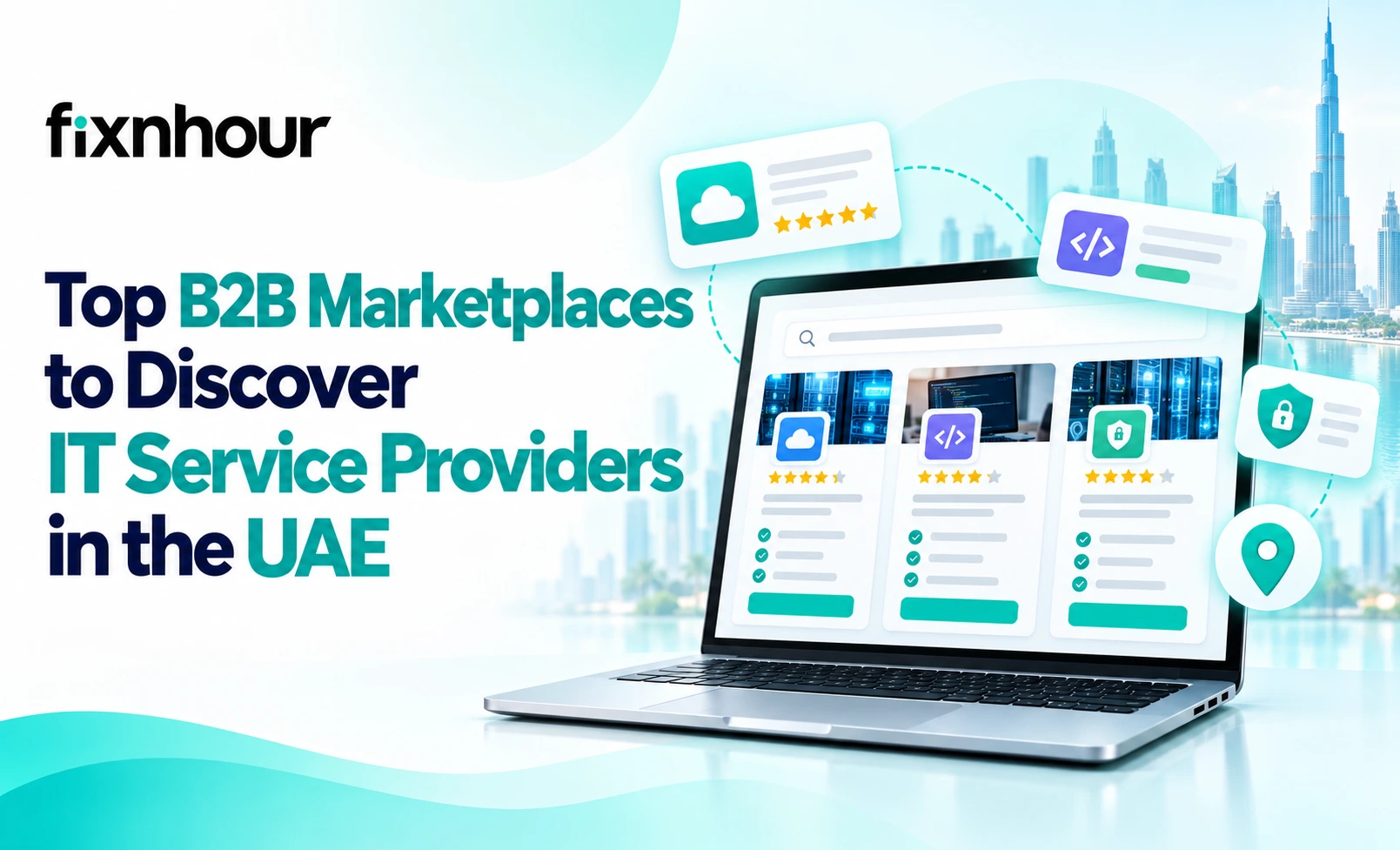
Top B2B Marketplaces to Discover IT Service Providers in the UAE
Choosing a B2B marketplace depends on the type of IT services you need, the depth of company information available, and your preferred evaluation process.B2B service marketplaces The following platforms are useful starting points for researching technology vendors. Always confirm their current UAE coverage, listing features, and review policies before making a decision.
|
Platform |
Best For |
Key Features |
Ideal For |
|---|---|---|---|
|
Clutch |
IT service provider research |
Client reviews, ratings, portfolios, company profiles |
Businesses comparing IT companies |
|
GoodFirms |
Software development companies |
Company listings, reviews, service categories |
Businesses seeking software development partners |
|
DesignRush |
Digital and technology agencies |
Agency portfolios, service specializations, project experience |
Businesses planning digital projects |
|
Sortlist |
Agency discovery and matching |
Service categories, agency profiles, project requirements |
Businesses looking for suitable agency partners |
|
Fixnhour |
B2B service provider discovery |
Company information, service categories, provider research |
Businesses exploring IT vendors |
|
|
Professional networking and vendor research |
Company profiles, professional backgrounds, industry connections |
Businesses researching potential IT partners |
1. Clutch
Clutch helps businesses research and compare IT service providers based on company profiles, client reviews, service offerings, and project experience. It can help UAE businesses shortlist software development companies, IT consultants, and technology partners by evaluating their expertise, customer feedback, and suitability for specific business requirements.
What to explore:
- Software development and IT consulting companies.
- Client testimonials, ratings, and case studies.
- Available pricing details and project experience.
- Providers with UAE and Middle East expertise.
2. GoodFirms
GoodFirms enables businesses to discover software development companies, mobile app developers, and technology service providers. Its company listings help buyers compare service specializations, client reviews, and portfolios. Businesses in the UAE can use the platform to identify potential technology partners that align with their technical needs and project goals.
What to explore:
- Software development and mobile app development firms.
- Company ratings and customer reviews.
- Service categories, portfolios, and industry expertise.
- Providers with relevant technical capabilities.
3. DesignRush
DesignRush helps businesses discover digital agencies and technology partners for various projects. Its listings cover services such as web development, mobile app development, and UI/UX design. UAE businesses can review agency portfolios, compare specializations, and identify potential partners whose experience matches their digital transformation and software development requirements.
What to explore:
- Web development and mobile app development agencies.
- UI/UX design and digital product capabilities.
- Agency portfolios and service specializations.
- Experience with similar projects and industries.
4. Sortlist
Sortlist connects businesses with agencies offering services across digital marketing, technology, design, and related fields. Its discovery and matching features can help companies identify potential partners based on project requirements. UAE businesses can use available profiles to evaluate agency expertise, understand service offerings, and shortlist suitable candidates for collaboration.
What to explore:
- Agencies offering digital and technology services.
- Project requirements and potential agency matches.
- Company experience, specializations, and portfolios.
- Communication, collaboration, and project expectations.
5. Fixnhour
Fixnhour offers another starting point for businesses researching B2B service providers and comparing available company information. Businesses exploring IT vendors can review relevant categories, company descriptions, and service details to identify potential matches. Before selecting a provider, buyers should verify its capabilities, experience, credentials, and suitability for their project requirements.
What to explore:
- Relevant IT service categories and company listings.
- Business descriptions and available service information.
- Provider capabilities aligned with project requirements.
- Independently verifiable company details and credentials.
6. LinkedIn
LinkedIn and specialized technology directories complement traditional B2B marketplaces by offering additional ways to research potential IT partners. LinkedIn helps businesses examine company profiles, professional backgrounds, and industry connections, while official technology partner directories can identify vendors associated with specific platforms, certifications, or technical ecosystems.
What to explore:
- Professional profiles and company information on LinkedIn.
- Official cloud provider partner directories.
- Cybersecurity vendors and certification directories.
- Regional business networks and technology associations.
What Types of IT Service Providers Can You Find on B2B Marketplaces?
B2B marketplaces cover different types of technology services, from building custom applications to managing cloud infrastructure and securing business data.Companies Listed on Fixnhour Understanding these categories helps buyers select relevant search filters and avoid wasting time on unsuitable vendors. Before comparing companies, define the technical problem and the business outcome you want to achieve.
Software Development and Custom Application Companies
Software development companies create digital products and business applications tailored to specific operational needs.
Common services include:
- Custom software and enterprise application development.
- SaaS product engineering and API development.
- System integration and legacy modernization.
- Quality assurance, testing, and ongoing maintenance.
Web Development and Mobile App Development Agencies
These providers build websites, online platforms, and mobile applications for customers, employees, and business partners.
Typical services include:
- Corporate websites and eCommerce development.
- Android and iOS application development.
- Cross-platform mobile app development.
- UI/UX design and digital product development.
Cloud Computing, Cybersecurity, and Managed IT Services
Specialist IT providers help organizations maintain reliable infrastructure, protect sensitive information, and manage day-to-day technical operations.
Look for services such as:
- Cloud migration and infrastructure management.
- Network security and vulnerability assessments.
- Managed IT support and help desk services.
- Backup, disaster recovery, and security monitoring.
AI, Automation, and Digital Transformation Consultants
Businesses seeking greater productivity can work with specialists who integrate AI and automation into existing processes.
Relevant services include:
- AI integration and machine learning.
- Business process automation.
- Data analytics and business intelligence.
- Digital transformation strategy and system modernization.
Benefits of Using B2B Marketplaces to Find IT Companies in the UAE
B2B marketplaces can make IT vendor discovery more organized by bringing company information, service descriptions, and available reviews together.Cross-Platform App Development Companies in Abu Dhabi They help businesses identify potential partners before investing time in meetings and proposals. However, the quality of results depends on the platform's coverage and the buyer's ability to evaluate vendors carefully.
Compare Multiple Providers in One Place
Instead of searching randomly, businesses can review several companies against consistent requirements.
- Compare service specializations and technology expertise.
- Examine available client reviews and case studies.
- Assess relevant project experience.
- Identify providers for further evaluation.
Reduce Vendor Research Time
Marketplace filters and categorized listings can narrow a large pool of companies to a more manageable shortlist.
- Search by service category and location where available.
- Identify providers with relevant industry experience.
- Organize company details in a comparison sheet.
- Spend more time evaluating qualified candidates.
Make More Informed Outsourcing Decisions
Company profiles and project evidence can support initial research, helping buyers prepare better questions for vendor discussions.
- Review previous work and project outcomes.
- Request references for important engagements.
- Compare delivery methods and communication processes.
- Assess ongoing support and maintenance capabilities.
Access Local and International Expertise
UAE businesses may benefit from local providers, international specialists, or a combination of both. The appropriate option depends on project complexity, support requirements, cost, and applicable data protection obligations.
- Consider local availability and regional business knowledge.
- Evaluate time-zone overlap and response times.
- Confirm requirements for sensitive or regulated data.
- Compare the total cost of each engagement model.
How to Choose the Right IT Service Provider in the UAE
Selecting an IT partner requires more than finding a highly rated company. Businesses should define their goals, review relevant expertise, compare proposals, and confirm contractual responsibilities.AI & Automation SaaS Solutions in UAE A structured selection process reduces avoidable risks and helps ensure that the chosen provider can deliver the required solution within the agreed scope and timeline.
|
Step |
Action |
Key Activities |
Expected Outcome |
|---|---|---|---|
|
Step 1 |
Define Project Requirements |
Identify business goals, features, integrations, budget, and deadlines |
Clear project scope |
|
Step 2 |
Shortlist Companies Through B2B Marketplaces |
Explore platforms, compare company profiles, and filter by expertise |
List of 3–5 potential partners |
|
Step 3 |
Evaluate Portfolios, Reviews, and Case Studies |
Review completed projects, client feedback, references, and technical skills |
Verified experience and capabilities |
|
Step 4 |
Compare Proposals and Pricing |
Evaluate deliverables, pricing models, milestones, and maintenance costs |
Transparent cost comparison |
|
Step 5 |
Verify Credentials and Contract Terms |
Check certifications, data security, intellectual property rights, and agreements |
Reduced business and legal risks |
|
Step 6 |
Conduct Interviews and Select Your Partner |
Assess communication, technical approach, team structure, and project management |
Best-fit software development partner |
Step 1: Define Your Project Requirements
Clearly document your business goals, project challenges, and technical expectations before searching for a software development partner. A detailed project brief helps companies understand your needs, estimate costs accurately, and recommend suitable solutions.
- Identify the problem your project needs to solve.
- List essential features, integrations, and technical requirements.
- Define project milestones, deliverables, and deadlines.
- Establish a realistic budget and expected outcomes.
Step 2: Shortlist Companies Through B2B Marketplaces
Explore trusted B2B marketplaces and business directories to discover software development companies that match your project requirements. Compare their service offerings, industry expertise, and available company information to create an initial list of suitable providers.
- Choose two or three relevant B2B platforms.
- Filter companies by services, location, and specialization.
- Compare company profiles and service capabilities.
- Shortlist three to five potential development partners.
Step 3: Evaluate Portfolios, Reviews, and Case Studies
Assess each shortlisted company's experience by reviewing its portfolio, completed projects, and client testimonials. Focus on providers with relevant industry knowledge and proven technical capabilities to determine whether they can deliver solutions that meet your business objectives.
- Review case studies and similar completed projects.
- Examine verified client reviews and testimonials.
- Request references from previous clients when necessary.
- Confirm the team's technical expertise and industry experience.
Step 4: Compare Proposals and Pricing
Request detailed proposals from shortlisted companies using the same project requirements. Comparing pricing structures, deliverables, and payment terms helps you understand the overall investment and select a provider that offers suitable value within your budget.
- Compare project scope, deliverables, and milestones.
- Evaluate fixed-price, hourly, and monthly pricing models.
- Check maintenance, licensing, and support costs.
- Assess long-term expenses alongside the initial quotation.
Step 5: Verify Credentials and Contract Terms
Before finalizing a development partner, verify its business credentials, technical expertise, and contractual commitments. Clear agreements regarding confidentiality, intellectual property, data security, and project responsibilities help protect your business and reduce potential risks throughout development.
- Verify business credentials and relevant certifications.
- Establish data protection and confidentiality requirements.
- Confirm source-code and intellectual property ownership.
- Review service-level agreements and termination conditions.
Step 6: Conduct Interviews and Select Your Partner
Arrange interviews with your preferred companies to evaluate their communication, technical approach, and problem-solving abilities. Discuss project risks, team responsibilities, and delivery processes before selecting a reliable partner who understands your business goals and long-term requirements.
- Ask about risk management and potential project delays.
- Confirm team responsibilities and communication procedures.
- Discuss testing, documentation, and final handover.
- Choose the company offering the best overall fit.
Challenges of Using B2B Marketplaces and How to Overcome Them
Although B2B marketplaces simplify vendor discovery, they do not eliminate the risks of choosing an unsuitable provider. Company profiles may be incomplete, reviews may not tell the whole story, and pricing information may be limited. Businesses should combine marketplace research with independent verification, direct discussions, and careful contractual checks.
Incomplete Company Profiles and Outdated Information
Some listings may not reflect a company's latest services, team, or business status.
- Confirm details through the official company website.
- Request an updated portfolio and service description.
- Check whether the company has relevant project experience.
- Confirm the availability of the proposed team.
Misleading Reviews and Unclear Vendor Credentials
Ratings can help identify potential providers, but they should not be the only selection criterion.
- Read detailed reviews instead of relying on star ratings.
- Request client references for significant projects.
- Validate technical certifications where relevant.
- Check whether case studies provide meaningful project details.
Difficulty Comparing Different Pricing Models
Two companies may quote different prices because their proposals cover different deliverables or service levels.
- Share a consistent project brief with every shortlisted vendor.
- Compare inclusions, exclusions, and assumptions.
- Confirm support arrangements and additional charges.
- Assess the overall value rather than the lowest price.
Cross-Border Communication and Data Security Risks
Working with international providers can introduce challenges involving time zones, communication, data access, and contractual responsibilities.
- Establish communication schedules and escalation procedures.
- Define access permissions for business systems and data.
- Review applicable UAE data protection requirements.
- Agree on confidentiality, incident reporting, and data handling before work begins.
Conclusion
Finding a suitable IT service provider starts with understanding your business requirements and researching the right marketplaces. Platforms such as Clutch, GoodFirms, DesignRush, Sortlist, and Fixnhour can help you explore potential vendors, subject to their current listings and capabilities. Compare expertise, portfolios, client feedback, pricing, and support before making a decision.
A thoughtful selection process can help UAE businesses identify technology partners for software development, cloud computing, cybersecurity, AI integration, and digital transformation. Rather than choosing the first company you find, shortlist suitable providers, request comparable proposals, and verify important claims independently. Talk to our experts
Frequently Asked Questions
Q1. What are the best B2B marketplaces to find IT service providers in the UAE?
Ans. Platforms such as Clutch, GoodFirms, DesignRush, Sortlist, and Fixnhour can be starting points for researching IT service providers. Their suitability depends on available listings, service categories, company information, and review features. LinkedIn and official technology partner directories can also support vendor research. Before selecting a platform, check whether it covers the UAE and includes companies relevant to your requirements. Compare providers using portfolios, detailed client feedback, technical expertise, and relevant experience. Independently verify important credentials and confirm project scope, pricing, and support arrangements before choosing a technology partner.
Q2. How can I find a reliable software development company in Dubai?
Ans. Start by documenting your project requirements, budget, preferred technology stack, and delivery timeline. Search B2B marketplaces for software development companies with relevant experience and review their portfolios and available client feedback. Shortlist several candidates and request proposals based on the same brief. During discussions, ask about team experience, project management, quality assurance, security, and post-launch maintenance. Verify business details and request references where appropriate. A reliable partner should explain its approach clearly, identify potential risks, and provide a realistic delivery plan. Avoid making your final decision based solely on price or marketplace ratings.
Q3. Which B2B platforms help businesses compare IT companies in the UAE?
Ans. Clutch, GoodFirms, DesignRush, and Sortlist are potential starting points for comparing agencies and technology providers. Fixnhour may also be worth exploring for relevant B2B company listings. Available comparison features and UAE coverage can differ, so verify each platform before relying on it. Compare company specializations, project portfolios, reviews, pricing information, and industry experience wherever these details are available. You can also use official websites and professional networks to validate information. Create a comparison sheet that records each provider's strengths, limitations, estimated cost, and support arrangements. This makes vendor selection more systematic and transparent.
Q4. How much does it cost to hire an IT service provider in the UAE?
Ans. IT service costs in the UAE vary according to the project type, complexity, technology stack, team experience, and delivery model. A small website project will generally require a different budget from enterprise software development, cloud migration, or a comprehensive cybersecurity engagement. Providers may charge fixed project fees, hourly rates, monthly retainers, or dedicated-team costs. Request itemized proposals from multiple companies using the same project scope. Check whether hosting, software licenses, taxes, maintenance, and ongoing support are included. The best option is not necessarily the cheapest; evaluate delivery quality, security, reliability, and total ownership costs.
Q5. Are B2B marketplaces suitable for finding cybersecurity and cloud service providers?
Ans. Yes, B2B marketplaces can help businesses discover potential cybersecurity and cloud service providers, provided relevant listings are available. Search for specialists offering cloud migration, infrastructure management, penetration testing, security monitoring, identity management, or managed IT services. Evaluate relevant experience, technical certifications, security processes, and client references. Ask how the provider handles incidents, access controls, backups, and service-level commitments. Businesses handling sensitive information should also assess applicable UAE data protection requirements and contractual responsibilities. Marketplace profiles can help create an initial shortlist, but important security claims should be independently validated before granting system access or sharing confidential data.
Q6. How do I verify reviews and credentials of IT companies listed on B2B directories?
Ans. Begin by examining detailed client reviews and case studies instead of relying exclusively on star ratings. Look for specific information about project scope, communication, delivery, and results. Check the provider's official website and professional profiles for consistent business details. Request references from clients with comparable requirements and contact them when appropriate. For certifications, verify validity and scope directly with the issuing organization whenever possible. You should also confirm the proposed team's experience, contractual responsibilities, and service capabilities. These checks help identify potential warning signs, although no single review or credential can guarantee successful project delivery.
Q7. Should I hire a UAE-based IT company or an international service provider?
Ans. The right choice depends on your project, budget, support expectations, and data requirements. A UAE-based provider may offer convenient local communication, regional business knowledge, and easier access to on-site support. An international provider may offer specialized expertise, a larger talent pool, or a different pricing structure. Compare both options using the same technical and commercial criteria. Check time-zone overlap, language, project management, support availability, and intellectual property terms. If your project involves sensitive or regulated information, evaluate applicable data protection and data residency requirements before deciding where work and data processing can take place.
Q8. What should I check before hiring an IT outsourcing company in the UAE?
Ans. Before hiring an IT outsourcing company, confirm that it understands your requirements and has relevant technical experience. Review its portfolio, client references, project plan, proposed team, pricing, and estimated timeline. Check the agreement for deliverables, milestones, acceptance criteria, confidentiality, intellectual property ownership, and termination terms. Discuss data security, access controls, backups, and applicable compliance obligations. Establish how progress will be reported and how delays or technical problems will be handled. Finally, clarify maintenance, documentation, training, and post-launch support. These steps help set realistic expectations and reduce the risk of misunderstandings during the engagement.