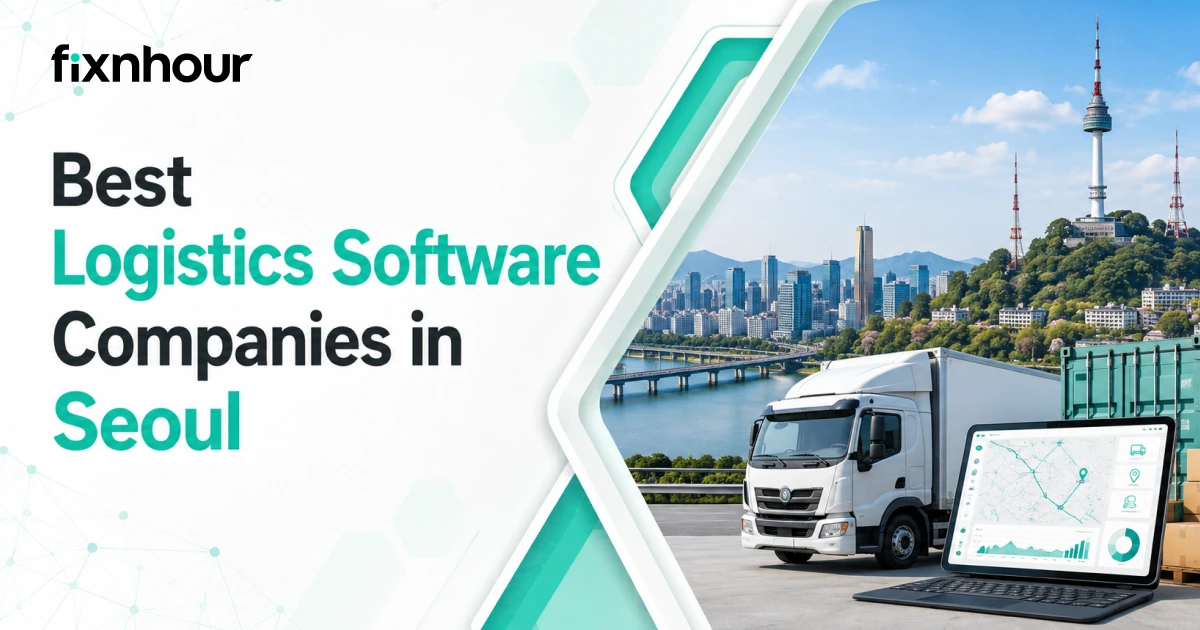
Seoul is one of Asia’s most advanced technology and business centres, making it an important market for digital logistics, supply-chain automation, warehouse management, and transportation technology. Businesses operating in the city can choose from Korean technology companies, specialized logistics platforms, and international enterprise software providers.
The best logistics software companies in Seoul support freight forwarding, fleet management, warehouse automation, inventory control, last-mile delivery, cold-chain monitoring, and real-time shipment visibility. This guide compares leading providers and explains the features, costs, benefits, challenges, and selection process businesses should consider.
Quick Answer
Leading logistics software companies serving Seoul include Samsung SDS, LG CNS, CJ OliveNetworks, Hyundai AutoEver, LogisAll, Willog, and VROONG. Fixnhour International options such as SAP and Oracle also support complex logistics operations. The right provider depends on whether a business needs freight management, warehouse automation, cold-chain monitoring, last-mile delivery, or enterprise-wide supply-chain integration.
Key Takeaways
- SAP and Oracle are suitable for enterprises requiring integrated global supply-chain management.
- TMS, WMS, fleet management, route optimization, and shipment tracking are essential logistics capabilities.
- Korean-language support and local implementation services can improve employee adoption.
- AI, IoT, robotics, and predictive analytics are transforming Seoul’s logistics sector.
- Logistics software pricing depends on users, shipments, vehicles, warehouses, integrations, and customization.
- Businesses should compare total ownership costs instead of considering only subscription or licensing fees.
- A pilot deployment can identify technical and operational problems before full implementation.
Top 10 Logistics Software Development Companies for South Korea
Businesses looking for logistics software development in South Korea can consider custom software companies capable of developing transportation, warehouse, inventory, fleet, shipment-tracking, and supply-chain applications.Software Development Companies in Seoul The following companies are listed on Fixnhour under software development or related technology services and can be evaluated based on relevant experience, technical expertise, integrations, scalability, and project requirements.
| No. | Company | Key Services | Best Suited For |
|---|---|---|---|
| 1 | Probey Services | Custom software, ERP & CRM, web/mobile apps, cloud, AI | Custom logistics platforms and enterprise workflow integration |
| 2 | Synergy Labs | Custom software, AI, digital products, mobile apps, automation | Shipment management and operational automation |
| 3 | Savvycom | Custom software, web/mobile apps, digital products, enterprise software | Transportation, warehouse, and logistics applications |
| 4 | Litmers | Custom software, AI apps, testing, web development, automation | Process automation and operational dashboards |
| 5 | Tallium Inc. | Custom software, SaaS, AI/ML, cloud apps, mobile development | Scalable logistics and inventory management platforms |
| 6 | Nextbrain Technologies | Software, mobile apps, AI/ML, IoT, analytics & BI | IoT-enabled logistics, analytics, and connected operations |
| 7 | Techfyte | Custom software, enterprise solutions, AI, automation, cloud | Logistics workflow modernization and enterprise systems |
| 8 | Enaviya Information Technologies | Enterprise software, cloud, automation, product engineering | Enterprise logistics applications and Microsoft-based systems |
| 9 | Next Big Technology | Software, mobile apps, SaaS, web development, consulting | Shipment apps, customer portals, and internal systems |
| 10 | Technoloader Pvt. Ltd. | Custom software, SaaS, AI, automation, mobile apps | Custom logistics management and business applications |
1. Probey Services
Probey Services is a software development and digital transformation company with a presence in Seoul, South Korea. The company provides custom software development, web and mobile applications, ERP and CRM solutions, cloud services, and AI-powered technologies. Logistics businesses can evaluate Probey Services for building customized platforms that connect transportation, inventory, warehouse, order management, and enterprise workflows.
Key Services:
- Custom software development
- ERP and CRM development
- Mobile and web application development
- Cloud solutions
- AI-powered applications
2. Synergy Labs
Synergy Labs is a software development company that builds customized digital products and applications for businesses. Its development capabilities can be considered by logistics companies seeking solutions for operational automation, shipment management, internal workflows, analytics, and customer-facing applications. Businesses should evaluate its relevant logistics experience, technology expertise, integration capabilities, and previous projects before choosing it as a development partner.
Key Services:
- Custom software development
- AI development
- Digital product engineering
- Mobile application development
- Business automation solutions
3. Savvycom
Savvycom is a software development company providing digital product engineering and technology solutions for businesses across different industries. Its development capabilities can be evaluated by logistics companies looking to create transportation management applications, warehouse solutions, operational dashboards, mobile logistics applications, workflow automation systems, and other customized digital platforms that integrate with existing business systems.
Key Services:
- Custom software development
- Web application development
- Mobile application development
- Digital product development
- Enterprise software solutions
4. Litmers
Litmers provides software development and technology services for businesses seeking customized digital solutions. Its capabilities can be considered for logistics applications involving process automation, operational dashboards, data management, connected systems, and scalable web platforms. Logistics businesses should assess the company's portfolio, technical capabilities, integrations, and relevant industry experience against their transportation, warehousing, inventory, and supply-chain requirements.
Key Services:
- Custom software development
- AI application development
- Software testing
- Web application development
- Business automation solutions
5. Tallium Inc.
Tallium Inc. is a custom software development company that builds digital products and applications for businesses across multiple industries. Its capabilities include custom enterprise software, SaaS products, AI-powered solutions, cloud-based applications, and mobile development. Logistics businesses can evaluate Tallium Inc. for developing scalable platforms supporting workflow automation, analytics, transportation operations, inventory management, and other specialized logistics processes.
Key Services:
- Custom software development
- SaaS product development
- AI and machine learning solutions
- Cloud application development
- Mobile app development
6. Nextbrain Technologies
Nextbrain Technologies provides software, web, mobile, AI, analytics, and IoT development services. This combination of capabilities can be useful when developing logistics applications involving real-time operational information, mobile access, connected assets, dashboards, or automated workflows. Businesses can assess Nextbrain Technologies based on its ability to integrate custom applications with existing enterprise, warehouse, transportation, and third-party systems.
Key Services:
- Software development
- Mobile app development
- AI and machine learning
- IoT development
- Analytics and BI software
7. Techfyte
Techfyte provides custom software development alongside AI, automation, mobile applications, web applications, cloud infrastructure, and enterprise software solutions. Logistics businesses looking to modernize manual processes can evaluate its development capabilities for customized operational applications, workflow automation, analytics, mobile logistics tools, and scalable enterprise systems designed around specific transportation or supply-chain requirements.
Key Services:
- Custom software development
- Enterprise software solutions
- AI and automation
- Mobile app development
- Cloud infrastructure solutions
8. Enaviya Information Technologies
Enaviya Information Technologies specializes in custom enterprise software, IT consulting, product engineering, cloud computing, and business-process automation. Its enterprise-focused capabilities can be considered by logistics organizations requiring customized applications that connect operational processes and business data. The company also works with Microsoft technologies, providing additional options for businesses already operating within Microsoft-based enterprise environments.
Key Services:
- Custom software development
- Enterprise application development
- Cloud computing
- Business process automation
- Product engineering
9. Next Big Technology
Next Big Technology provides web, mobile, software, SaaS, and application development services. The company works with technologies and frameworks used for building custom digital platforms and business applications. Logistics companies can evaluate its services for developing shipment-management applications, customer portals, mobile solutions, internal operational systems, analytics applications, and other software customized around specific business workflows.
Key Services:
- Software development
- Mobile application development
- SaaS development
- Web application development
- Software consulting
10. Technoloader Pvt. Ltd.
Technoloader Pvt. Ltd. provides software development alongside SaaS, AI, automation, mobile application, and emerging technology services. Its development capabilities can be considered by logistics companies seeking customized digital solutions instead of standard off-the-shelf platforms. Potential projects can include logistics management applications, mobile operational tools, business automation platforms, customer applications, and other software tailored to company-specific processes.
Key Services:
- Custom software development
- SaaS solutions
- AI and automation
- Mobile app development
- Business application development
Benefits of Using Logistics Software in Seoul
Logistics software helps Seoul businesses replace spreadsheets, paperwork, and disconnected communication with centralized digital workflows. It improves visibility across transportation, warehousing, inventory, fleets, and order fulfilment.Software Development Companies in South-Korea Automation reduces administrative work, minimizes human errors, accelerates order processing, and supports growing shipment volumes. Real-time tracking and accurate operational data also enable faster decisions, better coordination among logistics partners, more reliable deliveries, and an improved customer experience.
Key Benefits
- Real-time shipment and inventory visibility
- Faster order processing and fulfilment
- Improved route and vehicle utilization
- Reduced paperwork and administrative workload
- Better communication among logistics partners
- Lower operational costs and manual errors
- More accurate tracking updates
- Scalable logistics operations
Conclusion
The best logistics software company in Seoul depends on the problem a business needs to solve. Samsung SDS is a strong option for integrated global logistics and digital forwarding, while Willog focuses on AIoT cargo visibility and cold-chain monitoring. VROONG addresses last-mile delivery, and SAP, Oracle, and Microsoft support broader enterprise supply-chain transformation.
Before selecting a provider, compare functionality, Korean-language support, integrations, security, scalability, implementation experience, and total cost. A detailed requirements document, realistic demonstration, and controlled pilot project can help businesses choose software that produces measurable long-term improvements. Talk to our experts
Frequently Asked Questions
Q1. Which are the best logistics software companies in Seoul?
Ans. Leading logistics software companies serving Seoul include Samsung SDS, LG CNS, CJ OliveNetworks, Hyundai AutoEver, LogisAll, Willog, and VROONG. Businesses can also consider global providers such as SAP, Oracle, and Microsoft. The best choice depends on requirements for transportation, warehousing, fleet management, shipment visibility, automation, and supply-chain integration.
Q2. How much does logistics management software cost in Seoul?
Ans. Logistics software costs in Seoul vary based on users, shipment volumes, vehicles, warehouses, required modules, integrations, deployment models, and customization. Providers may offer subscription, licensing, transaction-based, or custom pricing. Businesses should compare quotations covering implementation, data migration, employee training, hosting, maintenance, upgrades, integrations, and ongoing technical support.
Q3. What is the best warehouse management software for Seoul businesses?
Ans. The best warehouse management software depends on warehouse size, inventory complexity, daily order volumes, automation requirements, and existing business systems. Seoul businesses can evaluate solutions from SAP, Oracle, Microsoft, LG CNS, and specialized providers. Compare receiving, inventory tracking, picking, packing, shipping, reporting, automation, and integration capabilities before selecting a WMS.
Q4. Which logistics software supports Korean-language operations?
Ans. Korean technology providers such as Samsung SDS, LG CNS, CJ OliveNetworks, and Hyundai AutoEver may support Korean-language business operations. International logistics software providers can also provide localization through regional teams or implementation partners. Businesses should confirm Korean-language interfaces, documentation, employee training, customer support, implementation assistance, and localization capabilities before purchasing software.
Q5. What features should transportation companies look for in logistics software?
Ans. Transportation companies should look for route optimization, real-time shipment tracking, automated dispatch, carrier management, electronic proof of delivery, vehicle monitoring, driver management, mobile access, freight settlement, alerts, and analytics. Integration with ERP, accounting, warehouse, and order-management systems is also important for maintaining connected and efficient transportation operations.
Q6. Is cloud logistics software suitable for small businesses in Seoul?
Ans. Yes, cloud logistics software can be suitable for small businesses because it reduces infrastructure requirements and offers remote accessibility, faster deployment, automatic updates, and scalable subscriptions. Small Seoul businesses should compare pricing, data security, integrations, technical support, user limits, transaction charges, scalability, and contract conditions before selecting a cloud-based logistics platform.
Q7. How long does logistics software implementation take in Seoul?
Ans. Implementation time depends on software complexity, business size, integrations, data migration, customization, automation equipment, testing, and employee training. A simple cloud logistics platform may take several weeks to implement, while customized TMS, WMS, or enterprise supply-chain software can require several months or longer before becoming fully operational across the organization.
Q8. How can businesses compare TMS and WMS providers in Seoul?
Ans. Businesses should create a detailed requirements checklist and compare providers based on functionality, industry experience, integrations, scalability, security, support, implementation services, and total ownership costs. Request workflow-based demonstrations using real business scenarios. A controlled pilot project can also help evaluate software usability, performance, compatibility, vendor support, and operational suitability.