Digital marketing in 2026 is evolving faster than ever, driven by AI, automation, and changing consumer behavior. Businesses that fail to adapt to the latest digital marketing trends risk falling behind in an increasingly competitive online landscape. From AI-powered marketing tools to voice search optimization and personalized customer experiences, brands must embrace innovation to stay relevant.Today’s users expect fast, engaging, and tailored content across multiple platforms, making it essential for marketers to rethink their strategies. Trends like video marketing, social commerce, and data-driven decision-making are no longer optional—they are critical for growth.In this blog, we will explore the top digital marketing trends in 2026 that can help you boost online visibility, improve customer engagement, and drive higher conversions. Whether you’re a startup or an established business Services, these insights will help you stay ahead of the competition and achieve long-term success.
Why Digital Marketing Trends Are Important for Business Growth
Following the latest digital marketing trends helps businesses stay competitive and relevant. Modern consumers rely on digital platforms for decision-making, making it crucial to adopt data-driven marketing strategies. Trends like SEO optimization, personalized content, and omnichannel marketing improve customer experience, increase engagement, and drive revenue growth in a highly competitive digital ecosystem.
- Helps businesses stay competitive by adapting to changing customer behavior and market demands.
- Improves marketing performance through data-driven strategies and modern tools.
- Increases brand visibility and reach across multiple digital platforms and channels.
- Enhances customer engagement and conversion rates with targeted and personalized campaigns.
Top Digital Marketing Trends in 2026
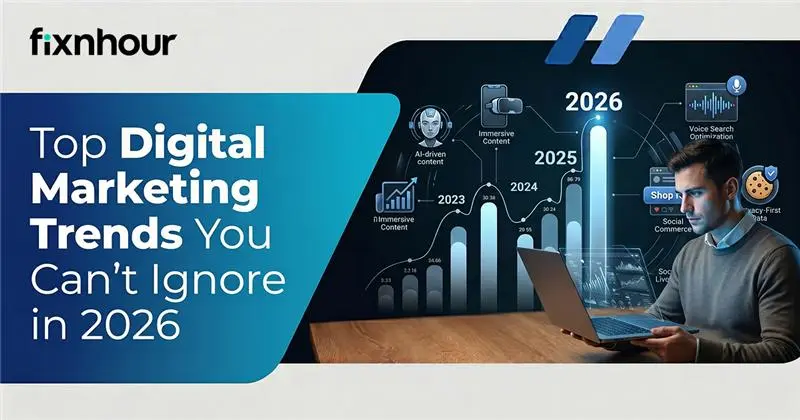
Top Digital Marketing Trends in 2026 focus on AI-driven personalization, voice and visual search, short-form video content, and privacy-first marketing. Brands will rely more on automation, data analytics, and immersive AR/VR experiences to engage users. Influencer marketing will shift toward micro-communities, improving trust, authenticity, and stronger customer connections for growth.
|
Topic |
Description |
|
AI-Powered Marketing & Automation |
AI transforms customer interaction through chatbots, predictive analytics, and automation. It improves personalization, efficiency, and ROI by analyzing user behavior and optimizing campaigns in real time. |
|
Voice Search Optimization |
Focuses on conversational content, long-tail keywords, and local SEO to capture voice-based queries from smart assistants and mobile users. |
|
Video Marketing Dominance |
Short videos, live streaming, and Reels/Shorts boost engagement and brand awareness, making video SEO and storytelling essential. |
|
Influencer & Creator Marketing Evolution |
Micro and nano influencers drive authentic engagement, improving trust, credibility, and targeted audience reach. |
|
Personalization & Customer Experience |
Data-driven personalization enhances engagement, loyalty, and conversions through tailored content, emails, and recommendations. |
|
Social Commerce Growth |
Enables direct shopping on social platforms using shoppable posts, in-app checkout, and user-generated content. |
|
SEO in 2026 (AIO & Voice Search Focus) |
Focuses on AI optimization, E-E-A-T, featured snippets, and conversational queries for higher visibility and organic traffic. |
|
Data Privacy & Cookieless Marketing |
Emphasizes first-party data and transparent practices to build trust and comply with privacy regulations. |
|
Omnichannel Marketing Strategy |
Ensures consistent branding and seamless customer experience across websites, apps, social media, and offline channels. |
AI-Powered Marketing & Automation
AI-powered marketing is transforming how businesses interact with customers. From chatbots to predictive analytics, AI tools enhance customer engagement and automate repetitive tasks. Businesses can deliver personalized experiences, analyze user behavior, and optimize campaigns in real time, improving efficiency, reducing costs, and increasing ROI through smarter digital marketing strategies.
Voice Search Optimization
Voice search optimization is becoming essential as more users rely on smart assistants. Marketers must focus on long-tail keywords, conversational content, and local SEO strategies. Optimizing for voice queries improves search visibility, enhances user experience, and helps businesses capture a growing segment of mobile and voice-driven traffic.
Video Marketing Dominance
Video marketing continues to dominate digital platforms in 2026. Short-form videos, live streaming, and interactive content drive higher engagement and conversions.Platforms like YouTube Shorts and Instagram Reels help brands connect with audiences quickly, making video SEO and storytelling crucial for building brand awareness and boosting online visibility. Tools like the AI Storyboard Generator make it easier than ever to plan and visualize compelling video narratives before production even begins.
Influencer & Creator Marketing Evolution
Influencer marketing is shifting towards authenticity and niche audiences. Micro and nano influencers are delivering better engagement and trust. Brands are collaborating with creators to produce genuine content that resonates with users, increasing brand credibility, improving reach, and driving targeted traffic through platform-specific influencer marketing strategies.
Personalization & Customer Experience
Personalization is key to successful digital marketing in 2026. Businesses use data analytics to deliver tailored content, product recommendations, and targeted emails. A personalized customer experience increases engagement, builds loyalty, and improves conversion rates, making it an essential strategy for brands aiming to enhance customer satisfaction and retention.
Social Commerce Growth
Social commerce is revolutionizing online shopping by enabling users to purchase directly from social media platforms. Features like in-app checkout, shoppable posts, and user-generated content improve the buying experience. Businesses can boost sales, increase engagement, and shorten the customer journey by leveraging social commerce strategies effectively.
SEO in 2026 (AIO & Voice Search Focus)
SEO in 2026 focuses on AI optimization (AIO), voice search, and user intent. Search engines prioritize high-quality, authoritative content following E-E-A-T guidelines. Businesses must optimize for featured snippets, zero-click searches, and conversational queries to improve rankings, increase organic traffic, and maintain strong online visibility in evolving search ecosystems.
Data Privacy & Cookieless Marketing
With growing privacy concerns, cookieless marketing is becoming a priority. Businesses are shifting to first-party data collection and transparent practices. Adapting to privacy regulations builds user trust and ensures compliance while maintaining effective targeting strategies. Ethical data usage is essential for long-term success in digital marketing.
Omnichannel Marketing Strategy
Omnichannel marketing ensures a seamless customer experience across multiple platforms, including websites, social media, and mobile apps. Integrating online and offline channels helps businesses deliver consistent messaging, improve engagement, and increase conversions. A strong omnichannel strategy enhances brand presence and ensures better customer retention in a competitive digital landscape.
Emerging Technologies Shaping Digital Marketing
Emerging technologies like augmented reality (AR), virtual reality (VR), and blockchain are transforming digital marketing. These innovations create immersive experiences, improve ad transparency, and enhance customer engagement. Businesses adopting these technologies can differentiate themselves, build stronger connections with users, and stay ahead in the competitive digital marketing landscape.
|
Emerging Technology |
How It’s Used in Digital Marketing |
Key Benefit |
|
Artificial Intelligence (AI) |
Personalizing ads, chatbots, predictive analytics |
Better targeting and higher ROI |
|
Machine Learning |
Analyzing user behavior and optimizing campaigns |
Smarter decision-making |
|
Augmented Reality (AR) |
Interactive product demos and virtual try-ons |
Enhanced customer experience |
|
Virtual Reality (VR) |
Immersive brand storytelling and virtual tours |
Strong engagement and brand recall |
|
Voice Search Technology |
Optimizing content for voice assistants |
Improved search visibility |
|
Blockchain |
Transparent ad tracking and fraud prevention |
Increased trust and security |
|
Big Data Analytics |
Processing large customer datasets for insights |
Data-driven marketing strategies |
Best Strategies to Adapt to Digital Marketing Trends
To stay ahead in digital marketing, businesses must invest in AI tools, focus on high-quality content, and optimize for mobile and voice search. Leveraging data analytics, improving user experience, and adopting omnichannel strategies can enhance performance. Continuous learning and adapting to new trends ensure long-term growth and competitive advantage.
- Leverage AI and automation tools to optimize campaigns, personalize customer experiences, and improve efficiency.
- Focus on high-quality, SEO-optimized content that aligns with user intent and evolving search algorithms.
- Strengthen presence on short-form video platforms and social media to boost engagement and brand visibility.
- Use data analytics and performance tracking to refine strategies and make smarter, results-driven decisions.
Common Mistakes to Avoid in Digital Marketing
Many businesses fail by ignoring SEO updates, over-automating processes, or neglecting customer experience. Not tracking performance metrics and relying on outdated strategies can limit growth. Avoiding these mistakes helps improve campaign effectiveness, boost engagement, and ensure sustainable success in the ever-changing digital marketing environment.
|
Mistake |
Description |
Impact |
|
No clear strategy |
Running campaigns without defined goals or planning |
Wasted budget and poor ROI |
|
Ignoring SEO |
Not optimizing content for search engines |
Low organic traffic and visibility |
|
Targeting wrong audience |
Not defining or researching ideal customers |
Poor engagement and conversions |
|
Weak content quality |
Posting low-value or irrelevant content |
Reduced trust and brand authority |
|
Not tracking analytics |
Ignoring performance data and insights |
Repeated errors and missed opportunities |
|
Overlooking mobile users |
Not optimizing for mobile devices |
High bounce rates and lost customers |
|
Inconsistent branding |
Different tone, visuals, and messaging |
Confused audience and weak brand identity |
Future of Digital Marketing Beyond 2026
The future of digital marketing will be driven by AI, predictive analytics, and hyper-personalization. Businesses will rely more on automation and data-driven insights to deliver customized experiences. As technology evolves, brands focusing on innovation, transparency, and customer-centric strategies will lead the market and achieve long-term digital success.
- AI-driven marketing will dominate, enabling hyper-personalized campaigns based on real-time user behavior and predictive analytics.
- Voice and visual search optimization will become essential as users shift from typing to speaking and image-based queries.
- Privacy-first marketing will grow, with stricter data laws pushing brands toward zero-party and first-party data strategies.
- Immersive experiences using AR/VR will redefine customer engagement, especially in e-commerce and brand storytelling.
- Automation tools will handle most repetitive marketing tasks, increasing focus on strategy and creative decision-making.
- Influencer marketing will evolve into micro and nano communities, focusing more on trust, authenticity, and niche audiences.
Conclusion
Digital marketing trends in 2026 highlight the importance of innovation, personalization, and technology adoption. Businesses that embrace AI, video marketing, SEO, and data-driven strategies will gain a competitive edge. Staying updated with these trends ensures better engagement, higher conversions, and long-term growth in the dynamic digital marketing landscape.
Contact us today to get expert support, boost growth, and achieve success with our professional and reliable services now available.
Frequently Asked Questions:
Q1. What are digital marketing trends 2026?
Ans. Digital marketing trends 2026 focus on AI-driven tools, automation, personalization, and smarter customer targeting. Businesses are using advanced analytics, voice search, and short-form videos to reach audiences more effectively. These trends help brands stay competitive in a fast-changing digital world. With evolving technology, companies must adapt quickly to improve engagement, conversions, and overall growth through modern digital marketing 2026 strategies.
Q2. Why are trends important in 2026 marketing?
Ans. Trends are important in 2026 marketing because they guide businesses toward better strategies and higher performance. Following digital marketing trends 2026 helps companies stay updated with customer behavior and market changes. It improves ROI, boosts brand awareness, and ensures effective campaign planning. Without trends, businesses may fall behind competitors in the digital space and miss valuable growth opportunities.
Q3. What role does AI play in marketing 2026?
Ans. AI plays a major role in digital marketing trends 2026 by automating tasks, analyzing customer data, and improving decision-making. It helps in creating personalized ads, predictive analysis, and smarter targeting strategies. AI tools save time and reduce marketing costs while increasing efficiency. Businesses using AI in 2026 can deliver better customer experiences and achieve stronger marketing results.
Q4. How does personalization affect marketing in 2026?
Ans. Personalization is a key part of digital marketing trends 2026, helping brands deliver tailored content to users. It improves customer engagement by showing relevant products, messages, and offers based on user behavior. Personalized marketing increases conversion rates and builds stronger relationships with customers. In 2026, businesses that focus on personalization will see higher loyalty and long-term growth.
Q5. What impact does voice search have in 2026?
Ans. Voice search is transforming digital marketing trends 2026 by changing how users find information online. More people are using smart assistants to search quickly and conveniently. Businesses must optimize content for voice queries to improve visibility. This trend increases website traffic and enhances user experience. In 2026, voice search optimization is essential for staying competitive in digital marketing.
Q6. Why is short video content important in 2026?
Ans. Short video content is a powerful part of digital marketing trends 2026 because it captures attention quickly. Platforms like reels and shorts help brands reach larger audiences in less time. These videos improve engagement, storytelling, and brand awareness. Businesses using short-form videos can connect emotionally with users and increase conversions effectively in the digital space.
Q7. How does data privacy affect marketing in 2026?
Ans. Data privacy is a crucial factor in digital marketing trends 2026 as users demand more control over their information. Brands must follow strict privacy rules to build trust and credibility. Secure data handling improves customer confidence and long-term relationships. In 2026, ethical marketing practices and transparent data usage will be key to successful digital marketing strategies.