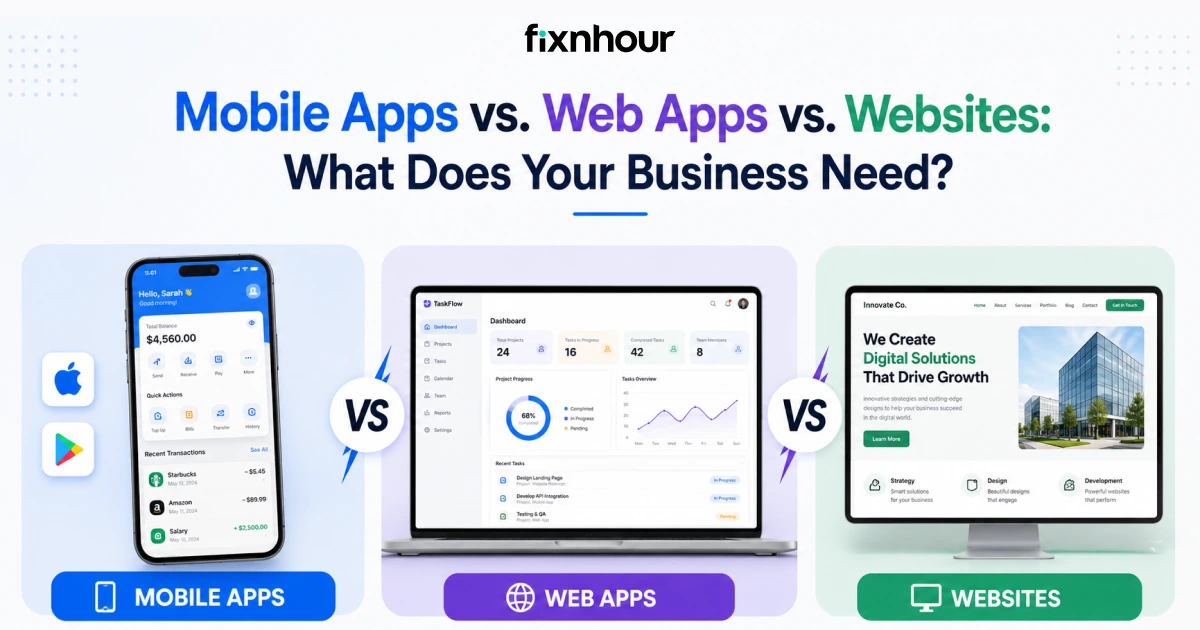
In today’s digital world, businesses need the right online solution to stay competitive, improve customer engagement, and drive growth. Whether it’s a mobile app, web app, or website, each option offers unique features, benefits, and business advantages. Choosing the right platform depends on your goals, target audience, budget, and required functionality. Understanding the differences between these digital solutions helps businesses make smarter technology investments and build stronger online experiences
Understanding Digital Solutions for Modern Businesses
Modern businesses rely on digital solutions like mobile apps, web apps, and websites to improve customer engagement, streamline operations, and boost online visibility. Each solution serves different business goals, budgets, and user experiences. Understanding their differences helps companies choose the right technology to enhance performance, support growth, and stay competitive in today’s fast-changing digital marketplace.
- A mobile application
- A web application
- Or a professional website
What Is a Mobile App?
A mobile app is a software application designed specifically for smartphones and tablets. Users download and install it from app stores like Google Play or the Apple App Store. Mobile apps offer fast performance, offline access, push notifications, and a highly personalized user experience. Businesses use mobile apps to improve customer engagement, increase brand loyalty, and deliver seamless digital services.
- Banking apps
- Food delivery apps
- Fitness apps
- Social media apps
Key Benefits of Mobile App Development
Top Mobile App Development Companies helps businesses deliver faster performance, better user engagement, and personalized customer experiences. Mobile apps support push notifications, offline access, secure transactions, and seamless navigation. They also improve brand visibility, customer retention, and sales opportunities. With growing smartphone usage, mobile apps provide businesses with a powerful way to connect with users anytime and enhance long-term digital growth.
Better User Experience
Mobile apps provide smooth navigation, fast loading speeds, and highly interactive experiences.
Push Notifications
Businesses can instantly connect with customers through personalized notifications and updates.
Offline Accessibility
Many mobile apps continue working even without an internet connection.
Stronger Customer Engagement
Apps increase user retention by offering convenience and personalized experiences.
Access to Device Features
- GPS
- Camera
- Bluetooth
- Microphone
- Fingerprint authentication
Also Read: Top 10 Mobile App Development Companies in Delhi List
Best Businesses for Mobile Apps
Businesses that benefit most from mobile apps include eCommerce stores, food delivery services, healthcare providers, fitness brands, banks, educational platforms, travel agencies, and on-demand service companies. Mobile apps help these businesses improve customer engagement, offer personalized experiences, enable quick transactions, and increase brand loyalty. Companies that require frequent user interaction and real-time communication often gain the most value from mobile app development.
- eCommerce brands
- Healthcare companies
- Travel businesses
- Fintech startups
- Food delivery services
- Education platforms
Also Read: How to Hire a Mobile App Developer in 2026: A Complete Smart Hiring Guide
What Is a Web App?
A web app is an interactive application that runs through a web browser without requiring installation on a device. Users can access it on desktops, tablets, and smartphones using the internet. Web apps provide features like user logins, dashboards, online collaboration, and real-time updates. Businesses use web apps to deliver flexible, cost-effective, and accessible digital solutions across multiple devices and platforms.
- CRM systems
- Project management tools
- SaaS platforms
- Online booking systems
Advantages of Web App Development
Web app development fixnhour offers businesses flexibility, easy accessibility, and lower development costs compared to mobile apps. Users can access web apps from any device with an internet connection and browser. Web apps are easier to maintain, update, and scale without requiring downloads or installations. They also support cross-platform compatibility, faster deployment, and improved collaboration, making them ideal for modern digital business operations.
Cross-Platform Compatibility
- Smartphones
- Tablets
- Laptops
- Desktop computers
Lower Development Cost
Top Web Development companies is generally more affordable than native mobile app development.
Easy Maintenance
Updates happen automatically without requiring users to download new versions.
Faster Deployment
Businesses can launch web apps quickly compared to traditional mobile applications.
Also Read: Top Web App Development Companies in Mumbai List Guide
When Should You Choose a Web App?
A web app is the right choice when your business needs a cost-effective, cross-platform solution accessible from any device through a browser. It works well for businesses requiring user accounts, dashboards, online collaboration, booking systems, or real-time data access. Web apps are ideal for startups and growing businesses that want faster development, easy maintenance, scalability, and broad accessibility without requiring users to install applications.
- You need a scalable online platform
- Your budget is limited
- Users access your platform from multiple devices
- You want faster development and deployment
What Is a Website?
A website is a collection of web pages designed to provide information about a business, service, or brand. A website is a collection of web pages accessible through a browser that provides information about a business, brand, product, or service. Websites are mainly designed for online visibility, marketing, and communication. They help businesses showcase content, generate leads, improve SEO rankings, and reach a wider audience. Unlike apps, websites are easy to access without installation and work across all internet-enabled devices.
- Brand awareness
- SEO visibility
- Lead generation
- Content marketing
Examples include:
- Corporate websites
- Portfolio websites
- Blog websites
- Business landing pages
Benefits of Professional Website Development
Professional website development helps businesses create a strong online presence with a modern, responsive, and user-friendly design. A well-developed website improves brand credibility, search engine visibility, customer engagement, and lead generation. It also ensures faster loading speed, mobile compatibility, better security, and smooth navigation. Professional websites support business growth by delivering a reliable digital experience that attracts and retains customers effectively.
Improves Online Visibility
A well-optimized website helps businesses rank on Google and attract organic traffic.
Builds Brand Credibility
Customers trust businesses with modern, professional websites.
Supports Digital Marketing
Websites are essential for:
- SEO
- Content marketing
- Email campaigns
- PPC advertising
Generates Leads and Sales
A website acts as a 24/7 online sales and marketing platform.
Mobile Apps vs. Web Apps vs. Websites: Key Differences
| Feature | Mobile App | Web App | Website |
|---|---|---|---|
| Installation Required | Yes | No | No |
| Internet Dependency | Partial | Yes | Yes |
| Performance | Very Fast | Fast | Moderate |
| User Experience | Excellent | Good | Basic |
| Push Notifications | Yes | Limited | No |
| SEO Benefits | Limited | Moderate | Excellent |
| Development Cost | High | Medium | Low |
| Offline Access | Yes | No | No |
Which One Does Your Business Need?
The right digital solution depends on your business goals, audience, and budget. Choose a mobile app if you need high user engagement, offline access, and personalized experiences. A web app is ideal for interactive platforms that require accessibility across devices without installation. A website works best for building online presence, sharing information, improving SEO, and generating leads. Many businesses combine all three for maximum digital growth and customer reach.
Choose a Mobile App If:
- You need high customer engagement
- Users access your services regularly
- You want personalized experiences
- Push notifications are important
Choose a Web App If:
- You need a business management platform
- Budget matters
- Multi-device accessibility is essential
Choose a Website If:
- You want online visibility
- SEO is your priority
- You need lead generation and branding
Cost Comparison in 2026
In 2026, development costs vary significantly based on features, complexity, and platform requirements. Mobile apps are usually the most expensive due to platform-specific development and maintenance. Web apps offer a more affordable and scalable option, while websites remain the most budget-friendly solution for businesses focused on online visibility and lead generation. Choosing the right solution depends on your goals, functionality needs, and long-term digital strategy.
Mobile App Development Cost
- Basic apps: $10,000 – $30,000
- Advanced apps: $50,000+
Web App Development Cost
- Small web apps: $5,000 – $20,000
- Enterprise solutions: $40,000+
Website Development Cost
- Business websites: $1,000 – $10,000
- Custom websites: $15,000+
Latest Trends in App and Website Development
The latest trends in app and website development focus on AI-powered experiences, Progressive Web Apps (PWAs), cross-platform development, server-first architecture, and personalized user interfaces. Businesses are also adopting voice search optimization, low-code development, edge computing, and stronger cybersecurity features. Modern designs now emphasize faster performance, responsive layouts, automation, and seamless user experiences across devices. These innovations help businesses improve engagement, scalability, and digital transformation in 2026.
AI-Powered Applications
Businesses are integrating AI chatbots and automation into apps and websites.
Progressive Web Apps (PWAs)
PWAs combine the best features of websites and mobile apps.
Cross-Platform App Development
Technologies like Flutter and React Native reduce development costs.
Voice Search Optimization
Businesses are optimizing websites for voice-based searches.
Cloud-Based Applications
Cloud integration improves scalability and performance.
How to Choose the Right Development Company
Choosing the right development company starts with evaluating its experience, portfolio, technical expertise, and client reviews. Look for a company that understands your business goals, industry requirements, and target audience. Check their communication process, project management approach, pricing transparency, and post-launch support services. A reliable development partner should offer scalable solutions, modern technologies, timely delivery, and a strong focus on quality, security, and user experience.
- Industry experience
- Technology expertise
- Portfolio quality
- Client reviews
- Post-launch support
- Pricing transparency
Final Thoughts
There is no one-size-fits-all solution when comparing mobile apps vs. web apps vs. websites. The right choice depends on your business goals, target audience, budget, and growth strategy.
- Mobile apps offer the best user engagement
- Web apps provide flexibility and scalability
- Websites are essential for online visibility and branding
Many successful businesses combine all three to create a complete digital ecosystem. If you want long-term digital growth in 2026, investing in the right technology solution is no longer optional — it’s a necessity. Partnering with an experienced development company ensures reliable, scalable, and future-ready solutions. Contact us today to discuss your project and build the perfect digital solution for your business.
Frequently Asked Questions
Q1. Which is better: a mobile app or a website?
Ans. Choosing between a mobile app and a website depends entirely on your business goals, target audience, and customer behavior. A mobile app offers better user engagement, faster performance, push notifications, and personalized experiences. On the other hand, a website is essential for SEO, online visibility, and reaching a broader audience through search engines. Many businesses start with a professional website and later invest in mobile app development to improve customer interaction and long-term business growth.
Q2. Are web apps cheaper than mobile apps?
Ans. Yes, web app development is usually more affordable than native mobile app development because a single web app can work across multiple devices and operating systems. Businesses do not need separate Android and iOS applications, which reduces development and maintenance costs. Web apps are also easier to update since changes happen directly on the server. For startups and small businesses with limited budgets, web application development can be a cost-effective solution with strong scalability and accessibility benefits.
Q3. Do small businesses need mobile apps?
Ans. Not every small business needs a mobile app in the beginning. Many businesses first focus on building a professional website to establish online visibility, improve SEO rankings, and generate leads. However, if customers frequently interact with the business, place orders regularly, or require personalized services, a mobile app can significantly improve customer engagement and loyalty. Businesses like food delivery, eCommerce, healthcare, and travel services often benefit greatly from investing in custom mobile app development solutions.
Q4. What is the biggest advantage of a web app?
Ans. The biggest advantage of a web app is its cross-platform accessibility. Users can access web applications from smartphones, tablets, laptops, or desktop devices without downloading anything. Web apps are also easier to maintain because updates are instantly available to all users. They offer faster deployment, lower development costs, and seamless scalability for growing businesses. Many companies choose web application development services because web apps combine convenience, flexibility, and affordability while delivering a smooth digital experience.
Q5. Can a business have both a website and a mobile app?
Ans. Yes, many successful businesses use both a website and a mobile app to maximize customer engagement and online visibility. A website helps attract users through SEO, digital marketing, and search engine traffic, while a mobile app provides a personalized and convenient user experience. Combining both platforms allows businesses to improve brand credibility, customer retention, and conversions. In 2026, businesses increasingly invest in integrated digital solutions that include websites, mobile apps, and web applications for complete digital growth.