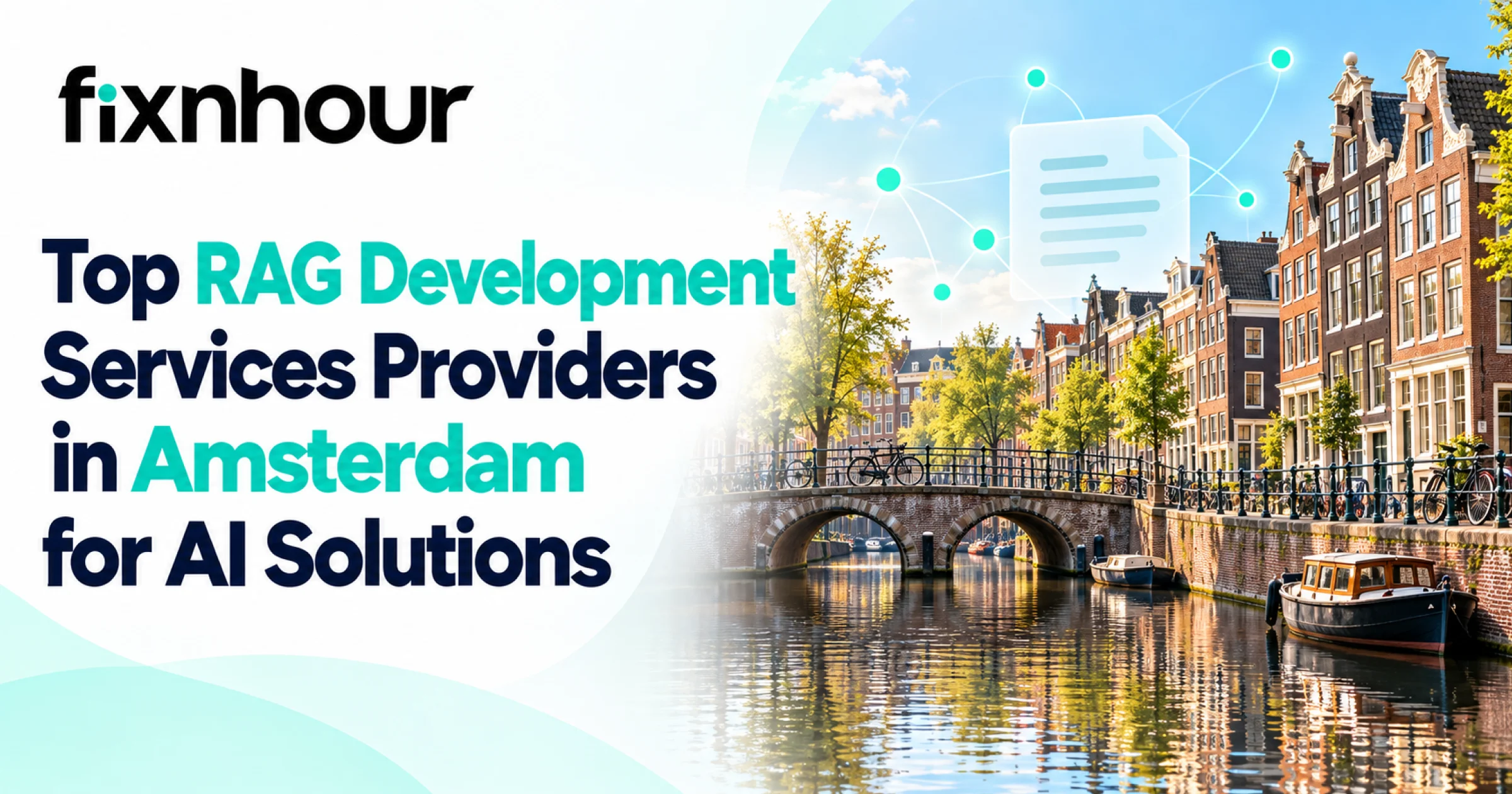
Amsterdam is becoming an important European hub for artificial intelligence, data engineering, and enterprise technology, creating growing demand for Retrieval-Augmented Generation (RAG) development services. RAG solutions help businesses connect large language models with proprietary documents, databases, knowledge bases, and real-time information to deliver more accurate and context-aware AI applications. From intelligent enterprise search and AI assistants to customer support automation and knowledge management, RAG can support a wide range of business use cases.
However, successful implementation requires expertise in data pipelines, vector databases, retrieval strategies, LLM integration, security, evaluation, and scalable deployment. This guide highlights the top RAG development services providers in Amsterdam for businesses exploring AI solutions. The list considers capabilities across generative AI, custom software development, data engineering, automation, and enterprise AI to help organizations identify providers aligned with their technical requirements and project goals.
Quick Answer
The providers covered in this article include Aegeantic, SolveIt, Goji Labs, Memory Squared, Build Me App, Lizard Global, Tallium Inc., MWDN, Synergy Labs, and Phenomenon Studio. Their capabilities span AI product development, intelligent search, custom software, AI assistants, data integration, and enterprise applications. Platforms such as Fixnhour can also help businesses discover and compare technology providers based on RAG architecture, security, integration, deployment, and support requirements.
Key Takeaways
- RAG connects generative AI models with external or proprietary business information.
- RAG applications can support enterprise search, AI assistants, chatbots, document processing, and knowledge management.
- A production RAG architecture may include embeddings, vector databases, retrieval pipelines, reranking, LLM orchestration, and evaluation.
- Data quality, access control, security, and monitoring are important when deploying RAG with business information.
- Amsterdam-based AI providers increasingly position RAG alongside AI agents, intelligent platforms, enterprise search, and custom AI applications.
- The right provider depends on the required technology stack, industry requirements, project scope, integrations, and deployment model.
Statistics & Market Insights
RAG is increasingly being adopted by businesses in Amsterdam to connect generative AI with private data, enterprise knowledge bases, documents, and internal systems. Organizations are prioritizing retrieval accuracy, data security, AI governance, scalable infrastructure, and seamless integrations when selecting RAG development partners. Many Generative AI Companies in Amsterdam are also combining RAG with AI agents, vector databases, enterprise search, automation, and multimodal AI to build reliable, context-aware business solutions.
Key RAG Market Signals
- Growing demand for private-data AI solutions
- Increased adoption of vector and hybrid search
- Stronger focus on AI security and governance
- Expansion of agentic RAG applications
- Rising demand for enterprise AI search
- Greater emphasis on data privacy and compliance
Top RAG Development Services Providers in Amsterdam
The following companies represent a mix of AI product development, software engineering, digital product development, and RAG capabilities. Since RAG is often integrated into broader AI architectures, businesses should evaluate each provider’s technical expertise, retrieval methods, LLMs, vector databases, security practices, and deployment models. Similar to selecting Vue.js Development Companies in Amsterdam, buyers should align technical capabilities with their project requirements, scalability, and long-term goals.
| Rank | Company | RAG / AI Focus | Key Capabilities | Potential Use Cases |
|---|---|---|---|---|
| 1 | Aegeantic | AI Platforms & Enterprise AI | AI agents, integrations, cloud-native systems | Enterprise AI, automation, knowledge systems |
| 2 | SolveIt | AI Development | AI integration, smart search, data extraction | AI assistants, search, automation |
| 3 | Goji Labs | RAG & AI Products | RAG pipelines, AI data layer, vector databases | AI assistants, enterprise search |
| 4 | Memory Squared | AI & Software Solutions | AI applications, software development | Knowledge systems, business automation |
| 5 | Build Me App | AI & App Development | Web, mobile, AI-powered applications | AI apps, customer solutions |
| 6 | Lizard Global | Digital Product Development | AI, software, web and mobile | Enterprise applications |
| 7 | Tallium Inc. | AI & Software Development | Custom software, AI, data solutions | Enterprise AI, automation |
| 8 | MWDN | AI & Software Engineering | AI development, custom software | AI applications, business systems |
| 9 | Synergy Labs | AI & Product Development | AI, mobile, web and software | AI-powered digital products |
| 10 | Phenomenon Studio | AI & Digital Product Development | AI, UX/UI, web and mobile | AI products, intelligent platforms |
1. Aegeantic
Aegeantic focuses on AI-powered products, scalable digital platforms, enterprise integrations, and secure AI agents. Its current positioning emphasizes secure, on-premise AI agents and integrated digital systems. Its website also highlights technologies and workflows associated with retrieval-augmented generation, LLM workflows, agent orchestration, and enterprise AI. This makes Aegeantic relevant for organizations exploring RAG as part of a broader enterprise AI architecture.
- AI-powered product development
- Enterprise system integration
- AI agents and automation
- Cloud-native and scalable platforms
2. SolveIt
SolveIt provides AI development and consulting services covering AI strategy, custom AI development, and integration with existing systems. Its publicly described AI capabilities include virtual assistants, smart search, image recognition, prediction engines, and data extraction. These capabilities can support RAG projects where retrieval, intelligent search, data processing, and AI interfaces need to work together within an existing software environment.
- Custom AI development
- Smart search solutions
- AI integration
- Data extraction and automation
3. Goji Labs
Goji Labs develops AI-powered products and specifically describes Retrieval-Augmented Systems, AI data layers, retrieval pipelines, vector databases, embedding systems, data integrations, model orchestration, and evaluation frameworks. Its RAG approach connects AI models with proprietary data for assistants, search, and reporting. The company also describes production-oriented AI development, making these capabilities relevant to organizations moving from an AI prototype toward a deployable product.
- RAG pipeline development
- Vector databases and embeddings
- AI data-layer architecture
- AI assistants and intelligent search
4. Memory Squared
Memory Squared can be considered for businesses looking at AI-enabled software and knowledge-driven applications. For a RAG project, the important evaluation areas include how a provider handles proprietary data, retrieval architecture, LLM integration, application development, and production deployment. Organizations should discuss their specific document sources, retrieval requirements, security model, and evaluation framework before selecting a project approach.
- AI application development
- Custom software solutions
- Business-focused AI workflows
- Knowledge-oriented applications
5. Build Me App
Build Me App works across digital product and application development, making it relevant for companies that want AI capabilities incorporated into web or mobile products. For RAG projects, businesses can evaluate its ability to connect application interfaces with business data, APIs, AI models, search functionality, and backend systems. This approach can support customer-facing applications where RAG is one component of a wider product experience.
- Web application development
- Mobile application development
- AI-enabled applications
- Custom software integration
6. Lizard Global
Lizard Global provides digital product development across software, mobile, web, and emerging technologies. For organizations considering RAG, its broader software-development capabilities can be relevant when the AI retrieval layer must integrate with an existing digital product. Potential project discussions may include AI assistants, intelligent search, business-data integration, API connectivity, and workflow automation alongside the core application.
- Digital product development
- Web and mobile applications
- Custom software development
- AI integration opportunities
7. Tallium Inc.
Tallium Inc. focuses on custom software and digital product development, including solutions that can incorporate AI capabilities. Businesses evaluating Tallium for RAG should examine its experience with data-intensive applications, AI integration, cloud architecture, APIs, and enterprise software. RAG can be incorporated into larger systems for internal knowledge discovery, automated assistance, document processing, and business intelligence depending on project requirements.
- Custom software development
- AI application integration
- Enterprise technology solutions
- Digital product engineering
8. MWDN
MWDN provides software-development and engineering capabilities that can support businesses building custom digital systems. For a RAG implementation, companies should assess experience with AI integrations, backend development, databases, APIs, cloud infrastructure, and application architecture. These components are important because a production RAG system normally requires more than an LLM interface; it also needs reliable data ingestion, retrieval, application logic, and monitoring.
- Custom software engineering
- AI application development
- Backend and API integration
- Business technology solutions
9. Synergy Labs
Synergy Labs develops digital products across mobile, web, software, and emerging technologies. Its capabilities can be relevant to companies that want RAG functionality embedded inside a customer-facing application or business platform. A typical project could connect an AI assistant to structured or unstructured business information, allowing users to retrieve relevant content through a conversational interface while the wider application manages authentication and workflows.
- AI-powered digital products
- Mobile application development
- Web application development
- Custom software solutions
10. Phenomenon Studio
Phenomenon Studio combines digital product development, UX/UI, software engineering, and emerging technologies. This broader product-development model can be useful when RAG is part of a complete AI product rather than a standalone backend system. Companies can evaluate capabilities around conversational interfaces, AI-enabled workflows, application architecture, data integration, and user experience when planning a customer-facing or internal RAG application.
- AI product development
- UX/UI and product design
- Web and mobile development
- Intelligent digital experiences
Benefits of RAG Development for Businesses
RAG allows organizations to build AI applications around their own information rather than relying solely on general model knowledge. By connecting AI models with documents, databases, websites, policies, and product data, businesses can improve relevance and accuracy. For organizations exploring RAG solutions, Software Development Companies in Amsterdam can help integrate these systems into scalable, secure, and business-focused applications.
More Relevant AI Responses
- Business-specific context
- Current information retrieval
- Relevant source selection
- Context-aware responses
Better Knowledge Access
- Faster information discovery
- Centralized business knowledge
- Conversational search
- Employee self-service
Flexible Business Integrations
- CRM integration
- ERP and database connectivity
- Document repositories
- Existing enterprise applications
Scalable AI Applications
- AI assistants
- Enterprise search
- Customer support
- Automated workflows
Conclusion
RAG development can help Amsterdam businesses connect generative AI with trusted organizational information, enabling smarter assistants, search platforms, knowledge systems, and automated workflows. The 10 companies featured here bring different strengths across AI, software, data, product development, and engineering. Businesses should evaluate providers based on RAG architecture, data security, retrieval accuracy, integrations, LLM expertise, testing, deployment, and ongoing support.
A well-defined use case and reliable data foundation can make implementation more effective. If you are planning your RAG project, Connect With Our Experts to discuss your requirements and explore a practical approach for your business.
Frequently Asked Questions
Q1. What is RAG development?
Ans. RAG development involves creating AI systems that retrieve relevant information from external or proprietary data sources before generating an answer with a language model. A typical system includes document processing, embeddings, retrieval, context assembly, and LLM generation. RAG can be used for enterprise search, knowledge assistants, customer support, document analysis, and other applications where responses need access to specific business information.
Q2. What does a RAG development company do?
Ans. A RAG development company designs and builds the technical architecture connecting business data with AI models. Services can include data preparation, document ingestion, embeddings, vector databases, retrieval pipelines, LLM integration, prompt orchestration, evaluation, security, deployment, and monitoring. The provider may also integrate the RAG system with existing applications, databases, APIs, enterprise platforms, or customer-facing interfaces.
Q3. How much does RAG development cost in Amsterdam?
Ans. RAG development costs vary according to application complexity, data volume, integrations, security requirements, model selection, infrastructure, and expected scale. A simple proof of concept can require substantially fewer resources than a production enterprise platform. Businesses should request a project-specific estimate after defining data sources, users, retrieval requirements, integrations, deployment preferences, evaluation criteria, and ongoing support requirements.
Q4. How long does it take to build a RAG application?
Ans. A RAG application can take anywhere from several weeks to several months depending on its scope. A prototype using a limited dataset may be developed relatively quickly, while an enterprise deployment requires additional work around data pipelines, permissions, integrations, evaluation, security, testing, monitoring, and scalability. A discovery phase can help establish realistic technical requirements and a project-specific development timeline.
Q5. What technologies are used for RAG development?
Ans. RAG solutions commonly use large language models, embedding models, vector databases, retrieval frameworks, APIs, data-processing pipelines, and cloud infrastructure. Technologies may include OpenAI or other LLM providers, LangChain or LlamaIndex, vector databases such as Weaviate, Pinecone, or PostgreSQL with pgvector, and hybrid search technologies. The appropriate stack depends on data characteristics, application requirements, security, cost, and deployment preferences.
Q6. Can RAG work with private company data?
Ans. Yes. RAG is specifically useful when an AI application needs access to proprietary information that is not contained in the model's general knowledge. Private documents, databases, product information, internal policies, and knowledge repositories can be processed and indexed for retrieval. The implementation should include appropriate authentication, authorization, data protection, access controls, and deployment policies for the organization's information.
Q7. Is RAG suitable for enterprise AI applications?
Ans. RAG can be suitable for enterprise applications where AI needs access to changing, proprietary, or domain-specific information. Common examples include internal knowledge assistants, enterprise search, customer support, document analysis, and research tools. Enterprise RAG should be designed around data quality, retrieval performance, permissions, security, evaluation, monitoring, and integration with existing business systems rather than treating the LLM as an isolated component.
Q8. How does RAG help reduce AI hallucinations?
Ans. RAG can reduce hallucination risk by supplying the language model with relevant information retrieved from defined data sources. Instead of relying solely on general model knowledge, the system can generate responses using retrieved context. However, RAG does not guarantee that every answer will be correct. Retrieval quality, source quality, prompt design, model behavior, evaluation, and validation mechanisms all influence final response reliability.