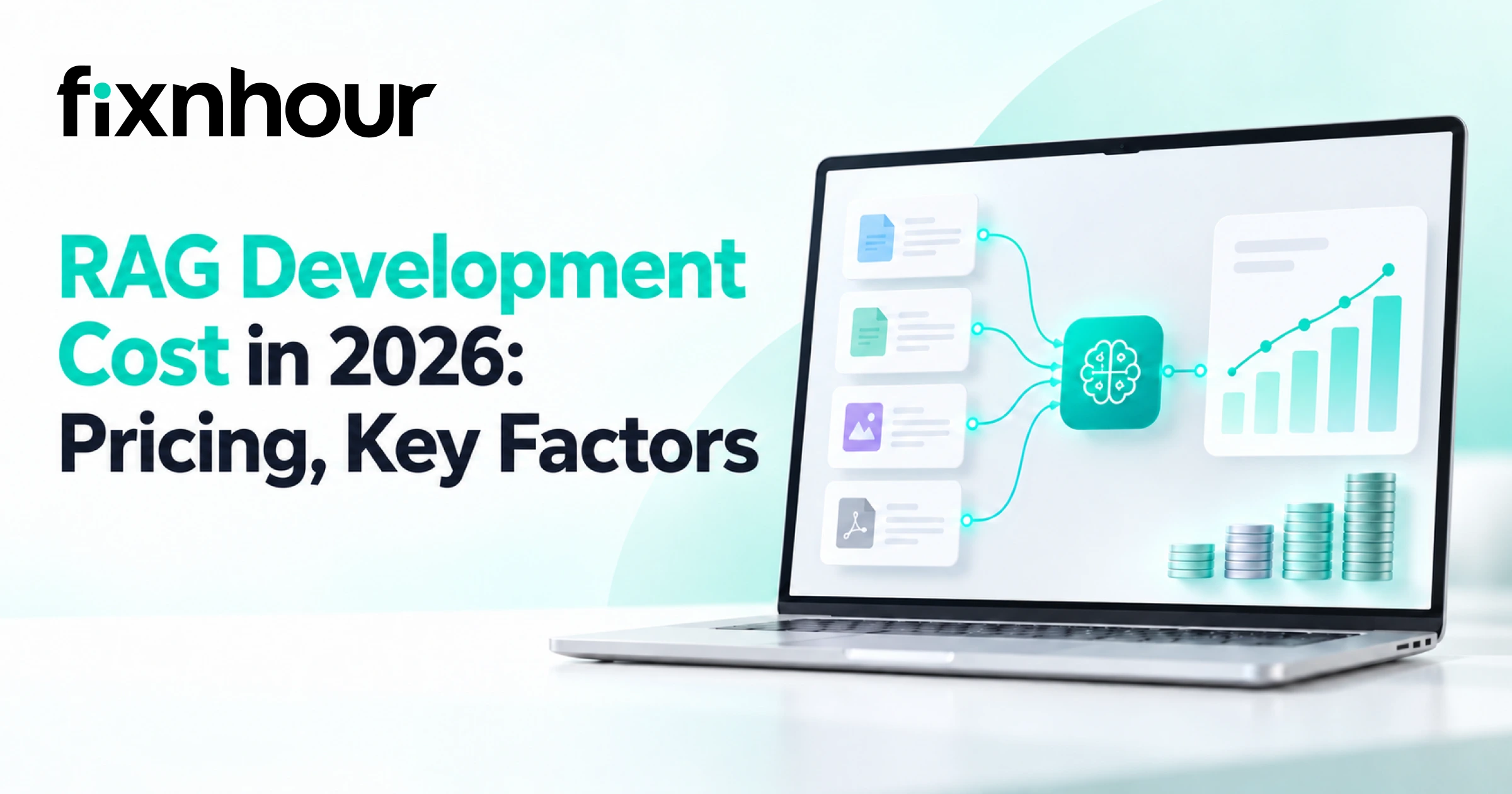
Retrieval-augmented generation (RAG) helps AI applications answer questions using information from selected documents and data sources. In 2026, the cost of RAG development depends on what you’re building, how ready your data is, which systems need to connect, and the security and performance your business requires.
A small proof of concept may need less work than a production-ready application with multiple data sources, user permissions, monitoring, and ongoing support. This guide explains the main RAG development cost factors, recurring expenses, and budgeting steps to help you request a clear, project-specific estimate.
Quick Answer
RAG development cost in 2026 depends on data quality, features, integrations, security needs, and deployment.RAG Development Services Providers in India A proof of concept generally requires less work than a production system with user permissions, monitoring, and support. Treat any quoted price as project-specific. Use the budget breakdown below to request an itemized estimate for your use case.
Key Takeaways
- A proof of concept and an enterprise deployment serve different purposes.
- Poorly organized data can add preparation work.
- More users and queries can increase operating costs.
- A pilot can reveal quality and access issues before wider rollout.
- The lowest initial quote may exclude work you need later.
How Much Does RAG Development Cost, and What Does Each Budget Include?
There is no responsible single price for every RAG application.RAG Development Services Providers in Berlin A small project might test answers against one approved document collection, while a larger system may need several data connectors, role-based access, and reliability controls. Ask providers to price the defined scope and show what is excluded before comparing estimates.
RAG project types and typical scope
| Project Type | Typical Scope | Budget Consideration |
|---|---|---|
| Proof of Concept (PoC) | One use case with a limited data set | Tests feasibility; usually has limited production controls |
| Pilot | A usable workflow for selected users | Adds feedback, evaluation, and selected integrations |
| Production System | Wider access and regular business use | Requires security, monitoring, reliability, and ongoing support |
| Enterprise Deployment | Multiple systems, teams, and complex permissions | Adds governance, extensive integrations, security, and operational requirements |
What a RAG development estimate should cover
Request separate line items for discovery, data preparation, retrieval design, application development, integrations, testing, deployment, documentation, and support. Ask for operating assumptions too: expected users, queries, model usage, storage, hosting, and monitoring.
How to read cost estimates responsibly
Check the assumptions behind each figure. Separate one-time build costs from recurring operating costs, and confirm who pays third-party service fees. A numerical range is only useful when its scope, date, and source are clear.
Which RAG Pricing Model Is Right for Your Project?
The right pricing model depends on how clearly you can define the work. Fixed pricing can suit a narrow project with agreed acceptance criteria.Fixnhour Exploratory work may need a flexible arrangement. In either case, set milestones, review spending regularly, and document how changes affect the budget and delivery date.
Fixed-Price Project
Use this model when the data sources, features, deliverables, and acceptance criteria are defined. Confirm what counts as a change request and how revisions are charged.
- Clearly define project scope, deliverables, and acceptance criteria.
- Establish timelines, milestones, and payment schedules.
- Specify change-request procedures and additional revision costs.
Time-and-Materials Pricing
This model can accommodate changing requirements during discovery or testing. Agree on a budget limit, reporting schedule, and decision points before work begins.
- Set hourly or daily rates for the development team.
- Establish a budget limit and regular progress reporting.
- Define review points for adjusting scope and priorities.
Dedicated Team or Ongoing Support
A continuing team may suit a product that needs regular improvements. Clarify each role, availability, response times, and the work included in the monthly fee.
- Define team roles, responsibilities, and availability.
- Set support hours, response times, and service expectations.
- Include maintenance, updates, optimization, and ongoing improvements.
What Factors Affect RAG Development Cost?
The biggest cost drivers are often the work around retrieval, not the question-and-answer screen itself.AI Product Development Companies: Complete Cost Teams must prepare usable data, connect systems, respect permissions, test answer quality, and keep the application running. The more sources, users, and reliability requirements you add, the more design, development, and operational work the project may require.
Data Sources, Quality, and Preparation
Document volume, file formats, duplicates, missing information, and update frequency affect preparation effort. Connecting a shared folder differs from integrating several systems with separate permissions.
- Review document volume, formats, duplicates, and missing information.
- Check data accuracy, ownership, permissions, and update frequency.
- Plan preparation based on the number and complexity of data sources.
Retrieval and Answer Quality Requirements
Chunking, embeddings, search, reranking, and citations may need tuning. Budget for tests using real user questions and for reviewing answers that are incomplete or unsupported.
- Optimize chunking, embeddings, search, and reranking methods.
- Test the system with realistic user questions and scenarios.
- Review citations and answers for accuracy, completeness, and support.
Integrations, Security, and Compliance
Existing apps, databases, identity tools, and APIs add implementation work. Privacy rules, audit logs, access controls, and applicable compliance requirements should be scoped early.
- Identify required applications, databases, APIs, and authentication systems.
- Define access controls, privacy requirements, and audit logging.
- Review applicable security standards and compliance requirements early.
Scale, Deployment, and Operating Needs
Expected traffic, response speed, uptime, and cloud or self-hosted deployment influence infrastructure choices. Monitoring and maintenance should be included in the operating plan.
- Estimate expected traffic, response times, and uptime requirements.
- Select suitable cloud, on-premise, or self-hosted deployment options.
- Plan monitoring, maintenance, scaling, and ongoing operational costs.
What Are the Benefits and Challenges of Building a RAG Application?
A well-designed RAG application can help people find and use information from approved sources, especially when that information changes or sits across systems.RAG Development Services Providers in Budapest Its usefulness depends on source quality and retrieval accuracy. Teams also need to manage unsupported answers, access permissions, response time, and usage costs after deployment.
Potential benefits
- Answers can draw on selected company or domain information.
- Users can search across connected, approved sources.
- The application can show references when citations are built into the workflow.
Common challenges
- Outdated or inconsistent documents can lead to poor answers.
- Retrieval may miss the right source or return irrelevant passages.
- Permission gaps can expose information to the wrong users.
- Query volume and model usage can make monthly costs difficult to predict.
What Is the Step-by-Step RAG Development Process?
Start by defining one user problem and deciding how you will measure improvement. Then audit the data, design the retrieval workflow, build the application, and test it with realistic questions. Deployment is another milestone: teams need to monitor answer quality, performance, access controls, and spending as usage grows.
| Step | What to Do | Key Actions |
|---|---|---|
| 1. Define the Use Case and Success Measures | Identify target users, common questions, required tasks, and measurable goals for the application. | • Identify target users and their needs• Define questions, tasks, and expected outcomes• Set KPIs for accuracy, response time, and cost |
| 2. Audit and Prepare the Data | Review and organize data to ensure it is accurate, authorized, relevant, and up to date. | • Verify data ownership and permissions• Organize and update business information• Create representative questions and approved test answers |
| 3. Design, Build, and Integrate | Select suitable AI models, retrieval methods, and architecture while connecting trusted data sources. | • Choose appropriate AI models and retrieval techniques• Integrate reliable data sources• Build workflows around real user requirements |
| 4. Test, Deploy, and Improve | Evaluate system performance before launch and continuously improve it using feedback, monitoring, and usage data. | • Test retrieval and answer quality• Monitor feedback, failures, and performance• Optimize results and operating costs |
1. Define the Use Case and Success Measures
Start by identifying your target users, their common questions, and the tasks your application must handle. Define measurable goals to evaluate relevance, accuracy, speed, and overall performance.
- Identify target users and their primary needs
- Define key questions, tasks, and expected outcomes
- Set KPIs such as accuracy, response time, and cost
2. Audit and Prepare the Data
Review your data sources to ensure they are accurate, authorized, relevant, and up to date. Prepare high-quality datasets and representative questions that support reliable testing and evaluation.
- Verify data ownership, permissions, and source quality
- Organize and update relevant business information
- Create representative questions and approved answers for testing
3. Design, Build, and Integrate
Choose suitable retrieval techniques, AI models, and system architecture based on your requirements. Connect trusted data sources and create a practical workflow that delivers useful user experiences.
- Select appropriate AI models and retrieval methods
- Integrate approved and reliable data sources
- Build workflows around real user requirements and tasks
4. Test, Deploy, and Improve
Evaluate both retrieved information and generated responses before deployment. After launch, continuously monitor performance, user feedback, failures, usage patterns, and costs to improve the application.
- Test retrieval accuracy and generated answer quality
- Monitor user feedback, performance, and common failures
- Optimize the system based on usage, results, and operating costs
What Statistics and Market Insights Should Buyers Consider?
AI adoption statistics can provide market context, but they cannot tell you what your RAG project will cost.RAG Development Services Providers in USA For budgeting, your own usage assumptions are more useful: how many documents will be processed, how often they change, and how many queries users will make. Validate these assumptions during a pilot.
RAG and Generative AI Adoption
If you include market statistics, name the source, publication date, geography, sample, and methodology. Distinguish survey responses from measured deployments.
- Verify the source, date, geography, and research methodology.
- Separate reported AI adoption from actual production deployments.
Cost Signals to Track During Planning
Track model and embedding usage, storage, compute, data transfer, monitoring, evaluation, and support effort. Measure actual usage during the pilot where possible.
- Monitor model, storage, compute, and data-transfer costs.
- Track evaluation, monitoring, maintenance, and support expenses.
How to Interpret Market Research
A broad finding about AI adoption is not evidence for a specific RAG development price. Use market research for context and an itemized project estimate for the budget.
- Use market statistics to understand broader industry trends.
- Build budgets using project-specific requirements and resource estimates.
Conclusion
A useful RAG development budget starts with the problem you want to solve. Define the users, approved data, integrations, security needs, and measures of answer quality before requesting quotes. Compare the one-time cost of building the application with the ongoing cost of running and improving it.
Ready to scope your project? Contact [Company Name] for an itemized RAG development estimate based on your use case. Link this call to action to the company’s relevant RAG development or AI development page before publishing. Talk to our experts
Frequently Asked Questions
Q1. How much does it cost to build a RAG application in 2026?
Ans. There is no fixed price for building a RAG application in 2026. The budget depends on the project scope, data quality, number of integrations, security requirements, expected usage, and deployment environment. Ask providers for an itemized estimate based on your use case, including development, third-party services, launch, and ongoing costs.
Q2. What is the difference in cost between a RAG proof of concept and a production system?
Ans.A proof of concept tests whether RAG can address a specific need, often using limited data, users, and features. A production system may require broader data access, user permissions, security controls, reliability testing, monitoring, and support. These added requirements increase development effort, so compare proposals with the same scope and success criteria.
Q3. What factors have the biggest effect on RAG development cost?
Ans.RAG development costs are often affected by data preparation, integrations, security requirements, retrieval quality, and expected scale. Connecting to several data sources or enforcing different user permissions may require additional engineering and testing. The effect of each factor varies, so ask providers to explain their assumptions and identify likely cost drivers.
Q4. How much does it cost to maintain a RAG system each month?
Ans.Monthly RAG maintenance costs depend on hosting, storage, model usage, query volume, monitoring, and support. Costs may change as the system gains users, processes more data, or requires updates. Ask for a monthly forecast based on expected usage, then compare it with actual spending after launch to adjust your budget.
Q5. Does RAG development cost include model and cloud usage?
Ans.Model and cloud usage may be included in a proposal or billed separately. Check whether the quote covers hosting, storage, API usage, monitoring, and other third-party services. Also ask who owns the accounts, manages billing, and pays recurring charges. This helps you understand the full cost of operating the application.
Q6. Can open-source models reduce RAG development costs?
Ans.Open-source models may reduce some licensing or per-request fees, depending on how they are used. However, they still require resources for deployment, infrastructure, evaluation, updates, and maintenance. Compare the total operating cost and the quality of results against your requirements before choosing a model for your RAG application.
Q7. How long does it take to build a custom RAG solution?
Ans.The timeline for a custom RAG solution depends on data access, project scope, integrations, security needs, and testing. A focused proof of concept may require less work than a production system connected to several sources. Ask providers for a milestone-based schedule after they review your requirements, data, and success measures.
Q8. How can a business estimate its RAG project budget?
Ans.Start by documenting the use case, intended users, data sources, integrations, security needs, expected query volume, and success measures. Share the same brief with each provider and request separate estimates for development and ongoing operations. Compare assumptions, deliverables, and recurring expenses so you can plan a budget around your actual requirements.