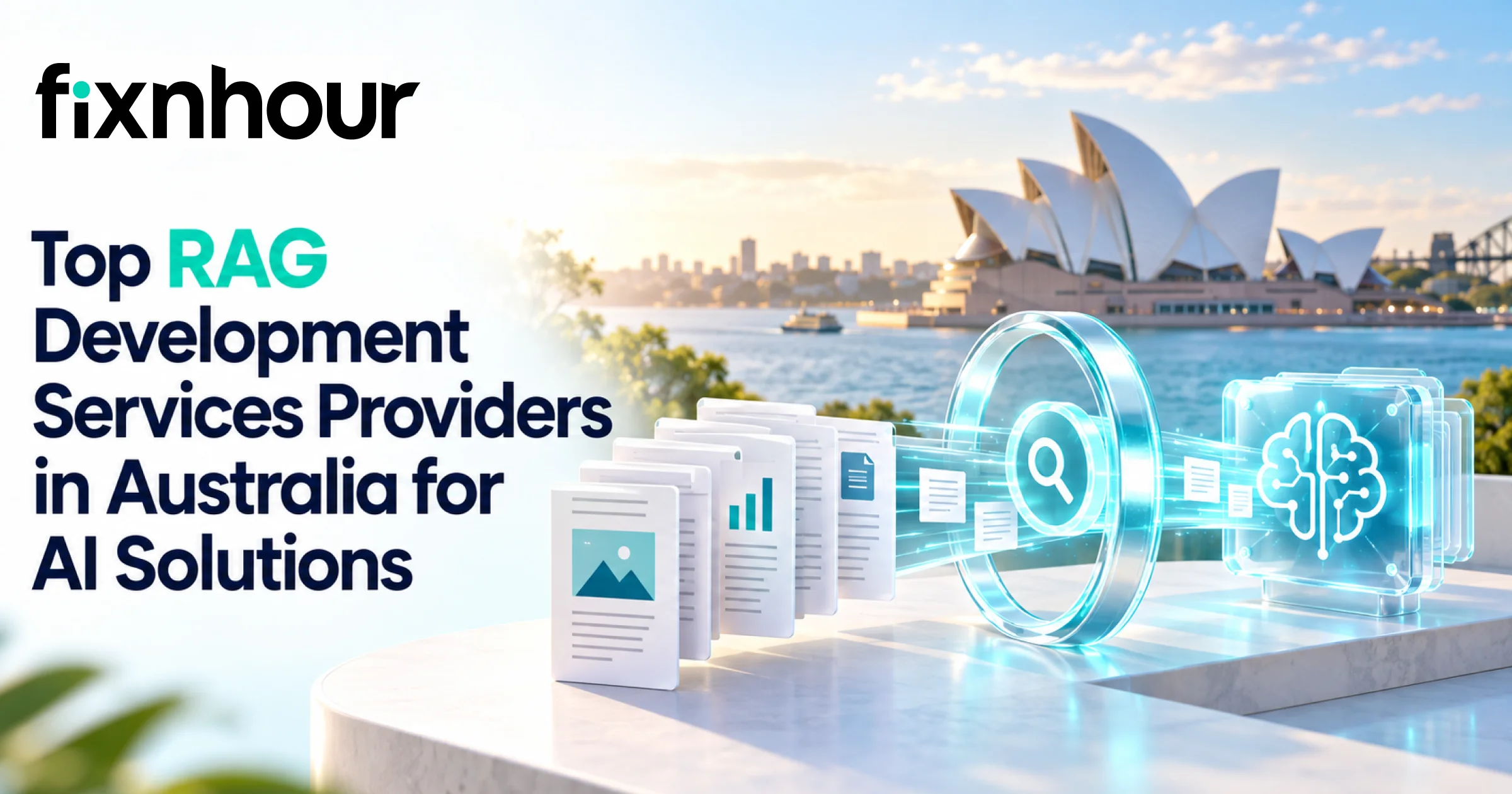
Retrieval-Augmented Generation (RAG) is helping Australian businesses build AI applications that can work with private documents, internal knowledge, databases, and other business information. Instead of relying only on an AI model’s existing knowledge, RAG systems retrieve relevant information and use that context to generate more grounded responses. RAG development services can support enterprise search, AI assistants, customer support, document analysis, knowledge management, and workflow automation. Australian businesses are increasingly exploring RAG alongside large language models (LLMs), AI agents, semantic search, and enterprise software integration.
Choosing a suitable provider requires looking beyond a chatbot demo and examining retrieval architecture, data security, integrations, evaluation, scalability, and ongoing support. This guide covers RAG development services providers in Australia and the capabilities businesses should consider when planning production-ready AI solutions.
Quick Answer
RAG development companies in Australia help businesses connect generative AI models with proprietary data through custom RAG applications, AI chatbots, vector search, document processing, LLM integration, and AI agents. Platforms like Fixnhour can also help businesses discover and compare suitable technology providers based on services, expertise, and project requirements. Security, data residency, retrieval quality, integrations, scalability, and monitoring remain important factors when selecting a RAG development partner.
Key Takeaways
- RAG connects AI models with relevant business information.
- RAG can improve access to private and frequently updated knowledge.
- Vector search, embeddings, chunking, and retrieval are core technical components.
- Enterprise RAG can support documents, websites, databases, and knowledge bases.
- AI assistants and RAG chatbots can provide context-aware responses.
- Security and permission-aware retrieval are important for sensitive information.
- Evaluation should measure retrieval and answer quality before production.
- Australian businesses may also need to consider data residency and governance.
- RAG can be integrated with existing software, cloud platforms, and enterprise systems.
- A clear business use case should guide the RAG architecture and technology stack.
Statistics & Market Insights
RAG development in Australia is moving from experimental AI chatbots toward production-ready enterprise solutions. Artificial Intelligence Companies in Australia increasingly focus on retrieval engineering, secure data access, AI evaluation, governance, and integration with existing business systems. RAG solutions are also combined with AI agents, enterprise search, and multimodal technologies, helping businesses improve accuracy, scalability, and context-aware automation while strengthening demand for reliable and secure AI implementation.
Key RAG Market Signals
- Growing enterprise demand for private-data AI
- Increased adoption of vector and hybrid search
- Greater focus on AI governance and responsible AI
- Expansion of agentic RAG solutions
- Rising demand for enterprise AI search
- Increased focus on data privacy and security
RAG Development Services Providers in Australia
RAG Development Services Providers in Australia help businesses build intelligent AI solutions that combine retrieval systems with generative AI models. These providers develop customized RAG applications, knowledge assistants, enterprise search platforms, chatbots, and AI automation tools. Alongside Software Development Companies in Australia, they integrate company data, APIs, vector databases, and large language models to deliver accurate, scalable, and context-aware solutions for diverse business requirements.
| Company | Location / Australian Presence | RAG & AI Focus | Key Services | Suitable Use Cases |
|---|---|---|---|---|
| HELLO PEOPLE | Perth, Australia | Enterprise RAG & knowledge systems | RAG, AI assistants, automation, AI integration | Knowledge management |
| Noice | Australia | Grounded RAG systems | Custom RAG, vector search, citations, AI assistants | Enterprise & regulated AI |
| NextWeb | Gold Coast, QLD | Custom AI & RAG | RAG, LLMs, AI apps, API integration | Enterprise AI |
| Webhouse | Australia | Product-focused RAG | RAG pipelines, vector search, AI assistants | SaaS & product AI |
| Continuum Labs | Australia | RAG & AI research | RAG architecture, data pipelines, open-source AI | Knowledge systems |
| Neuraxis AI | Sydney | Enterprise RAG & agents | RAG, AI agents, decision systems | Business automation |
| Evolve Mind Solutions | Sydney | LLM & RAG applications | RAG, agents, evaluation, cloud deployment | Custom enterprise AI |
| Toadster Technologies | Sydney | RAG & LLM development | RAG, AI agents, chatbots, LLMs | Business AI |
| Cloud DownUnder | Australia | RAG-powered AI systems | RAG knowledge bases, agents, AI software | Enterprise workflows |
| Vrinsoft | Melbourne | Generative AI & RAG | RAG, LLMs, AI automation, integrations | Custom business solutions |
1. HELLO PEOPLE
HELLO PEOPLE is an Australian AI development provider offering RAG and knowledge-system solutions for businesses. Its RAG approach focuses on connecting business documents and information with AI so users can search and receive answers grounded in organisational content. Its published capabilities include document search, knowledge assistants, workflow automation, AI integrations, and RAG-powered knowledge management. This makes its offering relevant for businesses looking to turn internal documentation into a searchable AI knowledge layer.
- Enterprise RAG knowledge systems
- Document and knowledge search
- AI assistants and workflow automation
- AI API and system integration
2. Noice
Noice provides RAG development services focused on grounded AI systems and enterprise knowledge retrieval. Its published approach includes custom RAG pipelines, vector embeddings, semantic retrieval, citations, evaluation, and Australian data-residency options. The company also describes integrations with existing search technologies such as Elasticsearch and Solr. These capabilities can be relevant for organisations that need AI responses connected to internal documents, existing search indexes, or regulated business information.
- Custom RAG pipelines
- Vector embeddings and retrieval
- Source citations and AI evaluation
- Australian data-residency options
3. NextWeb
NextWeb is a Gold Coast-based technology provider offering custom AI development for Australian businesses. Its AI services include custom LLM development, RAG architectures, AI-powered applications, and secure API integrations. Its positioning focuses on building AI systems around proprietary business information and private infrastructure. Businesses considering RAG for enterprise applications can evaluate its capabilities around LLM integration, data security, application development, and deployment.
- Custom RAG architecture
- LLM and generative AI development
- Secure API integrations
- Enterprise AI applications
4. Webhouse
Webhouse provides AI development services that include retrieval-augmented generation, vector search, chunking, and retrieval pipelines. Its approach focuses on embedding AI into products rather than treating AI as a standalone chatbot. RAG can be used to ground product assistants and copilots in documents, tickets, and structured business data. This makes the provider relevant for SaaS companies and businesses that want RAG functionality integrated directly into an existing digital product.
- RAG pipelines
- Vector search
- Product AI assistants
- Data and LLM integration
5. Continuum Labs
Continuum Labs is an Australian AI research and intellectual-property company working across models, data pipelines, agent architectures, and RAG systems. Its published RAG capabilities cover ingestion, retrieval, ranking, generation, and evaluation. The company also highlights open-source models and data sovereignty. Businesses exploring custom AI architectures can consider these capabilities when they require greater control over models, infrastructure, data, and the overall RAG technology stack.
- RAG system architecture
- Data ingestion and knowledge engineering
- Retrieval and ranking
- Open-source AI deployment
6. Neuraxis AI
Neuraxis AI is a Sydney-based AI development company focused on agentic AI, workflow automation, and enterprise RAG systems. Its RAG and decision-system offering is designed to turn private organisational data into information that can support business operations. Its broader AI capabilities include autonomous agents and workflow automation. This combination can be relevant for businesses looking to move from basic document retrieval toward AI systems that connect knowledge with operational workflows.
- Enterprise RAG systems
- AI decision systems
- Agentic AI development
- Workflow automation
7. Evolve Mind Solutions
Evolve Mind Solutions is an Australian AI company based in Sydney that provides AI development and consulting services. Its published AI engineering capabilities include LLM applications, RAG applications, agents, model integration, evaluation, guardrails, APIs, and production monitoring. This makes its services relevant for organisations that need more than a prototype and want RAG incorporated into a complete production architecture with testing, deployment, and ongoing operational support.
- LLM and RAG application development
- AI agents and automation
- Evaluation and guardrails
- Cloud deployment and monitoring
8. Toadster Technologies
Toadster Technologies provides AI development services in Sydney, including RAG development, LLM development, AI agents, and conversational AI. Its RAG offering is positioned around helping businesses connect their own information with AI models to produce more relevant responses. Businesses can consider this type of architecture for internal knowledge systems, customer-facing chatbots, and applications that need to work with company documents and existing business platforms.
- RAG development
- LLM application development
- AI agent development
- Conversational AI and chatbots
9. Cloud DownUnder
Cloud DownUnder is an Australian AI development company that builds custom AI solutions for businesses. Its capabilities include Retrieval-Augmented Generation (RAG) pipelines, LLM integration, AI agents, vector databases, and AI-powered applications. The company focuses on connecting AI models with business documents and systems to create practical, data-grounded solutions for enterprise workflows, knowledge retrieval, automation, and intelligent customer experiences.
- RAG Development & AI Pipelines
- LLM Integration & Fine-Tuning
- AI Agent Development
- Vector Databases & AI Integration
10. Vrinsoft
Vrinsoft is a Melbourne-based technology company providing AI development and enterprise software services across Australia. Its AI capabilities include generative AI, large language models, retrieval-augmented generation, AI agents, machine learning, computer vision, and workflow automation. The company also describes integration with CRM, ERP, business intelligence platforms, and cloud infrastructure. This can make its broader AI development capabilities relevant for businesses planning RAG within an existing software ecosystem.
- Retrieval-Augmented Generation
- Generative AI and LLM development
- AI workflow automation
- Enterprise platform integration
Benefits of Hiring RAG Development Services in Australia
Hiring RAG development services in Australia helps businesses build AI solutions that deliver accurate, relevant, and context-aware responses. Australian RAG developers can connect enterprise data sources, improve information retrieval, and support secure AI applications tailored to business needs. Alongside RAG expertise, businesses exploring modern web solutions can also work with Angular Development Companies in Australia to create scalable, responsive, and data-driven applications.
Grounded AI Responses
RAG allows AI applications to retrieve relevant information before generating an answer. This can make responses more closely connected to the organisation’s own documents and knowledge sources. Businesses can also design systems with citations, fallback behaviour, evaluation, and retrieval controls. These capabilities are particularly useful when users need to understand where an AI-generated answer came from rather than receiving an unsupported response.
Better Access to Business Knowledge
Employees often spend significant time searching through policies, manuals, contracts, product information, support documentation, and other internal resources. A RAG knowledge assistant can provide a conversational layer over these sources. Instead of manually searching multiple systems, users can ask questions in natural language and retrieve relevant information from connected knowledge repositories.
More Useful Enterprise Search
Traditional keyword search can struggle when users describe a concept differently from the wording used inside a document. Semantic retrieval uses embeddings to identify information based on meaning and context. Combining keyword search with semantic search can create a more flexible enterprise search experience. RAG can then use the retrieved results to generate a natural-language response.
Integration With Existing Systems
RAG does not necessarily require a business to replace its existing software. Depending on the architecture, a RAG application can connect with websites, document repositories, databases, search indexes, CRM systems, cloud services, or internal applications. This makes integration an important part of RAG development and allows organisations to build AI around existing data and workflows.
Scalable AI Knowledge Systems
As businesses grow, their information also changes. New documents, policies, products, support tickets, and knowledge articles can be added to a retrieval pipeline. When designed correctly, the system can update its searchable knowledge without requiring the underlying language model to be retrained every time information changes. This makes RAG useful for frequently updated business environments.
Conclusion
RAG development services can help Australian businesses connect generative AI with proprietary information, enterprise documents, databases, and operational knowledge. Providers differ in their technical expertise, deployment models, integrations, and industry experience, making it important to evaluate each option against specific business requirements. Key considerations include retrieval quality, data security, scalability, monitoring, system evaluation, integrations, and Australian data-residency needs.
A well-designed RAG solution can support enterprise search, knowledge assistants, customer service, document analysis, and AI-powered workflows. To explore the right approach for your needs, Talk to Our Team and discuss your RAG requirements.
Frequently Asked Questions
Q1. What is RAG development?
Ans. RAG development involves building AI applications that retrieve relevant information from connected knowledge sources and provide that information to a language model as context. The model then generates a response based on the retrieved content. RAG can connect AI with documents, websites, databases, knowledge bases, and internal systems, making it useful for enterprise search, AI assistants, customer support, and knowledge management.
Q2. What are RAG development services used for?
Ans. RAG development services are used to create AI applications that need access to business-specific information. Common applications include enterprise knowledge assistants, document search, customer support chatbots, internal copilots, product assistants, research tools, and AI-powered search. RAG can also connect with structured databases and business software, depending on the application architecture and data requirements.
Q3. How much does RAG development cost in Australia?
Ans. RAG development costs vary according to data complexity, integrations, security requirements, model usage, retrieval architecture, and application scope. A simple knowledge assistant can require substantially less engineering than a large enterprise system connected to multiple databases and permission layers. Businesses should request a project-specific estimate after evaluating data sources, user requirements, integrations, infrastructure, testing, and expected production usage.
Q4. What technologies are used in RAG development?
Ans. RAG applications commonly use large language models, embedding models, vector databases, semantic search, keyword search, document-processing pipelines, APIs, and cloud infrastructure. Development frameworks can also support orchestration, retrieval, evaluation, and agent workflows. The appropriate technology depends on the use case, existing infrastructure, data types, security requirements, expected traffic, latency targets, and whether the organisation needs cloud, hybrid, or private deployment.
Q5. Is RAG better than fine-tuning?
Ans. RAG and fine-tuning solve different problems. RAG is useful when an AI application needs access to changing or private information because the system can retrieve relevant content at query time. Fine-tuning is generally focused on adapting model behaviour, style, or task performance. Some applications may use both approaches, while others may require only RAG, traditional search, prompting, or another architecture.
Q6. Can RAG applications use private company data?
Ans. Yes. RAG applications can be designed to retrieve information from private business documents, databases, knowledge bases, websites, and internal systems. Access controls can also be incorporated so users only retrieve information they are authorised to see. Organisations should assess data handling, encryption, permissions, logging, model-provider policies, and deployment location before connecting sensitive information to a production RAG system.
Q7. Can RAG provide citations and source references?
Ans. Yes. A RAG application can be designed to return citations or links to the documents and passages used to generate an answer. Source references can help users verify information and can be particularly valuable for enterprise, compliance, research, and knowledge-management applications. The exact citation experience depends on how documents are indexed, retrieved, stored, and presented within the application.
Q8. How do I choose a RAG development company in Australia?
Ans. Start by defining the business problem, target users, information sources, security requirements, and expected outcome. Then compare providers based on demonstrated RAG experience, retrieval architecture, LLM expertise, integrations, evaluation methods, cloud capabilities, security controls, and post-launch support. Ask for a technical architecture and project scope rather than evaluating providers only from a chatbot demonstration or general AI services page.