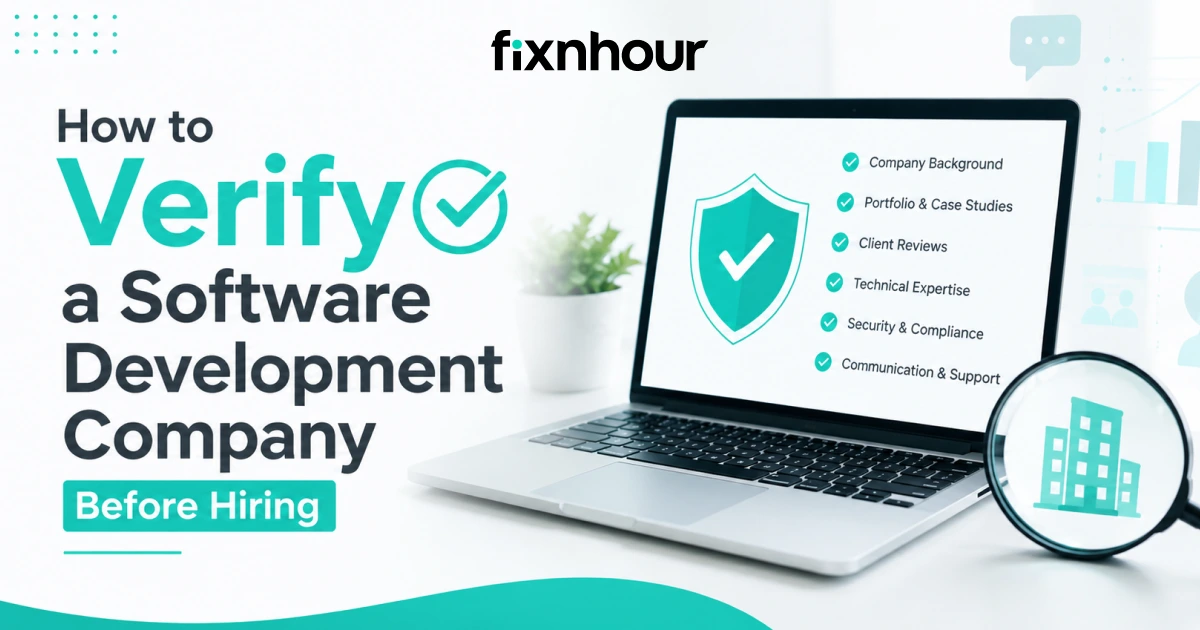
Hiring a software development company is a major business decision because the chosen partner can influence product quality, launch speed, customer experience, and long-term growth. A careful verification process helps startups and businesses avoid unreliable vendors, protect their investment, and select a team that understands both technical requirements and business goals.
Quick Answer
To verify a software development company, check its business identity, website, portfolio, independent reviews, technical expertise, client references, communication process, pricing, contracts, and security policies. Fixnhour Review live projects, speak with previous clients, and compare multiple proposals. Starting with a discovery sprint or pilot project can further reduce risk.
Key Takeaways
Verifying a development partner requires more than reviewing an attractive website or choosing the lowest quote. Businesses should validate real work, assess team capability, understand contract terms, and compare external reputation. A structured evaluation process improves transparency, reduces costly mistakes, and helps create a dependable long-term technology partnership.
- Verify the company’s legal business identity and online presence.
- Check live portfolio projects and relevant case studies.
- Read independent reviews from trusted third-party platforms.
- Ask for recent client references before signing.
- Evaluate technical expertise and communication quality.
- Review security, NDA, and source-code ownership terms.
- Compare value, scope, quality, and support—not price alone.
- Start with a discovery phase or small pilot when possible.
Why Is It Important to Verify a Software Development Company?
A verified software development company is more likely to deliver reliable communication, skilled development, transparent project management, and professional support.15 Questions Before Hiring an IT Company Verification helps buyers identify genuine technical partners while avoiding vendors with fake portfolios, poor delivery records, unclear pricing, or weak security standards that could create financial and operational risks.
Risks of Hiring an Unverified Development Partner
- Delayed launches and missed business opportunities
- Poor-quality code and expensive rework
- Fake portfolios or exaggerated experience
- Data privacy and intellectual property risks
- Lack of support after project delivery
What Verification Helps You Achieve
- Better project planning and realistic timelines
- Clearer communication and delivery accountability
- More confidence in product quality
- Stronger long-term vendor relationships
Step-by-Step Process to Verify a Software Development Company
A step-by-step verification process makes vendor selection more organized and objective. Begin by confirming the company’s identity, then validate its portfolio, reviews, technical skills, and client feedback. Finally, examine the proposal, contract, security approach, and support plan. Questions to Ask Before Hiring an App Development Company This process helps businesses create a trustworthy software development shortlist.
Step 1: Confirm Business Identity and Online Presence
Check the company’s legal name, official website, address, email domain, phone number, and LinkedIn presence. Details should remain consistent across business directories, social profiles, and company listings. A genuine provider usually has clear leadership information, employee profiles, service pages, and an active professional presence.
Step 2: Validate Portfolio Projects
- Open live links to websites, apps, or platforms
- Check whether projects match your requirements
- Ask what role the company played
- Review technologies, integrations, and outcomes
- Request a product demo where appropriate
Step 3: Review Independent Ratings and Feedback
Search for feedback on Fixnhour, Clutch, GoodFirms, Google, LinkedIn, and relevant industry directories. Look for detailed reviews that mention communication, development quality, deadlines, project management, and post-launch support. Consistent feedback from genuine clients is more valuable than a high rating with very little detail.
Step 4: Speak With Client References
Ask for references from recent projects that are similar in size, industry, or technology. During the conversation, ask whether the company met timelines, handled changes professionally, communicated clearly, and provided support after launch. Honest client conversations can reveal information that proposal documents rarely show.
Step 5: Review Proposal and Contract
- Confirm project scope and expected deliverables
- Review milestones, payment terms, and acceptance criteria
- Define change-request and revision processes
- Confirm source-code and intellectual property ownership
- Check warranty, maintenance, and project handover terms
Statistics and Market Insights on Software Development Outsourcing
Software outsourcing continues to grow as businesses seek specialists for web applications, mobile apps, cloud systems, AI solutions, SaaS products, and digital transformation. MVP Development Companies for 2026 As vendor options increase, buyers are relying more on independent reviews, verified profiles, detailed case studies, cybersecurity checks, and technical interviews to make safer hiring decisions.
What Buyers Commonly Compare
- Industry-specific software development experience
- Technology stack and engineering capabilities
- Client ratings, reviews, and testimonials
- Location, time-zone overlap, and communication
- Project cost, timeline, and post-launch support
Why Third-Party Proof Matters
A company’s own website is useful, but it should not be the only source of information. Independent company listings, review platforms, LinkedIn profiles, client feedback, and live product links provide stronger evidence that the company is established, experienced, and able to deliver the promised services.
How to Check a Software Company’s Portfolio Properly
A portfolio should demonstrate more than visual design. It should show that the company can solve real business problems through reliable technology, thoughtful user experience, and measurable outcomes. Evaluate whether projects are live, relevant, technically credible, and clearly connected to the company’s actual role in software delivery.
Signs of a Genuine Portfolio
- Live website, app-store, or product links
- Clear project goals and business challenges
- Mentioned technology stack and integrations
- Relevant screenshots, workflows, or product demos
- Measurable outcomes or client success indicators
Questions to Ask About Case Studies
Ask whether the project was built from scratch, redesigned, or only maintained. Confirm which parts were delivered by the company, who worked on them, and what challenges occurred. A reliable software company should explain its approach, technical decisions, delivery timeline, and results clearly without making vague claims.
How to Evaluate Team Expertise and Communication
The right software company should have both technical depth and a dependable communication process. Hire a Mobile App Developer Before hiring, understand who will work on your project, how they manage milestones, and how they handle problems. Strong collaboration between business stakeholders and the development team is essential for successful software delivery.
Important Team Roles
- Project manager or delivery manager
- Business analyst or product strategist
- UI/UX designer
- Front-end and back-end developers
- Quality assurance engineer
- DevOps or cloud specialist
Communication Checks Before Hiring
Ask how often progress meetings will happen, who will be your primary contact, and how quickly the team responds to questions. Confirm whether you will receive sprint reports, demos, testing updates, and milestone reviews. A transparent process makes it easier to identify risks before they become expensive delays.
Security, Compliance, and Intellectual Property Checks
Security and ownership should be discussed before development begins, especially when your product handles customer data, payments, health information, or confidential business processes. Platforms for Software Development Companies A reliable software company should explain its security practices, access controls, testing approach, and legal commitments. Never leave source-code ownership or data responsibilities unclear.
Essential Security Questions
- How is project and customer data protected?
- Does the team follow secure coding practices?
- What testing is completed before launch?
- How are cloud services and third-party APIs managed?
- Who can access source code and production systems?
Contract Clauses You Should Check
A good contract should cover confidentiality, NDA requirements, intellectual property rights, source-code ownership, payment schedules, delivery milestones, warranties, and support responsibilities. It should also include a clear handover process so your business can access code, documentation, credentials, and project assets if the engagement ends.
Benefits of Hiring a Verified Software Development Company
Hiring a verified software development company gives businesses greater confidence in their investment. It improves the chance of receiving high-quality code, practical product advice, transparent reporting, and long-term support. Verified partners are also more likely to have proven processes for security, testing, collaboration, and scalable product development.
Key Business Benefits
- Lower risk of vendor fraud and project failure
- Better control over timelines and budget
- Clearer project communication and accountability
- More reliable maintenance and post-launch support
Key Product Benefits
- Better user experience and product performance
- Scalable, maintainable, and secure code
- Stronger quality assurance processes
- Easier future updates and integrations
Conclusion
Verifying a software development company before hiring is essential for protecting your budget, product idea, customer data, and business goals. Check independent reviews, live portfolio projects, technical expertise, client references, communication practices, security policies, and contract terms. This research helps you avoid unreliable vendors and select a company with proven delivery capability.
Use Fixnhour to discover and compare software development companies, then validate each shortlisted provider through direct discussions and project-specific questions. Talk to our experts Do not choose based only on the lowest price. A reliable partner offers transparency, relevant experience, quality assurance, and long-term support that helps your software product succeed.
Frequently Asked Questions
Q1. How do I verify whether a software development company is legitimate?
Ans. Check its official website, registered business details, LinkedIn page, team profiles, portfolio, third-party reviews, and client references. Legitimate companies provide clear contact information, explain their services honestly, and are willing to discuss previous work, contracts, security, and project processes in detail.
Q2. What should I check in a software development company portfolio?
Ans. Check whether portfolio projects are live, relevant to your industry, and genuinely built by the company. Ask about the project scope, technologies used, business problem solved, team role, timeline, and measurable results. A credible portfolio contains specific information instead of only attractive screenshots.
Q3. How can I identify fake software development company reviews?
Ans. Be cautious of reviews that are overly generic, repeated, or posted within a short period. Look for detailed comments mentioning project scope, communication, quality, and results. Compare reviews across independent platforms and ask the company for client references to validate its reputation.
Q4. Should I ask a software development company for client references?
Ans. Yes. Speaking with previous clients helps you understand the company’s real performance. Ask whether the team met deadlines, stayed within budget, handled changes well, communicated regularly, and delivered post-launch support. Request references from projects that are similar to your planned software product.
Q5. What questions should I ask before hiring a custom software development company?
Ans. Ask about relevant experience, team structure, project methodology, timeline, technology stack, testing, security, pricing, ownership, maintenance, and communication. Also ask how the company handles scope changes, delays, bugs, and product handover. Clear answers indicate a more transparent and prepared development partner.
Q6. How do I verify a software company’s technical expertise?
Ans. Request a technical discussion with a solution architect, project manager, or senior developer. Ask about relevant frameworks, integrations, cloud platforms, security practices, and testing procedures. Review case studies, product demos, and team profiles. For large projects, consider involving an independent technical consultant.
Q7. What contract terms should I check before outsourcing software development?
Ans. Review deliverables, project milestones, payment schedule, acceptance criteria, confidentiality, NDA, source-code ownership, intellectual property rights, warranty, maintenance, and termination terms. Ensure your company receives access to code, documentation, credentials, and project files. Never sign an agreement with unclear ownership responsibilities.
Q8. Is a fixed-price or dedicated development team better?
Ans. A fixed-price model works best when the scope and requirements are clearly defined. A dedicated team is better for long-term products with changing needs, regular updates, or ongoing development. Compare both options based on your project flexibility, budget, timeline, and need for continuous technical support.