Home > DOTNET > USA

Ratings Updated: May 31, 2026

Top .NET Developers in USA

Read more
Services
Hourly Rate

List of theTop .NET Developers in USA

Sort By:

Share Your Experience & Build Your Business Credibility

Your review helps companies grow, improves trust, and increases visibility on Google

Write a Review & Get Featured
consult-img

Why Trust Fixnhour?

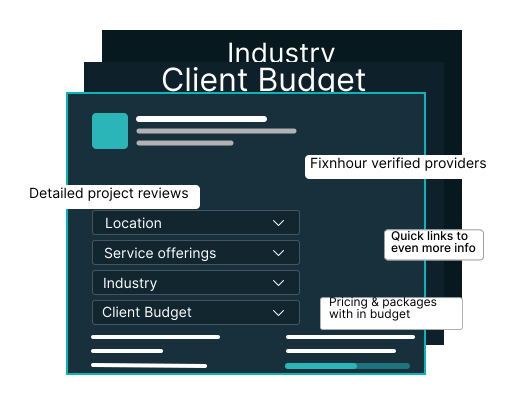
We create a high-integrity ecosystem for business services. When you browse companies on our platform, you are backed by:

icon

Verified Service Providers:

A trusted platform where verified service providers and genuine reviews by clients come together.

icon

Manual Verification Process:

We verify all registered businesses and projects undertaken by them through an official process of manual verification.

icon

Customer Reviews:

Ratings and reviews are based on actual customer experiences and real project results.

icon

Rankings You Can Trust:

Verified reviews, past performance, and industry-specific knowledge all influence our rankings.

Frequently asked questions (FAQs)

Whatever your business challenge, browse our most in-demand service categories to find top-ranked companies in specialized service lines.

Top .NET developers in the USA provide a full range of professional services centered around Microsoft’s .NET framework and ecosystem. These services typically include custom ASP.NET and .NET Core development, where developers build high‑performance web applications and enterprise platforms tailored to business requirements. Experienced .NET developers also offer API integration and development, allowing different software systems—like CRM, ERP, or payment systems—to communicate seamlessly. Many top .NET programmers specialize in cloud‑ready solutions, leveraging Microsoft Azure, AWS .NET support, or hybrid architectures to ensure scalability, resilience, and cost‑efficient infrastructure. This includes deploying .NET apps to cloud environments, implementing serverless functions, and optimizing performance across distributed systems. In addition to core development, leading .NET experts implement maintenance and support services, handling updates, security patches, version upgrades, and troubleshooting to ensure applications remain functional and compliant. They may also deliver UI/UX design within .NET environments, database design and optimization using SQL Server or NoSQL, and migration services—moving legacy systems to modern .NET Core or .NET 7+ environments.

The cost of hiring .NET developers in the USA varies depending on experience level, project complexity, and engagement model. On average, junior .NET developers might charge lower hourly rates, ranging from $30 to $60 per hour, because they are newer to enterprise solutions and often focus on foundational code tasks. Mid‑level .NET developers with several years of professional experience typically cost between $60 and $100 per hour, offering a balanced mix of skills such as ASP.NET, .NET Core, C#, and database work. For senior .NET developers and architects in the USA, hourly rates can range from $100 to $180+ per hour, particularly when the role involves complex system design, security architecture, cloud integration with Azure or AWS, or leading a development team. Fixed‑price project models are also offered, especially for clearly scoped .NET application builds or migrations, with project totals ranging from $10,000 to $150,000+, depending on scope. Hiring full‑time .NET developers adds salary considerations, where annual pay in the USA can range broadly from $80,000 to $150,000+. Other factors like contract length, remote vs. on‑site work, and specialized skills (e.g., microservices, DevOps, Azure, or performance optimization) influence cost. Ultimately, investing in quality .NET developers yields long‑term performance, security, and scalability benefits for software initiatives.

When hiring .NET developers in the USA, prioritize skills that demonstrate both technical depth and practical experience in building scalable, robust applications. Core skills include strong proficiency in C#, the primary programming language for .NET development, as well as experience working with ASP.NET MVC, .NET Core, and the latest .NET versions for modern web applications and APIs. Top .NET developers should also understand RESTful services and API integrations, enabling seamless communication between systems such as mobile apps, third‑party platforms, and enterprise tools. Knowledge of database design and optimization, especially with Microsoft SQL Server and ORM tools like Entity Framework, is essential for data‑driven applications. Cloud skills are increasingly important—look for experience with Microsoft Azure services, including App Services, Azure Functions, Cosmos DB, and containerized deployments using Kubernetes or Docker. Familiarity with DevOps and CI/CD tools like Azure DevOps, GitHub Actions, or Jenkins enhances deployment efficiency and product stability.

Hiring .NET developers in the USA offers several strategic advantages for businesses that prioritize quality, collaboration, and regional market insight. USA‑based .NET developers typically operate within the same time zone or overlapping business hours, enabling real‑time communication, faster feedback loops, and better alignment with project timelines. This proximity reduces delays, enhances accountability, and simplifies coordination across teams. Cultural and language alignment also improves collaboration. .NET developers in the USA often have professional experience working with local clients and enterprise standards, which can translate into clearer requirements understanding, precise documentation, and efficient iterations. Regulatory compliance—such as data privacy and security protocols—is another area where USA developers tend to have proven experience, especially for industries like finance, healthcare, and government. While offshore .NET talent may offer lower rates, USA‑based developers can deliver stronger quality assurance, higher accountability, and reduced managerial overhead. Their familiarity with the latest .NET frameworks, agile methodologies, and enterprise scalability practices often results in products that perform reliably at scale and require less rework. In competitive markets, partnering with top .NET developers in the USA helps businesses ship faster, avoid communication barriers, and maintain robust software solutions that meet client expectations and global standards.

ASP.NET and .NET Core developers both work within the Microsoft .NET ecosystem, but they specialize in different frameworks suited to varying application needs. ASP.NET developers primarily build web applications using the traditional ASP.NET framework, often tied to Windows servers and the full .NET Framework. This approach is common in legacy enterprise applications where compatibility with existing systems is essential. .NET Core developers, on the other hand, focus on the more modern, cross‑platform framework—now unified under .NET 5+ and beyond—which enables applications to run on Windows, Linux, and macOS. .NET Core is optimized for performance, scalability, and cloud‑native architectures, making it a better choice for microservices, containerized deployments, and modern web APIs. While ASP.NET developers may still be in demand for maintaining or upgrading existing systems, .NET Core developers bring flexibility and future‑proofing. They often work with the latest tooling, such as minimal APIs, asynchronous programming models, and improved dependency injection patterns. This makes .NET Core specialists especially valuable for startups, SaaS products, and greenfield projects where performance and cross‑platform support are priorities. Both skill sets have merits, but understanding your project goals helps determine whether you need classic ASP.NET experience or the more dynamic capabilities of .NET Core.

Top .NET developers ensure security and performance through a combination of best practices, tools, and architectural decisions throughout the software lifecycle. For security, they integrate authentication and authorization protocols such as OAuth, JWT tokens, and ASP.NET Identity to protect user access and data integrity. Regular code reviews, static analysis tools, and dependency audits help identify vulnerabilities early. .NET developers also implement secure coding standards, input validation, encryption for data at rest and in transit (e.g., HTTPS/TLS), and adhere to OWASP guidelines to mitigate common threats like SQL injection, cross‑site scripting, and CSRF attacks. Secure session handling and regular security patching further harden applications. To optimize performance, experienced .NET developers use asynchronous programming, caching strategies (MemoryCache, Redis), and database indexing for faster data retrieval. They also monitor performance using tools like Application Insights or New Relic, proactively detecting slow endpoints, memory leaks, or bottlenecks. Efficient use of .NET garbage collection, code profiling, and performance tuning ensures that applications scale smoothly under load.

Yes—top .NET developers in the USA specialize in migrating legacy systems to .NET 7 or later, ensuring modern performance, cross‑platform support, and long‑term maintainability. Migration involves several key steps: first, assessing the existing codebase—whether built on .NET Framework, older ASP.NET versions, or mixed technologies—to identify compatibility challenges and rewrite targets. .NET developers then plan a phased strategy, prioritizing business‑critical modules and dependencies. This includes updating outdated libraries, replacing unsupported APIs, and leveraging modern .NET features such as improved performance, minimal APIs, and built‑in security enhancements. During migration, developers often create automated tests to validate functionality and ensure that new versions behave consistently with the original system. Successful .NET migrations also involve database transformation, adoption of modern build systems, and containerization if needed. Developers may integrate Azure DevOps or CI/CD pipelines to streamline deployment and testing. Skilled .NET professionals help minimize downtime, reduce integration risks, and deliver a scalable migrated solution aligned with current industry standards. Choosing experienced USA‑based .NET developers ensures better communication, rigorous quality checks, and optimized delivery timelines for migration initiatives.

The timeline to build a .NET application varies based on project scope, complexity, and development methodology. For a simple web application using ASP.NET or .NET Core with basic CRUD features, authentication, and minimal third‑party integrations, development might take 6–12 weeks from planning to deployment. This includes requirements gathering, UI design, coding, testing, and deployment. A medium‑complex .NET project—featuring custom integrations (payment gateways, APIs), responsive frontend, database design, and moderate business logic—typically requires 3 to 6 months of development. This time accounts for architectural planning, iterative testing, quality assurance, and revisions based on stakeholder feedback. Enterprise‑grade .NET applications with complex workflows, high security requirements, cloud deployment, microservices, and scalability demands can take 6+ months or more. Agile practices help break these large efforts into manageable sprints, enabling incremental delivery and early validation. The experience level of your .NET developers also affects timelines. Top .NET professionals in the USA efficiently navigate challenges, optimize code quality, and reduce rework, helping projects stay on schedule without sacrificing performance or security.
Join Fixnhour

Create Your Professional Profile

Showcase your services, attract new clients, and grow your business by connecting with companies looking for trusted professionals.

Get Listed & Start Getting Leads


Create profile