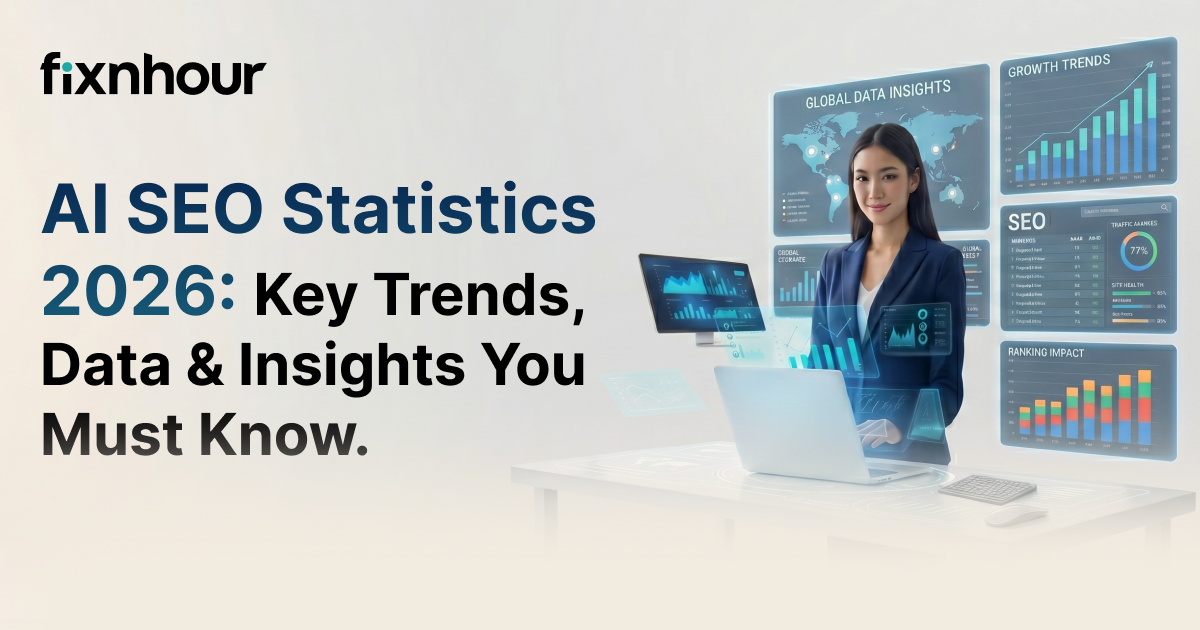
AI SEO in 2026 has become a major force in digital marketing, transforming how websites are optimized, ranked, and discovered online. Search engines are now powered by advanced artificial intelligence systems that prioritize user intent, context, and content quality over traditional keyword matching. This evolution has made SEO more intelligent, predictive, and data-driven. Businesses are increasingly adopting AI tools for keyword research, content creation, technical audits, and performance analysis to gain faster and more accurate results.
AI also helps marketers understand search behavior, user engagement, and ranking patterns in real time, allowing more strategic decision-making. As competition in search results continues to grow, AI SEO is no longer optional but essential for online success. In 2026, brands that effectively combine human creativity with AI-driven insights are achieving higher visibility, stronger rankings, and improved conversions across search engines.
Growth of AI in SEO Industry Statistics
The adoption of AI in SEO has grown significantly in recent years, with most digital marketers now relying on automation tools. AI is widely used for keyword clustering, content planning, competitor analysis, and reporting. This rapid growth is driven by the demand for faster workflows, better accuracy, and improved SEO performance in highly competitive digital markets.
| Metric / Area | 2026 Statistic | Growth Insight |
|---|---|---|
| AI adoption among SEO professionals | 94% of SEO professionals use AI tools | AI has become a standard part of modern SEO workflows |
| AI-driven organic traffic growth | Up to 58% increase in organic traffic | AI improves content optimization and search visibility |
| SEO task automation by AI | 58.4% of SEO tasks are automated | Reduces manual effort and improves efficiency |
| Businesses seeing SEO improvement | 79% report better SEO results | Strong ROI from AI-powered SEO strategies |
| Generative AI usage in marketing | 56% of marketers use AI for SEO | Rapid adoption in keyword research and content planning |
| AI search traffic growth | 527% year-over-year increase | AI is becoming a major source of referral traffic |
| AI-generated content in search results | 26.7% of top search results are AI-generated | AI is influencing SERP content structure |
| Zero-click searches (AI + SERP answers) | ~60% of searches end without clicks | More users get answers directly on search pages |
| AI Overviews in search results | 34% of queries show AI-generated summaries | Search engines increasingly use AI summaries |
| AI SEO tools market growth | Projected to reach $4.5B by 2033 | Strong long-term growth in AI SEO industry tools |
How AI is Changing Search Engines
In 2026, search engines use advanced AI models to understand meaning, context, and user intent instead of just matching keywords. This allows them to deliver more accurate and relevant results. AI also helps filter spam and low-quality content. With generative AI features, users often receive direct answers in search results, reducing the need to click multiple websites.
AI SEO Content Creation Statistics
AI is widely used for content creation, including blogs, product descriptions, and marketing copy. Marketers use AI to produce content faster while improving structure and readability. However, the best results come from combining AI-generated content with human editing. This hybrid approach ensures better engagement, stronger SEO performance, and improved ranking potential across search engines.
|
|
|
|
|
|
|
|
|
|
|
|
|
|
|
|
|
|
|
|
|
|
|
|
|
|
|
|
|
|
|
|
|
|
|
|
|
|
|
|
|
|
|
|
AI in Keyword Research & SERP Analysis
AI simplifies keyword research by organizing large data sets into meaningful topic clusters based on search intent. It also helps identify trending keywords before they become highly competitive. Real-time SERP analysis allows marketers to track ranking changes and adjust strategies quickly. These AI-driven insights make SEO planning more accurate, efficient, and performance-focused.
|
|
|
|
|
|
|
|
|
|
|
|
|
|
|
|
|
|
|
|
|
|
|
|
|
|
|
|
|
|
|
|
|
|
|
|
|
|
|
|
|
|
|
|
AI SEO Tools Usage Trends
AI-powered SEO tools are now essential for modern marketers. They automate tasks like rank tracking, site audits, backlink analysis, and competitor research. This automation saves time and improves accuracy in decision-making. Businesses using AI SEO tools often experience better traffic growth, improved efficiency, and higher return on investment compared to traditional manual SEO methods.
1. Rapid Adoption Across SEO Teams
AI SEO tools are now widely adopted, with most SEO professionals using them daily for keyword research, content creation, and technical audits.
2. Shift Toward Automation-First SEO
Marketers are moving from manual SEO processes to automation-driven workflows, where AI handles repetitive tasks like clustering and reporting.
3. Growing Use in Content Optimization
AI tools are increasingly used to optimize on-page SEO, including meta tags, headings, readability, and keyword placement for better rankings.
4. Increased Reliance on SERP Analysis Tools
SEO experts use AI-powered SERP analyzers to understand competitors, ranking patterns, and search intent more accurately and quickly.
5. Integration with Marketing Platforms
AI SEO tools are now integrated into CMS platforms, analytics tools, and marketing dashboards for seamless workflow management.
6. Focus on Predictive SEO Insights
Modern AI tools are shifting toward predictive analytics, helping businesses forecast keyword trends and optimize content before competition increases.
AI and Voice Search Optimization Statistics
Voice search is expanding rapidly as AI assistants become more advanced and widely used. Users now prefer conversational, question-based queries instead of short keywords. This shift requires content to be natural, structured, and easy to understand. AI helps optimize websites for voice search by analyzing language patterns and improving content relevance for spoken search queries.
|
|
|
|
|
|
|
|
|
|
|
|
|
|
|
|
|
|
|
|
|
|
|
|
|
|
|
|
|
|
|
|
|
|
|
|
|
|
|
|
|
|
|
|
AI Impact on Link Building & Technical SEO
AI improves link building by identifying high-quality backlink opportunities and detecting harmful links. It also automates technical SEO tasks such as fixing broken links, improving site speed, and analyzing site structure. These capabilities reduce manual effort while improving overall website health. As a result, businesses achieve stronger technical SEO performance and better search engine rankings.
1. Smarter Backlink Analysis
AI tools can quickly analyze backlink quality, domain authority, and spam signals, helping SEOs focus only on high-value link opportunities.
2. Automated Link Prospecting
AI speeds up finding relevant websites for outreach by scanning niche-relevant domains and suggesting strong link-building targets.
3. Improved Content Gap Detection
AI identifies missing topics and link opportunities by analyzing competitor content and backlink profiles more efficiently than manual methods.
4. Faster Technical SEO Audits
AI-powered crawlers detect site issues like broken links, duplicate content, and indexing errors in real time, improving site health quickly.
5. Predictive Link Value Scoring
Modern AI tools estimate the future SEO value of backlinks, helping prioritize outreach efforts that will bring the highest ranking impact.
6. Automation in Outreach Campaigns
AI assists in personalized email outreach, follow-ups, and response tracking, making link-building campaigns faster and more scalable.
User Behavior & AI Search Personalization
AI personalizes search results based on user behavior, location, and past activity. This ensures more relevant and targeted results for each individual. It also improves engagement by predicting user intent more accurately. Websites optimized for personalized search experiences benefit from higher click-through rates, better engagement, and increased conversions in competitive digital environments.
1. Personalized Search Results Based on User Intent
AI analyzes user history, preferences, and search patterns to deliver highly personalized results, ensuring each user sees content that matches their intent more accurately.
2. Behavioral Tracking for Better Recommendations
Search engines use AI to track clicks, dwell time, and engagement signals, helping refine future results and improve content recommendations.
3. Context-Aware Search Experiences
AI understands context like location, device, and time of search, allowing it to adjust results dynamically for more relevant and real-time answers.
4. Predictive Search Suggestions
AI predicts what users are likely to search next by analyzing behavior patterns, offering faster autocomplete suggestions and proactive answers.
Future of AI SEO (2026 and Beyond)
The future of AI SEO is highly automated, predictive, and intent-focused. Search engines will rely more on AI-generated answers and zero-click search results. Marketers must adapt by focusing on conversational content, user intent, and data-driven strategies. Those who embrace AI early will gain a strong competitive advantage in search visibility, traffic growth, and digital marketing success.
1. Fully AI-Driven Search Ecosystems
Search engines will increasingly rely on AI models to generate answers directly, reducing dependency on traditional blue-link results and changing how websites gain visibility.
2. Shift from Keywords to Intent Optimization
SEO will move beyond keywords toward deep intent understanding, where AI evaluates meaning, context, and user satisfaction instead of exact keyword matches.
3. Rise of Autonomous SEO Systems
AI will automate end-to-end SEO tasks like keyword research, content creation, optimization, and performance tracking with minimal human intervention.
4. Greater Importance of Authority and Trust Signals
AI algorithms will prioritize E-E-A-T signals (experience, expertise, authority, trust), making brand credibility more important than ever for rankings.
5. Integration of Multimodal Search (Text, Voice, Image, Video)
Future SEO will optimize for multiple search formats, as AI enables users to search through voice commands, images, and videos seamlessly.
Final words
AI is completely reshaping the future of SEO by making search engines more intelligent, predictive, and user-focused. From keyword research to content creation, link building, and technical SEO, AI is automating complex processes and improving accuracy at every stage. Search is shifting from keyword-based ranking to intent-driven and conversational experiences, where relevance and user satisfaction matter most. Businesses that adopt AI SEO strategies early will gain stronger visibility, better engagement, and higher ROI in competitive markets.
For more details on advanced AI SEO strategies and growth opportunities, contact us today to boost your online presence with powerful AI-driven optimization techniques.
Frequently Asked Questions
Q1: What are AI SEO statistics in 2026?
AI SEO statistics in 2026 refer to data and insights showing how artificial intelligence is transforming search engine optimization. These include trends in AI content creation, keyword research automation, SERP analysis, and ranking improvements. Businesses use these statistics to understand how AI impacts search visibility, user behavior, and overall digital marketing performance in modern SEO strategies.
Q2: How is AI changing SEO in 2026?
AI is changing SEO by making it more intelligent, predictive, and user-focused. Search engines now use AI to understand search intent instead of just keywords. This improves ranking accuracy and personalization. AI also automates tasks like content optimization, keyword clustering, and technical SEO, helping marketers achieve better results with less manual effort and faster execution.
Q3: What percentage of marketers use AI for SEO?
In 2026, a large majority of digital marketers—estimated at over 80%—use AI tools for SEO tasks. These tools help with keyword research, content creation, competitor analysis, and performance tracking. The growing adoption of AI SEO tools shows how essential automation has become for improving rankings, increasing organic traffic, and staying competitive in search engine results.
Q4: What are the benefits of AI SEO tools?
AI SEO tools provide faster keyword research, better content optimization, real-time SERP tracking, and automated technical audits. They save time and improve accuracy by analyzing large data sets instantly. These tools also help identify ranking opportunities and optimize content based on user intent, leading to improved visibility, higher engagement, and stronger ROI in digital marketing campaigns.
Q5: How does AI improve keyword research in SEO?
AI improves keyword research by grouping related search terms into intent-based clusters. It also identifies trending keywords before they become highly competitive. This helps marketers build stronger content strategies and improve topical authority. AI-powered keyword tools make SEO planning more accurate, data-driven, and aligned with real user search behavior and market demand.
Q6: Is AI-generated content good for SEO ranking?
AI-generated content can rank well when properly optimized and edited by humans. Search engines prioritize high-quality, relevant, and helpful content rather than how it is created. The best results come from combining AI-generated drafts with human creativity, ensuring better readability, originality, and engagement, which ultimately improves SEO performance and ranking potential.
Q7: What is the future of AI SEO?
The future of AI SEO is focused on automation, personalization, and predictive search. AI will continue to improve search accuracy, voice search optimization, and zero-click results. Marketers will need to focus more on user intent and conversational content. Businesses that adopt AI early will gain stronger visibility, higher rankings, and long-term digital growth.