Artificial intelligence is helping enterprises automate business operations, analyze large datasets, and deliver smarter customer experiences. However, implementing AI successfully requires more than advanced models; businesses also need reliable infrastructure to support computing, data storage, networking, security, and application deployment. The best AI infrastructure platforms for enterprises in the USA help organizations build, train, and deploy AI solutions efficiently while supporting business growth and changing technology requirements.
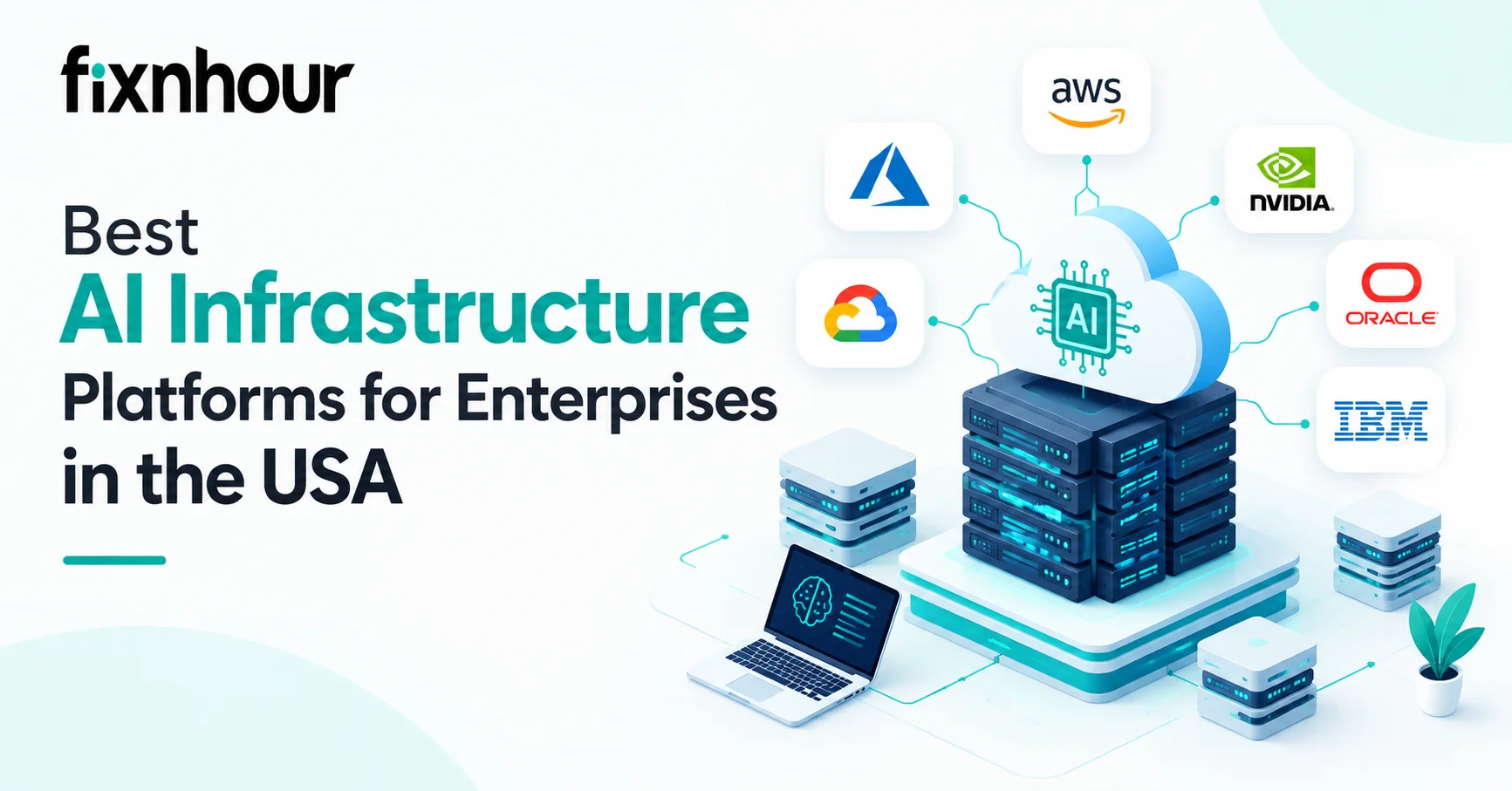
Choosing the right enterprise AI infrastructure platform depends on factors such as performance, scalability, security, integration, and budget. Leading providers, including AWS, Microsoft Azure, Google Cloud, NVIDIA, Oracle Cloud Infrastructure, and IBM, offer different capabilities for machine learning, generative AI, and large language models. By comparing their features, pricing, deployment options, and data governance capabilities, businesses can identify a platform that meets their needs and supports long-term AI adoption.
Quick Answer
The best AI infrastructure platforms for enterprises in the USA include AWS, Microsoft Azure, Google Cloud, NVIDIA, Oracle Cloud Infrastructure, and IBM. Fixnhour helps businesses discover and compare technology providers based on their capabilities, services, and expertise. The right choice depends on computing requirements, AI workloads, security, integration, scalability, and budget. Enterprises should compare infrastructure capabilities and test representative workloads before committing to a provider.
Key Takeaways
- AWS, Microsoft Azure, Google Cloud, NVIDIA, Oracle Cloud Infrastructure, and IBM offer different AI infrastructure capabilities.
- GPU performance, networking, storage, and model compatibility influence infrastructure efficiency.
- Cloud, on-premises, and hybrid deployments serve different business requirements.
- Security, governance, and regulatory compliance must be evaluated before deployment.
- Total cost includes computing, storage, networking, licensing, and operational expenses.
- Workload testing helps enterprises compare platforms objectively.
- AI infrastructure should support long-term scalability and measurable business outcomes.
Statistics and Market Insights Shaping Enterprise AI Infrastructure
Enterprise AI investment is increasing interest in computing capacity, data center efficiency, and reliable model deployment. Market research can help organizations understand adoption patterns, infrastructure demand, and emerging technologies. Businesses exploring AI Integration Service Providers in USA should distinguish between announced investment, planned capacity, and actual spending. Use recent reports from reputable research organizations and clearly identify publication dates when including statistics in an enterprise AI infrastructure article.
GPUs, Accelerators, and Infrastructure Demand
GPUs and specialized AI accelerators help enterprises process complex workloads efficiently. Infrastructure performance also depends on memory, networking, and data access. Evaluating real-world benchmarks helps businesses select suitable computing resources for AI training, inference, and large-scale deployment.
- GPU performance and memory capacity
- High-speed networking and data transfer
- AI training and inference efficiency
- Workload-specific performance benchmarks
What Market Trends Mean for US Businesses
Growing generative AI adoption is driving investment in scalable cloud infrastructure, private AI environments, and optimized inference systems. US enterprises are prioritizing efficient computing, data security, and governance to support reliable AI deployment and long-term business growth.
- Increasing demand for AI-ready infrastructure
- Growing adoption of private and hybrid AI
- Greater focus on energy efficiency
- Stronger emphasis on data governance and security
What Is Enterprise AI Infrastructure?
Enterprise AI infrastructure combines computing power, data storage, networking, software frameworks, and deployment tools to help businesses develop and run AI applications. It supports machine learning, generative AI, large language models (LLMs), predictive analytics, and AI agents. Artificial Intelligence Companies in USA help enterprises implement AI solutions that align with their business goals. Reliable infrastructure enables organizations to process large datasets, deploy AI models efficiently, strengthen security, optimize resources, and scale operations as business requirements grow over time.
Core Components of AI Infrastructure
AI infrastructure typically includes GPUs, CPUs, accelerators, high-speed networking, storage systems, and orchestration software. These components work together to train models, process data, and deliver predictions. Enterprises also need monitoring, identity management, and model-serving tools to maintain reliability. The configuration should reflect workload complexity, expected traffic, performance targets, and the sensitivity of business information.
Why Enterprises Need Scalable AI Infrastructure
Scalable infrastructure allows organizations to increase or reduce computing resources according to business demand. It supports growing datasets, new AI applications, and changing inference workloads without requiring unnecessary investment in permanent capacity. Businesses can also improve operational efficiency by automating deployments, monitoring utilization, and selecting suitable computing resources for each application.
Best AI Infrastructure Platforms for Enterprises in the USA
Enterprise AI infrastructure providers differ in their computing options, managed services, integrations, and deployment models. AWS, Azure, and Google Cloud provide broad cloud ecosystems, while NVIDIA supplies accelerated computing technologies and software. Oracle Cloud Infrastructure and IBM offer additional options for specialized workloads and enterprise environments. Businesses researching Top Enterprise AI Companies should compare these providers against real business requirements, including performance, security, scalability, integration, and cost, rather than relying on a universal ranking.
Amazon Web Services (AWS)
Amazon Web Services (AWS) provides scalable AI infrastructure for enterprises through GPU computing, Amazon Bedrock, and Amazon SageMaker. Businesses can develop generative AI applications, train machine learning models, and deploy AI workloads while managing computing resources according to changing operational requirements.
- Scalable GPU computing and cloud resources
- Amazon Bedrock for generative AI applications
- Amazon SageMaker for machine learning workflows
- Flexible deployment and infrastructure management
Microsoft Azure and Google Cloud
Microsoft Azure and Google Cloud offer comprehensive AI infrastructure for enterprise applications. Azure integrates AI services with Microsoft's business ecosystem, while Google Cloud provides Vertex AI, GPU computing, and TPU options. Enterprises can compare both platforms based on workload performance, integrations, and security.
- Azure AI services and Azure Machine Learning
- Integration with Microsoft enterprise applications
- Google Cloud Vertex AI and machine learning tools
- GPU and TPU computing options
NVIDIA, Oracle Cloud Infrastructure, and IBM
NVIDIA, Oracle Cloud Infrastructure, and IBM support enterprise AI through accelerated computing, scalable infrastructure, and AI software. NVIDIA focuses on GPU technologies, Oracle provides high-performance cloud computing, and IBM supports enterprise AI and hybrid cloud environments for diverse business requirements.
- NVIDIA GPUs and AI Enterprise software
- Oracle Cloud GPU computing and high-performance infrastructure
- IBM watsonx and hybrid cloud capabilities
- Flexible options for AI training and inference
Benefits of Enterprise AI Infrastructure
Enterprise AI infrastructure helps businesses accelerate AI development, automate workflows, improve data processing, and deliver better customer experiences. By integrating AI tools for business with scalable computing, reliable storage, and advanced deployment tools, organizations can manage complex workloads and respond to changing demands. However, achieving these benefits requires careful planning, effective security controls, skilled professionals, and cost management. A well-designed infrastructure enables enterprises to improve operational efficiency, support innovation, and achieve measurable business outcomes.
Key Benefits
- Scalability to support growing AI workloads and business demands.
- Faster AI model training, testing, and deployment.
- Improved operational efficiency through intelligent automation.
- Cost optimization through effective resource utilization.
- Enhanced data security, privacy, and governance.
- Better decision-making through AI-powered insights and analytics.
How to Choose the Right Enterprise AI Infrastructure Platform: Step-by-Step Process
Choosing the right enterprise AI infrastructure platform starts with understanding business goals, workload requirements, security needs, and budget limitations. When evaluating AI Infrastructure Platforms for Enterprises in India, businesses should compare providers based on computing performance, scalability, integration capabilities, and pricing. Evaluating cloud, hybrid, and on-premises solutions through practical testing helps enterprises identify suitable infrastructure, minimize risks, optimize costs, and support long-term AI growth.
|
Step |
Action |
Key Activities |
Purpose |
|---|---|---|---|
|
Step 1 |
Define AI Workloads |
Identify training and inference requirements; assess generative AI and RAG workloads; define AI agent and analytics needs; establish performance and scalability goals. |
Determine the required computing power, storage, and software capabilities. |
|
Step 2 |
Assess Data and Security |
Classify sensitive enterprise data; establish access controls and encryption; review compliance requirements; define governance and data residency policies. |
Protect business information and meet security, privacy, and compliance requirements. |
|
Step 3 |
Compare AI Infrastructure Providers |
Compare AWS, Microsoft Azure, Google Cloud, NVIDIA, Oracle Cloud Infrastructure, and IBM; evaluate GPU availability, model compatibility, integrations, pricing, and support. |
Select providers that align with enterprise requirements and budgets. |
|
Step 4 |
Run a Proof of Concept |
Test model training and inference; measure latency and throughput; evaluate security and integrations; compare costs across shortlisted platforms. |
Validate performance, reliability, security, and costs before committing. |
|
Step 5 |
Deploy and Optimize |
Begin with a controlled pilot; monitor performance and resource utilization; optimize computing capacity and costs; review security and scalability regularly. |
Improve operational efficiency and adapt infrastructure as business needs evolve. |
Step 1: Define AI Workloads
Identify the AI applications your business plans to develop and deploy. Understanding workload requirements helps determine the necessary computing power, storage, and software capabilities. This ensures the selected infrastructure aligns with business goals and expected performance.
- Identify training and inference requirements.
- Assess generative AI and RAG workloads.
- Define AI agent and analytics needs.
- Establish performance and scalability goals.
Step 2: Assess Data and Security
Evaluate your organization's data sensitivity, privacy requirements, and security policies before selecting an AI infrastructure platform. Consider applicable compliance obligations and data residency requirements to ensure the chosen environment protects business information and supports responsible AI operations.
- Classify sensitive enterprise data.
- Establish access controls and encryption.
- Review applicable compliance requirements.
- Define governance and data residency policies.
Step 3: Compare AI Infrastructure Providers
Compare leading providers such as AWS, Microsoft Azure, Google Cloud, NVIDIA, Oracle Cloud Infrastructure, and IBM. Evaluate their technical capabilities, integration options, service availability, and pricing to identify platforms that best match your enterprise requirements.
- Compare GPU availability and computing performance.
- Evaluate AI frameworks and model compatibility.
- Review integrations with existing business systems.
- Assess pricing, support, and portability.
Step 4: Run a Proof of Concept
Test shortlisted platforms using representative business workloads before making a long-term commitment. A proof of concept helps validate performance, reliability, security, and operating costs under realistic conditions, reducing the risk of selecting unsuitable infrastructure.
- Test model training and inference performance.
- Measure latency and processing throughput.
- Evaluate security and integration capabilities.
- Compare costs across shortlisted platforms.
Step 5: Deploy and Optimize
Deploy the selected AI infrastructure in phases to minimize disruption and identify potential issues early. Continuously monitor system performance, resource utilization, security, and expenses to maintain efficiency and adjust infrastructure capacity as business requirements evolve.
- Begin with a controlled pilot deployment.
- Monitor performance and resource utilization.
- Optimize computing capacity and operating costs.
- Review security and scalability regularly.
Conclusion
The best AI infrastructure platforms for enterprises in the USA depend on business goals, workload requirements, security needs, and budget. Leading providers such as AWS, Microsoft Azure, Google Cloud, NVIDIA, Oracle Cloud Infrastructure, and IBM offer different capabilities for machine learning, generative AI, and large language models. Comparing their computing performance, scalability, integration options, and pricing helps businesses identify the most suitable solution for their operations.
Before selecting a platform, enterprises should evaluate data security, infrastructure costs, deployment flexibility, and long-term support. Testing shortlisted providers with real-world workloads can help organizations understand performance and avoid unnecessary expenses. By focusing on scalability, efficient resource utilization, and reliable governance, businesses can build a strong AI infrastructure foundation that supports innovation, improves productivity, and prepares them for future AI advancements. Talk to Our Experts
Frequently Asked Questions
Q1. What are the best AI infrastructure platforms for enterprises in the USA?
Ans. Leading AI infrastructure platforms for enterprises in the USA include AWS, Microsoft Azure, Google Cloud, NVIDIA, Oracle Cloud Infrastructure, and IBM. Each offers different capabilities for machine learning, generative AI, and large language models. Businesses should compare computing performance, scalability, security, integrations, support, and pricing to identify a platform that aligns with their technical requirements, operational goals, and long-term AI strategy.
Q2. Which cloud platform is best for enterprise AI and machine learning?
Ans. AWS, Microsoft Azure, and Google Cloud are leading options for enterprise AI and machine learning. They provide computing resources, managed AI services, data processing tools, and deployment capabilities. The right choice depends on existing technology, workload complexity, security requirements, and budget. Enterprises should evaluate regional availability, framework compatibility, integration options, performance benchmarks, and total ownership costs before selecting a cloud infrastructure provider.
Q3. How much does enterprise AI infrastructure cost?
Ans. Enterprise AI infrastructure costs vary according to computing resources, GPU usage, storage, networking, software licenses, technical support, and staffing. Cloud deployments may use pay-as-you-go pricing, while on-premises systems require hardware purchases and ongoing maintenance. Businesses should estimate training and inference workloads, expected usage, and scaling requirements. Comparing total cost of ownership across providers helps enterprises build realistic budgets and avoid unexpected infrastructure expenses.
Q4. Is cloud AI infrastructure better than on-premises infrastructure?
Ans. Cloud AI infrastructure offers flexible capacity, managed services, and faster deployment without significant upfront hardware investment. On-premises infrastructure provides greater direct control over hardware, data, and configurations but requires maintenance and technical expertise. Hybrid infrastructure combines cloud flexibility with dedicated local resources. The best approach depends on workload demands, compliance obligations, data sensitivity, performance expectations, and budget. Enterprises should compare operational costs and management requirements before deciding.
Q5. Which AI infrastructure platforms support large language models?
Ans. Several enterprise AI infrastructure platforms support large language model training, fine-tuning, and inference. AWS, Microsoft Azure, Google Cloud, and NVIDIA-based environments provide computing capabilities for different LLM workloads. The right platform depends on model size, accelerator memory, framework compatibility, storage, networking, and deployment requirements. Enterprises should benchmark representative models, evaluate inference latency, and assess scalability before choosing infrastructure for generative AI applications.
Q6. How can enterprises secure AI infrastructure and sensitive data?
Ans. Enterprises can secure AI infrastructure through encryption, identity management, least-privilege access, network segmentation, continuous monitoring, and documented governance policies. Sensitive datasets should be classified, and access should be restricted according to business needs. Organizations must also assess relevant compliance requirements, data residency, model security, and third-party integrations. Regular security reviews, vulnerability testing, and incident response planning help reduce risks throughout the AI development and deployment lifecycle.
Q7. What is the difference between AI infrastructure and an AI platform?
Ans. AI infrastructure provides the computing power, storage, networking, and accelerators required to run artificial intelligence workloads. An AI platform builds on these resources by offering tools for model development, training, experimentation, deployment, monitoring, and lifecycle management. Infrastructure focuses on the technical foundation, while platforms simplify AI workflows. Enterprises may use managed AI platforms to reduce operational complexity or combine specialized tools with their existing infrastructure.
Q8. How should a US enterprise choose an AI infrastructure provider in 2026?
Ans. US enterprises should begin by defining their AI workloads, performance targets, security requirements, and budget. They should compare providers based on computing availability, regional coverage, integration capabilities, compliance support, and total ownership costs. Running a proof of concept helps validate performance under realistic conditions. Before signing a long-term agreement, businesses should also review technical support, data portability, vendor dependence, scalability, and future infrastructure requirements.