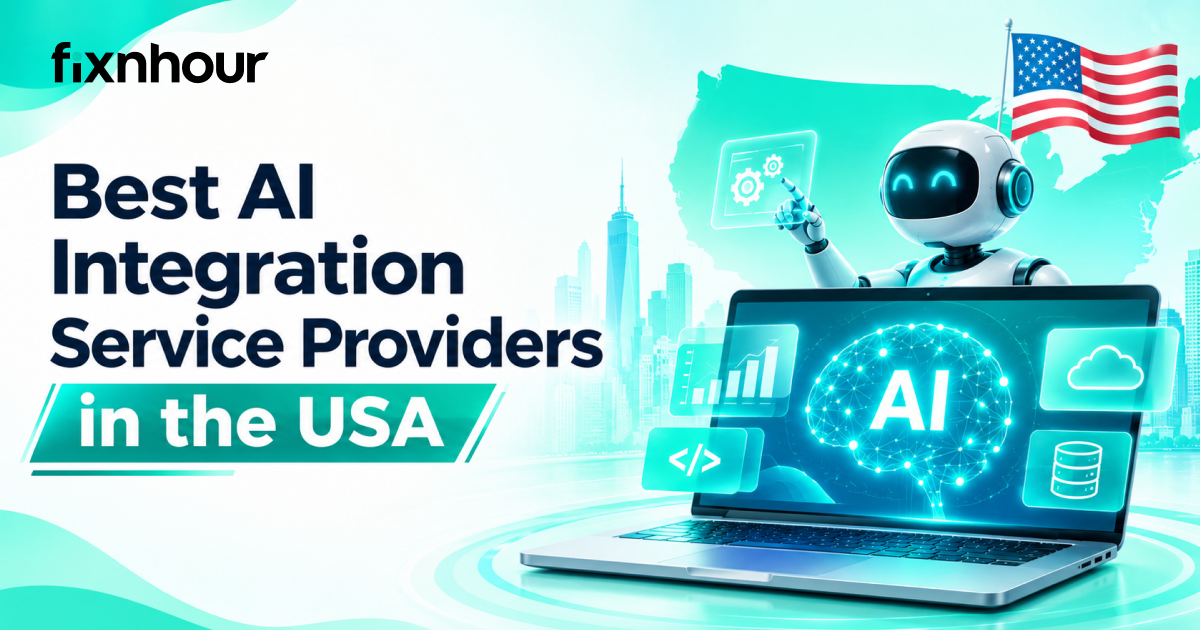
Artificial intelligence has moved beyond experimentation. Businesses now use AI to automate workflows, improve customer service, forecast demand, analyze documents, strengthen fraud detection, and make faster decisions. However, successfully connecting AI with existing software, data, cloud infrastructure, and business processes requires specialized expertise.
The best AI integration service providers in the USA help organizations evaluate opportunities, prepare data, select suitable models, integrate AI into enterprise systems, and monitor performance after deployment. This guide compares leading providers and explains services, benefits, costs, challenges, and the steps required for successful implementation.
Quick Answer
Leading AI integration service providers in the USA include Accenture, IBM Consulting, Deloitte, Capgemini, Cognizant, EPAM Systems, Thoughtworks, Slalom, LeewayHertz, and Markovate. Businesses can also explore and compare trusted providers on Fixnhour. The right partner depends on your industry, use case, infrastructure, data readiness, security requirements, budget, project complexity, and long-term scalability goal
Key Takeaways
- AI integration connects intelligent models with existing applications, data, APIs, and workflows.
- Providers offer AI strategy, data engineering, model development, cloud integration, MLOps, and governance.
- Generative AI, AI agents, predictive analytics, computer vision, and NLP are common integration areas.
- Reliable data is more important than choosing the most advanced AI model.
- A focused proof of concept can validate feasibility before a full enterprise rollout.
- US AI integration projects can cost from $15,000 for discovery to over $500,000 for complex platforms.
- Security, compliance, explainability, and human oversight must be included from the beginning.
- Continuous monitoring is necessary to maintain accuracy, relevance, performance, and ROI.
What Are AI Integration Services?
AI integration services help businesses connect artificial intelligence with existing software, data, and everyday workflows. Leading Generative AI Companies in the USA can integrate intelligent automation, forecasting, recommendation engines, and virtual assistants into CRM platforms, ERP systems, websites, mobile apps, and cloud tools, helping organizations improve efficiency and make faster, data-driven decisions.
Common AI Integration Services
- AI strategy and readiness assessment
- Data collection, cleaning, and engineering
- Machine learning model development
- Generative AI and LLM integration
- Retrieval-augmented generation, or RAG
- AI agents and workflow automation
- CRM, ERP, and legacy system integration
- API development and orchestration
- Cloud AI deployment
AI Integration vs. AI Development
AI development involves building new models, algorithms, or AI-powered products, while AI integration connects those solutions with existing software, databases, and workflows. Development creates intelligent capabilities; integration ensures they work smoothly within business operations and deliver measurable, practical value
10 Best AI Integration Service Providers in the USA
The following AI Consulting Companies in the USA were selected based on their publicly available services, enterprise experience, engineering expertise, cloud capabilities, governance support, and ability to deliver production-ready AI solutions. This list is designed to help businesses explore suitable providers and should not be considered an absolute ranking.
| Rank | Company | Core Expertise | AI Capabilities | Best Suited For |
|---|---|---|---|---|
| 1 | Cleveroad | Custom software, web & mobile development | AI-powered software solutions | Startups & enterprises |
| 2 | Saritasa | Software, mobile, web & IoT development | AI & intelligent solutions | Complex digital products |
| 3 | Infinum | Digital products, UX/UI & engineering | Emerging technology solutions | Product modernization |
| 4 | TLVTech | Software engineering, cloud & data | AI & data solutions | Startups & growing businesses |
| 5 | Langate Software | Enterprise, healthcare & custom software | Business-focused digital solutions | Healthcare & enterprises |
| 6 | EPAM Systems | Product engineering & data platforms | Generative AI & AI-native engineering | Large enterprises |
| 7 | Brights | Web, mobile, SaaS & product design | AI-powered product development | Startups & SaaS businesses |
| 8 | Tapptitude | Mobile apps, web & product strategy | Emerging technology solutions | Digital product companies |
| 9 | Sigma Software Group | Software, cloud, data & consulting | AI & machine learning | Multi-industry enterprises |
| 10 | OSMOS | Digital product design & engineering | Technology-driven solutions | Custom digital products |
1. Cleveroad
Cleveroad is a software development company delivering custom digital products, AI-powered solutions, web platforms, and mobile applications. Its development approach combines product discovery, UI/UX design, engineering, and emerging technologies to help startups and enterprises build scalable, secure, and user-focused software tailored to specific business requirements.
Key Strengths:
- AI-powered software development
- Custom web and mobile applications
- Product design and development
- Scalable software architecture
2. Saritasa
Saritasa is a full-service technology company providing custom software development, AI solutions, mobile applications, web platforms, IoT systems, and immersive technologies. Its multidisciplinary engineering teams help businesses transform complex requirements into practical digital products while focusing on usability, scalability, system integration, and long-term technology performance.
Key Strengths:
- Custom software development
- AI and intelligent solutions
- Mobile and web development
- IoT and system integration
3. Infinum
Infinum is a digital product development company specializing in product strategy, UX/UI design, mobile applications, web platforms, and emerging technologies. Its teams work with startups and established businesses to design and engineer reliable digital products, modernize existing systems, and create user-centered experiences supported by scalable technology.
Key Strengths:
- Digital product development
- UX/UI design
- Mobile and web engineering
- Product strategy and modernization
4. TLVTech
TLVTech provides custom software engineering and technology consulting services for startups and growing businesses. Its expertise spans web and mobile development, cloud infrastructure, data engineering, artificial intelligence, and scalable product development, helping organizations strengthen their technical capabilities and turn complex product ideas into reliable digital solutions.
Key Strengths:
- Custom software engineering
- AI and data solutions
- Cloud infrastructure
- Scalable product development
5. Langate Software
Langate Software develops custom software solutions designed around specific business processes and operational requirements. Its capabilities include web and mobile application development, healthcare technology, enterprise software, cloud solutions, and system modernization, helping organizations improve efficiency, streamline workflows, and build secure digital products that support long-term growth.
Key Strengths:
- Custom software development
- Healthcare technology solutions
- Web and mobile applications
- Cloud and system modernization
6. EPAM Systems
EPAM Systems applies an engineering-led approach to AI strategy, data platforms, generative AI, cybersecurity, and product modernization. It helps organizations transform early concepts into secure, production-ready solutions supported by governance, change management, performance measurement, and continuous operational improvement at enterprise scale.
Key Strengths:
- AI-powered product engineering
- Data platform modernization
- Generative AI development
- AI-native software engineering
7. Brights
Brights is a software development company that builds custom web applications, mobile products, SaaS platforms, and AI-powered digital solutions. Its team combines product strategy, UI/UX design, engineering, and technology consulting to help businesses create functional, scalable, and user-friendly products aligned with their operational and growth objectives.
Key Strengths:
- AI-powered product development
- Web application development
- Mobile app development
- UI/UX and product design
8. Tapptitude
Tapptitude is a digital product studio specializing in mobile applications, web platforms, product strategy, UX/UI design, and emerging technology solutions. It works with startups and established businesses to validate ideas, develop scalable products, improve existing applications, and create engaging digital experiences focused on user needs and business outcomes.
Key Strengths:
- Mobile app development
- Digital product strategy
- UX/UI design
- Product scaling and optimization
9. Sigma Software Group
Sigma Software Group provides software engineering, technology consulting, AI development, cloud solutions, data services, and product development for businesses across multiple industries. Its broad technical expertise enables organizations to develop complex digital products, modernize technology environments, automate workflows, and implement scalable solutions aligned with evolving business requirements.
Key Strengths:
- AI and machine learning solutions
- Custom software engineering
- Cloud and data services
- Digital product development
10. OSMOS
OSMOS focuses on building modern digital products through strategy, design, software engineering, and technology-driven development. Its approach supports businesses seeking customized web and mobile experiences, scalable platforms, and innovative digital solutions while emphasizing usability, efficient development, and alignment between technical implementation and broader business objectives.
Key Strengths:
- Custom digital product development
- Web and mobile solutions
- Product strategy and design
- Scalable software engineering
AI Integration Services Offered by US Providers
Leading AI integration providers in the USA support businesses throughout the entire implementation lifecycle. Similar to leading AI Integration Service Providers in India, they offer strategy, development, data preparation, model selection, system integration, testing, deployment, security, governance, monitoring, and optimization. This end-to-end support helps organizations launch reliable, scalable, and business-focused AI solutions with fewer technical and operational risks.
AI Strategy and Readiness Assessment
Consultants evaluate business processes, data quality, infrastructure, available skills, security concerns, and potential use cases. The resulting roadmap should prioritize projects based on feasibility, value, risk, and implementation effort.
Generative AI and LLM Integration
Businesses can introduce enterprise chatbots, employee copilots, document summarization, knowledge assistants, content tools, and conversational search. RAG solutions connect language models to approved company information, helping improve relevance and reduce unsupported responses.
Machine Learning and Predictive Analytics
Predictive models can support demand forecasting, customer segmentation, fraud detection, churn prediction, preventive maintenance, risk scoring, and product recommendations.
Enterprise and Cloud Integration
Providers connect AI with systems such as Salesforce, SAP, Microsoft Dynamics, ServiceNow, data warehouses, collaboration tools, and custom applications. Deployment may use AWS, Microsoft Azure, Google Cloud, private cloud, or a hybrid environment.
AI Governance and MLOps
Governance defines accountability, acceptable use, access rules, testing standards, and human review. MLOps supports version control, automated deployment, accuracy monitoring, drift detection, retraining, incident response, and model retirement.
Benefits of Hiring an AI Integration Company
Hiring an experienced AI integration company gives businesses access to strategy, data engineering, model development, cloud architecture, cybersecurity, and change-management expertise. These specialists also understand emerging AI in Finance Trends, helping organizations connect AI with existing systems, reduce implementation risks, and improve efficiency. Professional support accelerates deployment, strengthens governance, enhances user adoption, and generates measurable long-term value from AI investments.
Key Benefits:
- Faster implementation through proven delivery frameworks
- Better integration with existing systems and workflows
- Reduced technical, security, and compliance risks
- Improved operational efficiency and decision-making
- More personalized customer experiences
- Scalable architecture for future AI use cases
- Continuous model monitoring and optimization
- Knowledge transfer for internal teams
Conclusion
The best AI integration service providers in the USA combine strategy, data engineering, software development, cloud infrastructure, security, governance, and organizational adoption. Accenture, IBM Consulting, Deloitte, Capgemini, and Cognizant are strong candidates for large enterprise programs, while EPAM Systems, Thoughtworks, and Slalom offer powerful engineering and transformation capabilities. LeewayHertz and Markovate may suit more focused custom-development requirements.
Before selecting a provider, define a measurable business problem, evaluate your data readiness, compare relevant case studies, and confirm security and ownership terms. Start with a controlled proof of concept, validate its value, and scale only after accuracy, adoption, risk, and ROI meet agreed targets. Connect with our experts
Frequently Asked Questions
Q1. Which are the best AI integration service providers in the USA?
Ans. Leading providers include Accenture, IBM Consulting, Deloitte, Capgemini, Cognizant, EPAM Systems, Thoughtworks, Slalom, LeewayHertz, and Markovate. The best choice depends on your industry, existing systems, required AI capabilities, data maturity, budget, compliance needs, and preferred engagement model.
Q2. How much does it cost to hire an AI integration company in the USA?
Ans. A readiness assessment may cost 15,000–40,000, while a proof of concept may range from 25,000–75,000. Production generative AI or predictive systems can cost 40,000–200,000. Complex enterprise platforms involving multiple integrations, strict compliance, and custom models may exceed $500,000.
Q3. What services do AI integration companies provide?
Ans. AI integration companies provide strategy, readiness assessments, data engineering, machine learning, generative AI, RAG, AI agents, API development, cloud deployment, enterprise software integration, MLOps, governance, cybersecurity, testing, employee training, and continuous support.
Q4. How do I choose an AI integration partner for my business?
Ans. Define your use case and compare providers based on relevant experience, technical capabilities, data expertise, cloud partnerships, security practices, case studies, communication, pricing, intellectual-property terms, and post-launch support. Request a discovery workshop or small proof of concept before committing to a large implementation.
Q5. How long does an enterprise AI integration project take?
Ans. A readiness assessment may take two to six weeks, while a proof of concept commonly requires six to twelve weeks. A production implementation can take three to nine months. Large platforms involving legacy modernization, multiple departments, extensive data preparation, or regulatory controls may require twelve months or longer.
Q6. Can AI companies integrate AI with legacy business systems?
Ans. Yes. Providers may use APIs, middleware, event streams, robotic process automation, custom connectors, or staged modernization to connect AI with legacy systems. An assessment is required because outdated architecture, limited documentation, poor data access, and security restrictions can increase cost and implementation time.
Q7. Which industries benefit most from AI integration services?
Ans. Healthcare, financial services, insurance, retail, manufacturing, logistics, telecommunications, professional services, and SaaS businesses commonly benefit from AI integration. Valuable applications include intelligent customer support, forecasting, fraud detection, document processing, recommendations, predictive maintenance, workflow automation, and decision support.
Q8. How can businesses measure AI integration ROI?
Ans. Businesses should establish baseline performance before implementation and monitor metrics such as time saved, cost per transaction, error reduction, response time, conversion rate, revenue growth, customer satisfaction, employee adoption, and risk reduction. Total ROI should also account for cloud usage, model fees, maintenance, monitoring, training, and support.