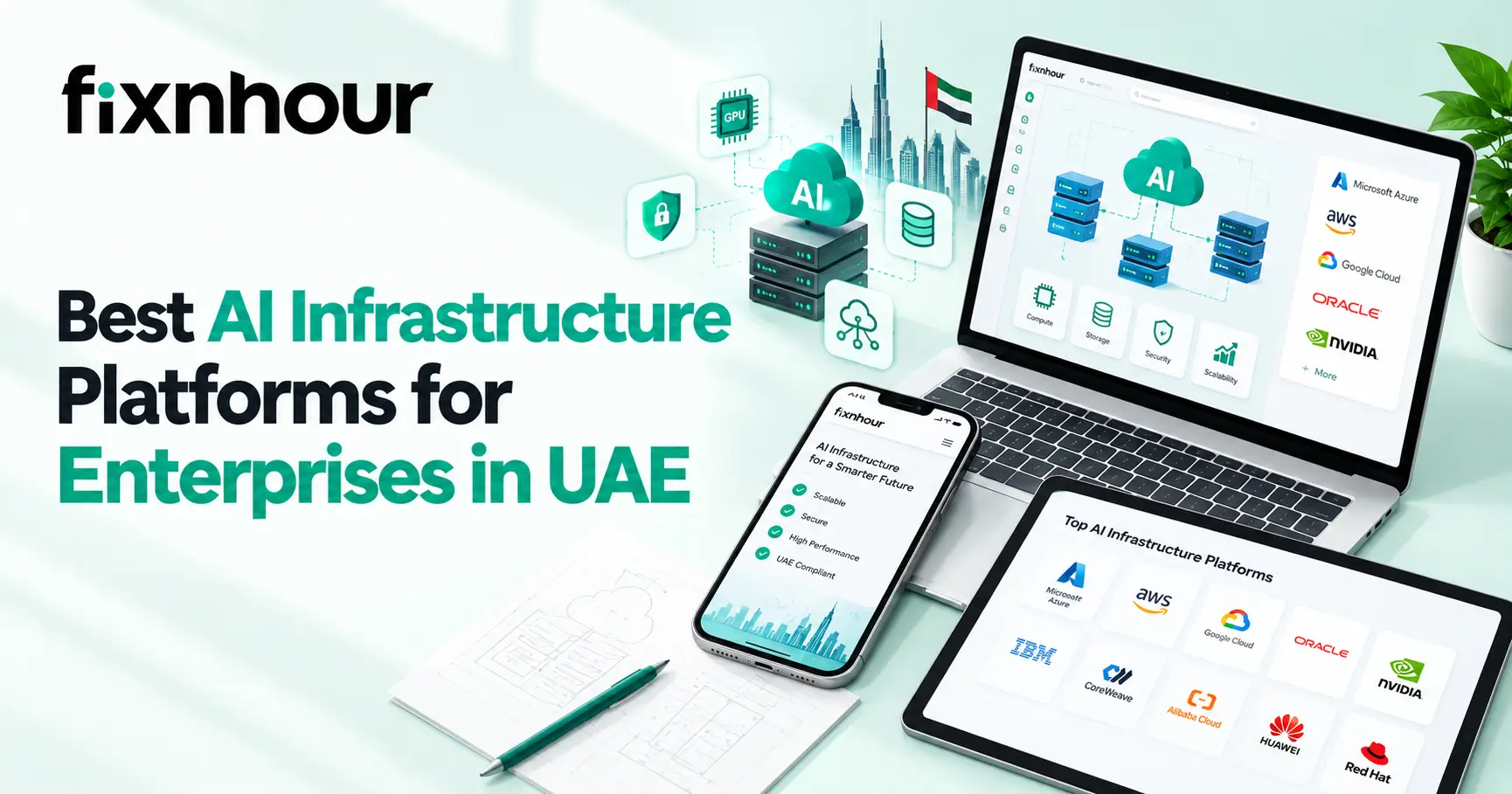
Artificial intelligence is becoming an important part of how businesses operate, compete, and serve customers. From banks using AI for fraud detection to retailers improving demand forecasting, enterprises across the United Arab Emirates (UAE) are exploring new ways to turn data into business value. However, successful AI adoption requires more than choosing a powerful AI model. Businesses also need reliable infrastructure to develop, train, deploy, and manage AI applications at scale. The best AI infrastructure platforms for enterprises in UAE provide the computing power, cloud services, storage, security, and management tools needed to run demanding AI workloads. These platforms can support generative AI applications, machine learning, intelligent automation, predictive analytics, and enterprise data processing.
For UAE businesses, the decision involves several factors, including performance, scalability, data residency, regulatory requirements, integration, and long-term operating costs. The right solution should meet current business needs while remaining flexible enough to support future growth. In this guide, we explore leading enterprise AI infrastructure platforms, their core capabilities, suitable use cases, and the factors UAE businesses should consider before investing.
Key Features to Look for in Enterprise AI Infrastructure Platforms
Choosing an AI infrastructure provider requires more than comparing cloud prices or processor specifications. Enterprises should evaluate how well the platform supports their workloads, protects business data, integrates with existing systems, and scales as demand increases. The following features are particularly important when selecting an AI infrastructure platform for a UAE-based organization. Discover the best AI integration service providers in the UAE and explore their expertise in generative AI, machine learning, automation, AI agents, cloud integration, and enterprise solutions. Learn how UAE businesses can integrate AI into existing applications, workflows, CRMs, ERPs, and digital platforms to improve efficiency and customer experiences.
High-Performance GPU Computing
Training advanced AI models and running large-scale inference workloads can require substantial computing power. GPU-accelerated infrastructure helps enterprises process complex calculations more efficiently than conventional computing alone in many AI workloads. Businesses should compare available GPU types, memory capacity, networking performance, and the ability to scale computing resources when workloads increase.
Scalable Cloud and Hybrid Deployment
AI requirements can change significantly between development, testing, and production. Scalable infrastructure allows businesses to increase or reduce computing capacity according to demand. Hybrid cloud and on-premises deployment options can also help enterprises maintain control over sensitive data while using cloud resources for workloads that benefit from additional capacity.
Enterprise Security and Data Governance
AI systems may process financial records, customer information, intellectual property, and confidential company documents. Organizations should look for strong identity management, encryption, access controls, logging, and monitoring capabilities. Businesses must also assess the UAE laws and sector-specific requirements applicable to their operations. A platform's security features alone do not guarantee regulatory compliance.
AI Model Training and Deployment
A capable enterprise AI platform should support the complete AI lifecycle, from preparing data and developing models to deploying applications and monitoring performance. Managed machine learning services, model-serving tools, container orchestration, and generative AI development environments can reduce the complexity of building production-ready solutions.
Integration With Existing Enterprise Systems
AI infrastructure should work with existing databases, business applications, analytics tools, and development workflows. Good integration reduces migration challenges and helps teams incorporate AI into their everyday operations.
Cost Optimization and Infrastructure Management
AI infrastructure expenses include more than computing. Storage, data transfer, software licenses, support, monitoring, and engineering resources can also influence the total cost of ownership. Enterprises should assess usage monitoring, resource scheduling, autoscaling, and workload optimization tools to avoid paying for capacity they do not need.
Best AI Infrastructure Platforms for Enterprises in UAE
The UAE enterprise market includes organizations with very different AI requirements. A financial institution may prioritize governance and controlled data access, while a technology company may need large-scale GPU computing for generative AI. Businesses across industries are investing in Artificial Intelligence companies in Abu dhabi to improve efficiency, automate operations, and deliver smarter customer experiences. The following platforms represent different approaches to enterprise AI infrastructure. Some provide complete cloud ecosystems, while others specialize in accelerated computing, AI software, or hybrid deployment. Their suitability depends on the workload, available services, and deployment requirements.
|
|
|
|
|---|---|---|
|
|
|
|
|
|
|
|
|
|
|
|
|
|
|
|
|
|
|
|
|
|
|
|
|
|
|
|
|
|
|
|
|
|
|
|
|
|
|
|
1. Microsoft Azure AI Infrastructure
Microsoft Azure is a strong option for enterprises looking to combine cloud computing, machine learning, generative AI, and existing business applications. Its infrastructure and AI services support organizations that want to develop AI-powered products without building every component from scratch. Azure can be particularly useful for businesses already using Microsoft 365, Azure cloud services, or enterprise identity and security tools. Organizations can use Azure Machine Learning and Azure's broader AI ecosystem to develop, deploy, and manage different types of AI workloads.
Key features and benefits:
- Best for: Enterprises using Microsoft technologies and cloud services.
- Key capabilities: Azure Machine Learning, GPU-enabled computing, AI application development, and model deployment.
- Enterprise benefits: Integration with business applications, identity management, and enterprise security tools.
- UAE considerations: Verify the availability of required AI services in the intended UAE region, along with data residency and compliance requirements.
2. Amazon Web Services (AWS) AI Infrastructure
Amazon Web Services offers a broad cloud infrastructure ecosystem for businesses building machine learning applications, generative AI solutions, and data-intensive systems. Its flexible computing and storage services can support projects ranging from early-stage experimentation to large-scale enterprise deployments. AWS provides services such as Amazon SageMaker for machine learning workflows and Amazon Bedrock for building generative AI applications using supported foundation models. Its infrastructure options allow enterprises to select resources based on performance, availability, and workload requirements.
Key features and benefits:
- Best for: Enterprises requiring flexible and scalable AI infrastructure.
- Key capabilities: GPU computing, Amazon SageMaker, Amazon Bedrock, and cloud-based data services.
- Enterprise benefits: Broad service integrations, flexible deployment architectures, and options for scaling workloads.
- UAE considerations: Confirm which AI services, models, and computing resources are available in the UAE Region and whether they meet the organization's data requirements.
3. Google Cloud AI Infrastructure
Google Cloud combines AI infrastructure, machine learning services, data analytics, and application development tools. It is particularly relevant to enterprises that want to connect large datasets with AI-powered applications and analytics workflows. Vertex AI provides a managed environment for developing and deploying machine learning and generative AI applications. Google Cloud also offers infrastructure and orchestration capabilities that can help teams operate AI workloads at scale.
Key features and benefits:
- Best for: Data-intensive enterprises and generative AI projects.
- Key capabilities: Vertex AI, Google Kubernetes Engine, AI computing, and cloud data analytics.
- Enterprise benefits: Managed AI workflows, integrated data services, and scalable infrastructure options.
- UAE considerations: Verify the regional availability of required AI services, accelerators, and data processing options before selecting the platform.
4. Oracle Cloud Infrastructure (OCI)
Oracle Cloud Infrastructure provides computing, networking, storage, and AI-related services for organizations operating demanding enterprise workloads. It can be a practical choice for businesses that already depend on Oracle databases, enterprise applications, or data-intensive systems. OCI offers infrastructure options for high-performance computing and GPU-based workloads, depending on regional availability and capacity. Its integration with Oracle's wider technology ecosystem can help organizations connect AI initiatives with existing business data.
Key features and benefits:
- Best for: Enterprises with Oracle-based applications and data environments.
- Key capabilities: GPU instances, high-performance computing, AI services, and database integration.
- Enterprise benefits: Support for demanding workloads and integration with enterprise data systems.
- UAE considerations: Check available regional capacity, the specific AI services offered, and applicable data residency obligations.
5. NVIDIA AI Enterprise
NVIDIA AI Enterprise is an enterprise AI software platform designed to support the development, deployment, and management of AI applications on compatible accelerated computing infrastructure. Unlike a general-purpose cloud provider, NVIDIA focuses on the computing technologies and software ecosystem that power demanding AI workloads. Enterprises can use NVIDIA's ecosystem with supported infrastructure from cloud providers, data center partners, or suitable on-premises environments. This makes it relevant for businesses developing large language models, computer vision applications, and high-performance AI inference systems.
Key features and benefits:
- Best for: Enterprises building GPU-intensive AI workloads.
- Key capabilities: Accelerated computing software, AI development frameworks, and inference optimization.
- Enterprise benefits: Optimized AI workflows, support for compatible infrastructure, and production deployment capabilities.
- UAE considerations: Evaluate supported hardware, software licensing, infrastructure partners, and the availability of local deployment and support options.
6. IBM watsonx and AI Infrastructure
IBM provides enterprise AI software and infrastructure capabilities for organizations that require governance, hybrid cloud integration, and structured management of business data. Its approach can be suitable for enterprises that need to integrate AI into established operational and technology environments. The watsonx ecosystem includes tools for AI development, data management, and governance. Depending on the architecture, organizations can combine these capabilities with cloud, private cloud, or other supported infrastructure environments.
Key features and benefits:
- Best for: Large organizations with complex governance and hybrid cloud requirements.
- Key capabilities: AI development, model management, data governance, and hybrid infrastructure integration.
- Enterprise benefits: Governance capabilities, integration with enterprise workflows, and flexible deployment approaches.
- UAE considerations: Review hosting options, applicable regulatory obligations, and compatibility with existing enterprise systems.
7. CoreWeave AI Cloud
CoreWeave specializes in GPU-accelerated cloud infrastructure for computationally intensive workloads. Its focus on AI computing makes it relevant to enterprises and AI teams that require substantial resources for model training, inference, and high-performance computing. Compared with broader cloud ecosystems, a specialized GPU cloud can be attractive when accelerated computing is the primary infrastructure requirement. However, businesses should evaluate networking, storage, availability, and integration alongside raw computing performance.
Key features and benefits:
- Best for: Enterprises with intensive GPU computing requirements.
- Key capabilities: GPU cloud computing, AI workload orchestration, and high-performance infrastructure.
- Enterprise benefits: Computing resources designed for demanding AI workloads and large-scale processing.
- UAE considerations: Verify regional availability, network latency, data transfer arrangements, contractual terms, and support coverage.
8. Alibaba Cloud AI Infrastructure
Alibaba Cloud provides cloud computing, data processing, storage, and AI services for businesses building digital products and intelligent applications. Its broader cloud ecosystem can be considered by enterprises evaluating alternative infrastructure providers. Depending on the selected services and deployment region, organizations can use cloud resources to support AI development, analytics, and application workloads. A detailed assessment is important to establish whether the platform matches the organization's technical and compliance requirements.
Key features and benefits:
- Best for: Enterprises evaluating diverse cloud ecosystems and AI-enabled applications.
- Key capabilities: Cloud computing, AI development services, data analytics, and scalable storage.
- Enterprise benefits: Integrated cloud services and support for varied application workloads.
- UAE considerations: Confirm the availability of required services, data location options, contractual arrangements, and regulatory suitability.
9. Huawei Cloud AI Infrastructure
Huawei Cloud offers cloud computing and AI-related services that can support enterprise data processing, intelligent applications, and digital transformation projects. It may be worth evaluating for businesses exploring different cloud ecosystems and infrastructure architectures. The platform's suitability depends on the services available for the intended deployment, the organization's existing technology stack, and its requirements for interoperability, security, and technical support.
Key features and benefits:
- Best for: Enterprises assessing alternative cloud and AI infrastructure ecosystems.
- Key capabilities: Cloud computing, AI development tools, data services, and application deployment.
- Enterprise benefits: Integrated infrastructure services and options for AI-enabled business solutions.
- UAE considerations: Evaluate service availability, interoperability, security requirements, and local support arrangements.
10. Red Hat OpenShift AI
Red Hat OpenShift AI helps enterprises develop, serve, and manage AI and machine learning workloads using a Kubernetes-based platform. It is particularly relevant to businesses that want to operate AI applications across supported hybrid cloud and on-premises environments. Rather than acting as a standalone hyperscale cloud provider, OpenShift AI provides platform capabilities that can run on supported underlying infrastructure. This approach can help organizations standardize application deployment and infrastructure management across different environments.
Key features and benefits:
- Best for: Enterprises seeking hybrid cloud and container-based AI deployment.
- Key capabilities: Kubernetes-based deployment, model serving, AI development workflows, and platform integration.
- Enterprise benefits: Consistent application management, infrastructure flexibility, and portability across supported environments.
- UAE considerations: Assess implementation complexity, available technical expertise, infrastructure compatibility, and ongoing operational requirements.
Benefits of Investing in Enterprise AI Infrastructure
A reliable AI infrastructure strategy gives businesses the foundation to move from isolated AI experiments to dependable, production-ready applications. Discover the top Enterprise AI companies delivering innovative artificial intelligence solutions for modern businesses. When infrastructure is aligned with business goals, organizations can improve efficiency while maintaining better control over performance, costs, and security. These benefits are not automatic. They depend on effective implementation, high-quality data, suitable models, skilled teams, and ongoing monitoring. Key benefits include:
- Faster AI development and deployment: Managed tools and reusable infrastructure can help teams move applications from testing into production.
- Improved scalability: Computing resources can be adjusted as usage and business requirements change.
- Better operational efficiency: AI-powered workflows can automate repetitive tasks and support faster, data-informed decisions.
- Stronger governance and control: Monitoring, identity management, and security controls can help teams manage enterprise AI environments.
- More effective cost management: Workload monitoring and resource optimization can reduce waste and improve infrastructure planning.
Conclusion
Selecting the best AI infrastructure platform for an enterprise in the UAE requires a clear understanding of business goals, computing requirements, security needs, data residency, and long-term costs. Microsoft Azure, AWS, Google Cloud, Oracle Cloud Infrastructure, NVIDIA AI Enterprise, IBM watsonx, CoreWeave, Alibaba Cloud, Huawei Cloud, and Red Hat OpenShift AI each serve different infrastructure and AI requirements. Rather than choosing a platform simply because it is popular, enterprises should shortlist providers based on their intended AI workloads, verify service availability in the UAE, compare total cost of ownership, and test their preferred architecture with a realistic proof of concept.
A well-planned AI infrastructure strategy can help UAE businesses build scalable AI applications, improve operational efficiency, and create a stronger foundation for digital transformation. The goal is not just to adopt AI technology, but to build an environment where AI can deliver reliable, secure, and measurable business value. Contact us for further queries.
Frequently Asked Questions
Q1. Which AI infrastructure platform is best for enterprises in the UAE?
Ans. The best platform depends on an organization's workload, budget, security requirements, and existing technology stack. Microsoft Azure, AWS, and Google Cloud offer broad cloud and AI ecosystems, while Oracle Cloud Infrastructure may suit Oracle-centric environments. NVIDIA AI Enterprise and CoreWeave focus on different aspects of accelerated computing, and Red Hat OpenShift AI supports hybrid AI deployment. Enterprises should compare specific services and verify UAE availability before deciding.
Q2. What is the difference between AI infrastructure and an AI platform?
Ans. AI infrastructure provides the underlying computing, storage, networking, and hardware resources required to run AI workloads. An AI platform generally offers software tools for developing, training, deploying, and managing models. Some enterprise products combine both layers, while others depend on infrastructure supplied by a separate cloud provider or data center.
Q3. Which cloud providers offer AI infrastructure in the UAE?
Ans. Major cloud providers to evaluate include Microsoft Azure, AWS, Google Cloud, and Oracle Cloud Infrastructure, alongside other providers where their services meet the business requirements. However, not every AI model, GPU configuration, or managed service is available in every region. Enterprises should verify current UAE regional availability, capacity, service terms, and data location options directly with each provider.
Q4. How much does enterprise AI infrastructure cost in the UAE?
Ans. There is no fixed price for enterprise AI infrastructure. Costs depend on GPU usage, computing capacity, storage, network traffic, software licensing, support, and implementation. Cloud services may offer usage-based pricing, while dedicated infrastructure can require larger upfront investments. Businesses should compare total cost of ownership and test expected workloads before committing to a large deployment.
Q5. Is cloud AI infrastructure better than on-premises infrastructure?
Ans. Cloud AI infrastructure can provide flexible capacity, managed services, and faster access to computing resources. On-premises infrastructure can offer greater direct control over hardware and certain data-processing arrangements, but it requires investment and ongoing maintenance. A hybrid model may work well for organizations with mixed workloads. The best approach depends on security, compliance, performance, staffing, and cost requirements.
Q6. How important is data residency when choosing an AI provider in the UAE?
Ans. Data residency can be important when an enterprise processes sensitive, regulated, or contractually restricted information. Businesses should confirm where data is stored and processed, including backups, logs, and third-party AI services. They should also review applicable UAE laws and sector-specific obligations. A provider's local presence alone does not establish that every workload meets all compliance requirements.
Q7. Which AI infrastructure is best for generative AI applications?
Ans. The best infrastructure depends on whether the application uses managed foundation models, self-hosted models, or custom model training. Managed AI services can simplify application development, while GPU-accelerated infrastructure can support workloads that require greater control over model deployment. Enterprises should compare latency, throughput, security, model availability, integration, and cost per request before selecting an architecture.
Q8. Can UAE enterprises combine multiple AI infrastructure providers?
Ans. Yes. Enterprises can adopt a multi-cloud or hybrid approach when it provides clear business or technical benefits. For example, a company may use one provider for managed AI services and another for specialized computing or existing business applications. However, multiple providers can increase integration complexity, networking costs, monitoring requirements, and governance overhead. A clear architecture and management strategy are essential