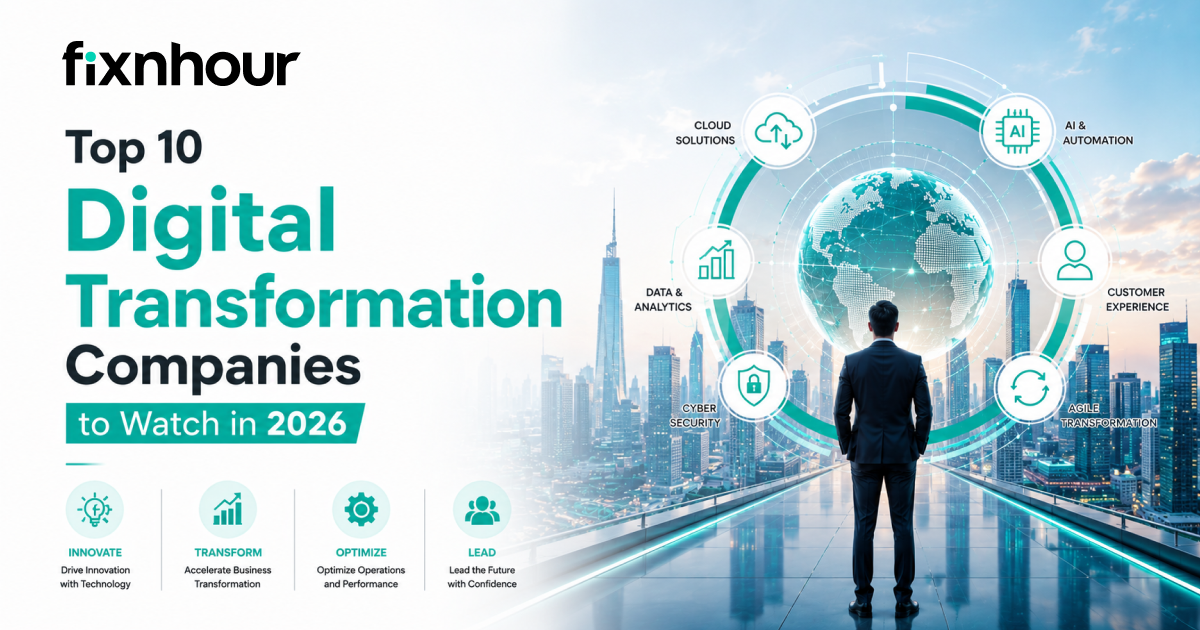
Digital transformation in 2026 involves more than simply adding new tools to an outdated business model. Companies are rethinking how they operate, serve customers, manage data, and make important decisions. Technologies such as artificial intelligence, cloud computing, automation, data analytics, and cybersecurity are now playing a central role in building faster, smarter, and more resilient businesses.
Choosing the right digital transformation partner can help an organization turn these technologies into measurable business results. This guide explores ten leading digital transformation companies to watch in 2026, comparing their core services, key strengths, estimated costs, and areas of expertise. It also covers the important factors businesses should consider when selecting a reliable transformation partner.
Quick Answer
The top digital transformation companies to watch in 2026 include Accenture, Deloitte, IBM Consulting, Capgemini, TCS, Infosys, Cognizant, Wipro, HCLTech, and Publicis Sapient. As AI trends transforming businesses continue to evolve, these companies help organisations modernise legacy systems, migrate to the cloud, adopt automation, strengthen cybersecurity, connect data, and create faster, more personalised customer experiences.
Key Takeaways
- Successful digital transformation begins with a business problem, not a technology trend.
- The strongest partners combine strategy, implementation, integration, change management, and ongoing support.
- AI agents, generative AI, cloud platforms, intelligent automation, and governed enterprise data are major priorities in 2026.
- Industry experience matters because workflows, regulations, risks, and customer expectations vary widely.
- Costs depend on organizational size, legacy complexity, integrations, security requirements, and delivery scope.
- A phased roadmap with early pilot projects can reduce risk and demonstrate value sooner.
- Employee communication, training, and executive ownership are essential for adoption.
- Buyers should compare relevant case studies, delivery teams, security practices, pricing, and post-launch support.
The Digital Transformation Landscape in 2026
Digital transformation in 2026 combines cloud migration, connected data, analytics, automation, customer portals, and modern core systems across industries. Platforms like Fixnhour help businesses connect with experienced digital transformation companies for their specific needs. As consulting demand grows, organizations must address infrastructure limitations by building strong data foundations, governance, cybersecurity, scalable cloud environments, and workforce readiness to convert AI investments into measurable business value.
How We Ranked the Top Digital Transformation Companies
This ranking evaluates digital transformation companies based on strategy, AI and cloud expertise, automation, data engineering, industry experience, global delivery, cybersecurity, scalability, case studies, and ongoing support. Similar to choosing Social Media Marketing Agencies, businesses should prioritize proven expertise and measurable outcomes, including cost savings, improved customer satisfaction, higher productivity, revenue growth, and faster time to market for long-term success.
Key Ranking Criteria
- Digital transformation strategy and roadmap capabilities
- AI, cloud, automation, and data engineering expertise
- Relevant experience across major industries
- Verified case studies and measurable client outcomes
- Global delivery and project management capabilities
- Cybersecurity, data privacy, and regulatory compliance
- Scalability and system integration expertise
- Pricing transparency and ongoing technical support
Top 10 Digital Transformation Companies to Watch in 2026
The leading digital transformation companies in 2026 combine strategy, AI, cloud, automation, data engineering, cybersecurity, and industry expertise. These providers help organizations modernize legacy systems, improve customer experiences, increase operational efficiency, and build scalable digital foundations for sustainable business growth.
| Company | Best For | Core Strength | Ideal Client |
|---|---|---|---|
| Accenture | Enterprise-wide reinvention | Strategy-to-operations capabilities at scale | Global enterprises |
| Deloitte | Strategy and change management | Business, risk, and technology alignment | Regulated enterprises |
| IBM Consulting | Hybrid cloud and AI | Mainframe, data, and Red Hat expertise | Data-intensive enterprises |
| Capgemini | Intelligent industry transformation | Digital and physical engineering | Manufacturers and global firms |
| TCS | End-to-end modernization | Large-scale program delivery | Large enterprises |
| Infosys | Cloud and AI adoption | Cobalt and Topaz ecosystems | Global mid-market companies and enterprises |
| Cognizant | Industry-focused digital engineering | Domain-led software modernization | Mid-sized and large enterprises |
| Wipro | Secure digital transformation | Cloud, AI, and cybersecurity | Security-conscious enterprises |
| HCLTech | Legacy system modernization | Application and product engineering | Technology-intensive enterprises |
| Publicis Sapient | Digital products and customer experience | Product strategy, experience, and data | Customer-focused enterprises |
1. Accenture
Accenture helps global enterprises execute complex transformation programs by combining strategy, technology, operations, cloud, cybersecurity, AI, and customer experience expertise.
Key Services:
- Enterprise transformation strategy
- Cloud and digital-core modernization
- Data, AI, and intelligent automation
- Cybersecurity and risk management
- Customer experience through Accenture Song
2. Deloitte
Deloitte supports business transformation through operating-model redesign, workforce change, technology modernization, risk management, governance, and structured implementation across complex organizations.
Key Services:
- Digital transformation strategy
- Operating-model redesign
- Workforce and change management
- Cloud and system modernization
- Technology governance and risk management
3. IBM Consulting
IBM Consulting helps data-intensive enterprises modernize hybrid environments through AI, automation, security, cloud-native engineering, workload transformation, and Red Hat technologies.
Key Services:
- Hybrid-cloud strategy and implementation
- Enterprise AI and automation
- Mainframe and workload modernization
- Cloud-native application development
- Cybersecurity and Red Hat solutions
4. Capgemini
Capgemini combines consulting, engineering, data, technology, and managed services to modernize connected products, manufacturing systems, energy operations, and industrial processes.
Key Services:
- Digital transformation consulting
- Product and software engineering
- Intelligent manufacturing solutions
- Data and AI implementation
- IT operations and managed services
5. Tata Consultancy Services
TCS delivers large-scale modernization programs through global delivery, cloud migration, application transformation, data, AI, automation, industry platforms, and managed services.
Key Services:
- Cloud migration and modernization
- Application and infrastructure transformation
- Enterprise data and AI solutions
- Intelligent process automation
- Industry-specific platforms and managed services
6. Infosys
Infosys combines cloud modernization, enterprise data, generative AI, experience design, and process transformation to enable scalable, technology-led business change worldwide.
Key Services:
- Infosys Cobalt cloud services
- Infosys Topaz generative AI solutions
- Data and analytics modernization
- Digital experience design
- Business process transformation
7. Cognizant
Cognizant provides industry-focused digital engineering by combining modern architecture, cloud platforms, automation, AI, custom software development, and enterprise systems integration.
Key Services:
- Digital product engineering
- Cloud and platform engineering
- Custom software development
- AI and intelligent automation
- Enterprise application integration
8. Wipro
Wipro enables secure enterprise transformation through cloud modernization, AI-assisted operations, application services, cybersecurity, identity management, zero-trust architecture, and incident response.
Key Services:
- Cloud migration and modernization
- AI-assisted IT operations
- Application transformation
- Identity and access management
- Cloud security and incident response
9. HCLTech
HCLTech modernizes complex application estates by transforming legacy systems, mainframes, and engineering processes into scalable, secure, cloud-native, AI-ready enterprise architectures.
Key Services:
- Legacy application modernization
- Mainframe transformation
- Cloud-native development
- Application portfolio management
- Generative AI-enabled engineering
10. Publicis Sapient
Publicis Sapient helps organizations build digital products, modernize commerce, improve customer journeys, and accelerate growth through personalized, data-driven experience transformation.
Key Services:
- Digital product strategy
- Customer experience design
- Commerce modernization
- Software and platform engineering
- Data-driven personalization
Digital Transformation Services and Solutions Compared
A full-service digital transformation partner usually starts by assessing a company’s current technology, processes, and capabilities. Leading Digital Transformation Companies in India use these findings to create practical roadmaps covering cloud migration, application modernization, data engineering, AI, automation, and managed services. Legacy modernization may also involve replacing ERP or CRM platforms, developing APIs, adopting microservices, refactoring applications, and migrating data securely.
Customer-focused transformation can involve mobile apps, e-commerce platforms, self-service portals, UX design, personalized experiences, and seamless omnichannel journeys. Cybersecurity should be integrated across every stage through identity and access management, zero-trust controls, data governance, threat detection, privacy protection, and regulatory compliance.
Benefits and Challenges of Hiring a Digital Transformation Company
Hiring a digital transformation company gives businesses access to specialised expertise, proven frameworks, advanced technologies, and scalable delivery resources. Many organisations also work with Digital Marketing Agencies to strengthen their online presence while transformation partners modernise legacy systems, improve efficiency, enhance security, support change management, and drive measurable long-term digital growth.
Key Benefits
- Access to specialised expertise
- Faster project implementation
- Reduced workload for internal teams
- Improved operational efficiency
- Better scalability and flexibility
- Stronger security and compliance
- Effective change management
- Clear and measurable outcomes
How Much Do Digital Transformation Services Cost?
Digital transformation costs vary based on project scope, business size, technology requirements, system complexity, and provider expertise. Small initiatives may require modest budgets, while enterprise-wide programs can cost more due to cloud migration, legacy modernisation, cybersecurity, integrations, training, and support.
| Transformation Service | Estimated Cost | Typical Timeline | Best Suited For |
|---|---|---|---|
| Strategy and technology roadmap | $15,000–$75,000+ | 4–10 weeks | Defining priorities and project scope |
| Proof of concept or pilot | $30,000–$150,000+ | 2–4 months | Testing a high-value use case |
| Cloud or application modernization | $100,000–$750,000+ | 4–12 months | Updating legacy and core systems |
| AI and automation implementation | $75,000–$500,000+ | 3–10 months | Improving decisions and workflows |
| Enterprise-wide transformation | $500,000–$5 million+ | 12–36+ months | Modernizing multiple business functions |
| Ongoing support and maintenance | $10,000–$100,000+ monthly | Ongoing | Optimization and managed services |
Step-by-Step Digital Transformation Process
A successful digital transformation begins with understanding business needs and setting clear goals. The process then moves through technology assessment, strategy development, solution design, implementation, employee training, and ongoing monitoring to ensure improvements deliver lasting value and support future growth
| Step | Digital Transformation Stage | Key Action |
|---|---|---|
| 1 | Assess Digital Maturity | Audit existing technology, processes, data, employee skills, security, and operational bottlenecks. |
| 2 | Define Goals and KPIs | Set measurable targets for cost reduction, revenue, speed, productivity, customer satisfaction, availability, and risk. |
| 3 | Prioritize Use Cases | Evaluate initiatives based on business value, complexity, urgency, risk, and expected return on investment. |
| 4 | Select a Transformation Partner | Review industry experience, case studies, team expertise, delivery methods, pricing, and ongoing support. |
| 5 | Build a Phased Roadmap | Organize quick wins, pilot projects, core modernization, wider implementation, and continuous optimization. |
| 6 | Implement and Test | Manage data migration, system integrations, security testing, quality assurance, and user acceptance testing. |
| 7 | Train Employees | Provide clear communication, leadership support, documentation, workshops, and role-based training. |
| 8 | Monitor and Improve | Track adoption, cost savings, customer experience, system performance, security incidents, and overall ROI. |
Step 1: Assess Your Current Digital Maturity
- Review your existing technology, software, and infrastructure.
- Identify slow, outdated, or inefficient business processes.
- Evaluate data quality, cybersecurity, and employee skills.
- Note the main gaps and operational bottlenecks.
Step 2: Define Clear Goals and KPIs
- Decide what the transformation should achieve.
- Set measurable goals for cost, revenue, speed, and productivity.
- Include customer satisfaction and risk-reduction targets.
- Choose KPIs to track progress and results.
Step 3: Prioritize the Right Use Cases
- List the digital initiatives your business could implement.
- Compare each idea based on value, cost, urgency, and difficulty.
- Consider the potential risks and expected returns.
- Begin with achievable projects that can deliver meaningful results.
Step 4: Select the Right Digital Transformation Partner
- Review the company’s industry experience and technical expertise.
- Study its portfolio, case studies, and client feedback.
- Compare project timelines, pricing, and delivery methods.
- Confirm that reliable post-launch support is available.
Step 5: Build a Phased Transformation Roadmap
- Divide the transformation into manageable stages.
- Start with quick wins and small pilot projects.
- Plan major system upgrades and integrations carefully.
- Create a timeline for implementation, expansion, and optimization.
Step 6: Implement and Test the Solutions
- Migrate business data securely and accurately.
- Connect new solutions with existing systems.
- Conduct security, performance, and quality testing.
- Complete user acceptance testing before the final launch.
Step 7: Train and Support Employees
- Explain why the transformation is important.
- Provide role-based training, workshops, and documentation.
- Encourage leaders to support and guide employees.
- Collect feedback and resolve adoption-related concerns.
Step 8: Monitor Performance and Improve
- Track employee adoption and process efficiency.
- Measure cost savings, revenue, and customer satisfaction.
- Monitor system performance and security incidents.
- Use data and feedback to make continuous improvements.
How to Choose the Right Digital Transformation Partner
Choosing the right digital transformation partner requires more than comparing prices. Whether implementing cloud solutions, automation, or AI in Real Estate, look for proven industry experience, technical expertise, strong governance, transparent communication, and reliable post-launch support. The ideal partner should protect your data, manage risks, and deliver scalable solutions that create measurable business value over time.
- Review relevant industry case studies and references.
- Confirm who will work directly on your project.
- Connect every technology recommendation to a business need.
- Discuss expected ROI and success metrics.
- Evaluate cybersecurity and data-protection practices.
- Clarify project scope, pricing, and delivery timelines.
- Check scalability and integration capabilities.
- Ask about knowledge transfer and employee training.
- Confirm maintenance and post-launch support.
- Begin with a defined pilot project when possible.
Conclusion
The best digital transformation company is not always the largest or most recognized. The right partner is one that understands your industry, existing systems, security requirements, budget, and business goals. Before making a decision, carefully review its team, case studies, delivery approach, governance process, pricing, and post-launch support.
Create a focused shortlist, speak with previous clients, and consider starting with a measurable pilot project. A reliable partner should do more than implement new technology it should strengthen your processes, employee capabilities, data foundation, and digital strategy to support sustainable growth and continuous improvement. Find the Right Tech Partner.
Frequently Asked Questions
Q1. What are the top digital transformation companies to watch in 2026?
Ans.Leading digital transformation companies to watch in 2026 include Accenture, Deloitte, IBM Consulting, Capgemini, TCS, Infosys, Cognizant, Wipro, HCLTech, and Publicis Sapient. However, the right provider depends on your industry, project scope, current technology environment, available budget, geographical requirements, security expectations, and the specific transformation capabilities your organization needs most.
Q2. Which digital transformation company is best for large enterprises?
Ans. Accenture, Deloitte, IBM Consulting, Capgemini, and TCS are among the strongest digital transformation partners for large enterprises. Evaluate them against your priorities because their strengths differ across organizational change, cloud adoption, product engineering, industry platforms, data transformation, cybersecurity, and mainframe modernization. Choose the provider with the most relevant proven experience.
Q3. How much does it cost to hire a digital transformation company?
Ans. Digital transformation consulting may begin at approximately $15,000 for strategy, while pilot projects often cost between $30,000 and $150,000 or more. Large-scale programs can reach hundreds of thousands or several million dollars. Final pricing depends on project scope, integrations, data complexity, cybersecurity, provider location, timelines, training, and ongoing support requirements.
Q4. What services do digital transformation companies provide?
Ans. Digital transformation companies provide strategy, maturity assessments, cloud migration, application modernization, AI implementation, workflow automation, data platforms, ERP and CRM transformation, digital product development, customer experience design, cybersecurity, change management, employee training, system integration, and managed support. Services are usually customized around an organization’s goals, infrastructure, industry, and operational challenges.
Q5. How long does a complete digital transformation take?
Ans. A digital transformation pilot may take two to four months, while cloud migration or application modernization often requires four to twelve months. A complete enterprise-wide transformation typically takes one to three years or longer because technology, processes, data, workforce skills, governance, and organizational behavior must evolve together through well-managed phases.
Q6. How do I choose the right digital transformation partner?
Ans. Start by defining clear business goals and measurable outcomes. Then compare potential partners based on industry experience, relevant case studies, team capabilities, technology partnerships, security practices, delivery methodology, pricing, client references, and post-launch support. Ask each provider how it will manage implementation risks, encourage adoption, and measure long-term business value.
Q7. Can small businesses benefit from digital transformation consulting?
Ans. Yes. Small businesses can use digital transformation consulting to improve efficiency, customer service, and decision-making without launching a large program. Practical starting points include CRM implementation, workflow automation, cloud migration, analytics, cybersecurity, and e-commerce improvements. A specialized consultancy may provide flexible pricing, relevant expertise, and service suited to smaller budgets.
Q8. What technologies are driving digital transformation in 2026?
Ans. The technologies driving digital transformation in 2026 include generative and agentic AI, intelligent automation, cloud and edge computing, modern data platforms, predictive analytics, low-code tools, APIs, IoT, digital twins, composable architecture, and zero-trust security. Their value depends on reliable data, strong governance, system integration, cybersecurity, employee adoption, and clear objectives.