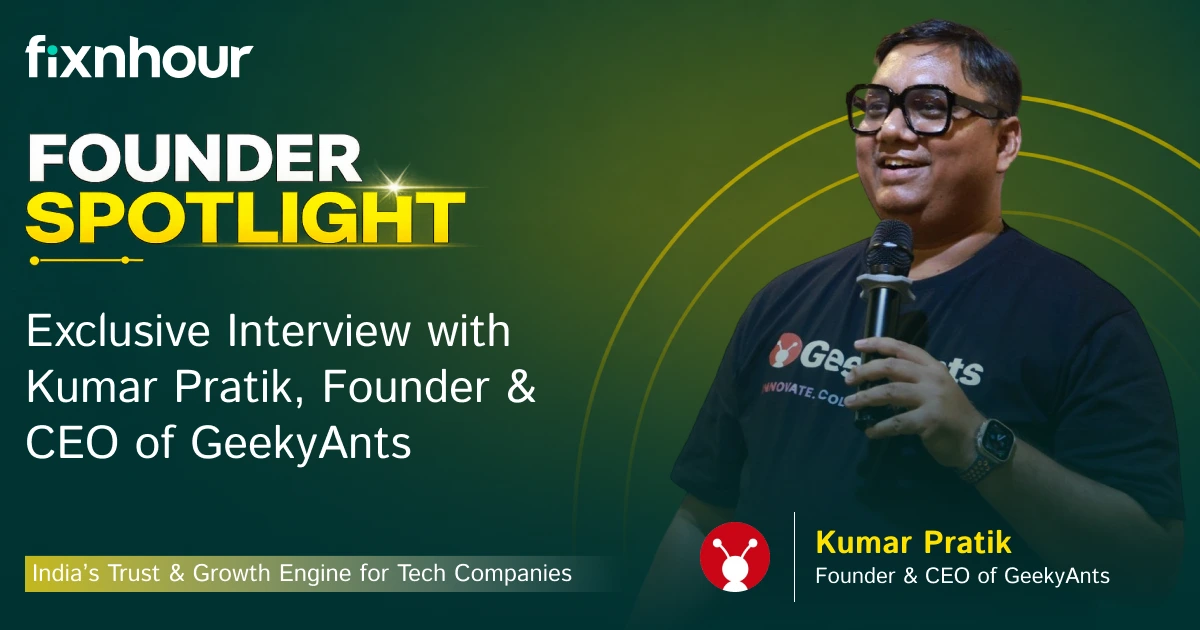
In today's AI-driven technology landscape, few leaders have successfully combined engineering excellence, open-source innovation, and business transformation like Kumar Pratik, Founder & CEO of GeekyAnts. With more than two decades of experience in software engineering and product development, he has built GeekyAnts into a globally recognized product engineering and technology consulting company, delivering over 550 successful engagements across startups, enterprises, and global brands.
Under Kumar's leadership, GeekyAnts has become known for its expertise in AI transformation, cloud-native development, digital product engineering, and modern web and mobile technologies. Beyond client success, the company has made a significant impact on the global developer community through renowned open-source projects such as NativeBase, gluestack-ui, and GeekLego, while pioneering its Agentic Development Life Cycle (ADLC) to redefine AI-powered software development.
About the Founder:
Kumar Pratik is the Founder and CEO of GeekyAnts, a global product engineering and technology consulting company. With over two decades of experience in technology, he brings systems-level expertise across frontend and backend engineering, infrastructure, distributed systems, cloud platforms, application performance, and enterprise architecture. His journey began with an early fascination for personal computing and the potential of software to solve practical problems. He went on to help build and scale GeekyAnts into an international engineering organization serving startups, enterprises, and global brands. The company has completed more than 550 engagements since 2006 and established an open-source legacy through projects such as NativeBase and gluestack-ui.
Kumar’s current work focuses on AI transformation, cloud-native platform engineering, large-scale modernization, performance engineering, and agent-driven software development. He is guiding GeekyAnts toward an AI-native operating model in which engineers combine human judgment with autonomous agents through the Agentic Development Life Cycle. His broader vision includes making performance a shared discipline across product, design, engineering, QA, and leadership teams. He has led more than 100 digital and software projects, driven talent-intelligence initiatives such as TopGeek.io, and authored Modern Application Performance 360. His leadership philosophy emphasizes curiosity, engineering excellence, distributed ownership, and measurable business outcomes.
1. What inspired the founding of GeekyAnts, and what vision continues to guide the company as it scales globally?
My interest in technology began long before GeekyAnts. I started experimenting with computers as a child and was fascinated by how software could change the way people worked and solved problems. After graduating in computer science, we started Sahusoft India in 2006 to deliver high-quality technology services. The 2009 recession forced us to partially close operations, but the team rebuilt the company between 2012 and 2013 and rebranded it as GeekyAnts in 2014. Our original ambition was to use technology to drive meaningful change. Today, that is reflected in our vision to empower everyone to build things faster. In the AI era, this means combining human expertise with machine intelligence to help organizations build secure, scalable, production-grade products not merely experimental prototypes.
2. GeekyAnts has grown into a globally recognized technology consulting and product engineering company. What have been the defining milestones in your journey so far?
The first defining milestone was rebuilding after the 2009 recession and establishing the GeekyAnts identity in 2014. That experience made resilience and adaptability central to our culture. Open source was another breakthrough. NativeBase became widely adopted within the React Native ecosystem and grew to more than 20,000 GitHub stars before evolving into gluestack-ui. It gave us visibility within the global developer community and demonstrated our engineering capabilities publicly. We subsequently expanded across India, the United States, and the United Kingdom, completed more than 550 engagements since 2006, and evolved from an application development studio into an AI-powered product engineering and consulting company. More recently, we established focused practices across AI consulting and transformation, AI-powered product engineering, enterprise system modernization, and digital customer experience. Receiving the Excellence in AI & Digital Transformation award at the ET Now Business Conclave & Awards 2026 was an important validation of that evolution. Lastly, GeekyAnts has also become a member of the recently launched AI Council of India.
3. What are the biggest digital transformation challenges your clients face today, and how does GeekyAnts help solve them?
Clients commonly face legacy systems, fragmented tech stacks, slow time‑to‑market, and the need for accessible, cross‑platform UX; GeekyAnts addresses these via end‑to‑end digital transformation services: modernization of monoliths into cloud‑native architectures, UX‑driven product development, and AI/automation enablement in delivery workflows. Our capabilities combine product development, model design sensibilities, and customizability with an enterprise consulting approach to provide scalable and growth-ready solutions.
4. Can you share a success story where GeekyAnts helped a client achieve significant business growth or operational transformation through technology?
A recent example is an AI document-intelligence platform published under the name Pillar Engine, with identifying details changed to respect the client’s NDA. The client needed to extract dependable insights from extremely large documents, a process that previously required days of manual review. We built an automated data pipeline and an AI agent using AWS Bedrock to transform complex information into contextual, human-readable responses while identifying the exact source pages. The resulting platform reduced manual effort by 99%, processed 10,000 pages in approximately two minutes, and achieved more than 85% response accuracy. The real transformation was not simply processing documents faster. The platform changed an effort-intensive research activity into an accessible, repeatable workflow that could support managers and decision-makers at scale.
5. How do you ensure every solution delivers not only technical excellence but also measurable business value and long-term scalability?
Every engagement should begin with a clear definition of success. Before software development, we establish the business problem, baseline performance, delivery risks, and the outcomes the client expects to improve. Depending on the engagement, those outcomes may include adoption, revenue enablement, manual effort, cloud expenditure, release frequency, uptime, performance, or time-to-market. Our AI-powered product development follows a validate–build–scale approach. During validation, we define measurable success criteria and determine which outcomes are sufficiently within our control to warrant them. During delivery, we combine senior engineering accountability with architecture reviews, automated testing, CI/CD, observability, security, and performance checks. We also maintain regular sprint reviews, client sync-ups, transparent project tools, and periodic business reviews. This enables us to measure both delivery quality and whether the product continues to create value after launch.
6. What differentiates GeekyAnts from other software development and digital product engineering companies in today's competitive market?
Our differentiation comes from deep engineering breadth, product thinking, open-source credibility, and accountability for outcomes. Our teams work across product strategy, UX design, design systems, mobile, web, backend, databases, distributed systems, cloud infrastructure, DevOps, QA, AI, and performance engineering. This breadth allows us to address the complete product and technology problem through one coordinated team. We are also applying the Agentic Development Life Cycle, or ADLC, to our engineering model. ADLC uses structured context, mandatory AI-assisted planning, parallel execution by specialized agents, and rigorous human verification. Engineers increasingly focus on problem decomposition, context architecture, orchestration, review, and system-level quality. Our AI-driven product development connects delivery commitments with defined timelines, production warranties, and measurable performance standards. Our open-source work gives clients an additional way to evaluate our engineering capability through technology that developers worldwide can inspect and use.
7. GeekyAnts has been an early adopter of modern technologies. Which emerging technologies or industry trends are currently shaping your innovation roadmap?
Agentic AI is one of the most important areas shaping our roadmap. We are exploring systems in which specialized agents can reason, use tools, collaborate, and execute multistep business workflows with appropriate human oversight. To complement this, we are developing the Agentic Development Life Cycle, or ADLC, as an operating model for building software with autonomous and specialized AI agents. We are equally focused on the engineering surrounding AI: grounded knowledge systems, RAG architectures, model evaluation, observability, data governance, security, cost control, and explainability. These are what turn an impressive demonstration into a dependable production system. AI-native software delivery is another major area of investment. We see opportunities to apply intelligent agents to quality engineering, architecture, code review, documentation, incident management, and delivery automation. Cloud-native systems, event-driven architectures, platform engineering, and performance engineering will continue to be foundational. AI may change how software is built, but it does not reduce the need for reliable infrastructure, thoughtful architecture, and excellent user experiences.
8. How is GeekyAnts helping organizations adopt AI, automation, cloud-native architectures, and modern web and mobile technologies?
We approach adoption through three stages: diagnosis, engineering, and operationalization. We first evaluate the business use case, available data, expected value, security requirements, and organizational readiness. This prevents companies from investing in AI or modernization programs without a clear path to measurable results. We then bring together cross-functional teams across AI, product strategy, UX, web, mobile, backend, cloud, DevOps, QA, and business analysis to engineer the solution. This may involve AI agents, RAG systems, workflow automation, APIs, mobile and web experiences, microservices, or cloud platforms. Finally, we operationalize the solution through monitoring, evaluation, access controls, automated delivery, infrastructure as code, cost management, and knowledge transfer. For enterprises with valuable existing systems, we often use phased modernization rather than risky, large-scale replacement.
9. Open-source has been an important part of GeekyAnts' journey. How has contributing to the developer community influenced your growth, culture, and client trust?
Open source has shaped GeekyAnts’ engineering culture and global reputation. NativeBase became one of our most recognized contributions, reaching approximately 20,400 GitHub stars and helping developers build consistent experiences across Android, iOS, and the web. Its evolution into Gluestack UI carried that work forward through a new generation of universal components and design system infrastructure. GeekLego represents a newer chapter in this journey. It is an open-source, design-system-first React component library built on Tailwind CSS and Radix UI. It allows teams to customize design tokens and brand systems while using AI-assisted development skills for component creation, Figma synchronization, security review, localization, and state handling. Our broader open-source work includes projects such as Vue Native, React Native Aria, Flutter Starter, developer boilerplates, and other community tools. We believe that public development strengthens documentation, accessibility, maintainability, compatibility, and responsiveness to feedback. It also gives clients direct evidence of how our teams design systems, address technical challenges, and collaborate with AI developers. These qualities reinforce trust even before a commercial engagement begins.
10. What qualities should businesses look for when selecting a long-term technology and product development partner?
Businesses should select a partner that understands the commercial purpose of the product and can connect each engineering decision to that purpose. A strong partner should ask difficult questions, identify hidden risks, explain trade-offs clearly, and provide evidence from production systems. Technical capability should cover architecture, security, performance, quality assurance, observability, documentation, and operational support. Transparency also deserves close attention. Clients should have clear visibility into progress, costs, dependencies, risks, technical debt, and changes in scope. The strongest long-term partners take ownership of adoption, reliability, scalability, and customer experience. Their delivery model supports the product through launch, growth, modernization, and changing market conditions. Open-source contributions, independently verified reviews, security credentials, measurable case studies, and long-standing client relationships provide useful evidence during the selection process.
11. As a founder, what leadership principles have had the greatest impact on building GeekyAnts' culture and global team?
Listening, empathy, reasoning, and ownership have had the greatest influence on my leadership approach. A leader must understand the people behind the work, create clarity around the goal, and make timely decisions. Emotional intelligence helps leaders receive criticism constructively, recognize different perspectives, and guide teams through uncertainty. Curiosity is another core principle at GeekyAnts. Technology changes continuously, so our people need the freedom and discipline to research, experiment, share knowledge, and challenge familiar approaches. As the company grew, I focused on developing independent leaders, as strong organizations distribute judgment and accountability across teams. Now, our goal is to retain the energy and ownership of a technology startup while building the maturity required to serve global enterprises.
12. How do you build lasting relationships with clients while maintaining transparency, collaboration, and consistent delivery across international markets?
Lasting relationships begin with a deep understanding of the client’s business, customers, operating constraints, and definition of success. During delivery, we establish a consistent communication rhythm through sprint reviews, weekly client sync-ups, shared project-management tools, dedicated communication channels, demonstrations, and formal stakeholder reviews. Long-term engagements also include periodic business reviews and partnership-health checks. These discussions measure delivery quality, responsiveness, technical performance, and continued alignment with business objectives. Fixnhour Our delivery, account, and leadership teams review client feedback together. The resulting actions may involve changes to team structure, planning, communication, technical execution, or delivery governance. International collaboration also requires flexibility across time zones, cultures, regulations, and stakeholder expectations. Shared engineering standards create consistency, while locally appropriate communication practices strengthen collaboration.
13. Where do you envision GeekyAnts over the next 3–5 years, and what long-term impact do you hope the company will create within the global technology ecosystem?
Over the next three to five years, I want GeekyAnts to become a benchmark AI-native product engineering organization. We are building toward a model in which human intent and machine intelligence work together throughout the product lifecycle. Agent-driven architectures, ADLC, enterprise AI systems, intelligent automation, cloud-native modernization, and developer productivity will play significant roles in this evolution. Performance engineering will also become a broader organizational practice. Product leaders, designers, architects, developers, QA teams, and executives will share responsibility for speed, reliability, scalability, and user trust. We will continue contributing open-source tools, research, engineering frameworks, and learning opportunities to the global developer community. Our long-term impact will come from helping organizations turn ambitious technology strategies into dependable systems. We want to make advanced product engineering faster, more accountable, more accessible, and more trustworthy.
14. Please share any notable awards, recognitions, certifications, open-source contributions, client success stories, case studies, milestones, or industry achievements that you would like us to feature during this Founder Spotlight.
The following achievements would be appropriate to feature: Company journey: Roots dating to 2006, with the company revitalized between 2012 and 2013 and rebranded as GeekyAnts in 2014. Global delivery: More than 550 engagements since 2006, with operations across India, the United States, and the United Kingdom. Industry recognition: Excellence in AI & Digital Transformation at the ET Now Business Conclave & Awards 2026. Open-source impact: NativeBase has approximately 20,400 GitHub stars and has evolved into gluestack-ui.
New open-source innovation: GeekLego, an AI-powered, design-system-first React component library with customizable tokens and AI-assisted development workflows. AI-native engineering: Development and application of ADLC, GeekyAnts’ Agentic Development Life Cycle for context-led planning, parallel agent execution, and systematic human verification. Product accountability: The Product Development Validate–Build–Scale model, defined delivery commitments, and production warranties for eligible engagements. Client transformation: Vendly’s ecosystem has enabled more than one million transactions, onboarded over 1,000 operators, and maintained 99.98% uptime. AI outcomes: A document-intelligence solution reduced manual effort by 99% and processed up to 10,000 pages in approximately two minutes.
Enterprise modernization: Published outcomes include a banking-domain migration completed with zero downtime across over 100 integrations and a diagnostic platform reaching a 100 performance score while supporting more than 1,200 outlets. Enterprise credibility: GeekyAnts publicly features work or relationships with organizations such as Google, Darden, Olive Garden, SKF, Pepperfry, MPL, ICICI Securities, PayPoint, and WeWork. Operational and security recognition: ISO-certified information security management, Cyber Essentials recognition, and a current Clutch profile displaying a 4.8 rating across 115 verified reviews. Healthcare compliance engineering: aligned with HIPAA and GDPR, alongside healthcare interoperability and assurance frameworks such as FHIR, HL7, SOC, and ISO. Financial-services compliance: GeekyAnts states production experience with RBI digital lending and UPI requirements, NPCI UPI certification, FinCEN AML, BaFin regulations, and MENA AML, KYC, and PCI DSS requirements.
Final Message
Thank you, Kumar Pratik, for sharing your inspiring journey, valuable insights, and forward-looking vision with the Fixnhour community. Your perspectives on AI-native product engineering, digital transformation, open-source innovation, and building scalable technology solutions provide meaningful guidance for entrepreneurs, technology leaders, and businesses navigating today's rapidly evolving digital landscape.
We truly appreciate your time and openness in sharing the story behind GeekyAnts and the principles that continue to drive its global growth. We wish you and the entire GeekyAnts team continued success in shaping the future of AI-powered software development and creating lasting impact across the global technology ecosystem. Contact us today