The AI revolution is impacting the software development process, paving the way for more applications to be developed in less time than ever before. But getting something done quickly is not enough to ensure reliability. The applications created by AI can be impressive in appearance, but they often have some code quality, security, and scalability problems. The demand for structured, secure, and maintainable software is growing with the increasing use of AI tools in software development. The importance of structured, secure, and maintainable software has become paramount as organizations increasingly rely on AI tools in software development.
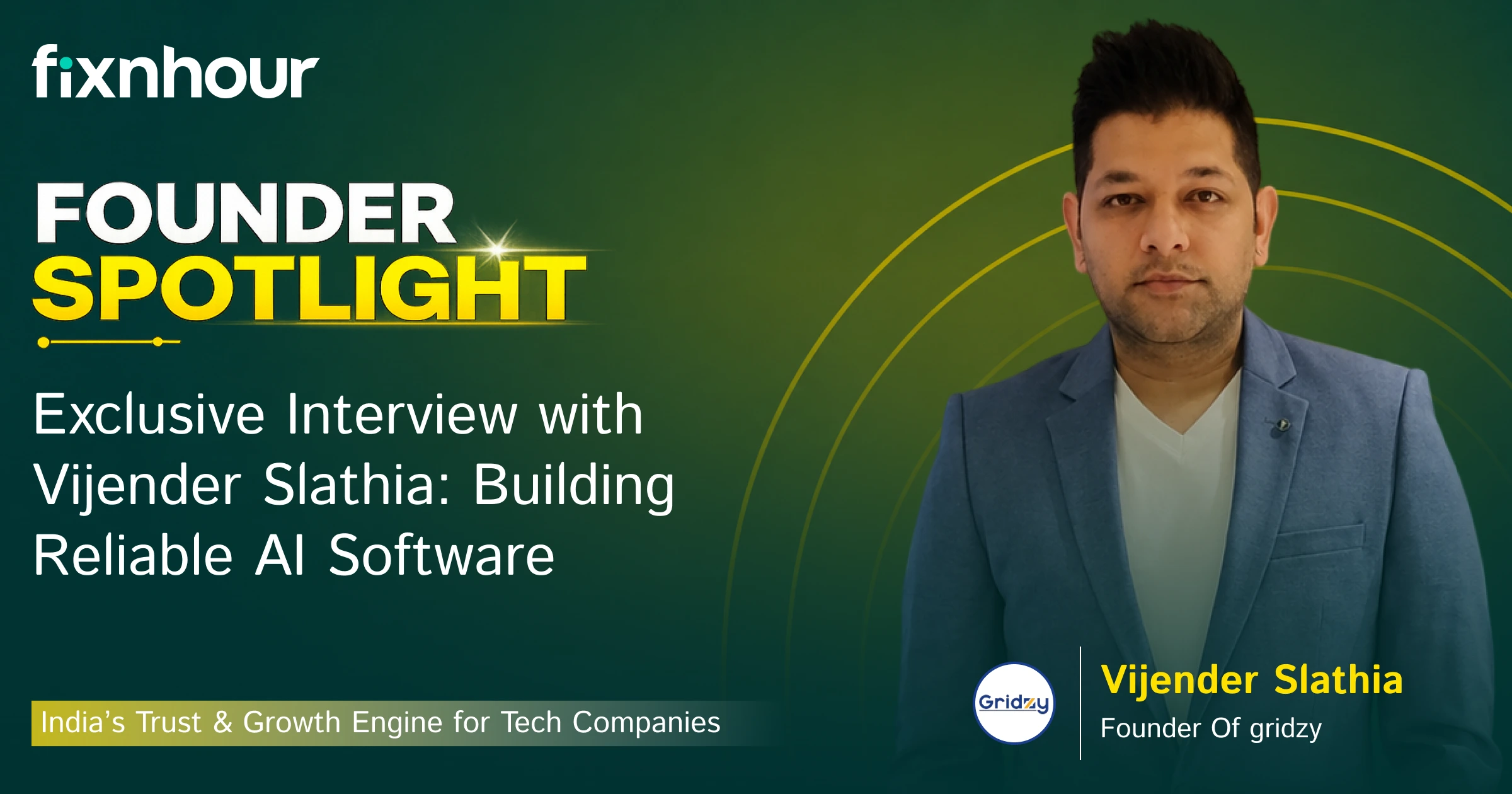
In this special Fixnhour Founder Spotlight, we sit down with Vijender Slathia, founder of Gridzy.ai, to talk about reimagining AI-backed software development. He explains how Gridzy's conversation AI and structured no-code enable non-technical teams to create reliable business applications without compromising security, data, or governance for technical teams. Vijender speaks with the future in mind and the necessity of a no‐code slop approach to development and the importance of reliability end‐to‐end, not speed.
Key Takeaways
- Rapid software development doesn't always result in production-ready applications.
- AI is most reliable when it works in a restricted architecture.
- Non-technical teams require autonomy and should not result in a security or maintenance situation.
- Structured visual logic can help to create more understandable and scalable applications.
- Data sovereignty is crucial to enterprise AI adoption.
- IT teams should keep control over databases, security, and governance.
- Business users and developers must work together and not against one another.
- Reliable no-code platforms do not want to be black boxes; they need to be easy to use.
- While AI is a game-changer for software development, engineering will continue to play a crucial role.
- Sustainable technology products are designed on trust, transparency, and value for the long haul.
Who is Vijender Slathia?
AI-driven software development has brought about a transformation that enables developers to convert simple natural language prompts into functional applications in a matter of minutes. That transition has opened up a whole new world of opportunity for founders, operations teams, HR leaders, and business owners that used to rely on developers to create even the most basic internal tools. However fast a new problem came. Applications built with AI can be impressive during a demo but have a layer of fragile logic, unreadable code, security concerns, and technical debt beneath. A tool can be excellent for the initial few interactions but then become challenging to manage, secure, and scale once real business data and users are introduced.
The next generation of AI development platforms is all about Vijender Slathia's central challenge. Vijender is the Founder of Gridzy.ai, where he's working on a new type of AI software builder that's focused on non-technical people who require reliable business applications, not just quick experiments. He envisions a vision where the speed and accessibility of a fully fledged conversational AI platform meet the structure, reliability, and transparency of one of the most developed no-code engines. Rather than letting AI algorithms develop code from the ground up, Gridzy is an AI translator. The user dictates what they wish with natural language, and the platform translates that into pre-checked visual elements and workflows. This translates into software that stays understandable, editable, and stable, despite fluctuating business needs.
This is an actual need in the market. Many businesses require a CRM that can be customized to fit their specific needs, such as employee onboarding, workflow management, client portals, or internal dashboards. Free-form AI coding platforms can generate applications that fall short of internal IT teams' approval standards, and traditional software development methods can be costly and time-intensive. Gridzy wants to connect both worlds. Non-technical teams are given the liberty to design and redesign applications by dialogue and graphical logic. Technical teams continue to have control of architecture, databases, security, and data sovereignty. It can integrate with existing databases like PostgreSQL, MySQL, and Supabase, enabling organizations to retain their data in trusted environments. Vijender's work is indicative of a trend in software development. Programmers may not be the only ones in charge of the future—or of the fully independent AI coding systems, for that matter. It could be part of platforms that enable business users and technical teams to work together in a structured environment. On this exclusive Fixnhour Founder Spotlight episode, Vijender Slathia gives an insight into Gridzy.ai's approach, the dangers of unstructured AI-generated code, and what needs to be balanced in the future of business software: speed and reliability.
Q1. Vijender, what inspired you to build Gridzy.ai?
The idea was spurred by seeing a very practical problem. Fixnhour while AI coding tools had been making software quicker to create, they weren't always making software more reliable. In a matter of hours, people were able to create wonderful prototypes, and once the honeymoon period was over, it became hard to grasp or sustain these applications. That might be fine for a developer testing something out with his own project. It's not for a business that needs a system each day. The last thing an HR team needs is a platform for employee onboarding to suddenly go down. If the operations manager is relying on code that nobody understands, it's not a viable basis for critical workflows. No business owner should be forced to wait a few months for customized development or take the chance with a flaky AI-generated application. We created Gridzy as an alternative to that. We wanted to preserve the naturalness of conversational AI's use of code and eliminate the uncontrollable nature of free-form code generation. Gridzy understands the user's need and translates this into structured and tested blocks. That allows the non-technical teams to retain speed without compromise to control or stability. The broader goal is to provide custom software without causing a new generation of technical debt problems.
Q2. You often use the phrase “code slop.” What does it mean, and why should businesses care?
"Code slop" is a term used to describe software that is hastily written, not well-documented, not well-structured, not consistent in its development, and not well considered for the future. It works but is not easy to audit, customize, and scale. The issue is AI itself. AI can be an amazing development tool. The issue is when organizations let AI produce a massive amount of production code without a structured architecture. Software is never static, and businesses should care. Requirements change. Teams grow. Integrations are added. Security standards evolve. When the original application is implemented on unstable code, each successive change runs the risk of increasing the costs and is more expensive. The risk is that non-technical users may not be aware of such shortcomings. Their eyes see a working screen, and they assume that the application is ready for production. Internal IT teams then find out that there are inconsistencies in the logic, security flaws, or architecture that is not suitable for real-world usage. With Gridzy, that's mitigated by the fact that the AI will only be a system of components that have been verified. The platform enforces architectural standards, and AI interprets and orchestrates.
Q3. How is Gridzy different from traditional vibe-coding platforms?
Most Vibe coding platforms consider AI as a standalone developer. The user describes an idea to them, and the AI writes code from scratch. This can be very quick but can also lead to a lot of "noise" as the system can generate different architectures, patterns, or logic with each run. But Gridzy has a different stance. AI is used not as an unrestricted code generator but as a translator. The user specifies what it is they want in plain language, and Gridzy takes that language and translates it to a set of pre-verified visual components, workflows, data structures, and business rules. This provides users with the conversational feel they have come to expect and provides stability to the application. The difference is significant once the rocket is launched. In Gridzy, the logic is exposed and is easily modifiable. The business user can grasp the workings of a workflow; the IT user can examine the architecture without having to sift through thousands of lines of unfamiliar coding. We do not wish to substitute prompts for development discipline. Prompts are how we're making disciplined software development accessible.
Q4. Who is Gridzy designed for?
Gridzy is built for organizations that require custom software but don't want to have all internal tools be traditional software development projects. It can be employed by small- to medium-sized business owners for client portals, CRMs, approval systems, or for operational dashboards that can be built without the involvement of a large engineering team. Operations leaders can develop their workflow trackers, inventory systems, reporting systems, and internal process applications to fit the actual operation of their own teams. HR teams can create employee onboarding systems, employee performance trackers, recruitment workflows, and training portals without relying on generic software that requires them to adapt their workflows. We do believe enterprise IT teams have a lot of value to gain from it too. Small applications are often on request from business departments and do not always have enough resources for IT teams to build. With Gridzy, these departments have some autonomy without compromising on databases, security, governance, etc. on the IT side. What these customers have in common is that they require software that they can rely on, rather than software that can be quickly made.
Q5. Why is data sovereignty such an important part of your platform?
Data sovereignty is important as business applications may have sensitive data. The data of employees, customers, finances, processes, workflows, and internal reports should not be confined to the unknown and black box of AI. There areQ a lot of companies out there who want to work with AI development tools, but they don't know where their data will be stored, how it will be processed, or if they will be able to move it at a later time. The idea of Gridzy is to put the customer in control. The platform can talk to any database you already trust, such as PostgreSQL, MySQL, or Supabase. This allows the frontend to be simple and conversational and the backend to be within an architecture approved by the technical team. This model establishes a healthy business-IT relationship. The business team owns the function the application serves, and the technical team has ownership of the data, infrastructure, and compliance. That equilibrium is key for the adoption of serious business.
Q6. What are the biggest mistakes companies make when adopting AI-powered development tools?
The first error is judging tools based on the time it takes to create a demo. Do not consider a prototype and a production system as synonymous. The question for businesses is what happens once they have created the initial application. Will the system deal with real data? Can it scale? Does the logic make sense? Does the internal team have the capability to sustain it? Are the building's structures safe? The second error is to take away technical governance altogether. While the use of AI is a way of enhancing the power of non-technical users, this doesn't mean that businesses should neglect security, data architecture, and compliance. The third error is to think that the more code is generated, the more value it has. The actual ideal system could be the one with the least amount of code, with clear and structured components, and with logic that is structured. AI development tools must be approached with the rigor that organizations use when considering any other enterprise software solution. Time is important, but reliability is more important.
Q7. How do you balance simplicity for business users with control for technical teams?
One of the fundamental design problems of Gridzy. Business people require an intuitive user interface. They should be able to explain a workflow, ask for a workflow change, or develop a new module without any knowledge of coding languages. There is a need for technical teams to be transparent. They must be familiar with data storage, permissions, integrations, and the application's adherence to approved standards. We separate the experience of the conversation from the experience of the underlying structure as we balance those needs. The business user will be engaged via prompts and visual logic. Gridzy converts those requests to controlled components. The technical team has a chance to examine the data connections, architecture, and behavior of the system. That is, autonomy does not require giving up control by one group for another group to have autonomy. It is not “business versus IT.” It is a model of collaborative working in which both partners work in their own comfort zone.
Q8. What does reliable no-code software look like in practice?
It is essential that the software be reliable and easily understood, predictable, secure, and changeable. Users should always be able to view the flow of data throughout the program. Workflows should be uniform. Permission needs to be well-stated. The platform should be stable, and integrations should be made in standard ways, and the platform should not be unstable with increasing complexity of applications. Another aspect of reliability is also avoiding lock-in where possible. Businesses need to keep data under their control and trust that technical teams will be able to interact with the system. On a positive note, a quality no-code system shouldn't reduce the complexity to a black box. It should structure complexity in a way that is accessible to a larger audience. This is what we are aiming for when we have Gridzy.
Q9. How do you see the role of software developers changing as AI and no-code platforms grow?
The role of the developer is going to keep changing, of course, but it won't stop playing a crucial role. AI and no-code tools will reduce the amount of time spent on repetitive application development. Developers will be able to focus more on architecture, complex integrations, performance, security, and strategic product decisions. There will also be more business involvement in software development. They will be able to create, and test, numerous workflows without having to write documents and wait for them to be sent months later. The most effective organizations won't see this as a battle of developers vs. non-technical users. They will develop systems that allow business teams to maneuver at a much quicker pace, while the foundation is laid by the developers to ensure a secure environment for the businesses to move at a faster pace. AI isn't taking the place of engineering skills. It will bring more valuable engineering, and more software will be developed by more persons.
Q10. What leadership lessons have shaped your journey as a founder?
One of the most important things to learn is that clarity is more important than complexity. In tech, you can get easily carried away with advanced systems, new frameworks, and extensive features. However, customers are typically looking to resolve a very specific issue. It is the responsibility of the founder to stay on that problem. I've also found that building trust involves being honest about the things you can't do. There is no such thing as a single platform that can address all use cases, and no technology is flawless. Customers like to be told more than they like being told things that they don't get. The lesson is the need for long-termQ thinking. Although speed might initially pay off on the market, sustainable companies are created by reliability, customer success, and consistent execution. Lastly, you must continuously listen to build products. Founders can have a great vision, but users will show the way users want the vision to develop.
Q11. What is your long-term vision for Gridzy.ai?
The ultimate goal of our vision is to have reliable custom software readily available for every business team. We'd like to see a day when an operations manager can design a workflow app, an HR professional can build an employee app, and a business owner can build a custom CRM without having to sacrifice security and maintainability. We also need technical teams to be confident that these applications are well-architected and linked to systems that they can control. The role of Gridzy should shift to more of a business-to-software translator to make business intent more reliable and more software. Our commitment is to responsibly leveraging AI's capabilities as they continue to evolve. We don't want to create the most code. We are attempting to guide businesses in developing suitable software but avoiding unnecessary complexity. This is where AI can truly make a difference.
About the Founder
Vijender Slathia is the founder of Gridzy.ai, an AI-powered platform that helps non-technical teams build secure, reliable, and customizable business applications without any code. With conversational language and structured no-code architecture, Gridzy enables business users to create applications while also giving technical teams ownership of the databases, security, and infrastructure behind the applications. Vijender's emphasis is on assisting companies to escape from "fragile" AI-generated code and transition to a more reliable framework for creating internal tools, platforms, operational systems, employee systems, custom business applications, and more.
Final Message to Business Leaders
Be not hasty; be ready. An app that takes minutes to develop can cause maintenance headaches for months to come. While AI can revolutionize software development, companies have more than just impressive demos to ask for. They ought to demand security, clarity, ownership, and reliability. Power to non-technical teams to create software. Technical teams need systems that they can trust. The next generation will be a platform for those who appreciate both needs. Quick construction, firm foundations.
Final Thoughts on the Founder
Vijender Slathia is tackling one of the most relevant questions out of the AI development wave: How can the software development process become more accessible and remain in the engineering-driven mantra of dependable software? His vision of what Gridzy.ai should be is not one where he's trying to reject AI coding. It is founded on the concept of more controlled and practical application of AI. Gridzy's aim is to make AI a translator and its combination with structured no-code architecture to offer a solution that can be used by both business users and technical stakeholders.
The most impressive thing about Vijender is his emphasis on reliability. As the pace and experimentation in business accelerate and business software is increasingly expected to perform reliably for enterprises under pressure, he is creating for businesses where the software must perform under real-life conditions. With a balance of accessibility, security, and architectural control, Gridzy could be a game-changer in the creation of internal business software in the age of AI. Contact us today