The financial services landscape is rapidly changing, with customers at the heart of innovation, digital transformation, and automation. Visionary technology leaders are driving this change as organizations adopt new technologies to provide quicker, smarter, and more secure financial solutions. They are instrumental in helping financial institutions get the best out of their advanced digital plans in order to boost operational efficiency, deliver better experiences for customers, and stay competitive in today's growingly digital landscape.
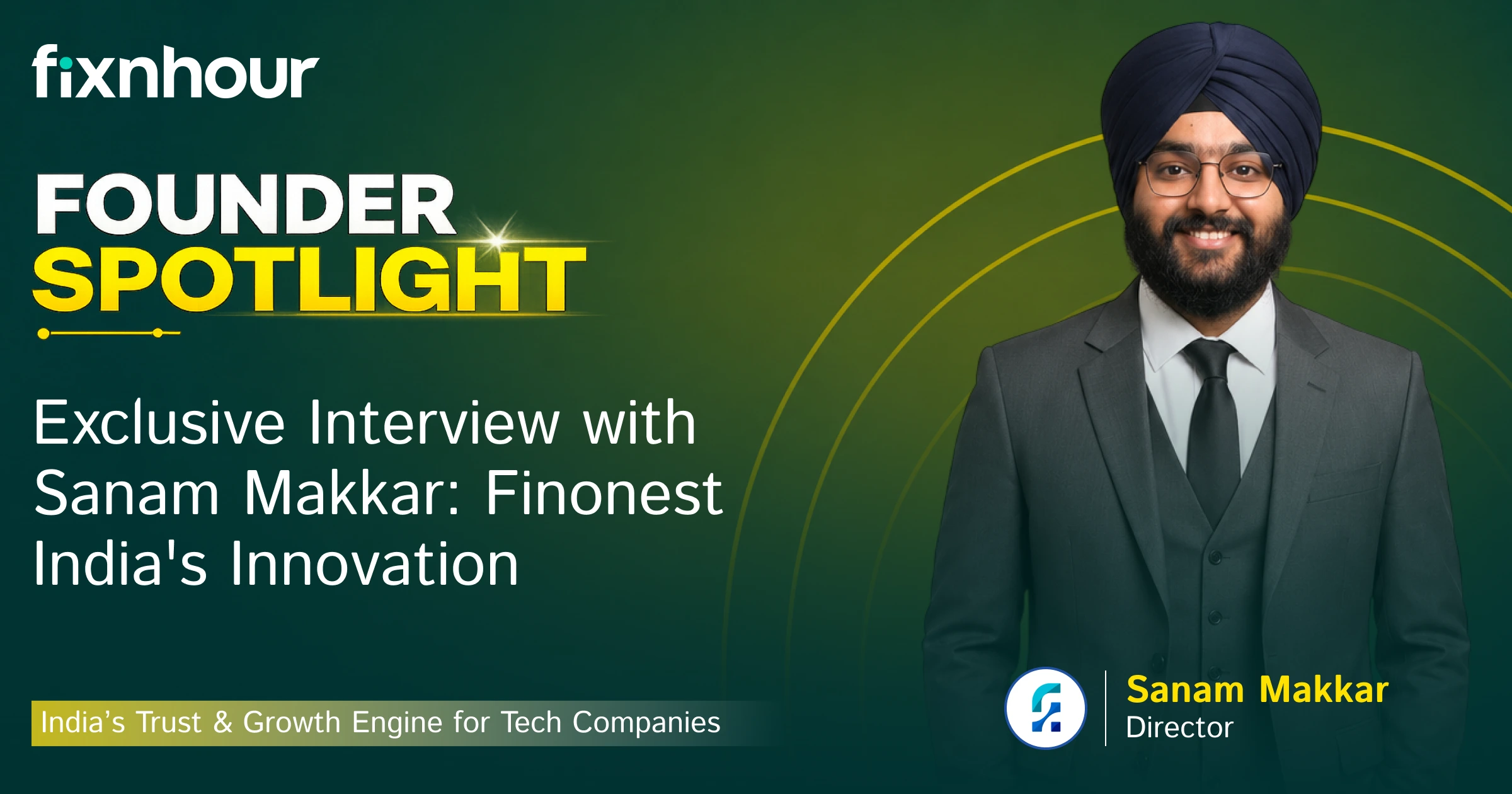
In this exclusive Fixnhour Founder Spotlight, we speak with Sanam Makkar, Director of Information Technology at Finonest India, about his journey as a technology leader and digital innovator. Sanam brings more than ten years of expertise in enterprise technology, product development, and digital transformation and has brought these valuable learnings to building scalable financial platforms, using artificial intelligence, leading high-performing technology teams, and customer-focused innovation that is shaping the future of financial services.
Key Takeaways
- Technologies should be used to solve business problems and not to add to them.
- People come before platforms in the process of digital transformation.
- AI is not about replacement; it's about augmentation.
- The focus of innovation should always be customer experience.
- The key to strong leadership is a blend of technical knowledge and business acumen.
- Technology professionals will never stop learning.
- Successful digital transformation is achieved by collaboration.
- With scalable technology comes sustainable business growth.
- It is essential to be curious and flexible in order to innovate.
- Trust, execution, and customer value are the building blocks for long-term success.
Who is Sanam Makkar?
The financial services sector is going through one of the most significant digital transformations in its history. With continuously changing customer expectations, technology is increasingly taking the lead in providing quicker, smarter, and easier solutions for finance. The key drivers of this transformation are technology leaders with strategic insight and innovative thinking who create products that streamline complex financial practices. Sanam Makkar, Director of Information Technology at Finonest India, is one such leader.
Sanam has contributed over 10 years of technology leadership, digital product development, enterprise solutions, and business transformation, assisting organizations to harness technology and create unparalleled customer experiences. His strengths are in linking business goals to scalable technology solutions that deliver measurable results. Sanam is a strategist with a focus on technology and digital aggregation in financial services at Finonest India. His contributions range from building smart lead management systems to implementing business sourcing portals for loan and credit card offerings—these efforts have bolstered the organization's digital agility and streamlined business processes for the internal teams and partners.
Sanam is unique because he believes technology should not be used just for the sake of automation. Instead, it should provide meaningful business results, enable teams, and provide seamless customer experiences. He brings a leadership style that is innovative, collaborative, and learned, qualities that have enabled him to lead large-scale digital transformation projects successfully. In an era defined by the advent and evolution of artificial intelligence, automation, cloud technologies, and data analytics, Sanam continues to work on developing platforms that are not just solving the problems of today but also preparing for the opportunities of tomorrow. In this exclusive Fixnhour Founder Spotlight, Sanam Makkar is joined by the editor to discuss his journey, the importance of digital transformation in financial services, lessons learned, and his vision for the future of tech-driven financial innovation.
Q1. Sanam, tell us about your professional journey. What inspired you to build your career in technology and digital transformation?
I'm always fascinated with technology because it can solve real-world problems at scale. I knew early in my career that software has so much more to it than coding; it has the power to change the way businesses operate, enhance customer experience, and create new avenues for business growth. In the last 10 years, I've had the good fortune to collaborate on a variety of technology initiatives that deepened my knowledge of enterprise systems, digital products, and business operations. For every project, I learned that the keys to successful technology implementation are understanding people and processes first and then choosing the right tools/platforms.
My career then took me to Finonest India, where I had the chance to fuse technology with the fast-changing financial services landscape. The financial sector is going through tremendous digital transformation, and it has been exciting and rewarding to be a part of it. My current priorities are on developing scalable and customer-centric tech solutions that deliver tangible business results while making financial services more efficient, accessible, and customer-centric.
Q2. Finonest India is building innovative digital solutions for financial services. What is the vision behind these initiatives?
In the past, the financial services sector has been characterized by its lengthy processes, multi-stakeholder nature, and manual workloads. Nowadays, customers demand quick decision-making, streamlined experiences, and digital-first interactions. We want to fill that gap with our vision. We are passionate about building intelligent digital platforms that make business sourcing, lead management, customer engagement, and workflows easy at Finonest India. Rather than thinking about technology as a support, we consider it a business growth driver.
Each of the products we develop is designed to make things more efficient and to make our customers, channel partners, and internal teams better off. Digital transformation is more than just a shift from paper to software. More about re-thinking complete business processes for speed, transparency, and convenience.
Q3. You have led projects like lead management systems and business sourcing portals. How do these solutions create business value?
Technology is useful if it can actually solve real business problems. We have created the Lead Management System that is useful for organizing, monitoring, and optimizing customer interactions throughout the sales lifecycle. It saves time, decreases response time, and increases business visibility. Likewise, our Business Sourcing Portal helps partners manage their loan and credit card sourcing in a more efficient way by using a digital platform. This not only boosts productivity but also contributes to a smoother workflow for all concerned.
The objective behind every project is simple: Reduce operational complexity. Improve decision-making. Provide improved customer experiences. With technology doing those three things, businesses become more competitive.
Q4. Artificial intelligence is transforming financial services. How do you see AI shaping the future of the industry?
AI is one of the most significant technologies in the financial sector. By leveraging AI, businesses can automate repetitive tasks, sift through vast amounts of data, identify fraud, tailor customer experiences, and make quicker business decisions. I think the use of AI should be alongside human expertise, though. Organizations are going to be the ones that bring intelligent automation and human judgment together and will have a future.
Sometimes, it is essential to involve empathy, trust, and ethics in the decision-making process, and these cannot be transferred to technology. Simultaneously, AI can also boost efficiency, enabling professionals to dedicate their time to more value-added tasks rather than tedious administrative work.
Q5. What leadership principles have helped you manage large technology initiatives successfully?
Teams are more effective when they have a clear purpose for their action. Successful leaders build a culture of collaboration, ownership, and ongoing learning. Technology projects are complex, have shifting priorities, and require customer expectations to shift.
Communication skills are just as critical as technical skills. Also, I think the leaders should give authority to teams but not micromanage them. Better outcomes occur when people are trusted, encouraged to innovate, and given opportunities to learn.
Q6. What are the biggest challenges organizations face during digital transformation?
A typical misunderstanding is digital transformation is solely about the adoption of new software solutions. Actually, the real problem is change management. Organizations need to re-engineer processes, train teams, redefine workflows, and integrate technology into business goals.
Leaders' commitment, cross-functional collaboration, and a mindset for constant improvement are all essential to successful transformation. It's not a technology thing that's going to change an organization. Transformation is accomplished by people.
Q7. How do you encourage innovation within technology teams?
Curiosity is the starting point for innovation. I want team members to challenge current practices, investigate new technologies, and experiment all the time to find the next best way of doing things. There's never a time to stop learning in the world of technology. We continually research the latest trends like artificial intelligence, automation, cloud computing, and data analytics to gain insight into how these can add value to business. An environment that encourages individuals to present ideas often results in the most powerful innovations.
Q8. What advice would you give young technology professionals aspiring to become IT leaders?
Never stop learning. Technology evolves fast, and the only competitive edge will be continuous learning. Gain technical skills and business knowledge. The best tech leaders are not only software makers; they're people who understand the business, its operations, and its customers, as well as strategy. As careers develop, communication skills, leadership, adaptability, and problem-solving become more critical. Above all, remain curious. Curiosity drives innovation.
Q9. What is your long-term vision for technology at Finonest India?
We're aiming to develop intelligent, scalable, and customer-focused digital platforms that will continue to make financial services easier. We'll keep investing in AI, automation, analytics, cloud technologies, and new app development and enhance our customer experiences at every interaction. The competition for the future of financial services is the one between the organizations that can meld technology and trust together. That's the direction we're heading in.
Q10. Finally, what message would you like to share with entrepreneurs and technology leaders?
Technology must start with a purpose. Don't create products just because new technologies are available. Create solutions to real customer issues. Continue to be dedicated to learning. Don't neglect your employees. Think long-term. Innovation is not a goal. It's an ongoing process. Companies that continue to be customer-centric and open to technological advancement will continue to make a difference in the coming years.
About the Leader
As the Director of Information Technology at Finonest India, Sanam Makkar spearheads strategic technology initiatives in the financial services sector, with a particular emphasis on digital transformation. He has now been in the enterprise technology, product development, digital platform, and business process innovation space for over a decade, specializing in user-centric, scalable solutions to enhance operational efficiencies and customer experience. His contributions continue to inspire Finonest India's vision of developing smart, technologized financial solutions to transform the lives of businesses, partners, and customers.
Final Thoughts on the Leader
In an interview with Sanam Makkar, you meet a tech leader who always strives to produce tangible business value from innovation. In the context of business transformation, his contributions at Finonest India exemplify the potential of strategic digital transformation to streamline operations, enhance team capabilities, and deliver exceptional customer experiences in a rapidly evolving sector.
Instead of technology being a final objective, Sanam believes it is a means to achieving business growth, operational excellence, and trust with customers in the long term. His leadership style is balanced, and his continuous learning and innovation make him a professional helping shape the future of digital financial services in India. Contact us today