The programming business is going a fresh era, where coding is no longer the only attribute of a effective programmer. AI, cloud, automation, and DevOps are driving a revolution in digital product design, development, scale, and maintenance. In this dynamic landscape, developers exhibiting technical competence along with problem-solving abilities, business acumen, and owning the entire project are becoming more critical.
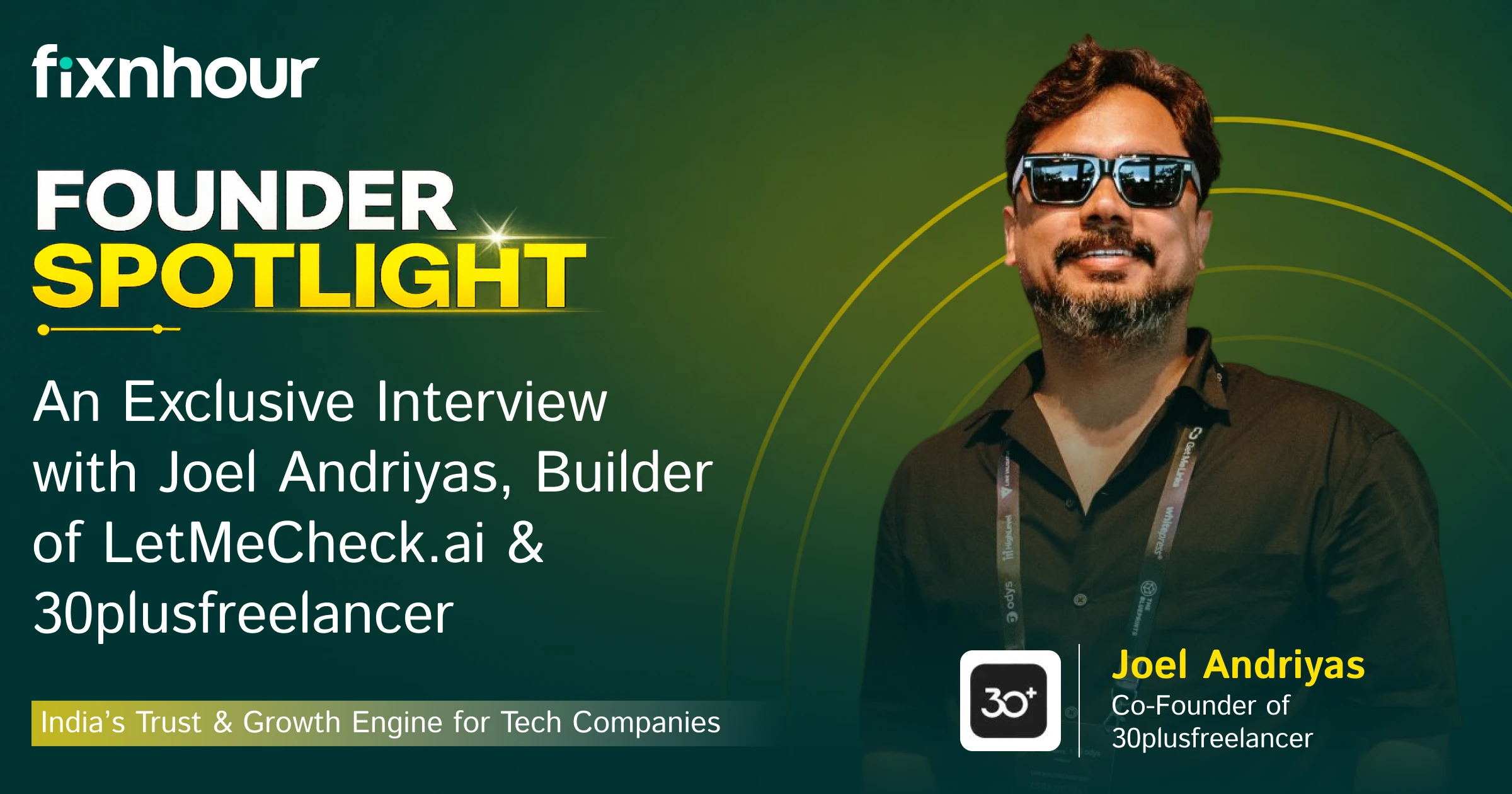
Joel Andriyas is a member of the new breed of technology creators. He has over 10 years of IT development and project lifecycle management experience, and has advanced from a junior developer to a freelance Power Programmer in charge of full technology solutions. He has a broad range of experience across AWS, DevOps, Generative AI, autoscaling, security and cost optimization, and is particularly skilled in scalable and reliable systems development.
Key Takeaways
- Coding speed will be less available and engineering judgement, decision making and problem solving will be more valuable.
- Joel's 10+ years of experience have emphasized the need to see the whole system, not just the bits of code.
- The strong developers must have a knowledge of scalability, security, cloud costs, architecture, and project ownership.
- LetMeCheck.ai shows one way where advanced developers can experiment with AI product development.
- 30plusfreelancer emphasizes the enduring relevance of seasoned tech experts amid the dynamic nature of the tech sector.
- AI can augment the skills of proficient developers, speeding up the processes while ensuring that the final decisions are made by the human developer.
- Emerging developers need to learn how to solve problems and make good technical decisions, rather than just writing code quickly.
- Clear communication, self-awareness and results delivery that adds value are essential for long term success.
Who is Joel Andriyas?
It can take a long time to go from developer to builder to entrepreneur.Typically, this comes after years of making problem-solving increasingly challenging, assuming greater responsibility, knowing and understanding customers on a level beyond what they're technically asking, and ultimately appreciating that technology can be used to not only do the vision of others, but your own too.That is an ongoing process for Joel Andriyas.Joel has been involved in IT development and project lifecycle management for over 10 years, and has evolved from the junior developer to the end to end project manager. He has been a freelance Power Programmer with a particular interest in three of the challenges that grow more critical as technology products scale: autoscaling, security and cost optimization.His current areas of interest are AWS, DevOps, Generative AI and AI native software development.
Joel's story is not just an engineering story.He is actively looking for opportunities to be acquired by companies, working on 30plusfreelancer and developing LetMeCheck.ai. It is interesting that it puts him at the nexus of independent talent, entrepreneurship, AI native product building, and the rapidly evolving economics of the software business.His philosophy is simple: Any problem is a problem solved!In the outside world, Joel is dedicated to physical challenges as well, such as Muay Thai, running and obstacle courses, which demand many of the same traits of consistency, endurance, adaptability, and the ability to keep going when it gets tough that are vital for entrepreneurship.This Fixnhour Founder Spotlight dives into Joel Andriyas's experience as a junior developer to independent software builder, how over a decade of software development has taught him the lessons, and the evolution of AI-native development and why the next generation of technology companies could be entirely different than the last ten years.
Q1. Joel, you started as a junior developer and now build complete solutions independently. What were the biggest turning points in that journey?
The major shift away from a code-only mentality was learning to think about the full problem.As a junior developer, you usually have a specific job to do. You are given a requirement, implement a feature, resolve a problem, and gradually improve your technical abilities.The more experience you gain, the more you realize how everything is connected. Platforms like Fixnhour also help businesses discover experienced technology professionals and development companies that understand these broader project requirements beyond simply writing code.Architecture affects scalability.Cloud costs are impacted by engineering decisions.Security issues are business issues.Communication is a major factor in successful project delivery.Over time, you discover that being a strong developer is not just about writing good code. It is about understanding the business challenge, considering the wider impact of technical decisions, and being accountable for the final results.Probably the most significant shift in my journey has been moving toward end-to-end ownership, understanding the problem, making responsible technical decisions, communicating effectively, and focusing on delivering outcomes that create real value.
Q2. After more than 10 years in technology, why are you particularly excited about becoming an AI-native software developer now?
AI is transforming the software development process, and this shift is nothing new.For years, developers have been working on enhancing productivity with various frameworks, cloud infrastructure, improved automation, libraries and DevOps.Generative AI adds an additional layer of leverage.It can help with coding, debugging, documentation, research, testing, prototyping, and even considering various ways of solving a problem.I don't think the strong developers are going to go away because of AI, though.It transforms development into what it ought to be.The value gradually shifts to architecture, judgement, understanding the problem, security, validation, and an understanding of how things should fit together.This is the fun that makes this time interesting.
Q3. You describe yourself as a “Power Programmer.” What does that mean to you beyond simply being good at coding?
If a Power Programmer is going to work on one part of the application, they will have much less reason to take ownership than someone who is working on a bigger part of the application.One should have a full understanding of the entire system.How will it scale?How will it be kept safe?What will be the running expenses?What shall you do if the traffic suddenly rushes up?Are there any potential bottlenecks?What is the rate at which something can change without affecting the rest of the system?The goal is not to create the most complex code!The goal is to develop the most straightforward dependable solution to a worthwhile task.
Q4. Autoscaling, security, and cost optimization are three areas you emphasize. Why do technology companies struggle so much with balancing them?
Because they are interrelated.The company can implement an infrastructure that can scale to be very large but is very costly.Can be highly cost optimizing, but have performance constraints.It can focus on speed at early stages of development and later find security issues that will be costly to correct.Often there's no single right architecture for any company.It is necessary to know what stage of the business is it, what are the expected usages, risk level, growth and budget.Good engineering frequently involves compromising for the best, not for the ideal.
Q5. You're building LetMeCheck.ai. What problem are you trying to solve, and what have you learned from building an AI-first product?
One of my favorite aspects of building AI products is the interaction between humans and software is evolving.People usually become familiar with a software by learning its interface.AI can now make software understand what the user wants, rather than going by the words they typed.AI opens the door to software comprehending the user's intentions, instead of the text entered.But also, developing an AI product is a learning experience in knowing that just because you add an AI model, doesn't mean you have a useful product.The true challenge is finding a problem that is meaningful and designing an experience that makes the AI-based solution more faster, simpler or smarter.It is more important to think about the product than the technology.
Q6. You're also growing 30plusfreelancer. Why did you feel there was a need to build something around experienced freelancers?
Experience can be a tremendous asset.Experts, having worked on actual projects for years, have encountered production problems, challenging clients, architecture choices, evolving technologies, team challenges, and business constraints.It's not something you'd necessarily see on a resume or freelance profile.I think that companies can benefit from the hands-on knowledge of a more experienced professional when they require someone who can assume responsibility and more than just execute tasks.There is a really intriguing possibility of better linkage of that experience to businesses that are more genuinely interested in it.
Q7. Do you think AI will make experienced developers more valuable or reduce the advantage that comes with years of coding experience?
I believe AI can enable the productivity of professional developers to be greatly increased.Almost everyone benefits from AI-powered faster execution.However, there are differences between speed and judgement.The experienced engineer has had a first-hand look at what can go wrong with systems.They understand trade-offs.They can see that an apparently good solution may lead to another problem.They understand the questions to ask prior to the start of development.AI can help to come up with options in a matter of seconds.It is experience that will tell you which one is the one to use.This can be a very potent mix.
Q8. As AI makes software development faster and cheaper, what happens to traditional software development companies?
What they offer will need to change.However, if a company's core business is to supply developers by the hour, AI will introduce a lot of pressure to such a model.Customers will be more focused on results.If this is such a much needed project, why do they need so many people?Why take so long?What are you doing to leverage AI to boost productivity?Domain expertise, architecture, product thinking, speed, security, reliability, and measurable business outcomes are all ways that technology companies prove value.While AI can cut down on costs of execution, good judgment can prove to be even more valuable.
Q9. Freelancing also requires sales, communication, and trust. What did you have to learn beyond technology to succeed with clients?
Communication is very critical.A client is not always interested in all of the nitty-gritty technicalities.They want to see that you have been able to comprehend their issue, that you can resolve it and what the risks are, and what the cost will be, and when it will be done.Reliability creates trust.Talk about it if there is an issue.If it will take longer, tell why.When you think the client is making a risky decision in a technically challenging area, tell them so, don't do it for them.As the years go by, your reputation is one of your best assets.That's why client recommendations are important to me. They are the experiences that people had with me and not just the technology that I provided.
Q10. You are openly exploring acquihire opportunities. What would make an opportunity attractive enough for you to consider joining forces with another company?
An acquihire to me is more than just a transaction.The problem is solved, the technology is aligned and the people involved, and the opportunity to make something valuable.I would want to be sure that my experience is adding value disproportionately in that environment.It is with the right opportunity that both sides should grow together to become stronger.At times, entrepreneurship involves proceeding on your own.The best way to grow an idea or capability is to merge it with the right organization, sometimes.If you have the choice, then you will have the choices of both situations.
Q11. What has been one of the biggest mistakes or difficult lessons from your decade-long technology journey?
One of the key takeaways is that technical prowess is not enough to win.Technically you can create something that nobody wants.A strong architecture can be established before the business really needs it.You may make months of enhancements to something that the customers are not seeing.There's a way of always going back to the problem, and that's what experience teaches.What do the user need?What does the business require at this time?What is the easiest solution that will reliably solve it?Engineering becomes much more valuable if it remains related to those questions.
Q12. You are serious about Muay Thai, running, fitness, and obstacle courses. Has that influenced the way you approach entrepreneurship and technology?
Definitely.Physical training is about being consistent.There are days when you are motivated and days when you aren't.In order to progress, you still need to show up.Technology and entrepreneurship are similar.You see bugs which you can't solve right away.Projects fail.Clients change requirements.Products don't always receive the response you expected.Requires the skills of being calm, flexible and persistent.Fitness is also a balance to work for me. Physical issues bring a whole new area of focus when you're a professional that spends a lot of time thinking and working with tech.
Q13. What advice would you give a young developer entering the industry when AI can already generate code in seconds?
Avoid AI competition in coding.Understand the functioning of systems.Understand databases.Understand networking.Learn cloud infrastructure.Understand security.Understand architecture and debugging.Most critically, know how to divide a problem into smaller problems.Do use AI but be not reliant on what it spits out.Ask why.Validate outputs.Be aware of the impact of decisions being taken.The developers who are able to mix in good foundations and AI native workflows will have a huge leg up.
Q14. Looking ahead, what do you want the next chapter of Joel Andriyas's journey to look like?
I wish to keep on constructing.It could be anything from cultivating my own products to building an ecosystem of successful freelancers, collaborating with ambitious companies, or finding the right acquihire opportunity, but as long as it's close to something meaningful.Generative AI is ushering in one of the most interesting times of my career.There will be a lot of experimentation.Some ideas are going to get lost.Other will turn into entirely new business types.I want to be a part of the creation of that future and not just a witness.Finally, my philosophy is the same:All problems are opportunities in disguise if taken with the right attitude and worked upon properly.
About Joel Andriyas
Joel Andriyas is a 10+ year technology builder and IT development and project lifecycle management freelance software developer with a native aptitude for AI.He has a passion for end-to-end AWS, DevOps, and Generative AI solutions, including autoscaling, security, and cost optimization.Currently, he's working on LetMeCheck.ai and developing 30plusfreelancer and considering the right acquihire opportunities.Joel's hobbies outside of technology include health and fitness, Muay Thai, running and obstacle course challenges.He believes that the mindset required for technology and entrepreneurship is the same, and that is the simplicity of it all:All problems are potential opportunities.
Final Thoughts on the Founder
Joel Andriyas is a type of tech entrepreneur that's becoming more prevalent: the AI native technical builder.He's not coming to artificial intelligence just because it's an in-vogue technology. His outlook is based on his experience in the harsh realities of software development, project lifecycle management, infrastructure, scalability, security and costs, client delivery for over a decade.That distinction matters.From ideas to operational software, AI is significantly reducing the effort. However, the relationship between software that works and products that are successful has never been the same.The lack of skills is transferred to other fields because execution becomes easier.Selecting the appropriate problem. Creating the correct design architecture. Understanding trade-offs. Building trust. Controlling costs. Protecting users. Understanding the positive and negative effects of scaling. And knowing when to realize that AI is incorrect.
As part of his efforts, Joel is also working on two parallel projects, namely, LetMeCheck.ai and 30plusfreelancer, which mirror two aspects of the future of work.One has to do with leveraging AI to develop new products.The other is the realization of the long-term benefit of old-fashioned humans.The following ideas are not mutually exclusive.They could well be the future technology companies.The people who are going to win the AI era might not necessarily be the ones who will opt for experience against AI.They could be the ones that figure out how to do both. Talk to our experts