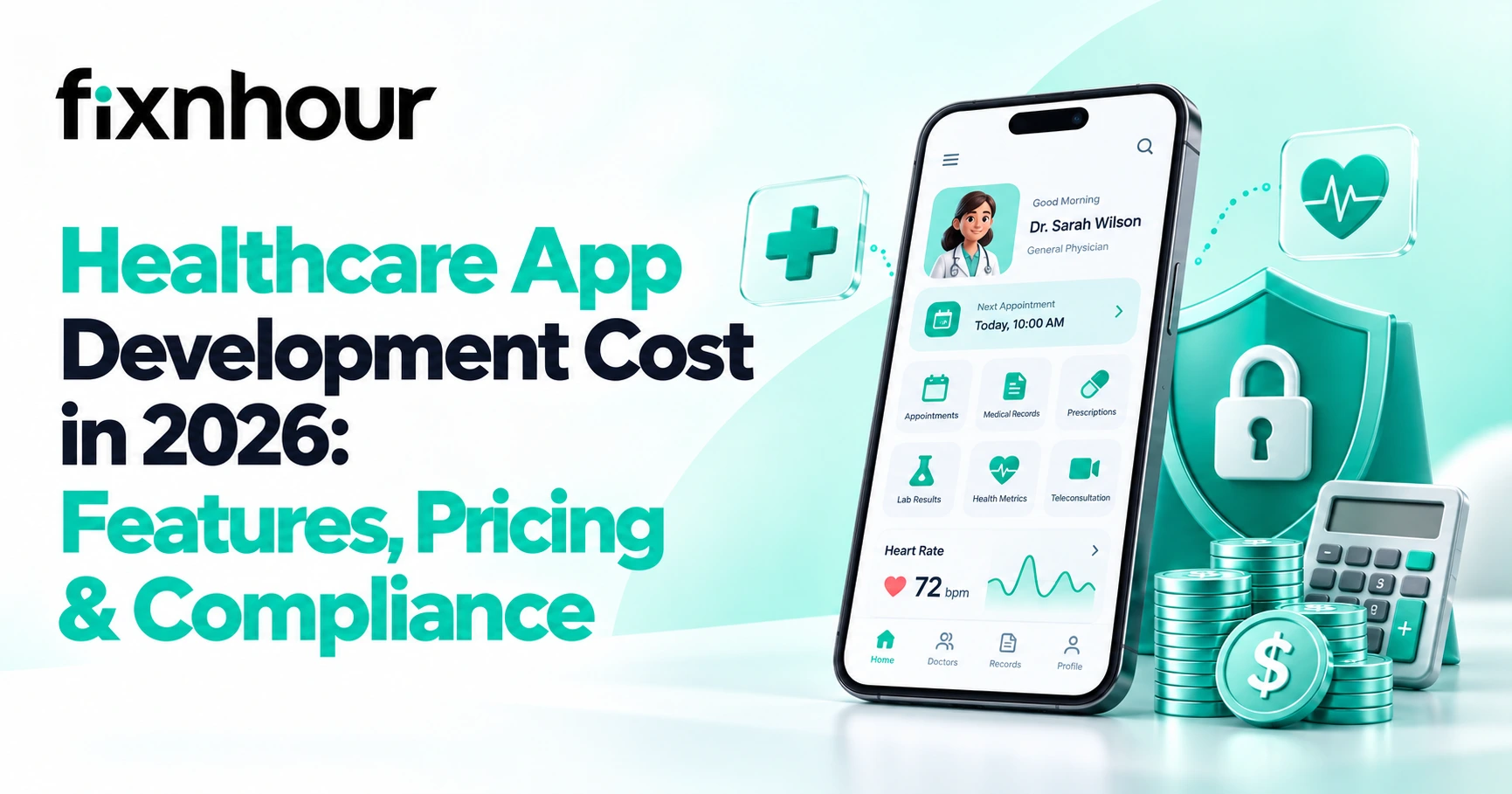
Healthcare is rapidly becoming more digital, with mobile applications helping patients book appointments, consult doctors, manage prescriptions, access medical records, monitor health conditions, and make payments. For healthcare businesses, hospitals, startups, clinics, and telemedicine providers, developing a secure healthcare app can improve patient engagement while creating new digital service opportunities.
However, healthcare app development requires more than attractive design and standard mobile functionality. Developers must consider data security, healthcare integrations, compliance requirements, scalability, accessibility, and ongoing maintenance. These factors directly influence the overall healthcare app development cost in 2026.
Key Takeaways
- Healthcare app cost depends heavily on feature complexity and technology requirements.
- Telemedicine, AI, IoT, and EHR integrations can significantly increase development costs.
- HIPAA, GDPR, and other privacy requirements must be considered during architecture and development.
- MVP development can help businesses validate their healthcare concept before investing in advanced functionality.
- Patient, doctor, and administrator interfaces usually require separate workflows.
- Security testing and compliance should be incorporated from the beginning.
Key Features That Affect Healthcare App Development Cost
Features are one of the biggest contributors to healthcare application development costs. Every additional workflow requires design, development, testing, backend support, security controls, and maintenance.Healthcare Software Firms in USA Healthcare applications also commonly have different interfaces for patients, doctors, and administrators, increasing the overall development scope.
Patient-Side Features
The patient app should make healthcare access simple, secure, and convenient. It should help patients find doctors, book appointments, manage medical information, communicate with providers, and handle payments from one platform.
- Secure registration and login
- Doctor search and appointment booking
- Medical records and prescriptions
- Medication reminders and notifications
Doctor-Side Features
The doctor app should streamline consultations, appointments, patient records, and communication. A well-designed interface enables healthcare professionals to manage availability, review medical information, document consultations, and provide digital healthcare services efficiently.
- Professional profile and availability management
- Appointment and consultation dashboard
- Patient history and medical reports
- Digital prescriptions and secure messaging
Admin Panel Features
The admin panel provides centralized control over the healthcare application. Administrators can manage users, verify doctors, monitor appointments, oversee payments, analyze platform performance, and maintain content and system security.
- Patient and doctor management
- Doctor verification and user permissions
- Appointment and payment monitoring
- Reports, analytics, and content management
Advanced Healthcare App Features
Advanced healthcare applications can use emerging technologies to improve diagnosis, monitoring, personalization, and patient engagement. These capabilities may require specialized development, third-party integrations, secure infrastructure, and additional investment.
- AI-powered healthcare recommendations
- IoT and wearable device integration
- EHR and EMR system integration
- Predictive analytics and remote monitoring
Statistics & Market Insights for Healthcare Apps in 2026
Digital healthcare continues to evolve as consumers, healthcare providers, and businesses increasingly adopt mobile applications, telemedicine platforms, remote monitoring, and AI-enabled healthcare services.Software Development Cost Calculator by Country These developments are influencing the types of applications businesses build and the technologies they prioritize when planning healthcare digital transformation strategies.
Digital Healthcare Adoption Trends
Digital healthcare is evolving rapidly as patients and providers increasingly rely on mobile and connected technologies. These trends are improving accessibility, convenience, remote care, and healthcare management while creating new opportunities for healthcare app developers.
- Growth of telemedicine and virtual consultations
- Increased mobile health application adoption
- Remote patient monitoring and wearable integration
- Digital appointments and online prescriptions
AI and Healthcare Technology Trends
Artificial intelligence is transforming healthcare applications by supporting automation, personalization, communication, and data-driven decision-making. AI-powered solutions can improve operational efficiency while helping healthcare providers deliver more responsive and personalized patient experiences.
- AI-powered healthcare assistants
- Automated clinical documentation
- Predictive analytics and health insights
- Intelligent patient communication and workflow automation
What These Trends Mean for Development Costs
Emerging healthcare technologies can increase initial development costs because they require specialized expertise, infrastructure, security, and integrations. However, strategic investment can improve scalability, automation, performance, and long-term platform capabilities.
- AI infrastructure and specialized development
- Strong data security and compliance
- Third-party API and healthcare integrations
- Cloud computing and continuous monitoring
Benefits of Investing in a Healthcare Mobile App
Healthcare applications can create value for patients, medical professionals, hospitals, clinics, and digital health businesses.IT Services Pricing Guide A well-designed platform can simplify routine healthcare interactions while improving access to information and services. For organizations, mobile applications can also create opportunities to automate workflows, improve communication, and develop scalable digital healthcare services.
Benefits for Patients
Healthcare apps make medical services more convenient, accessible, and organized. Patients can manage appointments, communicate with doctors, access health information, and follow treatment plans from their smartphones.
- Faster appointment booking
- Remote consultations
- Digital prescriptions and records
- Medication reminders and secure communication
Benefits for Doctors and Healthcare Providers
Healthcare applications help doctors manage patient information, appointments, communication, and consultations more efficiently. These tools reduce administrative effort while supporting better coordination and streamlined healthcare delivery.
- Digital patient management
- Centralized medical information
- Better appointment organization
- Remote consultation capabilities
Business Benefits
Healthcare businesses can use mobile applications to improve service delivery, automate operations, strengthen patient relationships, and create scalable digital healthcare solutions that support long-term growth.
- Improved patient engagement
- New revenue opportunities
- Operational automation
- Increased customer retention
Step-by-Step Healthcare App Development Process
A structured development process helps healthcare organizations control scope, manage risks, and create a scalable application.CRM Development Cost From defining the healthcare problem to launching and maintaining the platform, every stage should consider security, usability, compliance, performance, and future expansion. A carefully planned process can also prevent unnecessary development costs.
| Step | Healthcare App Development Process | Key Activities |
|---|---|---|
| Step 1 | Define the Healthcare App Concept | Identify target users, define healthcare services, establish business objectives, select a revenue model, and determine the geographic market. |
| Step 2 | Conduct Market & Competitor Research | Analyze competitor apps, study user reviews, compare pricing models, evaluate market demand, and identify opportunities and market gaps. |
| Step 3 | Define Features & Prepare the MVP | Prioritize essential features such as user registration, profiles, appointment booking, messaging, notifications, and basic administration. |
| Step 4 | Design the UI/UX | Create user flows, develop wireframes, build interactive prototypes, simplify navigation, and conduct usability testing. |
| Step 5 | Develop the Healthcare Application | Build mobile interfaces, backend systems, databases, APIs, cloud infrastructure, and third-party integrations using a secure and scalable architecture. |
| Step 6 | Integrate Security & Compliance | Implement data encryption, authentication, authorization, secure APIs, access controls, audit trails, and applicable healthcare privacy requirements. |
| Step 7 | Test the Healthcare App | Perform functional, security, performance, compatibility, usability, and user acceptance testing across devices and healthcare workflows. |
| Step 8 | Launch & Maintain the App | Deploy on the App Store and Google Play, monitor performance, fix bugs, release security updates, and continuously improve the application. |
Step 1: Define the Healthcare App Concept
Clearly define the healthcare problem, target audience, business objectives, services, revenue model, and geographic market. A well-defined concept provides direction for development and ensures the app addresses genuine user needs.
- Identify target users
- Define healthcare services
- Establish business objectives
- Select revenue model
Step 2: Conduct Market and Competitor Research
Market research helps identify user expectations, competitors, pricing strategies, and opportunities. Understanding existing solutions allows businesses to discover market gaps and create a healthcare application with stronger value.
- Analyze competitor applications
- Study user reviews
- Compare pricing models
- Identify market gaps
Step 3: Define Features and Prepare the MVP
Prioritize essential features for the minimum viable product to launch faster and control development costs. The MVP should focus on solving core user problems while allowing future feature expansion.
- User registration and profiles
- Appointment booking
- Messaging and notifications
- Basic administration
Step 4: Design the UI/UX
A healthcare app should provide a simple, accessible, and user-friendly experience. Wireframes and prototypes help validate navigation, workflows, and usability before developers begin building the application.
- Create user flows
- Develop wireframes
- Build interactive prototypes
- Conduct usability testing
Step 5: Develop the Healthcare Application
Development transforms approved designs into a functional healthcare application using mobile technologies, backend systems, databases, APIs, and cloud infrastructure. Secure architecture should support scalability, reliability, and smooth healthcare workflows.
- Develop mobile interfaces
- Build backend systems
- Integrate databases and APIs
- Connect third-party services
Step 6: Integrate Security and Compliance
Healthcare applications handle sensitive information, making security and compliance essential throughout development. Strong protection mechanisms help safeguard patient data while supporting privacy requirements and secure digital healthcare operations.
- Implement data encryption
- Add authentication and authorization
- Secure APIs
- Maintain audit trails
Step 7: Test the Healthcare App
Comprehensive testing ensures the application works reliably across devices, workflows, and healthcare scenarios. Testing helps identify technical issues, security vulnerabilities, usability problems, and performance limitations before launch.
- Perform functional testing
- Conduct security testing
- Test performance and compatibility
- Complete user acceptance testing
Step 8: Launch and Maintain the App
After testing, deploy the application through appropriate app stores and continuously monitor its performance. Regular maintenance, updates, security improvements, and bug fixes help maintain reliability and user satisfaction.
- Deploy on App Store and Google Play
- Monitor application performance
- Fix bugs regularly
- Release security updates
Conclusion
Healthcare app development in 2026 represents a significant digital investment, but the required budget depends heavily on the application's complexity, features, integrations, security architecture, compliance requirements, development team, and long-term scalability.
A simple healthcare MVP can provide an affordable starting point, while telemedicine, hospital management, AI-powered healthcare, remote monitoring, and EHR-connected applications require larger budgets and specialized expertise.The most effective approach is to define the healthcare problem first, identify the target users, prioritize MVP functionality, design secure architecture, plan compliance requirements early, and gradually introduce advanced technologies based on real user needs. Talk to our experts
Frequently Asked Questions
Q1. How much does it cost to develop a healthcare app in 2026?
Ans. Healthcare app development can cost approximately $40,000 to $300,000 or more depending on complexity. Basic applications with appointment booking and patient profiles require a smaller investment, while telemedicine, AI, EHR integration, IoT, advanced analytics, and compliance requirements can substantially increase development costs.
Q2. What factors affect healthcare app development cost?
Ans. The major factors include feature complexity, number of platforms, UI/UX requirements, backend architecture, development team location, third-party APIs, EHR/EMR integrations, security requirements, compliance obligations, testing, cloud infrastructure, and post-launch maintenance. Defining the MVP and technical requirements early can make cost estimation more accurate.
Q3. How much does it cost to develop a HIPAA-compliant healthcare app?
Ans. The cost of a HIPAA-compliant healthcare application depends on its functionality, architecture, data flows, infrastructure, integrations, security controls, and operational processes. Applications handling protected health information generally require appropriate access controls, encryption, audit mechanisms, secure infrastructure, and compliance planning, which can increase development costs compared with basic applications.
Q4. How long does it take to develop a healthcare mobile app?
Ans. A basic healthcare MVP may take approximately three to six months, while medium-complexity applications can require six to nine months or longer. Advanced telemedicine, hospital management, AI, IoT, and healthcare-integrated platforms may require nine to eighteen months or more depending on scope, testing, integrations, and compliance requirements.
Q5. What features should a healthcare app have?
Ans. Important healthcare application features can include secure registration, patient profiles, doctor search, appointment booking, teleconsultation, secure messaging, digital prescriptions, medical records, payments, notifications, administrative dashboards, analytics, and healthcare integrations. The exact feature set should depend on the application's target users, business model, healthcare service, and regulatory environment.
Q6. How can I make my healthcare app HIPAA compliant?
Ans. HIPAA compliance requires more than adding encryption to an application. Businesses should evaluate applicable HIPAA obligations, implement appropriate administrative, physical, and technical safeguards, control access to protected health information, maintain audit mechanisms, secure data transmission and storage, and work with qualified compliance and legal professionals for their specific use case.
Q7. How much does it cost to develop a telemedicine app with video consultation?
Ans. A telemedicine application with secure video consultation can commonly cost around $80,000 to $180,000 or more. Costs depend on video infrastructure, appointment scheduling, messaging, digital prescriptions, payment integration, patient records, security requirements, third-party APIs, platforms, and the scale of the expected user base.
Q8. Is healthcare app development more expensive than regular mobile app development?
Ans. Healthcare applications can be more expensive than many standard mobile apps because they often require stronger security, sensitive-data management, specialized integrations, compliance considerations, advanced testing, and multiple user roles. However, the actual cost depends on the application's scope rather than simply its classification as a healthcare application.