The healthcare industry is rapidly evolving as hospitals, clinics, insurance providers, pharmaceutical companies, and healthcare startups increasingly adopt digital technologies to improve patient care and operational efficiency. From electronic health records (EHR/EMR) and telemedicine platforms to AI-powered diagnostics and remote patient monitoring, modern healthcare organizations require secure, scalable, and compliant software solutions that meet industry regulations such as HIPAA. Choosing the right healthcare software development company is one of the most important decisions for any healthcare organization. An experienced development partner not only builds high-quality applications but also ensures data security, regulatory compliance, seamless system integration, and long-term scalability. Whether you're developing a patient portal, hospital management system, medical billing platform, wearable health application, or AI-driven healthcare solution, working with the right technology partner can significantly improve project success.
Quick Answer
Healthcare organizations need reliable software partners to build secure, scalable, and HIPAA-compliant digital solutions. The Top 10 Healthcare Software Firms in the USA specialize in custom healthcare software, telemedicine, EHR/EMR systems, AI-powered healthcare applications, cloud solutions, and enterprise healthcare platforms that improve patient care, operational efficiency, and long-term digital transformation. Companies like Fixnhour help healthcare providers develop innovative solutions tailored to modern healthcare needs.
Key Takeaways
- Healthcare software improves patient care and operational efficiency.
- HIPAA compliance is essential for healthcare applications.
- Custom healthcare software supports long-term business growth.
- AI, cloud computing, and telemedicine continue transforming healthcare.
- Choosing an experienced software partner reduces project risks.
- Security, scalability, and interoperability should be top priorities.
- Modern healthcare software increases patient engagement and productivity.
Why Healthcare Software Development Is Essential for Modern Healthcare
Healthcare organizations are under increasing pressure to deliver high-quality patient care while managing operational efficiency, regulatory compliance, and rising patient expectations. Traditional systems often struggle to handle growing amounts of medical data, complex workflows, and the demand for digital healthcare services. This is why custom healthcare software has become a critical investment for hospitals, clinics, diagnostic centers, insurance providers, and healthcare startups. Implementing Data Privacy Best Practices is equally essential to ensure that sensitive patient information is collected, stored, processed, and shared securely while maintaining compliance with healthcare regulations and strengthening patient trust.
Improving Patient Care Through Digital Healthcare
Healthcare software is transforming the way medical services are delivered by making healthcare more accessible, efficient, and patient-centered. Digital healthcare solutions enable providers to offer faster diagnosis, seamless communication, remote consultations, and personalized treatment plans while improving the overall patient experience.
- Enables online appointment scheduling.
- Supports virtual consultations through telemedicine.
- Provides secure patient portals.
- Improves doctor-patient communication.
- Reduces waiting time and administrative delays.
Streamlining Hospital Operations
Modern healthcare software automates routine administrative and clinical processes, allowing hospitals and healthcare providers to operate more efficiently. Automation reduces paperwork, minimizes human errors, improves resource allocation, and enhances collaboration between departments. Automates patient registration and billing.
- Simplifies appointment management.
- Improves inventory and pharmacy management.
- Reduces paperwork and operational costs.
- Enhances staff productivity and workflow efficiency.
Ensuring Regulatory Compliance
Healthcare organizations must comply with strict regulations to protect sensitive patient information and maintain legal compliance. Professional healthcare software incorporates industry standards such as HIPAA compliance, secure authentication, encryption, audit trails, and access controls to safeguard confidential medical records.
- Supports HIPAA-compliant application development.
- Protects confidential medical records.
- Improves audit readiness.
- Maintains secure access control.
- Reduces legal and compliance risks.
Supporting Data-Driven Healthcare Decisions
Healthcare software enables organizations to collect, analyze, and manage large volumes of clinical and operational data for better decision-making. Advanced analytics, artificial intelligence, and real-time reporting help healthcare professionals identify health trends, monitor patient outcomes, optimize treatment plans, and improve hospital performance. Partnering with experienced Software Testing Companies also helps healthcare organizations ensure that applications are thoroughly tested for functionality and regulatory compliance before deployment, resulting in reliable and high-quality healthcare software.
- Generates real-time healthcare analytics.
- Tracks patient treatment history.
- Supports predictive healthcare models.
- Improves clinical decision-making.
- Enables personalized patient care.
Top 10 Healthcare Software Firms in USA for Modern Healthcare
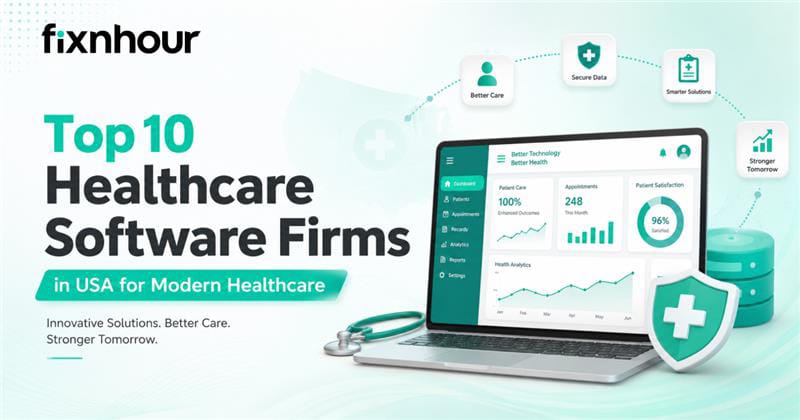
Choosing the right healthcare software development partner is essential for building secure, scalable, and compliant digital healthcare solutions. The companies listed below have been selected based on their healthcare expertise, years of experience, technical capabilities, client satisfaction, innovation, project delivery, regulatory compliance, and overall reputation. Whether you need a telemedicine platform, EHR/EMR system, AI-powered healthcare application, or custom hospital management software, these firms offer reliable solutions for healthcare organizations of all sizes.
| Rank | Company | Core Healthcare Expertise | Best Suited For |
|---|---|---|---|
| 1 | Cognizant | Healthcare applications, cloud modernization, AI, analytics, and interoperability | Hospitals, pharmaceutical companies, insurers, and large healthcare enterprises |
| 2 | ScienceSoft | EHR/EMR systems, patient portals, medical imaging, analytics, and IT consulting | Hospitals, laboratories, pharmaceutical companies, and healthcare providers |
| 3 | BairesDev | Custom applications, AI platforms, cloud development, DevOps, and product engineering | Healthcare startups, providers, and enterprises |
| 4 | ELEKS | Digital health platforms, medical AI, analytics, cloud development, and cybersecurity | Organizations requiring secure and compliant digital transformation |
| 5 | Andersen Inc. | Mobile healthcare apps, enterprise software, cloud platforms, and workflow automation | Hospitals, clinics, medical startups, and healthcare enterprises |
| 6 | Intellectsoft | Telehealth, enterprise applications, cloud modernization, and API integration | Modern healthcare providers and enterprise organizations |
| 7 | Chetu | Hospital management, medical billing, patient management, pharmacy software, and CRM | Hospitals, laboratories, pharmacies, and medical organizations |
| 8 | Simform | Mobile apps, cloud-native solutions, healthcare AI, analytics, and enterprise applications | Providers seeking scalable, cloud-first healthcare platforms |
| 9 | Net Solutions | Healthcare web apps, mobile apps, patient portals, cloud solutions, and product engineering | Organizations focused on patient experience and digital innovation |
| 10 | Appinventors INC | Healthcare AI, telemedicine, IoT, enterprise software, and cloud systems | Startups, hospitals, and enterprises building patient-centric products |
1. Cognizant
Cognizant is a globally recognized healthcare software development company that helps hospitals, healthcare providers, pharmaceutical companies, and insurance organizations accelerate digital transformation. The company specializes in healthcare application development, cloud migration, AI-powered healthcare solutions, data analytics, interoperability, and enterprise healthcare platforms.
- Healthcare application development
- Cloud migration and modernization
- AI-powered healthcare solutions
- Data analytics and interoperability
- Secure enterprise healthcare platforms
2. ScienceSoft
ScienceSoft is a well-established software development company with extensive experience in building healthcare IT solutions for hospitals, laboratories, pharmaceutical companies, and healthcare providers. Its regulatory, interoperability, and enterprise software expertise helps organizations modernize healthcare operations while maintaining security and performance.
- EHR and EMR development
- Patient portal solutions
- Healthcare data analytics
- Medical imaging software
- Healthcare IT consulting
3. BairesDev
BairesDev is a global software development company known for delivering high-quality healthcare applications using modern technologies such as artificial intelligence, cloud computing, and DevOps. Its engineering team supports healthcare startups, providers, and enterprises with complete software development services.
- Custom healthcare applications
- AI-powered healthcare platforms
- Cloud-based software development
- DevOps implementation services
- End-to-end product engineering
4. ELEKS
ELEKS is a leading technology consulting and software engineering company specializing in digital healthcare solutions. With a strong emphasis on quality, cybersecurity, and compliance, ELEKS helps healthcare organizations adopt digital transformation strategies successfully.
- Digital healthcare platforms
- AI-powered medical applications
- Healthcare analytics systems
- Cloud software development
- Cybersecurity and compliance support
5. Andersen Inc.
Andersen Inc. provides comprehensive healthcare software development services for hospitals, clinics, medical startups, and enterprise healthcare organizations. Its experienced team delivers secure, scalable, and high-performance solutions that improve operational efficiency and meet industry requirements.
- Custom healthcare applications
- Healthcare mobile app development
- Enterprise medical software
- Cloud-based healthcare platforms
- Workflow automation systems
6. Intellectsoft
Intellectsoft is an enterprise software development company offering advanced healthcare technology solutions for modern providers. Its technical expertise enables healthcare organizations to improve patient services, streamline operations, and adopt innovative digital solutions.
- Telehealth platform development
- Enterprise healthcare applications
- Cloud infrastructure modernization
- Healthcare API integration
- Secure software development
7. Chetu
Chetu is a custom software development company providing specialized healthcare solutions for hospitals, laboratories, pharmacies, and medical organizations. It focuses on automation, workflow optimization, compliance, and scalable software that supports long-term healthcare growth.
- Hospital management systems
- Medical billing software
- Patient management platforms
- Pharmacy management solutions
- Healthcare CRM development
8. Simform
Simform is a cloud-first software development company helping healthcare organizations build modern, secure, and scalable digital platforms. By leveraging emerging technologies, Simform enables providers to improve operational efficiency, patient engagement, and digital innovation.
- Healthcare mobile applications
- Cloud-native software solutions
- AI-powered healthcare systems
- Healthcare analytics platforms
- Enterprise application development
9. Net Solutions
Net Solutions develops custom healthcare software designed to improve patient experiences and healthcare operations. Its focus on user experience, scalability, and innovation helps organizations establish reliable and future-ready digital healthcare ecosystems.
- Healthcare web applications
- Medical mobile app development
- Digital patient portals
- Cloud healthcare solutions
- Digital product engineering
10. Appinventors INC
Appinventors INC is a globally recognized software development company delivering innovative healthcare technology solutions for startups, hospitals, and enterprise organizations. Its expertise in emerging technologies and healthcare compliance helps businesses create secure, scalable, and patient-centric digital products.
- AI-powered healthcare applications
- Telemedicine platform development
- Healthcare IoT solutions
- Enterprise medical software
- Cloud-based healthcare systems
Benefits of Hiring a Healthcare Software Development Company
Healthcare software development companies provide far more than technical expertise. They become long-term technology partners that help organizations build secure, scalable, compliant, and future-ready healthcare systems. By working with experienced professionals, healthcare providers can improve patient care, streamline operations, strengthen cybersecurity, and accelerate digital transformation while maintaining compliance with healthcare regulations. Many organizations also collaborate with FinTech Software Development Companies to develop secure payment processing systems, medical billing platforms, insurance claim management solutions, and financial healthcare applications that enhance operational efficiency and ensure secure financial transactions.
Improved Patient Care and Experience
One of the biggest advantages of hiring a healthcare software development company is the ability to deliver better patient care and an enhanced healthcare experience. Custom healthcare solutions simplify communication between patients and providers, reduce waiting times, and provide convenient access to medical services. Features such as online appointment scheduling, telemedicine, patient portals, and digital health records help healthcare organizations improve patient satisfaction while delivering faster, more personalized care.
- Faster healthcare services
- Better patient engagement
- Personalized treatment solutions
- Seamless communication
HIPAA Compliance and Data Security
Healthcare organizations handle highly sensitive patient information that must be protected against cyber threats and unauthorized access. Professional healthcare software development companies build applications that comply with HIPAA and other healthcare regulations while implementing advanced security measures such as encryption, multi-factor authentication, role-based access control, and secure cloud infrastructure. This helps organizations reduce compliance risks and strengthen patient trust.
- Secure patient data management
- Regulatory compliance
- Data encryption
- Risk reduction
Custom Healthcare Solutions
Every healthcare organization has unique operational requirements that cannot always be addressed by off-the-shelf software. Experienced healthcare software firms develop customized applications tailored to specific workflows, patient management processes, and business objectives. Custom solutions provide greater flexibility, improved efficiency, seamless integrations, and the ability to scale as healthcare organizations continue to grow.
- Tailored software development
- Industry-specific features
- Scalable architecture
- Easy third-party integrations
Increased Operational Efficiency
Healthcare software automates routine administrative tasks and streamlines clinical workflows, allowing medical professionals to focus more on patient care. Automation reduces paperwork, minimizes human errors, speeds up internal processes, and improves collaboration across departments. As a result, healthcare providers can increase productivity, optimize resource utilization, and deliver higher-quality healthcare services more efficiently.
- Workflow automation
- Reduced administrative tasks
- Faster appointment management
- Improved staff productivity
Cost Savings and Better ROI
Investing in custom healthcare software helps organizations reduce long-term operational expenses while improving overall business performance. Automated workflows, optimized resource management, and fewer manual processes lower administrative costs and reduce costly errors. A well-developed healthcare application also delivers a higher return on investment by improving efficiency, patient satisfaction, and long-term scalability.
- Lower operational costs
- Reduced manual errors
- Faster software deployment
- Long-term business value
Advanced Technologies and Innovation
Leading healthcare software companies leverage emerging technologies to build innovative healthcare solutions that improve diagnosis, treatment, and operational efficiency. Technologies such as Artificial Intelligence, Machine Learning, cloud computing, IoT, and predictive analytics enable healthcare organizations to deliver smarter, faster, and more data-driven medical services while staying competitive in the rapidly evolving healthcare industry.
- Artificial Intelligence integration
- Cloud-based healthcare platforms
- IoT-enabled healthcare solutions
- Data analytics and reporting
Scalable and Future-Ready Applications
Healthcare organizations require software that can grow alongside their business and adapt to changing technologies and regulations. Professional healthcare software development companies build scalable applications that support increasing patient volumes, additional features, cloud expansion, and system integrations without compromising performance. This ensures long-term reliability and supports future digital transformation initiatives.
- Easy feature expansion
- High-performance architecture
- Cloud scalability
- Supports business growth
Ongoing Maintenance and Technical Support
Software development does not end after deployment. Reliable healthcare software companies provide continuous maintenance, security updates, performance optimization, bug fixes, and technical support to keep applications running smoothly. Regular updates ensure compliance with evolving healthcare regulations while minimizing downtime and maintaining optimal software performance.
- Regular software updates
- Performance optimization
- Bug fixing and monitoring
- 24/7 technical assistance
Challenges of Healthcare Software Development
Developing healthcare software is more complex than building traditional business applications. Healthcare organizations must ensure that their software complies with strict regulations, protects sensitive patient information, integrates with existing medical systems, and delivers reliable performance. Understanding these challenges helps businesses choose the right healthcare software development partner and implement successful digital healthcare solutions. Businesses can also gain valuable insights from the Technology Trends Shaping modern software development, as emerging technologies such as artificial intelligence, cloud computing, automation, and advanced cybersecurity continue to improve scalability, security, cloud-native architecture, and overall application performance.
Maintaining Regulatory Compliance
Healthcare software must comply with regulations such as HIPAA, GDPR, and other regional healthcare standards to protect patient information and maintain legal compliance. Keeping up with changing regulations requires continuous monitoring, secure development practices, and regular software updates to avoid legal penalties and security risks.
- Compliance with HIPAA and GDPR
- Secure handling of patient records
- Regular compliance audits
- Reduced legal and financial risks
Protecting Sensitive Patient Data
Healthcare organizations manage highly confidential medical information, making cybersecurity a top priority. Strong encryption, multi-factor authentication, secure cloud infrastructure, and continuous monitoring are essential to protect patient data from cyberattacks, ransomware, and unauthorized access while maintaining patient trust.
- End-to-end data encryption
- Multi-factor authentication
- Role-based access control
- Continuous security monitoring
Integrating with Legacy Healthcare Systems
Many hospitals and healthcare providers continue using older software systems that may not easily connect with modern healthcare applications. Seamless integration with EHR, EMR, laboratory systems, pharmacy software, and medical devices requires technical expertise to ensure smooth data exchange and uninterrupted healthcare operations. Experienced Laravel Developers also play an important role in building secure backend systems, custom APIs, and scalable web applications that simplify legacy system integration while improving performance, security, and interoperability across modern healthcare platforms.
- EHR and EMR integration
- Laboratory information systems
- Medical device connectivity
- Secure API integration
Managing High Development Costs
Healthcare software development often involves significant investment due to advanced security requirements, regulatory compliance, third-party integrations, testing, and long-term maintenance. Organizations must carefully plan budgets while selecting development partners that provide high-quality solutions and long-term value.
- Advanced feature development
- Compliance implementation costs
- Infrastructure investment
- Ongoing maintenance expenses
Ensuring Software Scalability
Healthcare organizations continue to grow by serving more patients, expanding services, and adopting new technologies. Software must be designed to handle increasing workloads, large medical databases, cloud expansion, and additional integrations without affecting system performance or user experience.
- Cloud scalability
- High-performance architecture
- Future-ready infrastructure
- Flexible application growth
Best Practices for Hiring a Healthcare Software Development Company
Businesses can also evaluate the expertise and delivery standards followed by leading Software Development Companies as they often implement proven development methodologies, advanced technologies, and industry best practices to build reliable, high-performance software solutions. By following these best practices during the selection process, organizations can reduce development risks, improve collaboration, accelerate project delivery, and build high-quality healthcare software that supports long-term growth, enhances patient care, and adapts to evolving healthcare technologies and compliance requirements
Conclusion
Selecting the right healthcare software development company is a crucial step toward building secure, scalable, and future-ready digital healthcare solutions. The best healthcare software firms combine technical expertise, industry knowledge, regulatory compliance, and innovative technologies to develop applications that improve patient care, streamline hospital operations, and support long-term business growth. Whether you're developing a telemedicine platform, EHR/EMR system, healthcare mobile app, or AI-powered healthcare solution, partnering with an experienced software company can significantly increase your project's success while ensuring security and compliance.Get a Free Consultation today to discuss your project requirements, receive expert guidance, and discover how Fixnhour can help transform your healthcare ideas into innovative digital solutions that drive better patient outcomes and business growth.
Frequently Asked Questions
Q1. What is healthcare software development?
Ans. Healthcare software development is the process of designing, developing, and maintaining digital solutions for healthcare organizations. These solutions include hospital management systems, EHR/EMR software, telemedicine platforms, patient portals, healthcare mobile apps, medical billing systems, and AI-powered healthcare applications. The primary goal is to improve patient care, streamline operations, enhance data security, and ensure compliance with healthcare regulations.
Q2. Why should healthcare organizations hire a healthcare software development company?
Ans. Hiring a professional healthcare software development company provides access to industry expertise, modern technologies, and regulatory knowledge. Experienced developers build secure, HIPAA-compliant, and scalable healthcare applications while ensuring seamless integration with existing systems, improving operational efficiency, reducing risks, and supporting long-term digital transformation.
Q3. How much does healthcare software development cost?
Ans. The cost of healthcare software development depends on factors such as project complexity, required features, compliance requirements, third-party integrations, development timeline, and technology stack. A simple healthcare application may cost between $10,000 and $30,000, while enterprise healthcare platforms with advanced features can exceed $250,000 depending on business requirements.
Q4. What services do healthcare software development companies provide?
Ans. Healthcare software companies offer a wide range of services, including custom healthcare software development, EHR/EMR systems, telemedicine applications, hospital management software, healthcare mobile apps, patient portals, AI-powered healthcare solutions, cloud migration, API integration, cybersecurity implementation, software testing, maintenance, and ongoing technical support.
Q5. What features should modern healthcare software include?
Ans. Modern healthcare software should include secure patient record management, appointment scheduling, telemedicine capabilities, medical billing, e-prescriptions, role-based access control, data encryption, reporting and analytics, interoperability with EHR/EMR systems, cloud support, and compliance with healthcare regulations such as HIPAA to ensure secure and efficient healthcare operations.
Q6. How long does it take to develop healthcare software?
Ans. Healthcare software development timelines vary based on project size and complexity. A basic healthcare application typically takes 2–4 months to develop, while enterprise-level healthcare platforms with advanced features, integrations, AI capabilities, and compliance requirements may require 6–12 months or longer to complete.
Q7. How do I choose the best healthcare software development company?
Ans. When selecting a healthcare software development company, evaluate its healthcare industry experience, technical expertise, portfolio, client reviews, regulatory compliance knowledge, cybersecurity practices, communication process, pricing transparency, and post-launch support services. Choosing an experienced partner helps ensure a successful, secure, and scalable healthcare software project.
Q8. Why choose Fixnhour for healthcare software development?
Ans. Fixnhour delivers end-to-end healthcare software development services tailored to hospitals, clinics, startups, and healthcare enterprises. Our team specializes in custom healthcare applications, telemedicine platforms, EHR/EMR systems, AI-powered healthcare solutions, cloud-based software, and HIPAA-compliant development. We focus on building secure, scalable, and high-performance healthcare applications while providing transparent communication, timely project delivery, ongoing maintenance, and dedicated technical support to help organizations achieve long-term digital success.