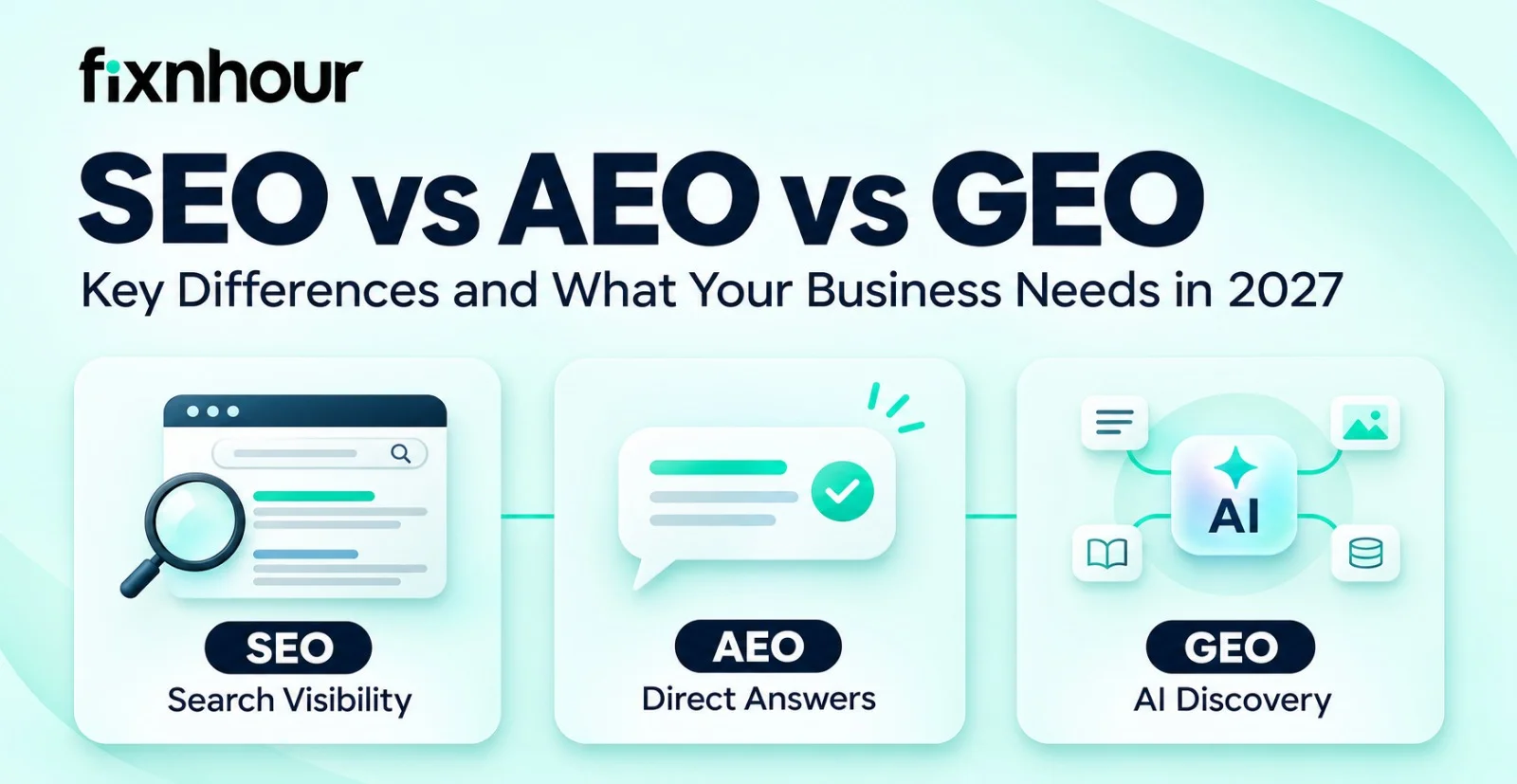
Search behavior is evolving as customers increasingly use traditional search engines, voice assistants, and AI-powered platforms to find information, compare services, and make purchasing decisions. Businesses must understand three important optimization approaches: Search Engine Optimization (SEO), Answer Engine Optimization (AEO), and Generative Engine Optimization (GEO).
SEO improves organic search visibility, AEO helps content appear in direct answers, and GEO focuses on visibility within AI-generated responses. In 2027, combining these strategies can help businesses strengthen their online presence, reach relevant audiences, and support customer discovery across multiple digital platforms.
Quick Answer
SEO improves website rankings and organic traffic in search engines. AEO optimizes content to provide direct answers to user questions, while GEO improves the chances of relevant information and brands being discovered or cited in generative AI responses. Platforms like Fixnhour also support B2B business visibility by helping companies showcase their services, share business information, and improve discoverability among potential buyers. Businesses benefit from combining all three strategies.
Key Takeaways
- SEO improves website visibility in traditional search engine results.
- AEO optimizes content for direct answers, featured snippets, and conversational searches.
- GEO focuses on brand and content visibility in generative AI responses.
- Google, ChatGPT, Gemini, and Perplexity are changing online information discovery.
- High-quality content, technical performance, and brand authority support all three approaches.
- Businesses should integrate SEO, AEO, and GEO rather than depend on one strategy.
- Regular performance measurement helps identify new search opportunities.
What Are SEO, AEO, and GEO? Understanding the Three Optimization Strategies
SEO, AEO, and GEO are three approaches to improving digital visibility, but each addresses a different search experience. SEO focuses on traditional search results, AEO prioritizes direct answers, and GEO addresses generative AI discovery. Understanding the differences between SEO vs AEO vs GEO helps businesses develop an effective digital visibility strategy, create relevant content, and improve brand discovery across search engines, answer engines, and AI-powered platforms. Fixnhour helps businesses strengthen their online presence through business listings and company discovery.
What Is Search Engine Optimization (SEO)?
Search Engine Optimization (SEO) is the process of improving a website's visibility in unpaid search engine results. It involves optimizing website content, technical performance, keywords, and backlinks to help search engines understand and discover relevant pages.
Important SEO activities include:
- Keyword research and search intent analysis.
- On-page optimization and internal linking.
- Technical SEO and website performance.
- Quality backlink development.
- Content updates and organic traffic analysis.
What Is Answer Engine Optimization (AEO)?
Answer Engine Optimization (AEO) focuses on making website content easy to understand, extract, and present as direct answers. It targets question-based searches, featured snippets, voice search, and other answer-oriented experiences where users expect clear information without extensive browsing.
Common AEO techniques include:
- Question-based headings and concise answers.
- FAQ and how-to content.
- Structured information and relevant schema.
- Conversational keyword optimization.
- Clear definitions and comparison tables.
What Is Generative Engine Optimization (GEO)?
Generative Engine Optimization (GEO) is an approach to improving how businesses and their information are discovered, understood, and potentially referenced by generative AI platforms. It emphasizes original content, recognizable brand information, topical relevance, and trustworthy supporting sources.
GEO strategies commonly include:
- Publishing original and informative content.
- Strengthening brand and entity information.
- Supporting expertise with credible references.
- Maintaining consistent business information.
- Monitoring AI-generated brand mentions and citations.
SEO vs AEO vs GEO: What Are the Key Differences?
Although these strategies have different objectives, they share several foundations, including useful content, clear information, and website accessibility. The primary difference is how they support information discovery. SEO targets organic rankings, AEO focuses on direct answers, and GEO addresses generative AI experiences. Businesses can also explore AI Visibility Platforms for Brands in India to strengthen their digital presence, improve brand discoverability, and build consistent business information across search engines and AI-powered platforms. Fixnhour supports business discovery through detailed company listings and profiles.
SEO vs AEO vs GEO Comparison Table
|
Factor |
SEO |
AEO |
GEO |
|---|---|---|---|
|
Main Objective |
Improve organic visibility |
Provide direct answers |
Improve AI search visibility |
|
Focus |
Search engine rankings |
Answer extraction |
AI-powered discovery |
|
Platforms |
Google, Bing |
Featured snippets, voice assistants |
ChatGPT, Gemini, Perplexity |
|
Content Format |
Blogs, landing pages |
FAQs, definitions, guides |
Original, authoritative content |
|
Keywords |
Search keywords |
Conversational questions |
Contextual and semantic queries |
|
Measurement |
Rankings, clicks, traffic |
Answer visibility |
AI citations and brand mentions |
How Do SEO, AEO, and GEO Work Together?
These optimization approaches complement one another. SEO provides a strong website and content foundation, AEO organizes information around user questions, and GEO supports discovery across generative AI experiences. Together, they create a broader visibility strategy.
Why Are SEO, AEO, and GEO Important for Businesses in 2027?
Customers increasingly use different digital platforms to research products, compare service providers, and evaluate business solutions. Traditional search remains important, while AI-powered search introduces additional discovery experiences. Businesses that maintain accurate Verified Business Listings can strengthen their online presence, communicate their services and expertise clearly, and make essential company information easier to discover. Platforms like Fixnhour support business discovery by helping potential customers research, compare, and shortlist relevant service providers throughout their purchasing journeys.
What Do the Latest Search Trends Tell Us?
Google announced in June 2026 that AI Overviews had surpassed 2.5 billion monthly active users and AI Mode had exceeded one billion monthly users. These figures highlight the growing reach of AI-powered search experiences.
Important developments include:
- AI-generated summaries are becoming part of search experiences.
- Conversational queries are supporting more detailed information discovery.
- Businesses have additional opportunities to reach audiences through AI-powered platforms.
- Google introduced dedicated generative AI performance reporting in Search Console in 2026.
Which Businesses Need SEO, AEO, and GEO?
Different businesses can benefit from these approaches depending on their audiences, services, and marketing objectives.
- B2B companies seeking qualified business inquiries.
- SaaS businesses targeting software-related searches.
- IT service providers attracting potential project clients.
- E-commerce brands improving product discovery.
- Local businesses reaching nearby customers.
- Professional service companies building online authority.
What Are the Benefits of SEO, AEO, and GEO?
SEO, AEO, and GEO offer different benefits for improving online visibility and reaching potential customers. SEO supports organic search traffic, AEO makes information easier to find through direct answers, and GEO creates opportunities for discovery through AI-powered platforms. Businesses can use an SEO Agency Pricing Guide to understand potential service costs, plan their digital marketing budgets, and choose suitable optimization strategies. Combining these approaches helps businesses strengthen brand awareness, improve content accessibility, and reach relevant audiences.
What Are the Main Benefits of SEO?
Search Engine Optimization helps businesses improve their visibility in traditional search engine results. A well-planned SEO strategy attracts relevant visitors, improves website usability, and supports long-term organic growth by connecting valuable content with users actively searching for related products, services, and information.
- Improved organic search visibility.
- Opportunities for sustainable website traffic.
- Better website structure and user experience.
What Are the Main Benefits of AEO?
Answer Engine Optimization makes website information easier to understand and access through direct-answer experiences. It helps businesses address customer questions clearly, target conversational searches, and improve opportunities to appear in featured snippets, voice search results, and other answer-focused search experiences.
- Improved opportunities for direct-answer visibility.
- Better coverage of conversational queries.
- Clearer information for potential customers.
What Are the Main Benefits of GEO?
Generative Engine Optimization helps businesses improve their discoverability across AI-powered search platforms. By publishing original, relevant, and authoritative information, companies can strengthen their digital presence, support brand recognition, and create opportunities to be referenced in AI-generated responses.
- Additional opportunities for AI-powered discovery.
- Stronger brand information and entity recognition.
- Potential visibility through AI citations and mentions.
How Much Do SEO, AEO, and GEO Services Cost in 2027?
The cost of SEO, AEO, and GEO services depends on website size, competition, campaign complexity, content requirements, and agency expertise. Businesses may purchase these services separately or through integrated digital marketing packages. Companies exploring Performance Marketing Agencies for E-commerce Brands should also evaluate deliverables, reporting methods, industry experience, and campaign strategies rather than choosing the lowest-priced provider. Selecting services that align with business goals helps improve marketing efficiency, strengthen online visibility, and support long-term growth.
What Factors Influence Optimization Costs?
SEO pricing generally depends on technical audits, keyword research, content development, and backlink requirements. AEO costs may involve answer-focused content, website restructuring, and structured data implementation. GEO services can include AI visibility research, content optimization, brand information development, and citation monitoring.
Before selecting a provider, consider:
- Monthly deliverables and reporting frequency.
- Content creation requirements.
- Technical implementation costs.
- Website size and competition.
- Performance measurement and conversion tracking.
Should Businesses Invest in SEO, AEO, or GEO?
The right investment depends on business priorities. Companies with limited organic visibility may begin with SEO fundamentals, while established websites can expand into AEO and GEO. A combined strategy is useful when customers discover services through traditional search, conversational questions, and generative AI platforms. Review current performance before deciding where additional investment will provide the greatest value.
How to Build an Effective SEO, AEO, and GEO Strategy: Step-by-Step Process
An effective optimization strategy requires research, planning, implementation, and continuous improvement. Businesses should begin by understanding their audiences and search behavior before selecting keywords or creating content. Working with experienced Enterprise IT Consulting Companies can also help organizations identify technology requirements, improve digital infrastructure, and support their optimization initiatives. Combining technical improvements, answer-focused information, and brand authority development helps create a consistent digital presence. Performance monitoring then identifies opportunities to improve visibility, engagement, and qualified business inquiries.
Steps to Implement an Effective SEO, AEO, and GEO Strategy
|
Step |
Strategy |
Description |
Key Activities |
|---|---|---|---|
|
Step 1 |
Understand Your Target Audience |
Identify ideal customers, industry requirements, business challenges, and search behavior to create a focused content strategy. |
Define customer profiles; identify pain points; understand purchasing behavior; analyze search intent; segment audiences. |
|
Step 2 |
Conduct Keyword and Topic Research |
Identify relevant search terms and topics that match customer intent and support business objectives. |
Research primary and secondary keywords; identify semantic and long-tail keywords; analyze competitors; find conversational queries; organize topics by search intent. |
|
Step 3 |
Create Helpful, Original Content |
Develop informative and original content that answers customer questions, demonstrates expertise, and supports the buying journey. |
Create blogs and service pages; develop comparison guides and FAQs; include examples and statistics; use clear headings; publish accurate information. |
|
Step 4 |
Optimize Your Website for SEO |
Improve website structure, technical performance, and on-page elements to help search engines discover and index content. |
Optimize titles and meta descriptions; use relevant keywords; build internal links; improve website speed and mobile responsiveness; fix technical errors. |
|
Step 5 |
Implement AEO Techniques |
Structure website content to help answer engines understand information and provide direct answers to user questions. |
Use question-based headings; provide concise answers; add definitions and comparison tables; implement structured data; address conversational queries. |
|
Step 6 |
Strengthen GEO and Brand Visibility |
Build a consistent online presence to improve the chances of brand and content discovery across generative AI platforms. |
Publish authoritative content; maintain consistent business information; build relevant third-party mentions; showcase case studies; strengthen business profiles. |
|
Step 7 |
Monitor and Improve Performance |
Evaluate optimization results, identify content gaps, and improve strategies based on performance data and changing search behavior. |
Monitor organic traffic and impressions; track keyword rankings; review conversions and leads; evaluate AI visibility; update existing content. |
Step 1: Understand Your Target Audience
Understanding your target audience helps businesses create relevant content that addresses customer needs and purchasing decisions. Identify your ideal customers, industry requirements, business challenges, and search behavior to develop a focused content strategy.
- Define your ideal customer profile and target industries.
- Identify customer requirements, pain points, and expectations.
- Understand purchasing behavior and decision-making processes.
- Analyze informational, commercial, and transactional search intent.
- Segment audiences according to business needs and interests.
Step 2: Conduct Keyword and Topic Research
Keyword research helps identify the search terms potential customers use when looking for products or services. Focus on relevant keywords and topics that match user intent, address common questions, and support your business objectives.
- Identify primary and secondary target keywords.
- Research semantic keywords and related search terms.
- Find relevant long-tail keywords and conversational queries.
- Analyze competitor keywords and content opportunities.
- Organize keywords according to search intent and topics.
Step 3: Create Helpful, Original Content
High-quality content helps businesses answer customer questions, demonstrate expertise, and provide useful information throughout the buying journey. Develop original, well-structured content that addresses audience needs while offering practical insights and relevant examples.
- Create informative blogs and detailed service pages.
- Develop comparison guides and frequently asked questions.
- Include relevant examples, statistics, and expert insights.
- Use clear headings and logical content structures.
- Provide accurate, original, and regularly updated information.
Step 4: Optimize Your Website for SEO
Website SEO optimization improves how search engines discover, understand, and index your content. Focus on on-page elements, technical performance, and user experience to make your website accessible, relevant, and easier for visitors to navigate.
- Optimize page titles and meta descriptions.
- Add relevant keywords to headings and website content.
- Build contextual internal links between related pages.
- Improve website speed and mobile responsiveness.
- Fix technical errors and maintain proper indexability.
Step 5: Implement AEO Techniques
Answer Engine Optimization (AEO) focuses on making website content easier for search engines and answer platforms to understand and extract. Organize information around specific questions and provide direct, accurate answers that address user search requirements.
- Use question-based headings throughout your content.
- Provide concise answers immediately after relevant questions.
- Include definitions, step-by-step explanations, and comparison tables.
- Implement relevant FAQ and other structured data.
- Address conversational queries and frequently asked questions.
Step 6: Strengthen GEO and Brand Visibility
Generative Engine Optimization (GEO) helps improve how your brand and content may appear in AI-generated search responses. Build a consistent digital presence through authoritative content, accurate business information, and relevant references across trusted platforms.
- Publish authoritative and informative industry-related content.
- Maintain consistent business information across online platforms.
- Build relevant mentions and references on third-party websites.
- Showcase expertise through case studies and original insights.
- Strengthen brand identity with complete business profiles.
Step 7: Monitor and Improve Performance
Regular performance monitoring helps businesses understand whether SEO, AEO, and GEO activities support their visibility and marketing objectives. Analyze relevant metrics, identify content gaps, and make improvements based on audience behavior and changing search experiences.
- Monitor organic traffic, search impressions, and clicks.
- Track keyword rankings and landing page performance.
- Review conversions, referral traffic, and qualified leads.
- Evaluate brand mentions and AI search visibility.
- Update existing content based on performance insights.
Conclusion
SEO, AEO, and GEO are complementary strategies that help businesses improve their digital visibility across traditional search engines, answer-based platforms, and generative AI experiences. SEO strengthens organic search presence, AEO makes content easier to understand and access through direct answers, while GEO supports brand discovery in AI-generated responses. Combining these approaches helps businesses reach potential customers across different digital discovery channels.
In 2027, businesses should focus on a balanced optimization strategy that includes technical SEO, high-quality content, conversational answers, brand authority, and consistent business information. Regularly monitoring performance, understanding customer search behavior, and adapting to changes in search technology can help companies maintain online visibility, build credibility, and create more opportunities to connect with their target audiences. Talk to Our Experts
Frequently Asked Questions
Q1. What is the difference between SEO, AEO, and GEO?
Ans. SEO improves organic search rankings and website traffic through keyword optimization, technical improvements, and quality content. AEO focuses on providing clear answers to user questions in search results. GEO helps businesses improve their visibility in generative AI platforms such as ChatGPT, Gemini, and Perplexity. Together, these strategies support broader digital visibility across traditional search engines and AI-powered discovery platforms.
Q2. Is GEO better than SEO for AI-powered search in 2027?
Ans. GEO and SEO serve different but complementary purposes in AI-powered search. SEO helps search engines discover, crawl, and index website content, while GEO focuses on improving brand visibility in generative AI responses. Neither strategy completely replaces the other. Businesses should combine technical SEO, authoritative content, relevant brand mentions, and accurate business information to strengthen their online presence across traditional and AI-driven search experiences.
Q3. How does Answer Engine Optimization improve Google search visibility?
Ans. Engine Optimization improves content accessibility by organizing information around specific user questions and search intent. Businesses can use question-based headings, concise answers, relevant keywords, structured content, and appropriate schema markup. These practices help search engines understand the information and identify relevant answers for suitable search experiences. Although AEO can support featured snippet opportunities, actual placement depends on Google's algorithms, content relevance, and competition.
Q4. How can businesses optimize websites for ChatGPT, Gemini, and Perplexity?
Ans. Businesses can improve their visibility across ChatGPT, Gemini, and Perplexity by publishing original, accurate, and informative website content. They should maintain crawlable pages, demonstrate industry expertise, provide clear company information, and develop relevant third-party references. Publishing detailed service descriptions, case studies, comparison guides, and FAQs can also support information discovery. Regularly monitoring brand mentions, citations, and AI referral traffic helps evaluate performance across generative AI platforms.
Q5. Does GEO replace traditional SEO?
Ans. No, Generative Engine Optimization does not replace traditional SEO. SEO remains essential for website crawling, indexing, technical performance, keyword relevance, and organic search visibility. GEO extends these practices by focusing on how generative AI platforms discover, interpret, and reference information when generating responses. Businesses should maintain strong SEO foundations while developing authoritative content, consistent brand information, and credible online references to support visibility across multiple discovery channels.
Q6. How much do SEO, AEO, and GEO services cost in 2027?
Ans. The cost of SEO, AEO, and GEO services in 2027 depends on business objectives, website size, industry competition, technical requirements, content volume, and campaign complexity. Some agencies offer monthly retainers, while others provide project-based optimization packages or specialized consulting services. Before selecting a provider, businesses should compare service deliverables, content strategies, technical expertise, reporting methods, and performance measurement to ensure the investment aligns with their marketing goals.
Q7. How long does it take to see results from SEO, AEO, and GEO strategies?
Ans. The time required to see results from SEO, AEO, and GEO strategies varies according to website authority, competition, content quality, technical performance, and implementation consistency. SEO improvements may take several months to generate measurable organic traffic growth. AEO visibility depends on content relevance and search engine selection, while GEO visibility can fluctuate across AI platforms. Businesses should monitor impressions, rankings, citations, referral traffic, and qualified leads regularly.
Q8. What is the best SEO, AEO, and GEO strategy for a B2B business in 2027?
Ans. An effective SEO, AEO, and GEO strategy for B2B businesses should combine technical optimization, industry-focused content, question-based answers, original case studies, and consistent company information. Businesses should target relevant commercial keywords and publish detailed service pages that address buyer requirements. Maintaining complete business profiles, collecting genuine customer reviews, and building credible third-party references can also support buyer research, brand visibility, and service provider discovery across search engines and AI-powered platforms.