Search is no longer limited to ten blue links on Google. Customers now discover businesses through featured snippets, AI Overviews, voice assistants, ChatGPT, Gemini, and Perplexity. This change requires companies to make their content searchable, answer-friendly, trustworthy, and easy for artificial intelligence systems to understand, summarize, reference, and recommend.
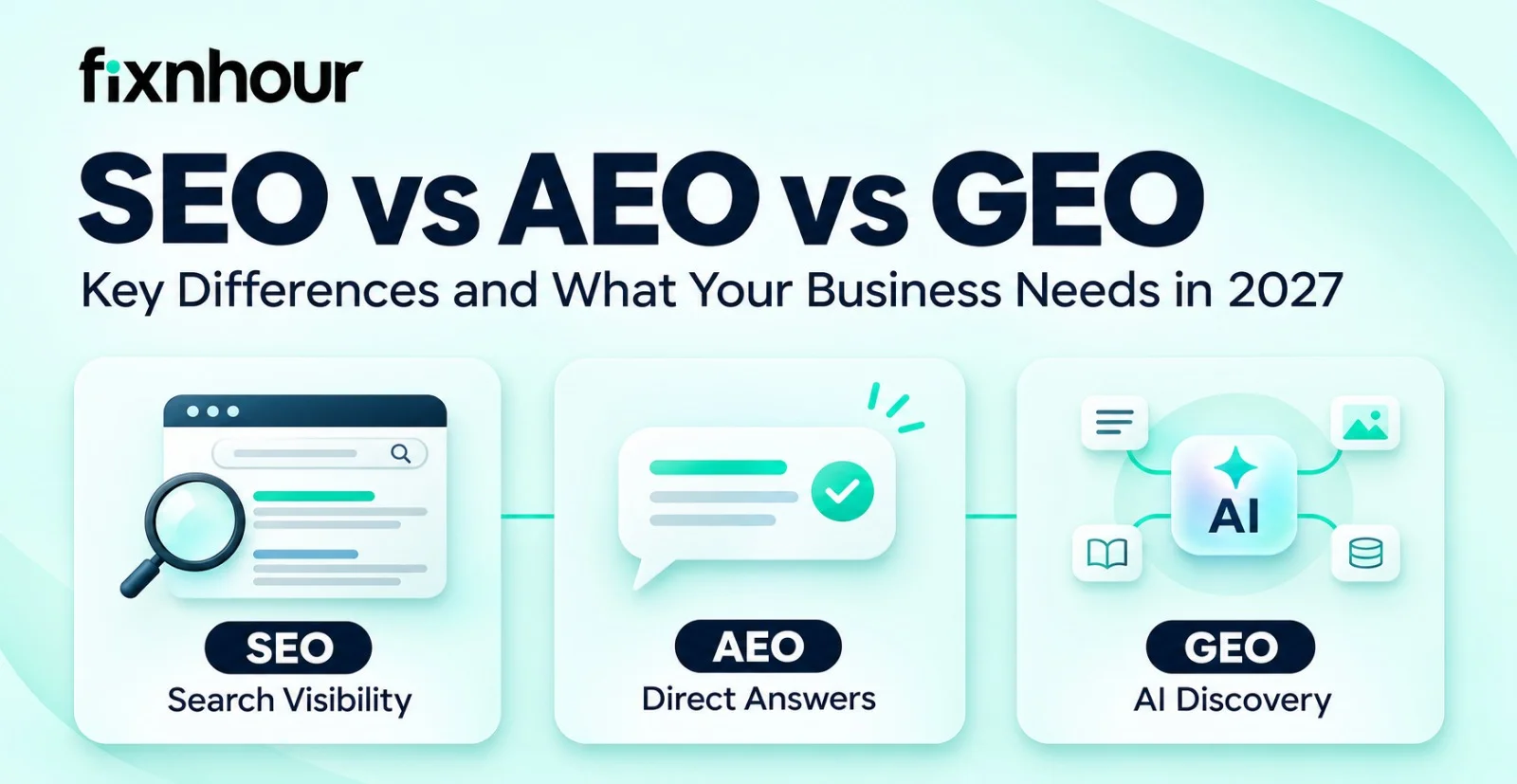
SEO, AEO, and GEO address different parts of this discovery journey. SEO builds organic rankings, AEO targets direct answers, and GEO improves visibility within generative AI responses. Businesses should not treat them as competing methods. An integrated strategy can increase website traffic, brand authority, AI citations, qualified enquiries, and long-term digital visibility.
Quick Answer
Businesses should begin with SEO because technical performance, crawlability, relevant content, and authority support every form of online visibility.seo services platforms They should then use AEO to answer customer questions clearly and GEO to strengthen mentions in AI-generated results. Combining all three creates a complete strategy for traditional, conversational, voice, and generative search discovery.
Key Takeaways
- SEO remains the foundation of online visibility.
- AEO targets featured snippets, People Also Ask, and voice search.
- GEO helps businesses appear in ChatGPT, Gemini, Perplexity, and AI Overviews.
- Strong SEO performance can improve AEO and GEO opportunities.
- Content should provide clear, accurate, and evidence-based answers.
- Brand mentions, reviews, backlinks, and citations strengthen authority.
- Businesses should track visibility and conversions, not traffic alone.
- The right priority depends on customer behavior and existing website performance.
SEO vs AEO vs GEO: What Is the Difference?
SEO, AEO, and GEO have related objectives, but their primary outcomes differ.AI search optimization SEO focuses on rankings and organic traffic, AEO helps platforms deliver concise answers, and GEO improves the chance of being mentioned or cited within generative responses. Understanding these distinctions allows businesses to select appropriate content formats, signals, platforms, and measurement methods.
What Is SEO?
Search Engine Optimization (SEO) improves a website’s visibility in traditional search results such as Google and Bing. It involves keyword research, quality content, technical improvements, backlinks, and user experience to increase organic rankings, attract relevant visitors, and generate consistent website traffic over time for businesses.
A complete SEO strategy covers:
- Keyword and search-intent research
- Technical website optimization
- On-page content optimization
- Internal linking and site architecture
- Authoritative backlink acquisition
- Local and international SEO
- Website speed and mobile usability
What Is AEO?
Answer Engine Optimization (AEO) structures content to provide clear, accurate, and direct answers to user questions. It helps content appear in featured snippets, People Also Ask sections, voice searches, and answer engines by using conversational language, question-based headings, concise responses, structured data, and reliable information online.
Effective AEO content commonly includes:
- Question-based headings
- Short definitions and direct answers
- Numbered steps and bullet lists
- Comparison tables
- FAQ sections
- Relevant schema markup
- Natural, conversational language
What Is GEO?
Generative Engine Optimization (GEO) improves the likelihood of content being mentioned, summarized, or cited by AI platforms such as ChatGPT, Gemini, Perplexity, and AI Overviews. It focuses on authority, factual accuracy, trusted sources, clear entities, expert insights, structured content, and consistent brand information across reputable digital platforms.
GEO focuses on:
- Clear brand and entity information
- Original research and expert insights
- Reliable statistics and source citations
- Third-party mentions and reviews
- Consistent business profiles
- Topical authority
- Easily summarized content
SEO vs AEO vs GEO Comparison
| Area | SEO | AEO | GEO |
|---|---|---|---|
| Full form | Search Engine Optimization | Answer Engine Optimization | Generative Engine Optimization |
| Main objective | Improve organic rankings | Provide direct answers | Earn AI mentions and citations |
| Main platforms | Google and Bing | Featured snippets, voice assistants, and answer engines | ChatGPT, Gemini, Perplexity, and AI Overviews |
| Content focus | Keywords and search intent | Questions and concise answers | Authority, evidence, and entities |
| Common result | Website visit | Direct search answer | AI-generated recommendation |
| Core metrics | Rankings, traffic, and conversions | Snippets and answer visibility | AI mentions, citations, and share of voice |
Statistics and Market Insights
AI-generated search has moved from a limited experiment to a mainstream discovery experience. Google reported in May 2025 that AI Overviews had expanded to more than 200 countries and territories and over 40 languages.Outsource SEO Services This rapid growth shows why businesses must consider visibility beyond ordinary rankings and website clicks in their strategies.
Google continues to integrate generative features into its core search experience. It has described AI Mode as a place for introducing advanced Gemini capabilities before bringing selected features into regular Search. In 2026, Google also announced additional AI-powered and agent-based search experiences, demonstrating that search is becoming more conversational, personalized, and action-oriented.
These developments create several important changes:
- Users can ask longer and more detailed questions.
- Search platforms can summarize information from multiple sources.
- Customers may discover a brand without visiting its website immediately.
- Verified reviews and third-party mentions can influence trust.
- Original research becomes more valuable than generic content.
- Visibility must be measured across both traditional and AI search.
What Should Businesses Prioritize First?
Most businesses should prioritize SEO first, but this does not mean waiting months before considering AEO or GEO.generative ai content marketing A technically accessible website, organized information architecture, and high-quality content create the foundation for all three approaches. Businesses can gradually add direct answers, structured data, expert evidence, brand mentions, and third-party citations while developing their SEO performance.
Prioritize SEO When:
- Important pages are not indexed.
- The website receives little organic traffic.
- Core keywords have weak rankings.
- Pages load slowly or perform poorly on mobile devices.
- Service pages do not match customer search intent.
- The website lacks internal links and authoritative backlinks.
Prioritize AEO When:
- Customers repeatedly ask similar questions.
- The industry receives many informational searches.
- Competitors occupy featured snippets.
- Website content contains long explanations without direct answers.
- Voice and mobile searches are important.
- The business wants greater People Also Ask visibility.
Prioritize GEO When:
- Customers use AI tools to compare service providers.
- Competitors appear in AI-generated recommendations.
- The company operates in a research-intensive B2B market.
- The website already has a reasonable SEO foundation.
- Brand information is inconsistent across online platforms.
- The company needs stronger authority and independent validation.
Priority by Business Type
| Business Type | Recommended Priority |
|---|---|
| New website | SEO first, followed by AEO |
| Local business | Local SEO, reviews, and AEO |
| B2B service company | SEO, GEO, and authority building |
| E-commerce company | Technical SEO, product AEO, and GEO |
| SaaS business | SEO topic clusters, comparison content, and GEO |
| Established brand | Integrated SEO, AEO, and GEO strategy |
Benefits and Challenges of an Integrated Strategy
Combining SEO, AEO, and GEO allows a business to appear wherever customers search for information, solutions, comparisons, or recommendations.AEO vs SEO This approach can improve rankings, answer visibility, brand recognition, topical authority, and qualified enquiries. However, it also requires accurate content, technical resources, regular updates, independent trust signals, and measurement across changing discovery platforms.
Major Benefits
Wider Search Visibility
An integrated strategy gives businesses opportunities to appear in organic results, featured snippets, People Also Ask sections, voice responses, AI Overviews, and generative platforms.
Stronger Brand Authority
Consistent expertise across company pages, educational content, directories, case studies, and industry publications reinforces the brand’s relationship with relevant topics.
More Qualified Enquiries
Answering specific questions helps attract users with clear needs. A customer searching for detailed costs, processes, comparisons, or service providers is often closer to making a decision.
Better User Experience
Organized headings, concise answers, tables, lists, and examples make content easier for both people and search platforms to understand.
Important Challenges
- AI citation tracking is still developing.
- Generative answers can vary between platforms and users.
- Businesses cannot completely control AI-generated descriptions.
- Generic content is unlikely to establish meaningful authority.
- Search features and algorithms change frequently.
- Original research and expert content require resources.
- Results may not always generate direct website clicks.
How Much Do SEO, AEO, and GEO Services Cost?
The cost of SEO, AEO, and GEO depends on website size, competition, target locations, technical condition, content requirements, and authority-building needs. Businesses may purchase individual audits, content packages, or monthly services.How Much Does SEO Cost Since AEO and GEO rely on strong SEO foundations, integrated packages are generally more efficient than treating each strategy as a completely separate activity.
Common Pricing Models
Businesses may encounter the following engagement models:
- One-time technical and content audits
- Monthly optimization retainers
- Per-page content creation or optimization
- Hourly strategy consultations
- Digital PR and authority-building campaigns
- Customized enterprise packages
Factors That Influence the Budget
The final price can vary according to:
- Number of pages requiring optimization
- Industry and keyword competition
- Website performance and technical problems
- Quantity and depth of required content
- Need for original research or expert interviews
- Number of target countries and languages
- Link-building and digital PR requirements
- Frequency of reporting and AI visibility monitoring
Step-by-Step SEO, AEO, and GEO Process
An effective strategy begins with research rather than immediate content production. Businesses must understand their technical condition, audience questions, ranking gaps, competitors, brand reputation, and existing AI visibility. The following process connects website optimization, answer-focused formatting, and authority building so that each activity supports discoverability across Google Search and generative AI platforms.
Step 1: Audit Current Visibility
Review the website’s indexation, rankings, traffic, conversions, featured snippets, backlinks, business listings, reviews, and brand mentions. Test important industry questions across Google, ChatGPT, Gemini, and Perplexity to see which competitors appear.
Step 2: Map Search Intent
Organize keywords and questions according to user intent:
- Informational: “What is GEO?”
- Comparative: “SEO vs AEO vs GEO”
- Commercial: “Best GEO agencies”
- Transactional: “Hire an SEO company”
- Navigational: Searches for a particular brand
Step 3: Strengthen SEO Foundations
Resolve crawling, indexing, mobile usability, Core Web Vitals, duplicate content, broken links, and site-architecture problems. Optimize titles, descriptions, headings, images, URLs, and internal links.
Step 4: Create Answer-Friendly Content
Add direct answers below relevant questions. Use definitions, numbered steps, bullet points, comparison tables, FAQs, and short summaries. Detailed explanations should support the initial answer rather than delay it.
Step 5: Establish Topical Authority
Develop connected content clusters around important services and customer problems. A software company, for example, might publish content about development costs, technology selection, hiring processes, security, timelines, and vendor comparisons.
Step 6: Improve GEO Signals
Publish expert commentary, original data, transparent company details, case studies, and verifiable claims. Earn mentions from relevant publications, directories, review platforms, professional associations, and industry websites.
Step 7: Measure and Improve
Track:
- Organic rankings and traffic
- Featured snippet appearances
- AI citations and brand mentions
- Branded search growth
- Leads and conversion quality
- Visibility compared with competitors
- Pages supporting assisted conversions
Conclusion
SEO, AEO, and GEO are not competing strategies from which businesses must choose only one. SEO builds technical visibility and organic authority, AEO turns valuable information into direct and accessible answers, and GEO helps generative platforms understand, trust, cite, and recommend a brand. Together, they cover the complete modern search journey.
Businesses should first resolve their SEO foundations, then make content easier to extract and strengthen authority across trustworthy sources. The winning strategy is to publish accurate, original, well-structured, and useful information for real customers.Connect With Verified Service Providers Companies that invest in all three areas will be better prepared for Google Search, voice search, AI Overviews, and generative discovery.
Frequently Asked Questions
Q1. What is the main difference between SEO, AEO, and GEO?
Ans. SEO improves organic rankings, visibility, and website traffic. AEO formats content to deliver direct answers through featured snippets, People Also Ask, and voice search. GEO strengthens brand authority and content clarity for AI-generated responses. Although each targets a different discovery experience, all depend on useful content, accessibility, accuracy, and trust.
Q2. Should small businesses prioritize SEO, AEO, or GEO first?
Ans. Small businesses should prioritize technical, local, and on-page SEO to establish strong digital foundations. They can simultaneously support AEO by answering customer questions and GEO by maintaining accurate profiles, earning reviews, and securing credible mentions. However, website accessibility, indexing, usability, and content quality should receive immediate attention before advanced optimization.
Q3. Is GEO replacing traditional SEO?
Ans. GEO is not replacing traditional SEO because AI platforms still depend on accessible, relevant, organized, and trustworthy online information. Instead, GEO extends SEO by optimizing how generative systems understand, summarize, cite, and recommend brands. Businesses need both strategies to remain visible across conventional search results and emerging AI-powered discovery experiences.
Q4. How can businesses optimize content for AI Overviews?
Ans. Businesses can optimize for AI Overviews by providing concise answers, using descriptive headings, covering topics comprehensively, and supporting claims with reliable evidence. Strong technical SEO, structured data, internal linking, expert authorship, and original insights improve credibility. Content should also remain accurate, accessible, regularly updated, and aligned with genuine search intent.
Q5. How can I get my business mentioned by ChatGPT or Gemini?
Ans. No strategy can guarantee mentions from ChatGPT or Gemini. However, businesses can improve their chances by publishing authoritative content, earning genuine reviews, securing reputable backlinks, and maintaining consistent company information. Detailed service pages, case studies, expert articles, directory profiles, and independent brand mentions help AI platforms understand credibility and expertise.
Q6. What type of content works best for AEO?
Ans. Definitions, concise explanations, FAQs, comparison tables, step-by-step guides, and question-based articles work effectively for AEO. The ideal format depends on search intent. Use short paragraphs for definitions, numbered lists for processes, bullet points for quick takeaways, and tables for comparisons. Every answer should be accurate, clear, relevant, and easy to understand.
Q7. How long does SEO, AEO, and GEO take to show results?
Ans. Results may appear within weeks or require several months, depending on website condition, competition, authority, resources, and content quality. Technical improvements and clearer answer formats may deliver early gains. Competitive rankings and consistent AI visibility usually take longer, requiring regular publishing, credible mentions, performance testing, authority building, and continuous content updates.
Q8. How can businesses measure GEO and AI search visibility?
Ans. Businesses can measure GEO visibility by testing consistent prompts across ChatGPT, Gemini, Perplexity, and other AI platforms. Track brand mentions, citations, sentiment, competitor appearances, referral traffic, branded searches, review growth, and assisted conversions. Because generated answers change, companies should monitor the same queries regularly and compare performance over consistent intervals.