In today’s fast-paced business environment, managing employees efficiently is no longer optional. Companies of all sizes are investing in digital HR and payroll solutions to automate operations, reduce manual errors, and improve employee experiences. Two of the most commonly used systems are HRMS software and payroll software. Managing employees and payroll efficiently is essential for every growing business. Many companies often get confused between HRMS and payroll software because both systems handle employee-related operations.
However, their functions and business benefits are quite different. HRMS software offers complete workforce management, while payroll software mainly focuses on salary processing and compliance. Understanding these differences helps businesses choose the right solution based on their operational needs, workforce size, and long-term growth goals. While many businesses use these terms interchangeably, they serve different purposes. Understanding the difference between HRMS vs Payroll software is essential before choosing the right solution for your organization. Whether you run a startup, SME, or large enterprise, selecting the correct Employee management system can help streamline HR operations, ensure salary accuracy, maintain compliance, and improve workforce productivity.
What is HRMS Software? (Human Resource Management System)
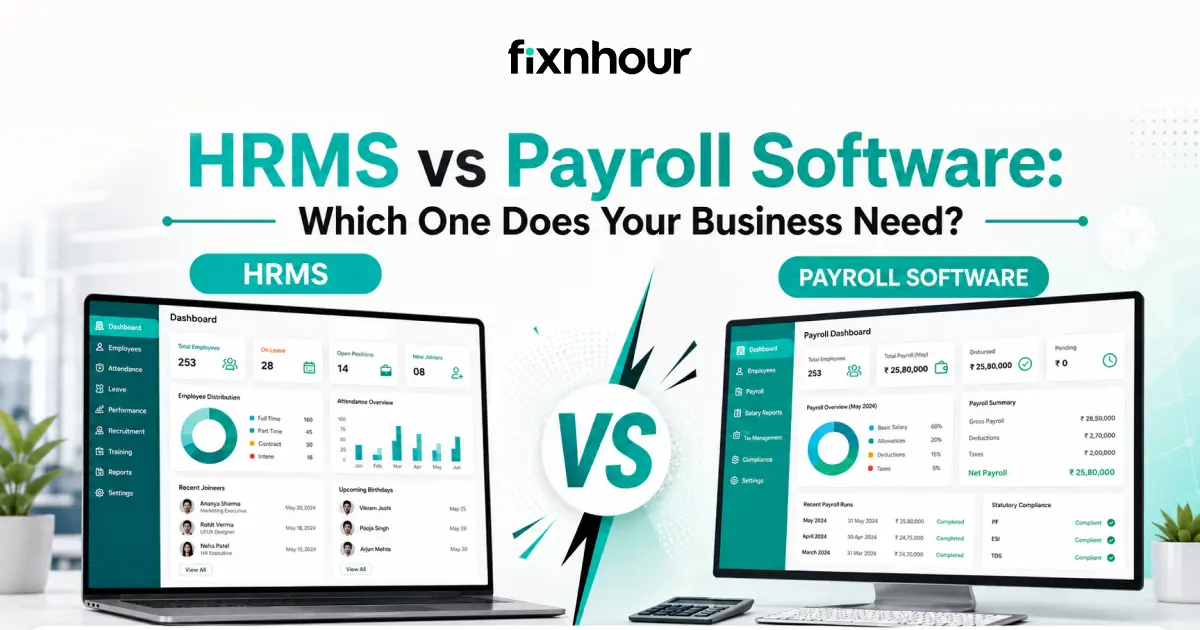
HRMS software, meaning a Human Resource Management System (HRMS), is an integrated software system that provides users with the ability to manage all HR-related functions for an organization. In addition to providing an organization with a central location for the collection of employee data, the HRMS will support an organization's ability to manage employee attendance, recruitment, performance evaluations, and leave requests. The HRMS will also provide support for the onboarding of new employees and will allow for the transfer of training and development information to payroll so that it can be calculated properly.
- Management database of employee data
- Reporting for employee attendance and leave allowances
- Recruitment and onboarding
- Performance evaluations
- Compliance management
- Payroll integration
- Training and development.
Key Differences Between HRMS and Payroll Software
Top HRMS & Payroll Software Companies differ in functionality and business scope. HRMS manages complete human resource operations, including recruitment, attendance, leave, employee records, and performance tracking. Payroll software primarily focuses on salary processing, tax calculations, and compliance management. While HRMS includes payroll as a feature, payroll software is dedicated mainly to employee compensation and payroll accuracy.
| Feature | HRMS Software | Payroll Software |
|---|---|---|
| Meaning | Complete human resource management solution | Software focused on salary and payroll processing |
| Primary Purpose | Complete HR management | Salary and payroll processing |
| Employee Records | Yes | Limited |
| Attendance Tracking | Yes | Sometimes |
| Recruitment Management | Yes | No |
| Leave Management | Yes | Basic / No |
| Payroll Processing | Integrated | Main function |
| Compliance Handling | Advanced | Payroll-focused |
| Performance Management | Yes | No |
| Employee Self-Service | Yes | Limited |
| Best For | Workforce management | Salary processing |
Payroll software features are the following:
- Salary Calculations
- Tax Deduction Calculations
- Bonus & Incentive Payments
- Generating Payslips
- Calculating PF, ESI & TDS
- Payments to Employees' Banks Via Bank Transfer
Also Read: How FixnHour Helps Businesses Reduce Payroll Errors and Revenue Leakage
HRMS vs Payroll Software: Which One Should You Choose?
Choosing between HRMS and payroll software depends on your business needs and workforce size. HRMS Fixnhour software offers complete employee management, including recruitment, attendance, leave, and performance tracking, while payroll software mainly focuses on salary processing and compliance. Businesses seeking full HR automation should choose HRMS, whereas companies needing only payroll management can benefit from dedicated payroll software solutions.
When to Use Payroll Software
For small businesses or new businesses, Payroll management system India can help with payroll processing, tax reporting & compliance, as well as generating pay cheques. It is a cost-effective solution that can be simple for a company with minimum HR operations and manual time & attendance tracking to use.
When to Use HRMS Software
HRMS software meaning a great software package for growing companies that need to recruit and hire employees, track attendance and performance, and gather metrics and data. HRMS can consolidate employee data, support payroll, decrease human error, and help with developing long-term employment relationships and compliance.
Small Business Preference – Cloud HRMS
More and more start-up companies are utilising cloud-based best HR software for small business, which combines payroll software, time and attendance, and an employee management system, which helps lower costs associated with the software; increase efficiencies; and allow for mobility while providing flexibility for future growth of the company's workforce.
Also Read: How Review Platforms Help Businesses Scale Faster in 2026
Benefits of Using an Integrated HRMS + Payroll System
An integrated HRMS and payroll system helps businesses streamline employee management and salary processing within a single platform. It reduces manual work, improves payroll accuracy, ensures better compliance management, and saves time through automation. Businesses also benefit from centralized employee data, real-time reporting, improved attendance tracking, and enhanced employee self-service features for greater operational efficiency.
Centralized Employee Data
Every person’s record, salary, attendance, and payroll documents will reside in one place.
Fewer Errors for Payrolls
When an employee takes time off, is absent from work, has extra hours recorded, or has deductions made from pay, the HR system will automatically sync with the payroll management system India.
More Efficient Compliance with Laws and Regulations
Integrated systems help ensure that companies meet legal obligations for things like labour law compliance, tax compliance, etc.
An Improved Employee Experience
Employees can view payslips, request vacation time, change contact information, and monitor attendance from a self-service web portal.
Time and Money Savings
HR and payroll automation tools not only create ease of use and cost savings for businesses but also free up HR administrators from performing repetitive tasks.
Also Read: How FixnHour Helps Businesses Reduce Payroll Errors and Revenue Leakage
Conclusion
It all comes down to your business needs when selecting HRMS or payroll software. If all you're doing is processing payroll and ensuring compliance, then a payroll management system India is sufficient for you. If you're looking to manage employees from beginning to end, automate workforce processes, and take advantage of advanced HR functionality, then an HRMS would be a better long-term solution. Many businesses now use integrated HR and payroll automation tools, as they simplify company operations, provide greater operational efficiencies, and contribute to company growth. By implementing the right employee management system of Fixnhour as workforce management becomes more digital, your company will have a greater competitive advantage. Contact us today for the best HR software for small businesses.
Frequently Asked Questions
Q1. What is the difference between HRMS and payroll software?
Ans. HRMS and payroll software serve different business purposes. HRMS software manages complete human resource operations, including recruitment, attendance, leave, employee records, and performance management. Payroll software mainly focuses on salary calculation, tax deductions, payslip generation, and payroll compliance. HRMS offers broader workforce management, while payroll software is designed specifically for handling employee compensation and salary processing efficiently.
Q2. Is payroll software included in HRMS?
Ans. Yes, payroll software is often included as a module within modern HRMS solutions. An HRMS integrates payroll processing with employee records, attendance, leave management, and compliance tracking in one system. This helps businesses automate salary calculations, reduce manual errors, and manage HR and payroll operations more efficiently through a centralized platform.
Q3. Which is better for small businesses: HRMS or payroll software?
Ans. For small businesses, the choice between HRMS and payroll software depends on business needs and employee size. Payroll software is ideal for companies mainly focused on salary processing and tax compliance. However, businesses managing recruitment, attendance, leave, and employee performance may benefit more from an HRMS, which provides complete workforce management in a single platform.
Q4. Can HRMS software improve employee productivity?
Ans. Yes, HRMS software can improve employee productivity by automating routine HR tasks such as attendance tracking, leave management, payroll, and performance monitoring. It reduces manual workload, improves communication, and provides employees with self-service access to important information. This allows HR teams and employees to focus more on strategic work, collaboration, and overall business growth.
Q5. Why do companies prefer integrated HR and payroll systems?
Ans. Companies prefer integrated HR and payroll systems because they simplify workforce management by combining employee data, attendance, leave tracking, and salary processing into one platform. This integration reduces manual errors, saves time, improves payroll accuracy, ensures compliance, and enhances reporting. Businesses also benefit from better data management, smoother workflows, and improved employee experience through centralized HR and payroll operations.