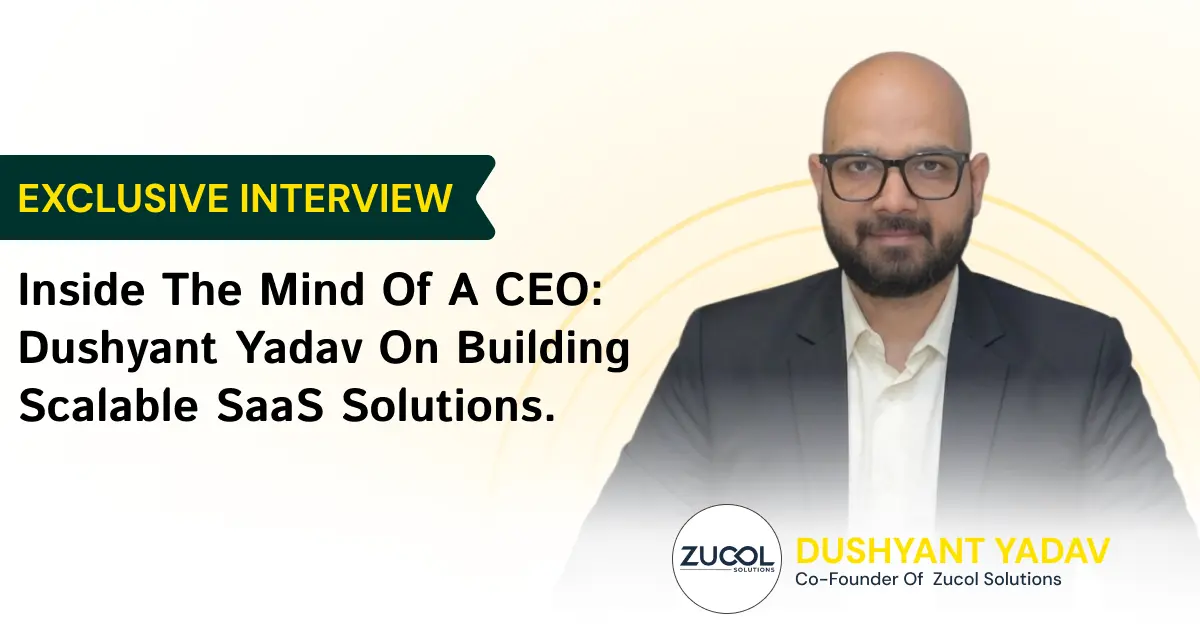
In today’s rapidly evolving digital ecosystem, SaaS (Software as a Service) has become the backbone of modern business transformation. From startups to enterprise-level companies, organizations are focusing on building scalable SaaS solutions that can handle growth, performance, and global demand. In this exclusive insight, CEO Dushyant Yadav shares his strategic vision on how scalable SaaS products are built, optimized, and expanded in competitive markets.
This discussion explores real-world challenges, architecture decisions, product-market fit, monetization models, and leadership strategies behind successful SaaS companies. Whether you are a founder, developer, or investor, these insights will help you understand what it truly takes to build a future-ready SaaS business. Let’s dive into expert perspectives on SaaS scalability, innovation, and long-term growth strategies that define success in 2026 and beyond.
Q1. What inspired you to start building SaaS solutions, and how did your journey begin?
The inspiration to start building SaaS solutions usually comes from spotting real-world problems that lack efficient digital solutions. In my journey, it began with noticing how businesses struggled with repetitive tasks, disconnected tools, and manual processes that slowed growth. That gap sparked the idea of creating software that could simplify operations and deliver measurable results.Early on, the focus was not on building a “big product” but on solving one clear problem for a specific audience. The journey started with validating the idea talking to potential users, understanding their pain points, and testing small prototypes. This phase was crucial in shaping the product direction and avoiding unnecessary features.As development began, challenges like limited resources, technical decisions, and user acquisition pushed continuous learning. Adopting agile methods, iterating quickly, and listening to early users helped refine the product and improve usability.
- Inspired by solving real business pain points
- Focus on cloud-based, scalable architecture
- Passion for product-driven development approach
- Shift from traditional software to SaaS model
- Emphasis on recurring revenue systems
- Building globally accessible digital products
- Long-term vision for tech innovation growth
Q2. How do you define a truly “scalable” SaaS product?
A truly scalable SaaS product isn’t just one that grows it’s one that can handle rapid growth in users, data, and revenue without breaking performance, increasing costs disproportionately, or degrading user experience.At its core, scalability means your product can serve 10x or even 100x more customers with minimal changes to the system, team, or infrastructure. It’s about efficiency, not just expansion.
- Ability to handle growing user demand efficiently
- Cloud-native infrastructure for flexibility and speed
- Modular architecture for easy upgrades
- Strong performance optimization under load
- Automated scaling and deployment systems
- Efficient database and API management
- Business model that supports rapid expansion
Q3. What are the biggest challenges startups face while scaling SaaS platforms?
Startups face several critical challenges while scaling SaaS platforms, and most of them come from growing too fast without strengthening the foundation. In 2026, competition is intense, so scaling successfully requires balancing product, technology, and business execution.One of the biggest challenges is infrastructure scalability. As users grow, systems often struggle with slow performance, downtime, or database overload if architecture is not cloud-native or properly optimized.Another major issue is maintaining product quality while scaling features quickly. Many startups rush innovation but end up introducing bugs, unstable releases, and inconsistent user experiences.Customer churn also becomes a serious problem. If onboarding is weak or the product does not continuously deliver value, users quickly drop off despite high acquisition spending.Startups also struggle with hiring and team scaling. Finding experienced SaaS engineers, DevOps experts, and product managers at the right cost is difficult, which slows down execution.
Q4. How important is product-market fit before scaling SaaS?
Product-market fit (PMF) is the most critical checkpoint before scaling any SaaS business. Without it, scaling usually just means increasing costs faster not revenue or retention.PMF means your product is solving a real, painful, and frequent problem for a clearly defined audience, and users are willing to pay for it, stick with it, and recommend it. In SaaS terms, it shows up as strong retention, low churn, organic growth, and consistent usage patterns.
- Validates real customer demand
- Ensures strong user retention rates
- Reduces risk of product failure
- Helps optimize feature development
- Improves customer acquisition efficiency
- Guides pricing strategy and positioning
- Builds long-term business sustainability
Q5. What tech stack or architecture is best for scalable SaaS?
A scalable SaaS product in 2026 needs a modern, flexible, and cloud-native tech stack that can handle growth, high traffic, and fast feature development without breaking performance or security.The best architecture today is microservices-based, API-first, and cloud-native SaaS architecture. Instead of building one large application, the system is divided into small services (auth, billing, analytics, notifications), making it easier to scale and maintain.On the frontend, popular choices include React, Next.js, or Vue.js, which deliver fast, responsive user experiences. For backend development, Node.js, Go, Java (Spring Boot), or Python (FastAPI) are widely used depending on performance needs and team expertise.
- Cloud platforms like AWS, Azure, GCP
- Microservices-based architecture design
- Containerization using Docker and Kubernetes
- RESTful or GraphQL APIs for flexibility
- Scalable databases like PostgreSQL, MongoDB
- CI/CD pipelines for continuous deployment
- Strong focus on backend optimization
Q6. How do you ensure performance, security, and reliability?
Ensuring performance, security, and reliability is the backbone of scalable SaaS success, especially in 2026 where users expect instant speed, zero downtime, and strong data protection. SaaS companies must design systems that perform consistently even under heavy traffic while staying secure from evolving cyber threats.To ensure performance, companies focus on optimized architecture such as microservices, load balancing, caching (CDN usage), and database indexing. Regular performance testing and monitoring tools help identify bottlenecks before they impact users.For security, a layered approach is essential. This includes data encryption (both in transit and at rest), secure authentication methods like MFA, role-based access control, and regular security audits. Following compliance standards like GDPR or ISO builds additional trust with users and enterprises.Reliability is achieved through strong infrastructure design. High availability systems, automated backups, disaster recovery plans, and redundant servers ensure the platform remains operational even during failures. Continuous monitoring and real-time alerts help teams respond quickly to any issue.
Q7. Role of customer feedback in SaaS scalability?
Customer feedback plays a critical role in SaaS scalability, product improvement, and long-term user retention. In 2026, successful SaaS companies treat feedback as a continuous growth engine rather than an occasional input. It directly shapes product development, pricing strategies, and customer experience optimization.When SaaS businesses actively collect and analyze feedback, they can identify pain points early and fix issues before they lead to churn. This helps improve customer satisfaction and lifetime value (LTV) while reducing acquisition costs.
- Direct insight into user pain points
- Helps prioritize feature development
- Improves product usability and UX
- Enhances customer retention rates
- Drives innovation based on real needs
- Reduces product-market mismatch
- Strengthens customer relationships
Q8. Balancing innovation with stability in SaaS?
Balancing innovation with stability is one of the most important challenges in SaaS scalability, product management, and long-term business growth. In 2026, SaaS companies must innovate quickly to stay competitive while ensuring their platforms remain reliable, secure, and user-friendly.Innovation drives growth by introducing new features like AI automation, predictive analytics, and advanced integrations. These improvements help attract new users and increase customer retention. However, rapid changes without control can lead to system bugs, performance issues, and poor user experience.On the other hand, stability ensures that existing customers can rely on the platform daily without disruption. A stable SaaS product builds trust, reduces churn, and strengthens brand reputation in competitive markets.
Q9. Best monetization strategies for SaaS in 2026?
In 2026, Zoice AI SaaS monetization strategies are becoming more flexible, data-driven, and customer-centric. The focus is shifting from just selling subscriptions to building multiple revenue streams that maximize lifetime value and reduce churn. Companies that adapt early are seeing stronger SaaS growth, recurring revenue, and higher customer retention.Freemium remains highly effective in 2026, especially when combined with smart onboarding that converts free users into paid customers. Many SaaS businesses are also adopting AI-powered personalization, offering premium features like automation, insights, and predictive analytics as upsell opportunities.Another strong strategy is annual billing discounts, which improve cash flow and reduces churn. SaaS companies are also monetizing through add-ons and integrations marketplaces, allowing users to expand functionality as needed.Finally, value-based pricing is gaining popularity, in which pricing is aligned with the actual business value delivered to customers rather than with fixed feature access.
Q10. How to build a high-performing SaaS tech team?
Building a high-performing SaaS tech team requires a balance of strong hiring practices, clear processes, and a culture that prioritizes ownership, scalability, and continuous learning. The foundation starts with hiring the right talent engineers who not only understand coding but also cloud architecture, scalability principles, and product thinking. In SaaS, technical skills alone are not enough; mindset and problem-solving ability matter equally.A successful team structure includes clear roles such as backend developers, frontend engineers, DevOps specialists, QA engineers, and product managers who work closely together. Agile development methodology plays a key role in ensuring fast iteration cycles, transparency, and continuous delivery of value.
Equally important is fostering a culture of ownership, where every team member feels responsible for product performance and user experience. Encouraging open communication between product, design, and engineering teams helps reduce friction and improves execution speed.Investing in modern tools like CI/CD pipelines, cloud platforms, containerization, and monitoring systems ensures smooth deployment and scalability. Regular code reviews, performance audits, and automated testing maintain high-quality standards.Continuous learning is another critical factor. SaaS technology evolves rapidly, so teams must stay updated with the latest frameworks, cloud technologies, and security practices.
Ultimately, a high-performing SaaS tech team is built on trust, technical excellence, collaboration, and a shared vision of delivering scalable, reliable, and user-focused products.
- Hiring skilled full-stack developers
- Strong DevOps and cloud expertise
- Agile development methodology adoption
- Continuous learning and upskilling culture
- Clear communication and ownership roles
- Performance-driven work environment
- Collaboration between product and tech teams
Q11. Common mistakes founders make while scaling SaaS?
Founders often make critical mistakes while scaling SaaS businesses, and these errors usually come from rushing growth without building a stable foundation. One of the most common mistakes is scaling before achieving true product-market fit. When a product is not fully validated, scaling only increases customer churn, support issues, and infrastructure costs without sustainable revenue growth.Another major mistake is poor architecture planning in the early stages. Many startups choose quick, low-cost solutions that later fail under high traffic loads, leading to performance issues and expensive re-engineering. Ignoring technical debt is also a serious problem that slows down long-term scalability.
Founders also underestimate customer feedback, assuming they already know what users want. In reality, ignoring real user insights often leads to irrelevant features and poor user experience. On the business side, weak monetization strategies and unclear pricing models can limit growth potential and reduce profitability.Additionally, many startups fail to invest in the right talent, especially experienced engineers and DevOps professionals who understand scalable systems. Over-hiring too quickly or hiring without technical alignment can also harm productivity.
Lastly, scaling marketing and customer acquisition too aggressively without strengthening retention strategies often leads to high churn rates. Successful SaaS scaling requires balance between growth, stability, user satisfaction, and long-term technical planning.
Q12. Long-term vision for SaaS innovation?
The long-term vision for SaaS innovation is moving toward highly intelligent, adaptive, and deeply integrated digital ecosystems that go far beyond traditional cloud software. In the coming years, SaaS will not just be about delivering applications over the internet it will become the foundation for AI-driven business operations, real-time automation, and hyper-personalized user experiences. Companies are increasingly shifting toward platforms that learn from user behavior, predict needs, and automate complex workflows without manual intervention.
A major direction of SaaS innovation is the integration of artificial intelligence and machine learning at every layer of the product. From customer support automation to predictive analytics and smart decision-making systems, SaaS platforms will become more autonomous and self-improving. Another key trend is the rise of low-code and no-code platforms, enabling non-technical users to build and customize powerful applications quickly, reducing dependency on engineering teams.Scalability will remain a core priority, with cloud-native architectures, microservices, and edge computing enabling global performance at scale. Additionally, SaaS products will increasingly focus on security, data privacy, and compliance as businesses handle more sensitive data across borders.
Overall, the future of SaaS lies in creating intelligent, flexible, and user-centric platforms that not only support businesses but actively drive their growth, efficiency, and innovation in a fully connected digital world.
- AI-powered SaaS platforms growth
- Increased automation in workflows
- Hyper-personalized user experiences
- Expansion into global markets
- Low-code/no-code SaaS evolution
- Strong focus on data-driven decisions
- Continuous innovation and scalability focus
Final words
The journey of building scalable SaaS solutions is never linear t’s a mix of vision, execution, failures, and constant learning. As shared by Dushyant Yadav, success comes from focusing on real customer problems, building with purpose, and scaling with the right strategy. From product-market fit to advanced architecture, every step matters in creating a sustainable SaaS business. If you're looking to build or scale your own SaaS platform, the right guidance can make all the difference contact us today to turn your ideas into powerful, growth-driven solutions.
As the SaaS ecosystem continues to evolve, staying ahead requires innovation, agility, and the right technology partner. Whether you're a startup or an enterprise, leveraging expert support can accelerate your journey and reduce risks. Platforms like fixnhour are helping businesses connect with skilled professionals to build scalable, secure, and high-performing SaaS products for the future.
Read More: Contact us