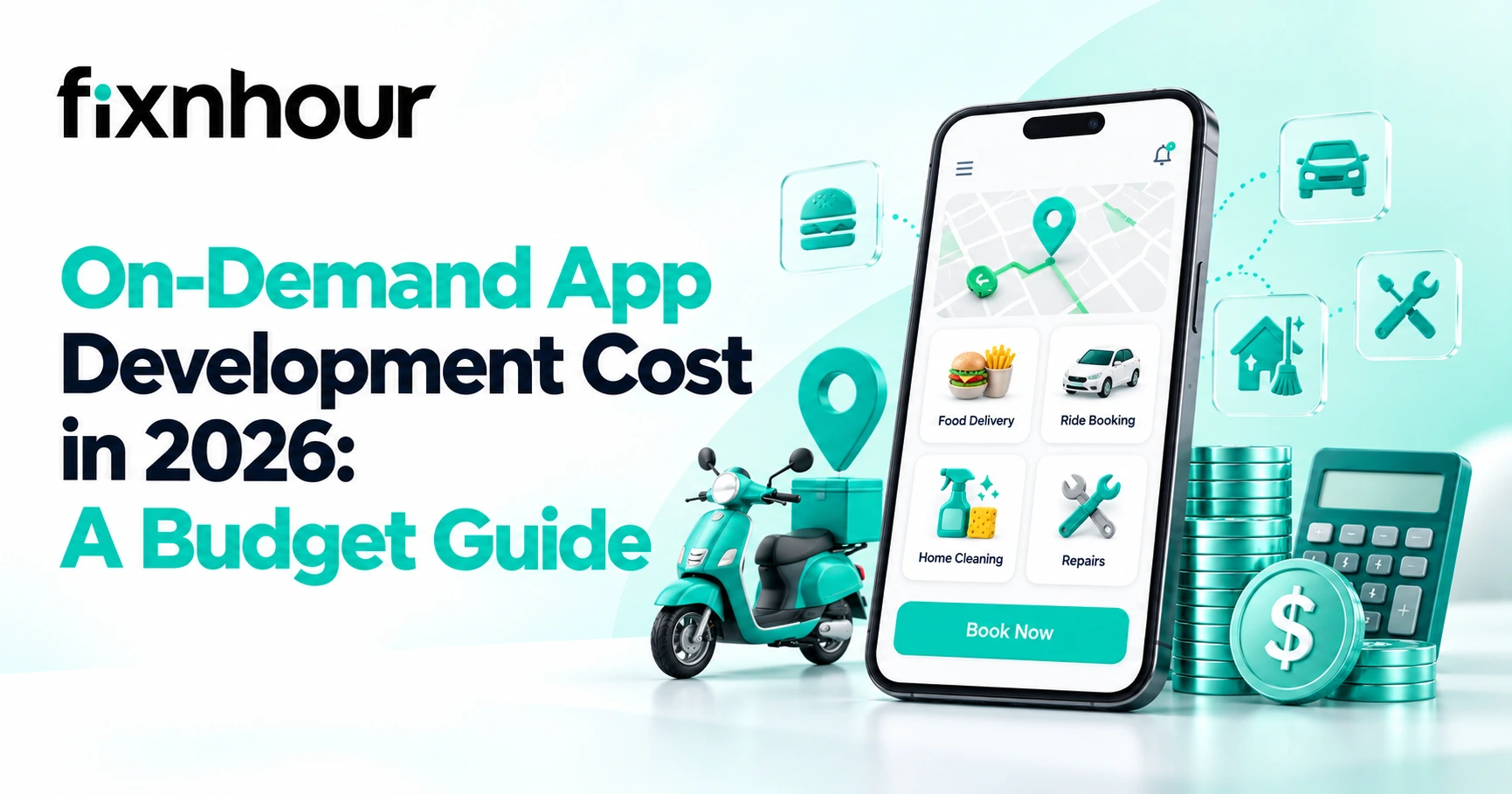
On-demand apps have changed how customers book services, order products, hire professionals, schedule appointments, and access businesses. From food delivery and ride-hailing to healthcare, home services, beauty, logistics, and grocery delivery, businesses are increasingly investing in mobile applications that provide instant access to services.
In this guide, we explain the estimated on-demand app development cost in 2026, major cost factors, essential features, development process, benefits, challenges, maintenance expenses, and future trends so you can create a realistic development budget.
Key Takeaways
- Basic on-demand apps may cost around 25,000–50,000.
- Medium-complexity applications can cost approximately 50,000–100,000.
- Advanced applications with AI, automation, real-time tracking, and complex integrations can exceed $150,000.
- The number and complexity of features significantly influence development costs.
- iOS, Android, and cross-platform development have different budget requirements.
What Factors Affect On-Demand App Development Cost?
On-demand app development costs are not determined by one factor. Features, technology, design, integrations, security, platform selection, and scalability all influence the final estimate.Website Development Pricing in India A simple booking application requires significantly less development effort than a multi-sided marketplace with real-time tracking and automated service allocation.
Features and Functional Requirements
Features directly influence app development costs because complex functionality requires additional development, testing, and integration. Businesses should prioritize essential features while planning advanced capabilities for future updates and scalability.
- User registration and authentication
- Profiles, search, and filters
- Booking, scheduling, and tracking
- Online payments and notifications
Technology Stack
The technology stack affects application performance, scalability, security, development time, and maintenance expenses. Choosing reliable technologies helps businesses build a flexible application that can support growing users, integrations, and future feature requirements.
- Frontend and backend technologies
- Databases and APIs
- Cloud infrastructure and authentication
- Payment gateways and analytics
Essential Features of an On-Demand App
A successful on-demand application normally involves multiple user groups. Customers need a convenient service experience, providers need efficient management tools, and administrators require centralized control.RAG Development Cost Therefore, the application should be designed around the complete service ecosystem rather than focusing only on the customer-facing mobile app.
Customer App Features
The customer application should provide a simple and convenient experience for discovering services, managing accounts, and making bookings. A well-designed customer app improves engagement by helping users quickly find suitable providers and access services whenever needed.
- Sign-up and Login: Secure registration through email, phone number, social accounts, or other authentication methods.
- Profile Management: Users can update personal information, preferences, addresses, payment details, and account settings.
- Service Discovery: Customers can browse available services, providers, pricing, ratings, reviews, and detailed service information.
- Search and Filtering: Advanced filters allow users to find services based on location, price, availability, ratings, categories, and other preferences.
Service Provider Features
Service providers need dedicated tools to manage their profiles, services, availability, bookings, and customer interactions efficiently. These features help providers organize daily operations while responding quickly to customer requests and managing their service delivery.
- Provider Registration: Service professionals can create accounts, submit required details, and complete verification before offering services.
- Profile Management: Providers can update business information, service descriptions, pricing, images, working areas, and professional details.
- Availability Settings: Providers can define working hours, available dates, time slots, holidays, and service availability.
- Booking Management: Providers can view upcoming requests, accept or reject bookings, manage orders, and update booking statuses.
Admin Panel Features
The admin panel provides centralized control over the entire application ecosystem. Administrators can monitor users, providers, services, transactions, and platform activity while maintaining security, quality standards, and smooth business operations.
- User Management: Admins can monitor customer accounts, update user information, manage permissions, and handle account-related issues.
- Provider Management: Administrators can verify providers, manage profiles, review documents, approve accounts, and monitor provider performance.
- Service Management: Admins can add, edit, categorize, approve, or remove services while controlling pricing and service availability.
- Platform Monitoring: The dashboard can track bookings, payments, complaints, reviews, reports, analytics, and overall application performance.
Step-by-Step On-Demand App Development Process
Developing an on-demand application requires more than coding. A structured development process helps businesses validate their idea, prioritize features, reduce unnecessary expenses, and create a scalable product.Fixnhour From market research and MVP planning to testing and post-launch optimization, every stage can influence the final cost and quality.
| Step | Development Stage | Key Activities | Purpose |
|---|---|---|---|
| Step 1 | Define the Business Model | Target customers, service providers, revenue model, pricing strategy, competitors, and unique selling proposition | Establishes the app’s target market, business structure, and competitive advantage. |
| Step 2 | Plan the MVP | Customer features, provider functionality, secure payments, booking, and admin management | Focuses on essential features to launch faster, test demand, and validate the business idea. |
| Step 3 | Design the UI/UX | User research, user journeys, wireframes, interactive prototypes, and usability testing | Creates an intuitive, engaging, and easy-to-navigate application experience. |
| Step 4 | Develop the Application | Frontend, backend, database, APIs, authentication, security, payments, and admin infrastructure | Converts approved designs into a fully functional and scalable application. |
| Step 5 | Test and Launch | Functional, performance, compatibility, security, API, payment, and load testing | Identifies technical issues and ensures reliable performance before launch. |
| Step 6 | Maintain and Scale | Performance monitoring, bug fixes, security updates, new features, analytics, and user feedback | Keeps the application secure, stable, competitive, and ready for long-term growth. |
Step 1: Define the Business Model
A clear business model establishes the app’s target audience, service structure, revenue strategy, market scope, and competitive advantage. It helps businesses understand customer needs and create a marketplace or service platform with sustainable growth potential.
- Target customers and user needs
- Service providers and offerings
- Revenue and pricing model
- Competitors and unique selling proposition
Step 2: Plan the MVP
Planning an MVP helps launch the application faster by focusing on essential features instead of unnecessary functionality. A well-defined MVP allows businesses to test demand, collect feedback, and validate the concept before investing further.
- Essential customer features
- Provider functionality
- Secure payment processing
- Booking and admin management
Step 3: Design the UI/UX
UI/UX design focuses on creating an intuitive, visually appealing, and user-friendly application. Designers study user expectations, map journeys, develop prototypes, and test usability to ensure smooth navigation and engaging digital experiences.
- Conduct user research
- Create user journeys and wireframes
- Develop interactive prototypes
- Perform usability testing
Step 4: Develop the Application
During development, technical teams transform approved designs into a functional application. They build the frontend, backend, database, APIs, authentication systems, payment integrations, and administrative infrastructure required for reliable operation.
- Frontend and backend development
- Database and API integration
- Authentication and security
- Payment and admin infrastructure
Step 5: Test and Launch
Thorough testing ensures the application performs reliably across different devices, environments, and user scenarios. Before launch, developers identify technical issues, strengthen security, validate payments, and optimize performance for a smooth user experience.
- Functional and performance testing
- Device and compatibility testing
- Security and API testing
- Payment and load testing
Step 6: Maintain and Scale
After launch, continuous maintenance keeps the application secure, stable, and competitive. Businesses should monitor performance, resolve technical issues, study user behavior, release improvements, and introduce new capabilities according to changing customer expectations.
- Monitor performance and analytics
- Fix bugs and security issues
- Release regular updates
- Add features based on feedback
Statistics & Market Insights for On-Demand Apps
The on-demand economy continues to expand as consumers become increasingly comfortable with digital ordering, mobile payments, instant booking, and location-based services.cybersecurity Services Pricing Guide Businesses across transportation, food delivery, healthcare, home services, logistics, beauty, and professional services are adopting mobile-first experiences to improve convenience and operational efficiency.
On-Demand Economy Trends
Major trends include:
- Growing demand for instant services
- Mobile-first customer experiences
- Digital payment adoption
- Location-based service delivery
- Personalized recommendations
Technology Trends Influencing Development Costs
Technologies such as AI, cloud computing, real-time location tracking, automation, analytics, and generative AI are expanding what on-demand applications can offer.
However, advanced technology can increase development costs because it may require specialized developers, additional infrastructure, data processing, testing, and ongoing optimization.
Benefits of Investing in On-Demand App Development
On-demand applications can create value for businesses, customers, and service providers simultaneously.Cloud Migration Cost By connecting demand and supply through a digital platform, companies can simplify transactions, automate operations, collect valuable customer data, and provide faster services while creating new revenue opportunities.
Benefits for Businesses
- Increased revenue opportunities
- Better customer engagement
- Automated operations
- Improved service management
- Stronger customer relationships
- Better business analytics
Benefits for Customers
Customers benefit from:
- Faster service access
- Convenient booking
- Real-time updates
- Multiple payment options
- Transparent pricing
- Personalized experiences
Benefits for Service Providers
Service providers can use on-demand platforms to:
- Reach more customers
- Manage bookings
- Track earnings
- Control availability
- Communicate with customers
- Build their digital reputation
Conclusion
The on-demand app development cost in 2026 depends on much more than the number of screens or the developer's hourly rate. Features, user roles, platform selection, UI/UX complexity, backend architecture, integrations, security, real-time functionality, AI capabilities, and long-term maintenance all contribute to the final investment.
A realistic budget should therefore include not only development but also design, testing, cloud infrastructure, third-party services, security, maintenance, and future scaling. With the right technology strategy and development partner, an on-demand application can become a scalable digital platform rather than simply another mobile app. Talk to our experts
Frequently Asked Questions
Q1. How much does it cost to develop an on-demand app in 2026?
Ans. The cost of developing an on-demand app in 2026 generally ranges from $25,000 to $150,000 or more. A basic MVP may cost approximately 25,000–50,000, while medium-complexity applications can range from 50,000–100,000. Advanced platforms with AI, real-time tracking, complex APIs, multiple user roles, and sophisticated backend systems can exceed $150,000. The final price depends on features, platform, design complexity, technology stack, development team, integrations, security requirements, testing, and maintenance.
Q2. What is the average cost to build an on-demand service app?
Ans. The average cost depends primarily on the complexity of the service platform. A basic service-booking application may start around $25,000, while a feature-rich platform can cost $100,000 or more. Applications requiring real-time tracking, online payments, provider management, chat, advanced analytics, and multiple user roles require additional development effort. Businesses should define an MVP first and obtain a detailed estimate based on their exact features rather than relying only on generic industry pricing.
Q3. How much does it cost to build an on-demand delivery app?
Ans. An on-demand delivery app can cost approximately 30,000–150,000+, depending on its functionality. A basic delivery application may include ordering, payments, notifications, and order management. More advanced platforms can require GPS tracking, route optimization, driver management, automated dispatch, multiple vendors, digital wallets, ratings, promotions, and analytics. Grocery, food, pharmacy, logistics, and multi-vendor delivery applications can have different requirements, so development costs vary according to the business model and operational complexity.
Q4. What factors affect the cost of on-demand app development?
Ans. The major cost factors include application complexity, number of features, platform selection, UI/UX requirements, backend architecture, APIs, payment gateways, real-time tracking, security, development team location, testing, cloud infrastructure, and maintenance. Advanced technologies such as AI, machine learning, automation, and predictive analytics can also increase the development budget. A well-defined feature list and technical specification make it easier to estimate the project cost accurately before development begins.
Q5. How much does it cost to build an on-demand app for iOS and Android?
Ans. Developing an on-demand application for both iOS and Android generally costs more than building for one platform because additional testing, optimization, and platform-specific requirements are involved. However, cross-platform technologies can potentially reduce development time by allowing teams to reuse a significant portion of the codebase. The final cost depends on the application's functionality, design, backend complexity, integrations, and whether native or cross-platform development is selected.
Q6. Is it cheaper to build an MVP for an on-demand app?
Ans. Yes. Building an MVP is usually more cost-effective than developing a complete application with every planned feature. An MVP focuses on the core functionality needed to launch the product and validate the business model. Once customers begin using the application, businesses can analyze feedback and usage data before investing in advanced features. This approach can reduce initial development costs, shorten time to market, and minimize the risk of spending heavily on features customers may not need.
Q7. How long does it take to develop an on-demand mobile app?
Ans. Development time can range from approximately 3 to 12 months or more, depending on the project's complexity. A basic MVP may take three to five months, while medium-complexity applications can require five to eight months. Advanced platforms involving AI, real-time tracking, complex integrations, multiple user roles, and sophisticated backend infrastructure can take eight to twelve months or longer. Planning, design, development, testing, deployment, and revisions all contribute to the overall timeline.
Q8. How can I reduce on-demand app development costs?
Ans. Businesses can reduce development costs by starting with an MVP, prioritizing essential features, selecting an appropriate technology stack, using reliable third-party APIs, choosing cross-platform development when suitable, and planning requirements carefully before coding begins. It is also important to avoid unnecessary customization and feature overload during the first release. However, businesses should not compromise on essential areas such as security, scalability, testing, user experience, and payment reliability simply to reduce the initial budget.