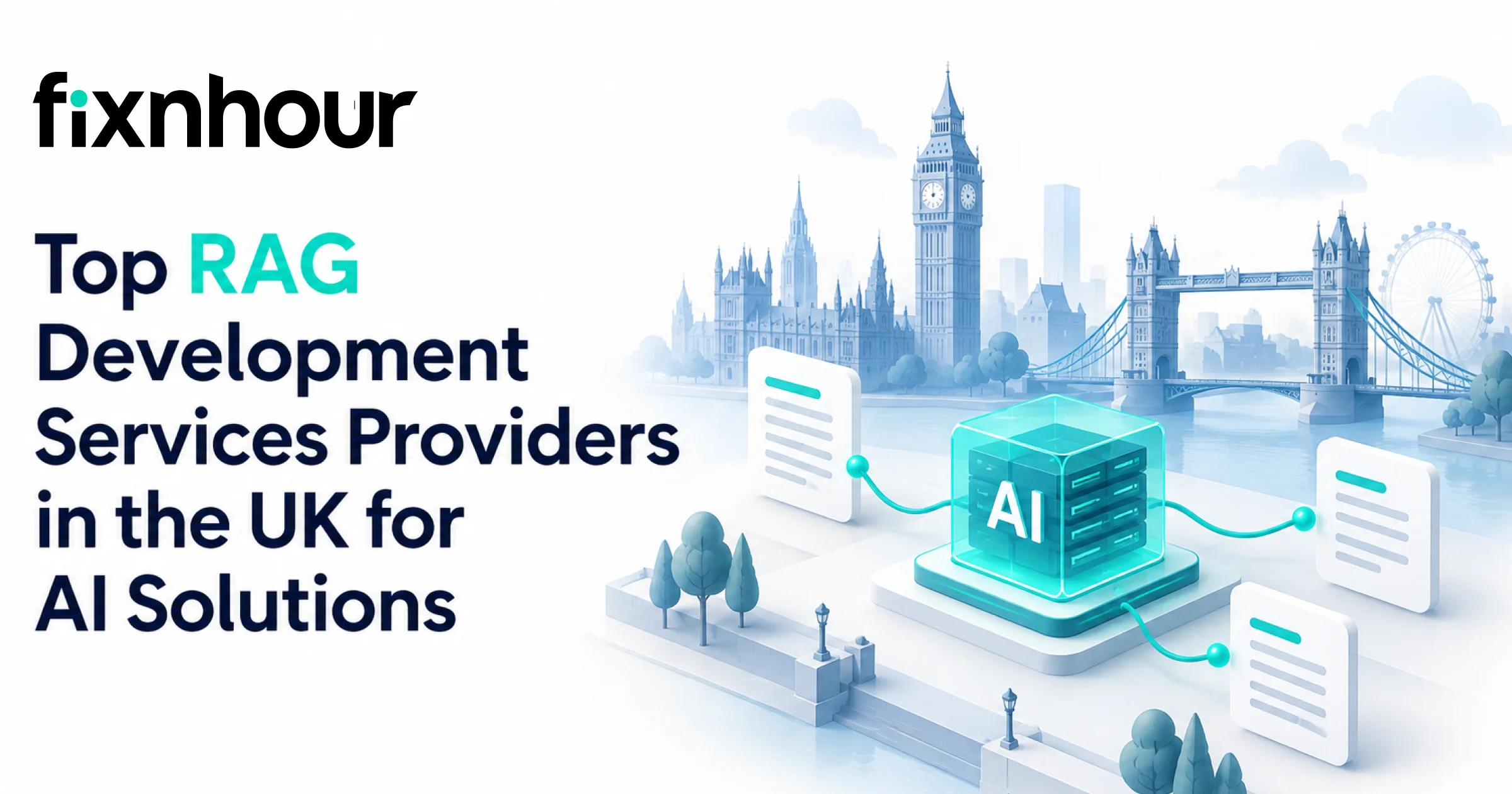
Retrieval-Augmented Generation (RAG) is becoming an important approach for businesses that want AI applications to work with their own documents, databases, knowledge bases, and business information. Instead of relying only on an LLM’s pre-trained knowledge, RAG retrieves relevant information and provides it as context before generating an answer. This can support more relevant, traceable, and up-to-date AI experiences.
The UK’s RAG ecosystem includes specialist AI companies as well as larger technology consultancies offering generative AI, data engineering, enterprise search, and LLM development. This guide covers 10 RAG development services providers in the UK and explains their capabilities, use cases, benefits, and selection considerations.
Quick Answer
Businesses seeking RAG development services in the UK can explore providers such as OpenKit, Thoughtworks, DataArt, Reply, Tomia Digital, Foundry 5, Pixelfield, RapidData, Softomate Solutions, and iGrowix. Platforms like Fixnhour can also help businesses discover and compare technology providers based on services, expertise, project requirements, security needs, integrations, budget, and ongoing support, making the selection process more structured and informed.
Key Takeaways
- RAG connects large language models with external business knowledge.
- Vector search, semantic search, hybrid retrieval, and reranking can improve information retrieval.
- RAG can support enterprise search, AI assistants, customer support, document intelligence, and knowledge management.
- Security and access controls are important when RAG systems work with private company information.
- Evaluation should measure both retrieval quality and generated-answer quality.
- The right RAG architecture depends on data quality, query patterns, integrations, and business requirements.
- GraphRAG and agentic RAG can be considered for more complex information and workflow requirements.
- Ongoing monitoring is important because business information and user queries change over time.
Statistics & Market Insights
RAG is increasingly moving from experimental chatbot projects toward production-focused enterprise AI across the UK. Businesses are prioritizing retrieval accuracy, secure data access, AI governance, evaluation, integrations, and scalable deployment when selecting RAG development partners. Many Generative AI Companies in UK are also combining RAG with AI agents, enterprise search, vector databases, and multimodal AI to deliver reliable, context-aware, data-driven business applications.
Key RAG Market Signals
- Growing enterprise demand for private-data AI
- Increased adoption of vector and hybrid search
- Greater focus on AI governance and security
- Expansion of agentic RAG solutions
- Rising demand for enterprise AI search
- Increased attention to data privacy and compliance
RAG Development Services Providers in the UK
RAG development services providers in the UK help businesses build AI solutions that retrieve relevant information from trusted data sources before generating responses. Alongside specialized AI expertise, many Web Development Companies in UK support data integration, AI chatbots, vector databases, LLM integration, knowledge assistants, and enterprise search. These capabilities enable accurate, context-aware, and scalable AI applications for customer service, business intelligence, and industry-specific needs.
| Rank | Company | RAG & AI Focus | Key Capabilities | Potential Use Cases | UK Presence |
|---|---|---|---|---|---|
| 1 | OpenKit | RAG & AI Search | Hybrid retrieval, citations, GraphRAG, access-aware search | Enterprise knowledge | UK |
| 2 | Thoughtworks | Enterprise AI & RAG | RAG architecture, retrieval, reranking, data platforms | Enterprise AI | UK |
| 3 | Goji Labs | AI & RAG | Vector search, LLMs, AI applications | Customer service, content | UK / Global |
| 4 | Reply | Generative AI & RAG | AI solutions, RAG applications, data engineering | Marketing, eCommerce | UK / Global |
| 5 | Tomia Digital | Custom RAG | Knowledge assistants, RAG pipelines, LLM integration | Support, research | UK |
| 6 | Foundry 5 | Production RAG | Hybrid search, citations, evaluation | Business knowledge | UK |
| 7 | Pixelfield | Production RAG | Chunking, reranking, GraphRAG, evaluation | AI products | London / UK |
| 8 | RapidData | Enterprise AI & RAG | RAG, AI agents, data pipelines, MLOps | Enterprise AI | UK |
| 9 | Softomate Solutions | RAG Knowledge Assistants | Document search, source answers | Business assistants | UK |
| 10 | iGrowix | Enterprise RAG | Pinecone, pgvector, hybrid search | AI search, knowledge bases | UK |
1. OpenKit
OpenKit focuses specifically on RAG and AI search, with an emphasis on connecting business documents to AI responses. Its publicly described capabilities include hybrid semantic and keyword retrieval, cited answers, access-aware retrieval, GraphRAG, and multimodal RAG. These capabilities can be relevant for organisations that need AI systems to work across contracts, manuals, case files, tickets, drives, and other business knowledge while retaining links to source information.
- Custom RAG and AI search
- Hybrid semantic and keyword retrieval
- Source citations and access-aware answers
- GraphRAG and multimodal retrieval
2. Thoughtworks
Thoughtworks is a global technology consultancy with UK operations and documented experience with retrieval-augmented generation. Its Technology Radar has discussed RAG, vector databases, reranking, hybrid search, and GraphRAG as approaches for improving LLM applications. Its material highlights the importance of selecting relevant context rather than simply supplying large amounts of information to a model.
- Enterprise AI architecture
- RAG and retrieval engineering
- Vector and document search
- Hybrid retrieval and reranking
3. Goji Labs
Goji Labs provides AI and software engineering services and has documented RAG implementation experience. In one UK airport case study, DataArt used a RAG approach with FAQ information stored in a vector database to support automated customer responses. The solution combined retrieval with language models and semantic search, demonstrating how RAG can be applied to practical customer-service workflows.
- Retrieval-augmented generation
- Vector database implementation
- LLM integration
- AI-powered customer-service solutions
4. Reply
Reply works across artificial intelligence, data, machine learning, and digital transformation. Data Reply, part of the Reply network, has documented a UK-based eCommerce project involving two RAG solutions: a generative AI newsletter generator and a product description generator. The project demonstrates how retrieval can be incorporated into content-generation workflows using business-specific information and existing system architecture.
- Generative AI development
- RAG-based applications
- Data and AI integration
- eCommerce AI use cases
5. Tomia Digital
Tomia Digital provides RAG development services that connect language models with business documents, databases, and knowledge bases. Its stated services cover data preparation, embedding strategies, retrieval architecture, LLM integration, evaluation, and ongoing quality monitoring. It also describes applications such as knowledge assistants, enterprise search, customer support, and domain-specific RAG systems.
- Custom RAG application development
- Knowledge-base AI assistants
- Multi-source data integration
- RAG testing and optimisation
6. Foundry 5
Foundry 5 focuses on production-oriented RAG systems built around business data. Its approach includes document ingestion, chunking, embeddings, vector databases, semantic and hybrid search, citations, evaluation, security, and monitoring. The company describes RAG systems that can connect to real business content and provide answers that can be traced back to source passages.
- Production RAG development
- Hybrid semantic and keyword search
- Citation-based AI answers
- Retrieval evaluation and monitoring
7. Pixelfield
Pixelfield is a London-based engineering company offering production RAG development for organisations that need AI applications to work with their own data. Its described capabilities include data-specific chunking, hybrid retrieval, reranking, query rewriting, citation tracking, GraphRAG, evaluation, and monitoring. The company also discusses using real production queries and adversarial cases to evaluate RAG performance.
- Production RAG pipelines
- Hybrid retrieval and reranking
- GraphRAG and agentic RAG
- RAGAS and DeepEval evaluation
8. RapidData
RapidData offers enterprise AI development services across the UK, including retrieval-augmented generation, generative AI applications, AI agents, data pipelines, model integration, and MLOps. Its RAG offering focuses on enterprise knowledge and describes capabilities such as cited answers, access control, freshness, evaluation, and governance. This makes its service scope broader than RAG alone and relevant to larger AI implementation programmes.
- Enterprise RAG systems
- Generative AI applications
- AI agents and automation
- Data engineering and MLOps
9. Softomate Solutions
Softomate Solutions offers RAG knowledge assistants for UK businesses, allowing employees or customers to ask questions about defined document collections and follow answers back to their sources. Its approach considers document access, answer testing, source updates, and the underlying information required by the AI. This can suit organisations looking for focused knowledge assistants rather than broad AI transformation programmes.
- RAG knowledge assistants
- Document-based AI search
- Source-linked answers
- Business knowledge retrieval
10. iGrowix
iGrowix provides custom RAG and enterprise LLM application development for UK organisations. Its publicly described technology stack includes Next.js, Vercel AI SDK, Pinecone, and pgvector, with hybrid vector and keyword search for internal documents and databases. The company positions its RAG solutions around secure access to corporate information through AI search and conversational interfaces.
- Enterprise RAG platforms
- Vector and keyword search
- Pinecone and pgvector
- AI search and knowledge applications
Benefits of Hiring RAG Development Companies in the UK
Hiring a specialist RAG development company can help businesses move beyond basic AI chatbots toward systems built around their data, workflows, and users. These solutions can also complement AI Agent Frameworks for Developers in UK, enabling more grounded and context-aware automation. The value depends on data readiness, retrieval architecture, security, evaluation, and implementation quality, especially when information changes frequently or relies on proprietary content.
Improved Access to Business Knowledge
RAG applications can bring information from documents, databases, knowledge bases, and other approved sources into a conversational search experience. Instead of manually searching multiple systems, users can ask questions in natural language and receive responses based on retrieved information. This can support internal knowledge management, employee assistance, customer support, technical documentation, and research workflows.
Better Grounding and Source Traceability
A RAG architecture can retrieve relevant source material before generating an answer. When citations and source tracking are implemented, users can inspect the information behind an AI response. This is particularly valuable for legal, financial, technical, compliance, and enterprise applications where users may need to verify the information before acting on it. UK government guidance also describes RAG as a way to supplement LLMs with external knowledge and improve relevance.
Flexible Integration With Existing Systems
RAG does not have to operate as a standalone chatbot. Development teams can connect retrieval pipelines with business applications, APIs, cloud storage, document repositories, CRM systems, support platforms, and databases. This enables businesses to create AI experiences around existing workflows rather than requiring employees to move between multiple disconnected tools.
Scalable Enterprise AI Architecture
For larger businesses, RAG can become one layer within a broader AI architecture. Depending on the use case, this may include vector databases, hybrid search, reranking, LLM gateways, access control, evaluation pipelines, monitoring, and MLOps. More advanced requirements may also involve GraphRAG or agentic workflows. The architecture should be selected according to the business problem instead of adding complexity simply because a technology is available.
Conclusion
RAG development can help UK businesses connect generative AI with their own trusted information, enabling applications such as enterprise search, knowledge assistants, customer support, document intelligence, and AI-powered research. Providers differ in technical expertise, retrieval methods, integration capabilities, and project focus. When selecting a RAG development services provider, businesses should assess retrieval quality, data engineering, security, evaluation, scalability, integration, and ongoing support.
A well-designed RAG system should align with the organisation’s data and user requirements rather than simply adding an LLM to an existing application. For tailored guidance, Reach Out to Us to discuss your RAG requirements.
Frequently Asked Questions
Q1. What is RAG development?
Ans. RAG development involves building AI applications that retrieve relevant information from external sources before an LLM generates a response. These sources can include documents, databases, knowledge bases, websites, and internal business systems. The retrieved context helps the model respond using current or domain-specific information rather than relying only on its pre-trained knowledge. RAG can also include citations, access controls, evaluation, and monitoring.
Q2. Why do businesses use RAG solutions?
Ans. Businesses use RAG to make AI applications work with proprietary and frequently changing information. A RAG system can retrieve relevant content from company documents, knowledge bases, databases, or other approved sources before generating an answer. Common applications include internal knowledge assistants, enterprise search, customer support, document analysis, technical help systems, and research tools where access to business-specific information is important.
Q3. What services do RAG development companies provide?
Ans. RAG development companies can provide services covering the complete application lifecycle. These may include data preparation, document ingestion, chunking, embeddings, vector database implementation, semantic or hybrid search, reranking, LLM integration, prompt engineering, security, evaluation, deployment, monitoring, and maintenance. Some providers also offer GraphRAG, multimodal RAG, AI agents, and integrations with enterprise platforms depending on project requirements.
Q4. How does RAG reduce AI hallucinations?
Ans. RAG can reduce hallucination risk by giving the language model relevant external information to use when generating an answer. Instead of depending exclusively on its learned knowledge, the model receives retrieved context from defined sources. However, RAG does not guarantee that every answer will be correct. Retrieval quality, source quality, prompting, model behaviour, evaluation, and system design all affect the final response.
Q5. What technologies are used for RAG development?
Ans. RAG applications commonly use several technology layers, including embedding models, vector databases, document-processing pipelines, retrieval systems, rerankers, and large language models. Depending on requirements, developers may use technologies such as Pinecone, pgvector, Elasticsearch, Qdrant, cloud AI services, or GraphRAG approaches. The technology selection should depend on data volume, query patterns, security requirements, integrations, latency, and operating costs.
Q6. How much does RAG development cost in the UK?
Ans. There is no single fixed price for RAG development because projects vary substantially in complexity. A focused knowledge assistant can require considerably less investment than a multi-source enterprise RAG platform with access controls, hybrid retrieval, evaluation, monitoring, and multiple integrations. Public UK provider estimates show ranges from roughly £10,000 for focused systems to £100,000 or more for complex production implementations.
Q7. How long does it take to build a RAG application?
Ans. Development time depends on the data environment, application scope, integrations, security requirements, and evaluation process. A focused RAG knowledge assistant may be developed within several weeks, while a multi-source enterprise implementation can require several months. Tomia describes focused pilots in approximately four to six weeks, while larger multi-source systems may take two to four months. Discovery and data preparation can affect the schedule significantly.
Q8. How should I choose a RAG development company in the UK?
Ans. Start by defining the questions your AI application must answer and identifying the sources containing the required information. Then evaluate providers based on RAG experience, data engineering, retrieval architecture, security, integrations, evaluation methodology, deployment capabilities, and post-launch support. Ask potential providers to explain how they will measure retrieval quality and answer accuracy using your real business data before moving into a full production build.