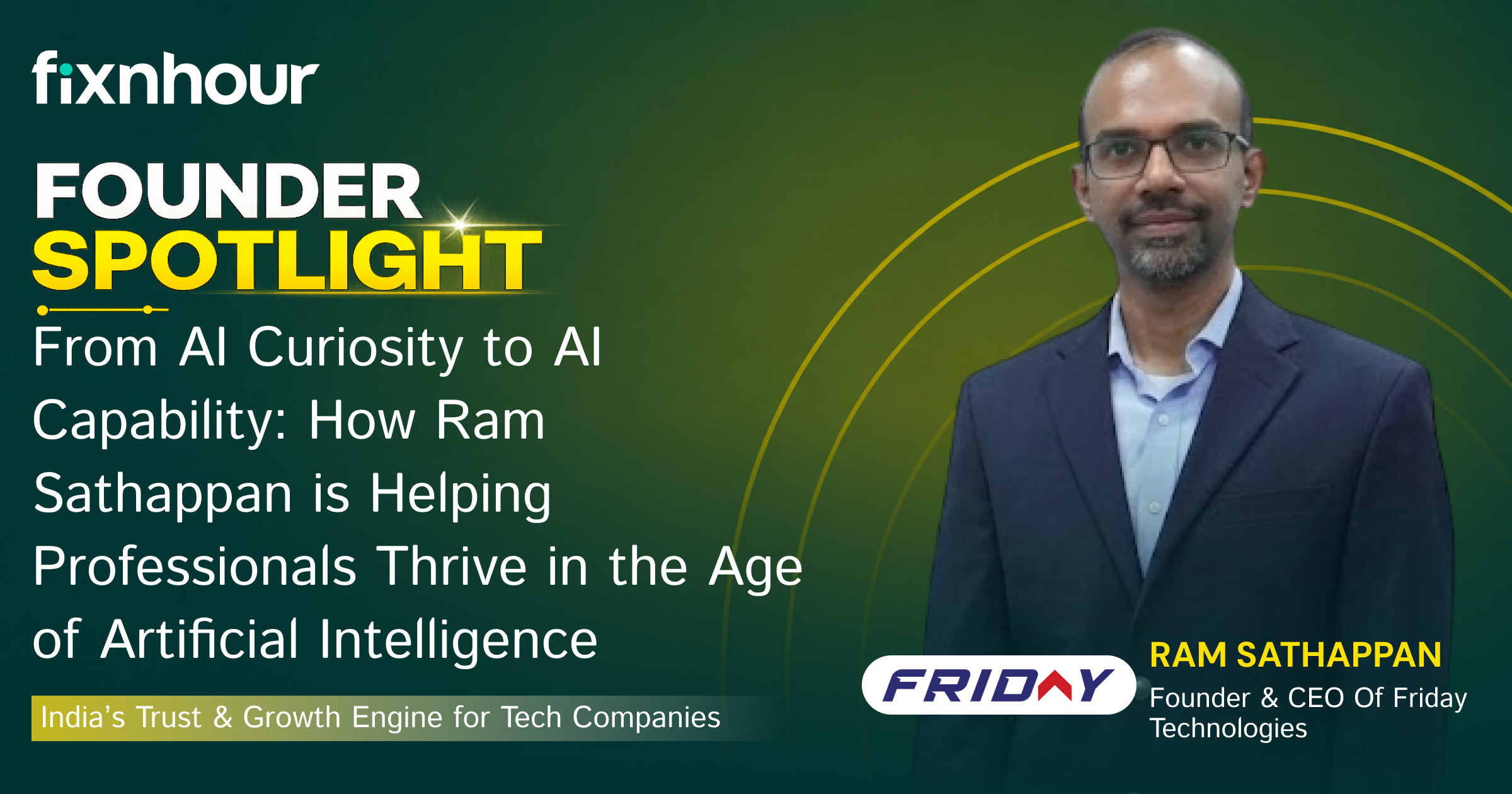
Artificial Intelligence is transforming industries faster than ever, but the real challenge lies in helping professionals move beyond curiosity and develop practical AI capabilities. As businesses embrace AI-driven innovation, individuals must learn how to apply these technologies confidently to stay relevant, competitive, and future-ready. This shift requires the right guidance, practical learning, and a clear understanding of AI's real-world impact across different professions.
In this exclusive Founder Spotlight, we speak with Ram Sathappan, a visionary leader dedicated to making AI education accessible and actionable. Through his mission, he is empowering professionals, entrepreneurs, and organizations to bridge the gap between learning and implementation, enabling them to thrive in the rapidly evolving age of artificial intelligence.
Who is Ram Sathappan?
Artificial Intelligence has quickly become one of the most talked-about technologies of our generation. Every day, professionals hear about AI transforming industries, automating workflows, and creating new opportunities. Yet for many working professionals, the conversation around AI often feels overwhelming.
They know AI is important.
They know it is shaping the future.
But they are unsure where to begin.
This gap between curiosity and capability is exactly where Ram Sathappan has chosen to build his mission.
As an AI Educator and Entrepreneur, Ram is focused on helping professionals move beyond simply understanding AI concepts and begin applying them in practical, meaningful ways. While many organizations discuss the future of artificial intelligence, Ram concentrates on a more immediate challenge: helping people become confident and capable users of AI in their daily professional lives.
What makes his work particularly relevant is his understanding that technology adoption is rarely about technology alone. It is about education, confidence, accessibility, and practical application. Throughout his journey, Ram has observed that many professionals are not resistant to AI; they simply need guidance on how to integrate it into their work effectively.
Rather than positioning AI as a complex technical discipline reserved for engineers and data scientists, Ram believes AI should become a practical tool that empowers professionals across industries.
His mission is clear.
Help people move from curiosity to capability.
Help them understand not only what AI is, but how it can improve productivity, decision-making, creativity, and career growth.
In this exclusive Founder Spotlight with Fixnhour, Ram shares his perspective on AI education, the future of work, and why learning may become the most important skill of the AI era.
Q1. Ram, how would you describe your mission as an AI educator and entrepreneur?
When people hear the term "artificial intelligence," their reactions often vary widely. Some are excited. Some are curious. Others feel intimidated or uncertain about what it means for their careers.
My mission is to bridge that gap.
I believe that AI should not be viewed as something reserved for technical experts. It should be accessible to professionals across industries, regardless of their background or experience level.
Throughout my work, I have seen how quickly people's confidence grows when they move beyond theory and start using AI practically. Once individuals understand how AI can help them solve real problems, improve efficiency, and make better decisions, their perspective changes completely.
My goal is to make that transition easier. I want professionals to move from simply knowing about AI to confidently using it in their everyday work.
Q2. What inspired you to focus specifically on AI education?
The inspiration came from observing a significant gap in the market.
There was no shortage of information about AI. Articles, videos, webinars, and courses were everywhere. Yet despite this abundance of content, many professionals still felt unsure about how to apply AI in their own roles.
I realized that people were not struggling because information was unavailable. They were struggling because much of the information felt disconnected from their daily responsibilities.
Working professionals need practical guidance. They want to understand how AI can help them write better proposals, analyze data faster, improve customer experiences, automate repetitive tasks, or generate new ideas.
That realization inspired me to focus on education that emphasizes practical capability rather than theoretical knowledge alone.
Q3. Do you believe AI will replace jobs?
This is one of the most common questions people ask.
My perspective is that AI will certainly transform jobs, but transformation does not necessarily mean replacement.
Throughout history, technology has consistently changed how people work. New tools have automated certain tasks while simultaneously creating new opportunities.
What makes AI different is the speed of change.
Professionals who learn how to work alongside AI will likely gain significant advantages. Those who ignore it may find themselves struggling to remain competitive.
The future is not about humans versus AI.
It is about humans who use AI effectively versus those who do not.
That distinction is extremely important.
Q4. What are some of the biggest misconceptions people have about AI?
One misconception is that AI is only relevant for technical professionals.
In reality, AI is becoming useful across virtually every industry and role. Marketing professionals, consultants, educators, managers, entrepreneurs, healthcare providers, and finance professionals can all benefit from understanding how to use AI effectively.
Another misconception is that AI requires advanced technical skills.
While technical expertise is valuable, many modern AI tools are designed specifically for non-technical users.
The barrier to entry is much lower than many people assume.
The most important skill is not coding.
It is learning how to think, experiment, and solve problems using AI tools.
Q5. What skills will become most valuable in the AI era?
Learning agility will become one of the most valuable skills.
Technology is evolving rapidly. The ability to continuously learn and adapt will matter more than any single technical skill.
Critical thinking will also become increasingly important. AI can generate information, but professionals must still evaluate, interpret, and apply that information effectively.
Communication, creativity, leadership, and emotional intelligence will remain essential because these are areas where human capabilities continue to provide significant value.
The future belongs to individuals who combine technical awareness with strong human skills.
Q6. How can working professionals start their AI journey?
The biggest mistake people make is waiting for the perfect time.
My advice is simple: start small.
Choose one task that consumes time or creates frustration in your daily work. Then explore how AI might help improve that process.
Experimentation is one of the best ways to learn.
You do not need to master everything immediately. Focus on building confidence through practical experience.
Small improvements accumulate over time and eventually create significant capability.
Q7. What role does entrepreneurship play in your journey?
Entrepreneurship has taught me the importance of adaptability.
Building products, educating professionals, and operating in a rapidly evolving industry require continuous learning and experimentation.
Entrepreneurship is ultimately about solving problems. Whether through education, technology, or innovation, the objective remains the same: create value for people.
That mindset continues to guide everything I do.
Q8. What leadership lessons have shaped your approach?
One lesson stands out above all others.
Leaders do not need to have all the answers.
In fast-changing environments, it is impossible to know everything. Effective leaders focus on creating learning cultures where people feel encouraged to experiment, grow, and adapt.
Curiosity is one of the most powerful leadership qualities in today's world.
Leaders who remain curious continue evolving. Those who stop learning eventually become disconnected from change.
Q9. How has Fixnhour helped build visibility and trust for businesses?
Trust has become one of the most important assets in today's digital economy.
People want to understand who they are working with. They want to learn about founders, business values, expertise, and experiences.
What I appreciate about Fixnhour is its focus on credibility and founder visibility. Through company profiles, founder interviews, and business showcases, the platform helps organizations communicate their story in a meaningful way.
Trust is built through transparency, and platforms that encourage transparency create value for the entire ecosystem.
Q10. What is your long-term vision?
My vision is to make AI education practical, accessible, and empowering for professionals around the world.
I believe we are entering an era where AI literacy will become as important as digital literacy.
The organizations and individuals who embrace continuous learning will be best positioned to thrive.
My goal is to help people build confidence, capability, and adaptability so they can participate actively in this transformation rather than simply observe it.
If we can help more professionals move from curiosity to capability, we will create a future where technology becomes an enabler of human potential rather than a source of uncertainty. Get Started Today.