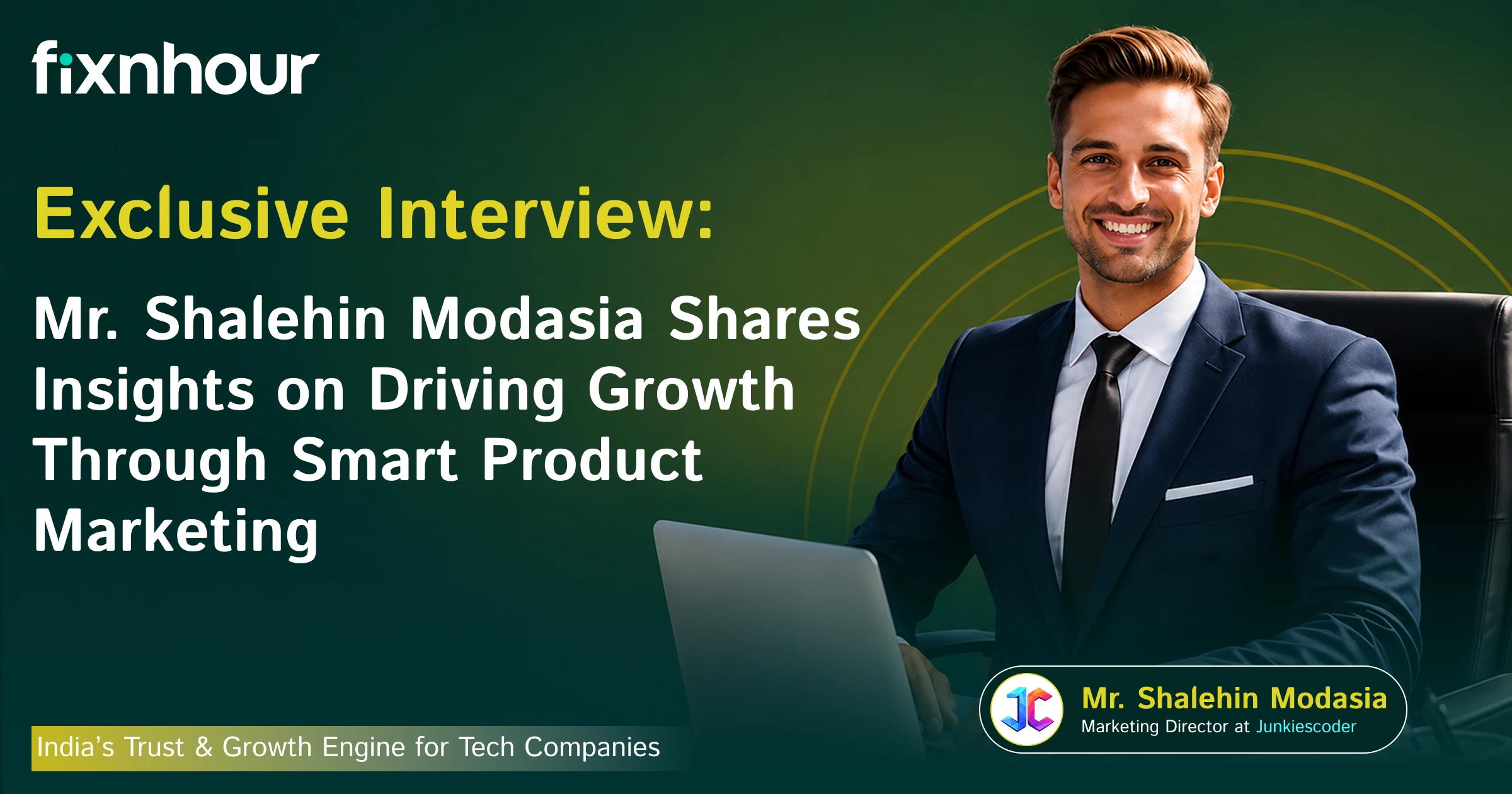
Effective product marketing is crucial in today’s competitive commercial world to foster development and establish strong client connections. Successful businesses know how to read the market trends, communicate their value, and develop strategies that will resonate with their audience. In this exclusive interview, Shalehin Modasia talks about how smart marketing decisions could affect the long-term performance of the company.
With his professional background, Shalehin emphasizes the role of customer-centric initiatives, innovation, and data-driven planning in reaching sustainable development. He also highlights how companies can retain their strong brand presence while adapting to the changing needs of consumers in an increasingly competitive and dynamic sector.
Q1. What inspired you to start the company, and what gap in the market were you trying to solve?
Most founders were not short of ideas; they were short of a team who built like they had skin in the outcome. The market was full of dev shops that deliver features and send you an invoice. Hardly any of them asked if the feature moved the business. That’s the gulf. Junkies Coder is here to bridge the gap between product and outcome to build like a co-founder, not a vendor. If a founder is burning the runway, the worst thing you can do is build them exactly what they asked for without asking if that is the right thing to build. We initiated because someone had to take responsibility for that question.
Q2. What are the biggest business challenges your clients usually face before approaching your company?
It’s rarely “we can’t build.” It’s “we don’t know what to build first.” Founders come to Junkies Coder with a strong idea, some early traction or capital, and no clear path from there to a product that scales. The common pattern: runway being spent on the wrong build order, tech debt from a cheap early MVP that now can’t carry growth, and no senior technical owner who can make architecture decisions tied to business risk. The challenge is almost always sequencing and judgment, not raw engineering capacity.
Q3. Which industries or client segments do you specialize in, and where do you create the highest impact?
We're founder-led-company specialists more than industry specialists early-to-growth-stage ventures, heavily in SaaS, marketplaces, automotive, on-demand, retail, manufacturer, healthcare, edtech, proptech, and fintech-adjacent products. Our highest impact lands in two phases: the 0-to-1, where the question is "Does this even work?" and the messy 1-to-10, where something works but the architecture, team, and processes weren't built to scale. That second phase is where most companies quietly stall, and it's where good build decisions compound the most.
Q4. How does your team approach a project from discovery and planning to execution and delivery?
We start with the business model, not the feature spec. Discovery is about finding the wedge and the riskiest assumption, the thing that, if wrong, breaks everything. Then we thin-slice toward an MVP that tests that assumption, not one that tries to do everything. Execution runs in tight weekly loops with the founder in the room, not a quarterly reveal. Here's the shift worth naming: AI has collapsed the cost of building, so the bottleneck moved upstream to knowing what to build. We spend our planning energy there, because that's where projects are actually won or lost now.
Q5. Can you share a recent success story where your solution created measurable business results?
iQuQ App, developed by Junkies Coder, is a social music platform designed to democratize music control during live events. It empowers all participants to have equal influence over the playlist in real time, enhancing audience engagement. Junkies Coder, known for high-performance mobile and software development, has delivered robust MVPs for startups and global brands. Their expertise in building scalable, user-centric apps positions iQuQ as an innovative solution in the live entertainment space.
Q6. What makes your company stand out in today's highly competitive technology market?
We think like operators and investors, not order-takers. So when a founder asks for something, we're weighing it against their runway, their next raise, and their distribution, not just whether it's technically possible. In a market where anyone can spin up code fast, the differentiator isn't speed anymore. It's judgment. Knowing what not to build is the most underrated competitive edge there is.
Q7. How do you maintain quality, transparency, and timely delivery across projects?
Three principles. First, small senior teams not quietly handing your project to a junior pool after the sales call. The people who scope it are the people who build it. Second, transparency is the default, not a request for shared boards, direct access, no black box. Third, we ship in short increments, so trust gets earned weekly instead of promised upfront. Timely delivery isn't about working faster; it's about scoping honestly and cutting the right things early. Most delays come from saying yes to everything at the start.
Q8. What emerging technologies or trends do you believe will shape the future of your industry?
The big one is AI-native architecture products designed around agentic workflows from day one, not bolted on later. Alongside that, the collapse of build cost means smaller teams will do what used to take large ones, and the premium is shifting hard toward taste, judgment, and distribution. The companies that win the next cycle won't be the ones with the most engineers; they'll be the ones who know exactly where AI compounds value and where it's just noise. The moat is moving from "can you build it" to "do you know what's worth building."
Q9. What are the most common mistakes businesses make while selecting a technology partner?
Optimizing for the hourly rate. The cheapest build is almost always the most expensive one, because you pay for it twice when you have to rebuild. The second mistake is treating it as outsourcing instead of partnership handing over a spec and disappearing. The third is choosing a partner on stack buzzwords instead of business understanding; the framework matters far less than whether the team grasps what your company is actually trying to win. And finally no shared incentive and no senior owner accountable for outcomes. If nobody on the other side wins when you win, you've hired a vendor, not a partner.
Q10. How important is long-term client relationship building in your business model?
It's the entire model. Most of our growth is repeat work and referrals we optimize for the second project, not the first invoice. Building a real venture is a multi-year arc, not a single engagement, and the trust you build in year one is what lets you make the harder, more honest calls in year two. A partner who's only thinking about the current contract will tell you what you want to hear. We'd rather be the one who's still around when it matters.
Q11. What advice would you give to startups or businesses planning to invest in digital transformation?
Don't digitize your org chart and redesign the process. Most transformation budgets get burned recreating broken workflows in software. Pick the one workflow that's most painful and most repeated, fix that, and let the win fund the next. Don't buy tools, buy outcomes a tool nobody adopts is a cost, not a transformation. And apply AI where it compounds, not where it demos well; the flashy use case is rarely the valuable one. Start narrow, prove value, then expand. The companies that try to transform everything at once usually transform nothing.
12. What's your vision for the company over the next 3–5 years?
I want Junkies Coder to be the build-and-scale partner founders default to the team you bring in when an idea needs to become a real, scalable venture. The bigger vision is tightening the loop between Startups and Enterprise Businesses so capital, advisory, and execution work as one engine: we don't just build for founders, we help fund and scale the right ones. Long term, that's a genuine venture engine where the gap between "great idea" and "real company" gets a lot shorter for the founders we back, Brands we backbone, and Enterprise we Maintain.
Q13. How do you decide what to build with AI versus what to build the traditional way?
We ask one question: does this need to be right every time, or good most of the time? AI is incredible for second drafting, summarizing, routing, anything with tolerance for variance. But founders get seduced by putting it in the critical path of things that must be deterministic, like payments or compliance logic, and then spend months patching reliability. We use AI to compress the work around the core, and keep the core boring and bulletproof. The skill isn't adding AI, it's drawing that line correctly.
Q14. A lot of MVPs become technical debt the moment they get traction. How do you build one that doesn't?
You build the MVP to be thrown away in the parts that are experiments, and kept in the parts that are bets. Most teams build the whole thing at the same low quality, then traction arrives and everything has to be rebuilt at once. We separate the two from day one the assumptions we're testing get built cheap and disposable, the foundation we're confident in gets built properly. So when growth hits, you're upgrading, not rewriting. That single distinction saves founders the most painful six months of their early life.
Q15. When a founder comes to you without a technical co-founder, how do you fill that gap?
We become the technical judgment they don't have yet not just the hands. A non-technical founder's real risk isn't that code gets written badly; it's that they can't tell whether they're being told the truth about timelines, trade-offs, and architecture. So our job is translation and honesty: explaining the why behind every major call in business terms, and flagging the expensive decisions before they're made instead of after. The goal is to make them a sharper technical decision-maker, not dependent on us forever.
Q16. What's a build decision founders underestimate the cost of?
Choosing tools and infrastructure based on where they want to be in three years instead of where they are now. Founders over-engineer for scale, they don't have microservices for a product with fifty users, multi-region setups before product-market fit. Premature scaling architecture burns the runway and slows you down precisely when speed matters most. The right call is almost always: build for the next 10x, not the next 1000x. You can re-architect once with money in the bank far cheaper than you can survive moving slowly while broke.
Q17. How do you measure whether a build actually succeeded?
Not by whether we shipped on time or on spec, by whether it moved the metric the founder cared about. A project can hit every deadline and still fail if it doesn't change activation, retention, or revenue. So we tie success to a business outcome before we write a line of code, and we're honest when a feature we built didn't earn its keep. Most agencies measure delivery. We measure whether the thing we delivered was worth building. That's the difference between a vendor and a partner.
Conclusion
This insightful conversation with Shalehin Modasia highlights how smart product marketing, strategic thinking, and outcome-driven execution are essential for sustainable business growth. His approach of aligning technology decisions with real business impact offers valuable lessons for startups and enterprises alike. As markets continue to evolve, adopting a customer-centric and data-driven mindset will remain key to staying competitive. If you’re looking to build, scale, or transform your product with expert guidance, feel free to contact us and take the next step toward growth.