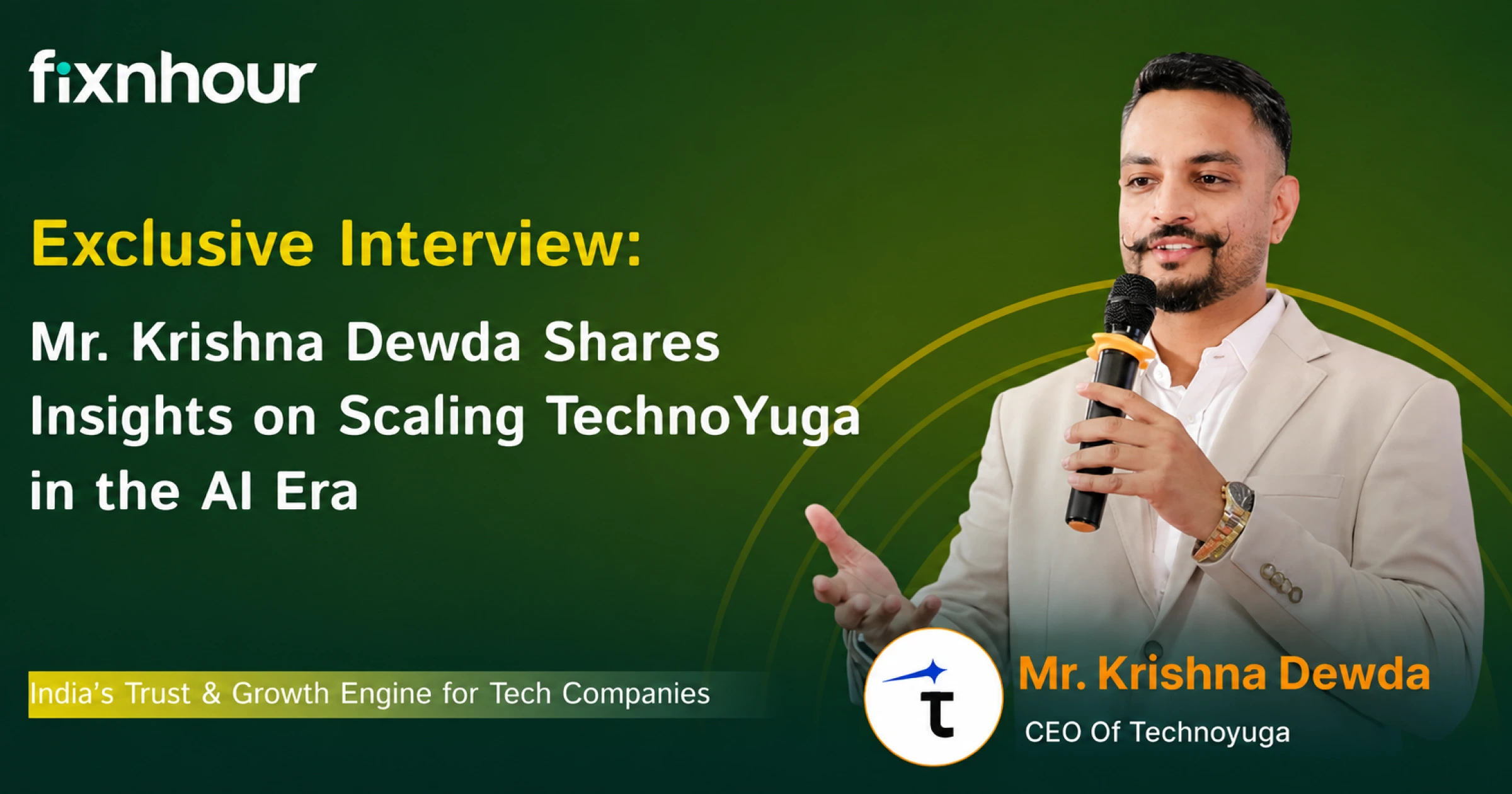
Krishna Dewda is a visionary entrepreneur who is leading innovation and digital growth as the CEO of TechnoYuga. He has guided the company to a strong market position by leveraging modern technologies such as AI, blockchain, and scalable software solutions. His leadership is rooted in a client-focused approach and a commitment to high-quality development.
In the AI era, Krishna Dewda envisions empowering businesses to become smarter and future-ready. He considers AI a powerful growth driver that is transforming industries worldwide. His strategic thinking and execution have positioned TechnoYuga as a trusted global technology partner.
Q1. What specific business problems do your clients typically come to you with, and how do you solve them differently?
Most clients come to Fixnhour with business ideas, manual operational challenges, outdated systems, or products that need to be built, modernized, or scaled. These requirements typically involve mobile apps, custom software, SaaS platforms, AI solutions, enterprise systems, or workflow automation.For startups, Fixnhour helps build MVP products that enable quick idea validation, reduce initial investment risk, and accelerate market entry. For enterprises, Fixnhour develops AI Proof of Concepts (POCs) to test automation opportunities, AI workflows, and operational improvements before moving into full-scale implementation.
What makes our approach different is that we first focus on understanding the business problem behind the technology requirement. We study the users, operations, revenue model, workflows, scalability requirements, and long-term business goals before development begins. This helps us create solutions that are practical, scalable, and aligned with real business outcomes rather than just building software features.
Q2. Who is your ideal client, and what type of projects do you deliver best results in?
Our ideal clients are startups, solopreneurs, SMEs, and enterprises that want to leverage technology to solve meaningful business problems or build scalable digital products.We deliver the best results in custom software development, mobile applications, SaaS platforms, AI-powered systems, enterprise workflow automation, and digital transformation projects where technology directly contributes to operational efficiency, revenue growth, customer engagement, or scalability.
Q3. Can you walk us through your process from understanding client requirements to final delivery?
Our process starts with a detailed discovery phase where we understand the client’s goals, users, business challenges, workflows, and technical requirements.After that, we define the scope, user journeys, technical architecture, product roadmap, timelines, and execution strategy. Once everything is aligned, our design team works on UI/UX while the engineering team prepares the development environment and architecture.
The project then moves into development, QA testing, deployment, and launch in milestone-based phases. Clients receive regular updates, demos, and review sessions throughout the project lifecycle.Even after launch, we continue supporting clients with maintenance, optimization, scaling, and future feature development to ensure long-term product success.
Q4. Can you share a recent project where you delivered measurable impact?
We recently worked on automation and verification systems for large-scale enterprise operations, including workflow optimization and KYC verification tools for the hospitality industry in collaboration with Samsung-backed ecosystem initiatives.The solution automated several manual verification and operational processes, significantly improving efficiency, reducing turnaround time, and increasing visibility across departments.We have also delivered AI-powered operational systems where businesses were able to reduce repetitive manual effort, improve reporting accuracy, and make faster business decisions through centralized dashboards and automation.
Q5. What should businesses look for when choosing a tech partner, and what mistakes should they avoid?
Businesses should choose a technology partner that understands both business and technology. A good partner should ask the right questions, communicate transparently, suggest better alternatives when needed, and think about scalability from day one.Honesty and transparency are extremely important. Clients should always have clarity around timelines, budgets, technical limitations, risks, and priorities.
One of the biggest mistakes businesses make is choosing a development company purely based on low pricing. Poor planning, weak architecture, lack of communication, and inexperienced execution often create larger long-term problems. A strong technology partner focuses on delivering long-term business value, not just completing development tasks.
Q6. In a crowded market, what truly differentiates your company from others offering similar services?
What differentiates TechnoYuga is that we combine strong engineering capabilities with business understanding and AI-native product development.We do not position ourselves as just a coding company. We work as a long-term technology partner focused on helping clients succeed commercially.
Our focus goes beyond development. We care about user growth, operational efficiency, revenue generation, ROI, scalability, and even helping startups become investment-ready. Whether it is improving product adoption, optimizing business workflows, or helping startups launch successfully, our goal is always measurable client success.Our long-term client relationships and growth stories reflect the impact of this approach.
Q7. What technology trends or shifts are you currently focusing on, and how are they impacting your clients?
We are heavily focused on AI product development, AI agents, workflow automation, LLM-powered applications, cloud-native systems, and product modernization.These technologies are helping businesses automate repetitive work, improve productivity, reduce operational costs, and create smarter user experiences.We strongly believe the future of software is AI-native, where systems do more than simply manage data. Modern software will actively assist teams, automate decisions, improve workflows, and enhance operational intelligence.
Q8. What are the most common challenges in delivering tech projects, and how does your team handle them?
The most common challenges include unclear requirements, changing priorities, unrealistic timelines, communication gaps, and weak technical planning.We handle these challenges through proper discovery, detailed documentation, milestone-based execution, regular communication, sprint planning, and continuous QA testing.This structured approach helps keep projects aligned with business goals while reducing misunderstandings and execution risks.
Q9. How do you ensure smooth communication and long-term relationships with your clients?
We maintain smooth communication through clear timelines, milestone reviews, weekly project review calls, regular demos, and transparent discussions around challenges and progress.During weekly review meetings, we share testable builds, live demos, progress updates, bottlenecks, and future roadmap planning so clients remain fully involved throughout the project lifecycle.Long-term relationships are built through ownership and trust. We continue supporting clients after launch with maintenance, scaling, improvements, and strategic technology guidance.
Q10. How do you handle projects with changing requirements or evolving business needs?
Changes are very common in technology projects, especially as businesses evolve and gain new market insights.We manage this through flexible development processes, milestone-based execution, and transparent communication. Whenever there is a change request, we clearly explain the impact on scope, effort, timelines, and cost so clients remain comfortable and informed throughout the process.This clarity helps avoid confusion and ensures healthy long-term collaboration.
Q11. What factors are most important when building a scalable digital product?
Scalability starts with the right foundation. That foundation begins during the project discovery phase where the scope, business goals, architecture, workflows, and scalability expectations are properly defined.Beyond that, strong architecture, clean code practices, security, flexibility, maintainability, and performance optimization are all essential for long-term scalability.A scalable product should be designed not only for current users but also for future business growth.
Q12. How do you manage timelines and ensure projects stay on track?
We manage projects through structured planning, defined deliverables, weekly sprints, and continuous progress tracking using tools like Trello and Jira.From developers and QA engineers to designers, DevOps teams, and client stakeholders, everyone has clearly defined responsibilities from the beginning of the project.This creates accountability, transparency, and better execution consistency throughout development.
Q13. Why is custom software becoming more important for modern businesses?
Every business operates differently, and generic software often fails to support unique operational requirements.Custom software enables businesses to create workflows, systems, and user experiences tailored specifically to their processes and goals. This improves operational efficiency, flexibility, scalability, and long-term competitive advantage.
Q14. What role does cloud technology play in modern software development?
Cloud technology plays a critical role in scalability, flexibility, accessibility, and operational efficiency.Cloud-based systems help businesses reduce infrastructure complexity, improve collaboration, manage data more efficiently, and scale operations more effectively.We help clients build cloud-native systems that support long-term growth and performance optimization.
Q15. How do you ensure security in software and application development?
Security is integrated into every stage of our development lifecycle, from architecture planning and infrastructure setup to coding, testing, and deployment.We follow secure development practices, role-based access controls, encrypted communication, testing standards, and data protection measures to ensure applications remain secure, reliable, and compliant.
Q16. What makes a successful digital product in today’s competitive market?
A successful digital product solves a real business or user problem while delivering a smooth and intuitive user experience.Beyond technology, success depends on execution quality, adaptability, scalability, continuous improvement, and understanding changing user behavior and market trends.
Q17. How do you approach collaboration between technical teams and business stakeholders?
Strong collaboration is essential for successful delivery.We start projects with kickoff meetings where all stakeholders align on business goals, workflows, technical expectations, timelines, and responsibilities.Internally, we conduct planning sessions involving project managers, designers, developers, QA teams, and DevOps engineers to ensure everyone fully understands the scope and execution strategy.This alignment helps reduce misunderstandings and improves delivery quality.
Q18. What challenges do startups usually face during product development?
Startups commonly face challenges such as limited budgets, unclear product direction, rapidly changing priorities, and pressure to launch quickly.We help startups overcome these challenges through lean MVP development, proper discovery, scalable architecture decisions, and phased execution strategies that balance speed, quality, and scalability.
Q19. How do emerging technologies impact traditional business models?
Emerging technologies like AI, automation, cloud computing, and data-driven platforms are fundamentally changing how businesses operate and compete.Companies adopting these technologies early can improve efficiency, reduce costs, automate workflows, enhance customer experiences, and create entirely new business opportunities.Businesses that adapt quickly are often able to scale faster and remain more competitive in evolving markets.
Q20. What do you believe is the key to building long-term client trust?
Long-term trust is built through honesty, transparency, consistency, empathy, and delivering real business value.From day one, we believe in setting clear expectations, communicating openly, and being transparent about challenges, timelines, and scope changes.
We also strongly focus on post-sales support and long-term collaboration. Many of our clients continue working with us for years because they know we genuinely care about their business success, not just project delivery.In fact, our very first client is still associated with us today, which reflects the trust and relationships we have built over time.
Conclusion
Mr. Krishna Dewda’s insights clearly highlight how technology, when aligned with real business needs, can become a powerful driver of growth and innovation. Under his leadership, TechnoYuga is not just building software but enabling businesses to become smarter, scalable, and future-ready in the rapidly evolving AI era.
Contact Us To learn more about TechnoYuga’s innovative solutions or to discuss how your business can scale in the AI era, feel free to get in touch with our team. We’re here to help you turn ideas into impactful digital experiences.