Trust is one of the most powerful assets a company can have in today's business world of digital first. B2B buyers spend considerable time researching vendors online before signing contracts, putting out requests for proposals, or arranging meetings. They check out company profiles, read reviews from customers, consider case studies, and search for evidence of a company's credibility. This change has put verification of businesses to the forefront.
A verified firm is one that is genuine, transparent, and professional. Verified businesses give buyers a sense of trust that they are working with an actual business, whether they are listed on a B2B marketplace, business directory, or review site. This trust can result in increased inquiries, improved conversion rates, and deeper, ongoing business relationships.
Quick Answer
As verified companies build trust before initiating a conversation, they are more successful in winning over B2B clients. Business verification validates the legitimacy of a business, minimizes the risk for buyers, enhances search engine visibility, and boosts online credibility. Colleges that use verified companies will obtain more quality leads, higher conversion rates, and create lasting connections with their customers.
Key Takeaways
- Verified businesses have an instant trust factor with prospective clients.
- Business verification minimizes the risk that purchasers take in buying from a business.
- Google and AI search engines give preference to company profiles that have been verified.
- Consumers will more easily reach out to companies that have information that is available and reviews that are genuine.
- Trust signals are a mechanism that helps to reduce the B2B buying cycle and boost conversions.
- Established businesses are more authoritative in their fields.
- AI search engines are more likely to value credible and verified businesses.
- In the long run, verification can push up your quality leads and repeat customers to help improve the growth of your business.
Also Read: How Business Listing Platforms Help Companies Generate Leads in 2026
What Does a Verified Company Mean in B2B?
Business verification is the process of confirming the legitimacy of a business, its operation, and its trustworthiness. Fixnhour it includes verifying business data by official records, contact details, legal registration, and more trust signals that instill confidence in prospective customers.
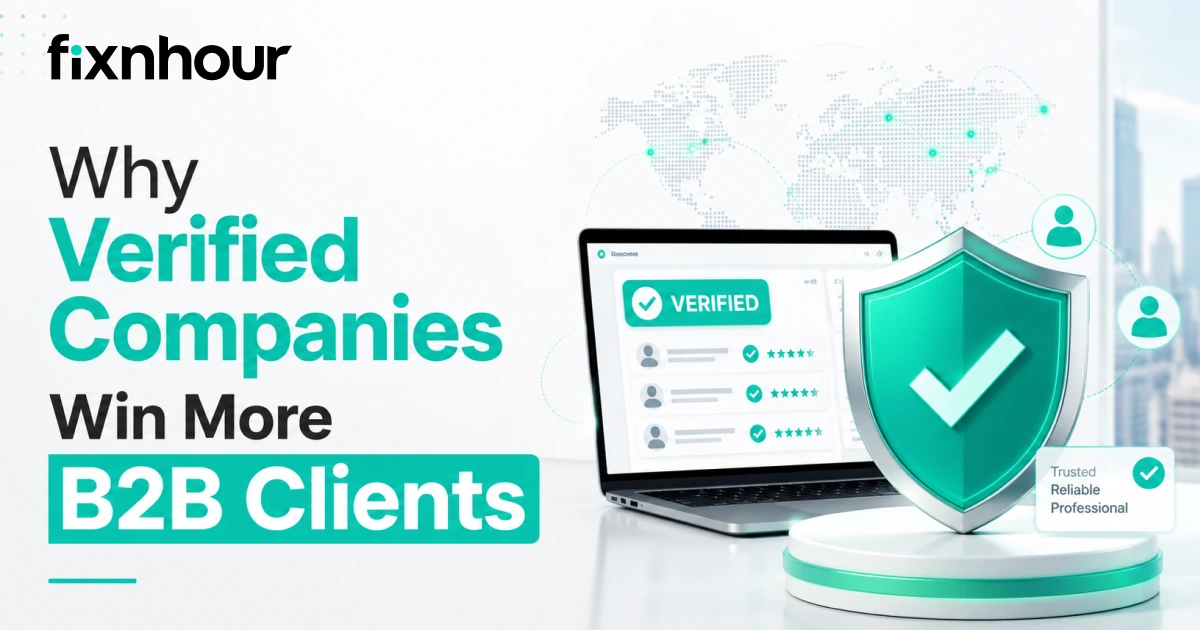
In contrast to the consumers, B2B transactions may include substantial investments, multiple stakeholders, and long-term contracts. When it comes to business, the buyer can't afford to work with unreliable vendors. Verification serves to reduce uncertainty by affirming a company's legitimacy and professional management. Businesses that proudly boast verified badges or certifications on reliable B2B marketplaces and business directories convey credibility right away. Consumers are more likely to trust organizations with verified credentials.
Types of Business Verification
Legal Registration, Identity, Website, Phone, Email, Address, Tax or GST, Customer Review and Certification Verification forms the various types of business verification. These verification methods add up to a company's authenticity, a credibility boost, and a buyer's pinpointing of the authentic business.
Business Registration Verification
It assures that the company has been registered with the relevant government authorities. Legal registration is often the first sign of legitimacy that the buyer may think of.
Contact Information Verification
Verified phone numbers, business email addresses, and office locations assure potential clients that they can easily communicate with the company when needed.
Website Verification
A secure, professional website that is HTTPS encrypted, has clear contact information, and has transparent business information builds trust and credibility across the entire buying process.
Domain Ownership Verification
Many B2B sites verify the title of the company that owns the website in question, which decreases the chances of being misled with fake listings.
Customer Review Verification
Customer reviews that have been verified are genuine reviews from previous customers. Verified reviews have a much greater impact than anonymous ones, as buyers are aware that this is a genuine business experience.
Certification and Compliance Verification
Trust can be further enhanced by the presence of industry certifications, quality standards, security compliance, and professional memberships that are pertinent to the industry.
All of these verification actions can provide a number of trust signals, which can impact buying choices and increase business credibility.
Also Read: How AI Is Changing the Way Businesses Find Service Providers in 2026
Why Verification Matters More Than Ever in Modern B2B Buying
Over the last couple of years, the B2B buying journey has undergone a transformation. Buyers don't just call sales people, but do a lot of research on the internet first!Industry research shows that the decision makers look at several vendors individually before soliciting proposals. A major factor that influences decisions during this research phase is trust.
Today's Buyers Expect Transparency
Modern businesses want complete transparency before making purchasing decisions. They tend to seek out:
- Verified business profiles
- Authentic customer reviews
- Company registration details
- Professional websites
- Industry certifications
- Case studies
- Client testimonials
- Clear contact information
- A positive social media profile. A positive social media profile.
Trust Reduces Buyer Risk
All B2B transactions carry some degree of risk (financial and/or operational). If the right vendor isn't chosen, the project will experience delays, failures, budget overruns, and business relationship issues.
AI Search Is Making Trust Even More Important
AI is driving the future of vendor discovery.AI is changing the way businesses find vendors.
Google AI Overviews, ChatGPT, Gemini, and Perplexity can now provide search experiences with a summary of information from trusted sources instead of just presenting search results. The AI systems analyze authority, credibility, consistency, and trust signals to provide businesses with recommendation.
Verified companies will gain from having the following in place:
- Accurate business information
- Consistent online profiles
- High-quality customer reviews
- Strong website authority
- Citations on reputable sites
- Professional digital presence
Verification Supports Better SEO and GEO Performance
Business verification is not just a measure for gaining trust from customers, it also enhances the performance of digital marketing.
The verified businesses get many benefits, such as:
- Better local SEO rankings
- Higher click-through rates
- Improved brand searches
- Improved exposure in business listings.More exposure in businesses directories.
- Enhanced Google Business Profile performance
- Stronger AI Overview inclusion
- More Generative Engine Optimization (GEO) visibility
Also Read: Why Businesses Are Choosing Fixnhour Over Clutch for Company Listings in 2026
Top Reasons Verified Companies Win More B2B Clients
Business verification is more than just a badge on a LinkedIn profile; it's a strong trust indicator that impacts all parts of the B2B purchase process. Because verified companies help eliminate uncertainty and appear professional from the initial search and all the way to the final contract, they are always better than unverified companies.
Builds Instant Business Credibility
Buyers usually first check the company's website, business listings, reviews, certifications, and online reputation before reaching out to them. Having a verified profile instantly signals to users that the company is trusted by a trusted platform.
When buyers are in doubt about the authenticity of a business, they can concentrate on assessing the company's expertise and services. This leads to an improved chance of them submitting an inquiry or requesting a proposal.
When a company is verified, it shows the following:
- Authentic business identity
- Professional operations
- Transparent company information
- Commitment to quality
- Long-term business stability
Improves Search Engine Visibility
Google and other search engines want to return to a searcher, the most accurate answer that is relevant to that search. Having a full and verified business profile can help make it easier for your company to be prominently featured in search engine results, as it provides reliable and consistent information.
Verified businesses can gain from:
- Better organic rankings
- Higher local SEO visibility
- Increased click-through rates
- Improved Google Business Profile results.Better Google Business Profile performance.
- Improved listing visibility in business directories.Increased listing visibility business directories.
- Enhanced AI-driven search suggestions.Enhanced AI-driven search advice.
Increases Lead Conversion Rates
To turn those leads into paying customers is a matter of trust.A verified business profile assists in establishing trust before a sales conversation has even taken place. Consumers are more likely to reach out to reputable companies.
Verification has the following benefits in terms of improving conversion rates:
- Reducing skepticism
- Building confidence
- Demonstrating legitimacy
- Supporting purchase decisions
- Shortening evaluation time
Reduces Buyer Risk
Every B2B purchase involves financial investment, operational planning, and organizational risk. Decision-makers must justify vendor selection to multiple stakeholders, making trust a critical factor.
Business verification minimizes perceived risks by confirming:
- Reducing skepticism
- Building confidence
- Demonstrating legitimacy
- Supporting purchase decisions
- Shortening evaluation time
- Reduces Buyer Risk
Also Read: How Fixnhour Helps Companies Generate More Qualified B2B Leads
Statistics & Market Insights
B2B purchasing is radically transformed by digital transformation. Today's buyers do a lot of the work to find out about the vendor before they call their sales team.There are a number of market trends that show how critical verification for businesses and online credibility are.
Digital-First Buyer Behavior
Modern B2B buyers increasingly:
- Check on the internet for information about several vendors before contacting them.
- Do research on reviews, ratings and case studies.
- Check out company websites to assess experience.
- Check social proof and certifications.
- Check the credibility of business before asking for bids.
Trust Influences Purchasing Decisions
Businesses and organizations would like to collaborate with business organizations that show them the following:
- Transparency
- Professionalism
- Proven expertise
- Verified credentials
- Positive customer experiences
AI Is Transforming Vendor Discovery
Artificial intelligence is changing how businesses search for service providers.
Instead of manually comparing dozens of websites, buyers increasingly ask AI-powered platforms questions like:
- Which software development company is most trusted?
- What are the best verified marketing agencies?
- Which IT companies have the strongest client reviews?
Business Directories Continue Growing
Business directories are still one of the most important tools available to find vendors.The trusted platforms with verified listings assist firms in the following ways:
- Increase visibility
- Generate qualified leads
- Build authority
- Improve SEO
- Earn customer trust
Benefits of Becoming a Verified Company
Being verified as a company can increase your credibility and trust with prospective clients and help your company's online reputation. A verified profile makes you more visible, raises your profile in search results, draws in more qualified B2B leads and improves your conversion rates. It is also a way of ensuring the buyer that your business has authenticity, trust worthiness, and reliability.
Better Lead Quality
Verified companies draw in customers that are serious about buying as opposed to just window shopping.
A great quality lead will lead to:
- Better conversion rates
- Larger projects
- Higher contract values
- Stronger customer relationships
Increased Customer Confidence
Trust reduces hesitation.If a business is immediately recognized as valid, buyers are more likely to feel comfortable setting up a meeting, requesting a proposal, and talking about the project requirements.
Improved Online Visibility
Verification strengthens digital presence across:
- Search engines
- Business directories
- AI search platforms
- Review websites
- Local search results
Competitive Advantage
Product buyers tend to compare companies in competitive industries that provide similar services. A verified profile is an instant mark of authenticity and professionalism. By simply establishing more trust signals, small businesses can counter the larger companies.
Stronger Brand Authority
The strength of authority builds over time through a series of consistent quality, transparency and good customer contacts.
Verification helps build trust in the authority by substantiating business information and strengthening brand credibility throughout a variety of digital platforms.
Higher Customer Retention
Satisfied customers tend to remain loyal to businesses they trust.
Verified companies often experience:
- Higher renewal rates
- More repeat business
- Better referrals
- Increased lifetime customer value
Also Read: Where Businesses Find Trusted Technology Partners
Challenges Companies Face Without Verification
Businesses that don't verify face difficulties in gaining the trust of their customers, building quality leads, and outcompeting the rivals. The quality of the leads may be doubted, resulting in reduced inquiry and conversion rates. Unverified businesses also lose out on increased search visibility, building brand credibility, and long-term enterprise partnerships.
Common challenges include:
- Lower search visibility
- Reduced customer trust
- Fewer qualified inquiries
- Longer sales cycles
- Lower conversion rates
- Difficulty winning enterprise contracts
- Increased skepticism from buyers
- Missed partnership opportunities
Cost of Business Verification
The common misconception is that the business verification will be costly. Actually, the price depends on the platform and verification level. There are many types of business directories and online platforms that provide free basic verification, and there are also premium verification programs with extra features like better profiles, better visibility, lead generation, and analytics.
Factors That Influence Verification Costs
- Platform or marketplace requirements
- Industry-specific certifications
- Verification depth
- Premium listing features
- Additional trust badges or compliance checks
Is Verification Worth the Investment?
The ROI for most B2B businesses is noteworthy. The marginal cost of premium verification is more than offset by a single new customer that comes in due to better credibility. In addition to the revenue generated, verification also improves brand reputation, aids in SEO and AI visibility, and fosters longer-lasting trust with prospective buyers.
Step-by-Step Process to Become a Verified Company
Being a verified company isn't difficult, but it does need to be accurate, transparent, and consistent. By following the correct procedure, you can establish trust with your buyers and make them easier to find on search engines, AI platforms, and B2B marketplaces.
Step 1: Complete Your Business Profile
Connect by building a detailed business profile on your website and reputable B2B directories.
Include:
- Company name
- Business description
- Services offered
- Industry expertise
- Office address
- Contact details
- Website URL
- Business hours
- Company logo
- Social media profiles
Step 2: Verify Your Business Registration
Upload the required legal documents requested by the platform.
Common verification documents include:
- Business registration certificate
- GST or VAT registration
- Tax identification number
- Incorporation certificate
- Business license
Step 3: Verify Contact Information
Communication accuracy builds trust with the buyer.
Verify your:
- Business email
- Phone number
- Office location
- Website domain
Step 4: Build a Professional Website
Your web pages are frequently the very first impression that buyers have of your business.
Make sure your website is designed to include the following:
- HTTPS security
- Clear navigation
- About Us page
- Service pages
- Case studies
- Client testimonials
- Contact page
- Privacy Policy
- Terms & Conditions
Step 5: Collect Verified Customer Reviews
Positive reviews are among the strongest trust signals in B2B marketing.
Encourage satisfied clients to leave honest reviews after project completion.
Focus on gathering reviews that mention:
- Project quality
- Communication
- Timely delivery
- Technical expertise
- Customer support
- Overall satisfaction
Step 6: Showcase Certifications and Achievements
Display industry certifications, awards, partnerships, and compliance standards wherever possible.
Examples include:
- ISO Certifications
- Google Partner badges
- Microsoft Partner status
- AWS Partner Network
- Industry awards
- Security certifications
Step 7: Keep Business Information Updated
Outdated information damages credibility.
Regularly review:
- Contact details
- Team information
- Services
- Pricing
- Certifications
- Office locations
- Business hours
Step 8: Monitor Your Online Reputation
Verification is not a one-time task.
Monitor:
- Customer reviews
- Brand mentions
- Business listings
- Search engine results
- Social media comments
Also Read: What Makes a Good B2B Company Profile? Complete Guide
Conclusion
Good relationships have grown on trust in B2B. Verification is a powerful signal of credibility, professionalism, and reliability in a marketplace where consumers are doing extensive research to make purchase decisions.
Verified companies always beat unverified companies, as they minimize the risk for buyers, enhance visibility on the Internet, boost brand reputation, and produce better leads. Trust signals will become increasingly vital to which companies get visibility and new business as AI-powered search platforms such as Google AI Overviews, ChatGPT, Gemini, and Perplexity continue to influence the vendor discovery process. Contact us today
Frequently Asked Questions
Q1. Why do verified companies get more B2B leads than unverified companies?
Ans. Trust in verified companies is established prior to the first interaction. Having a verified profile makes businesses feel more real and reliable to the buyers so that they are more confident about making a call to them. This credibility encourages inquiries, increases lead quality, speeds up decision making and ultimately assists companies to generate more quality B2B leads than un-verified competitors.
Q2. Business Verification is designed to boost trust between enterprise buyers and sellers.
Ans. Business verification is confirmation that a company is a legitimate entity that is legally in business. When verified documents, certifications, customer reviews and accurate contact information are displayed, buyers are at less risk. Verified vendors offer transparency, accountability and confidence throughout the procurement process, making them more likely to be engaged by enterprise clients.
Q3. What is the significance of verification for companies on Google and AI search engines?
Ans. Verification aids in SEO by making sure business data is correct and consistent on online platforms. It's not a ranking signal by itself but rather supports other trust signals that help boost visibility in search results, local SEO, AI overviews, and generative engine optimization (GEO), which will help capture organic traffic.
Q4. What are the common documents used for business verification?
Ans. Official business registration documents, tax identification numbers, GST/VAT information, business licenses, verified phone numbers, verified email addresses and website ownership verification are required on most platforms. It establishes the legitimacy of the company and enables platforms to list trustworthy businesses for purchasers.
Q5. Does the Business Verification make sense for small businesses?
Ans. Yes. Verification builds trust, makes it easier for small businesses to stand out from the big names, and brings in better customers. Having a verified profile boosts visitor's trust in the buyer, helps them find you online more easily, helps build a positive reputation for the brand and leads to better prospects to gain leads and long-term buyers.
Q6. What is the length of an assessment period?
Ans. The verification time differs according to the document review process and platform. Some business directories can verify businesses in a few hours with automated processes, while other directories may need to review documents submitted for their business listing first, which can take several business days.
Q7. What kind of payment options do you expect to find on a reputable e-commerce site?
Ans. Yes. Authentic social proof is provided by verified customer reviews, giving buyers confidence to make their purchasing decisions. Positive reviews convey customer satisfaction, foster trust, lessen purchase hesitation, and boost the chances of customers selecting your business over your competitors, ultimately leading to improved conversion rates.
Q8. What types of B2B platforms have company verification?
Ans. There are several well-known B2B marketplaces, business directories, and review sites that offer company verification services. These platforms can validate business data, certifications, and company information to provide buyers with a way to find reputable vendors, increase trust in the marketplace, and find reputable service providers in various sectors.