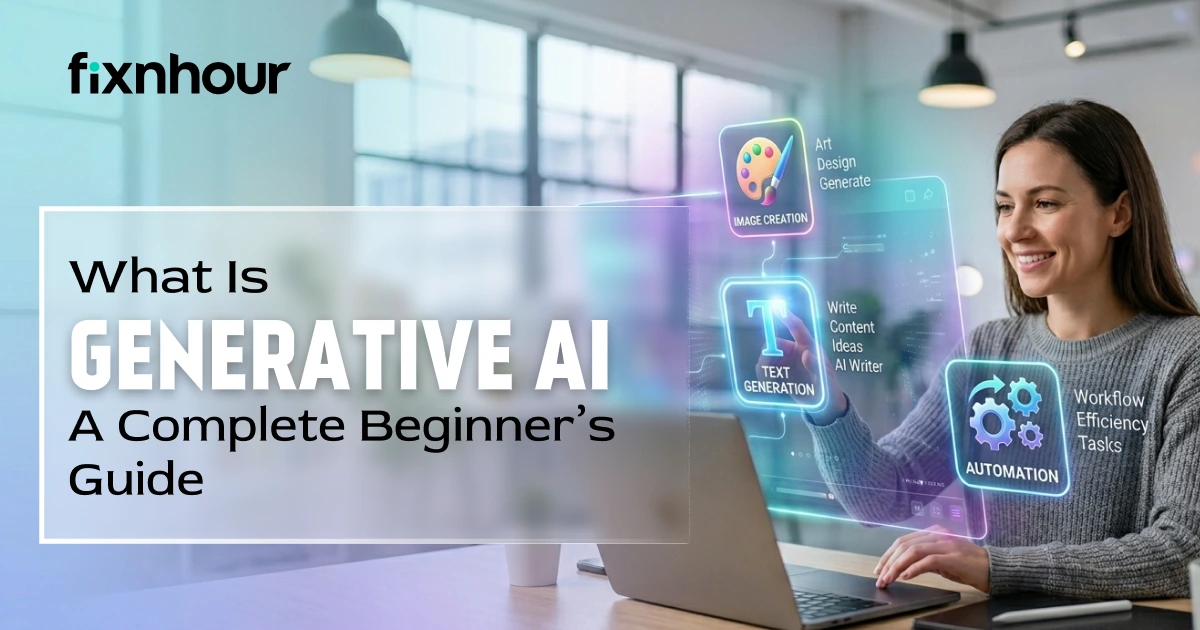
Generative AI is no longer just a trending buzzword it has rapidly evolved into one of the most transformative technologies shaping how individuals and businesses operate in 2026. At its core, generative AI refers to advanced systems capable of creating new content, whether it’s text, images, videos, music, or even computer code, by learning patterns from massive datasets. Unlike traditional software that simply follows programmed instructions, generative AI models can understand context, mimic human creativity, and produce original outputs that feel remarkably natural.
This shift is revolutionizing industries across the board: marketers can generate high-quality content in seconds, designers can create visuals without starting from scratch, developers can write and debug code faster, and educators can personalize learning experiences like never before. The technology works through sophisticated machine learning techniques, particularly neural networks, which are trained on vast amounts of data to recognize patterns and relationships.
Why Generative AI is Trending in 2026
Generative AI is trending in 2026 because it dramatically boosts productivity, creativity, and automation across industries. Businesses use it for content creation, coding, design, and customer support, saving time and costs. Its easy accessibility and rapid advancements make it valuable for professionals and beginners alike, driving innovation and transforming how people work, learn, and create globally.
- Faster content creation for businesses and creators
- Cost reduction in design, development, and marketing
- Rise of AI tools accessible to everyone
- Demand for personalization in digital experiences
How Generative AI Works
Generative AI works by using advanced machine learning models, especially neural networks, trained on large datasets. It learns patterns, language, and structures from this data. When given a prompt, it predicts and generates new content such as text, images, or code. The more data and training it has, the more accurate and human-like the output becomes.
1. Training on Large Data
Generative AI models are trained on massive datasets—books, images, videos, and more.
2. Learning Patterns
The AI identifies patterns, structures, and relationships within the data.
3. Generating Output
When you give a prompt (like “write a blog”), the AI uses learned patterns to generate relevant content
Types of Generative AI Models
Generative AI models come in several types, including transformers, GANs (Generative Adversarial Networks), VAEs (Variational Autoencoders), and diffusion models. Transformers power text tools, GANs create realistic images, VAEs generate variations of data, and diffusion models produce high-quality visuals. Each model type is designed for specific tasks like text generation, image creation, or data simulation..
1. Text Generation Models
Used for writing blogs, emails, scripts, and more.
2. Image Generation Models
Create realistic images, designs, and artwork.
3. Audio & Video Generation Models
Generate music, voiceovers, and even full videos.
Key Benefits of Generative AI
Generative AI offers several key benefits, including increased productivity, faster content creation, and cost efficiency. It helps automate repetitive tasks, enabling professionals to focus on strategic work. Businesses can generate text, images, and code quickly, improving innovation. Additionally, it enhances personalization, supports better decision-making, and makes advanced technology accessible to users without technical expertise.
- Saves Time: Automates repetitive tasks
- Boosts Creativity: Generates ideas instantly
- Reduces Costs: Minimizes need for large teams
- Scales Easily: Produces content in bulk
- Enhances Personalization: Tailors experiences for users
Also Read :- Top Artificial Intelligence Companies in Dubai (2026 Guide)
Real-World Use Cases of Generative AI
Generative AI is widely used across industries for practical tasks. In marketing, it creates content and ads. In healthcare, it assists in diagnostics and drug discovery. Developers use it for coding and debugging, while designers generate visuals and prototypes. It also powers chatbots, personalized recommendations, and video creation, helping businesses improve efficiency, creativity, and customer experience.
1. Business & Marketing
- SEO content creation
- Ad copy generation
- Social media posts
- Email marketing automation
2. Healthcare
- Drug discovery research
- AI-assisted diagnostics
- Virtual health assistants
3. IT & Software Development
- Code generation
- Debugging assistance
- Automated testing
4. E-commerce
- Product descriptions
- Personalized recommendations
- AI-generated visuals
Challenges and Limitations of Generative AI
Generative AI faces challenges like inaccurate or biased outputs, data privacy concerns, and high training costs. It may generate misleading information if not properly monitored. There are also ethical issues around content ownership and misuse. Additionally, reliance on large datasets can limit originality, and lack of human judgment means outputs still require careful review and validation.
- Data Privacy Risks: Sensitive data misuse concerns
- Bias in AI Models: Results depend on training data
- Quality Control Issues: Outputs may require editing
- Ethical Concerns: Misuse in deepfakes and misinformation
Also Read:- AI Adoption and Usage: Trends, Benefits, Challenges & Future Outlook (2026 Guide)
Generative AI vs Traditional AI
Generative AI differs from traditional AI in its ability to create new content rather than just analyze data. Traditional AI focuses on prediction, classification, and automation based on predefined rules or patterns. In contrast, generative AI produces text, images, code, and more. This makes it more creative, flexible, and useful for tasks requiring human-like output.
|
|
|
|
|
|
|
|
|
|
|
|
|
|
|
|
|
|
|
|
How to Get Started with Generative AI
To get started with generative AI, begin by exploring beginner-friendly tools and learning how prompts work. Platforms like ChatGPT and Canva make it easy to create content, images, and designs. Practice regularly with small projects and follow tutorials to improve skills. You can also hire experts on Fixnhour to accelerate learning and build real-world AI solutions.
Step-by-Step Guide:
- Learn basic AI concepts
- Try free AI tools
- Practice writing prompts
- Build small projects
- Stay updated with trends
Final Thoughts
Generative AI is rapidly transforming how we create content, automate tasks, and interact with modern technology. In 2026, it’s no longer limited to developers or tech experts—generative AI tools are accessible to everyone, from businesses to beginners.
If you haven’t started exploring generative AI applications, AI tools, and automation solutions, now is the right time to take the first step. Early adopters are already gaining a competitive edge in today’s digital world. The future belongs to those who embrace AI innovation and adapt quickly. Want to leverage generative AI for your business or projects? Contact us today to get started with the best AI solutions!
Frequently Asked Questions
Q1: What is Generative AI used for?
Ans. Generative AI is widely used for content creation, automation, and digital transformation across industries. It can generate high-quality text, images, videos, audio, and even software code based on user prompts. Businesses use generative AI for SEO content writing, marketing campaigns, chatbots, and personalized user experiences. In sectors like healthcare, finance, and e-commerce, it helps improve efficiency and innovation. Overall, generative AI tools are transforming how companies create, scale, and deliver digital content.
Q2. Is generative AI free to use?
Ans. Many generative AI tools offer free versions or freemium plans, making them accessible for beginners and small businesses. However, advanced features like high-quality outputs, faster processing, API access, and customization are usually available in paid plans. Popular AI platforms provide flexible pricing based on usage. For those starting out, free tools are great for learning and experimentation. As your needs grow, investing in premium generative AI solutions can deliver better performance, scalability, and professional results.
Q3. Can beginners learn generative AI?
Ans. Yes, beginners can easily learn. Generative AI with the availability of user-friendly AI tools, online courses, and tutorials. You don’t need advanced coding skills to start using AI for tasks like content writing, image generation, or automation. Many platforms are designed with simple interfaces and guided workflows. By practicing prompt writing and exploring real-world use cases, beginners can quickly build skills. Learning Generative AI today can open doors to career growth, freelancing, and business opportunities.
Q4. Is generative AI the future?
Ans. Generative AI is considered a key driver of the future of technology, automation, and innovation. It is already transforming industries by enabling faster workflows, smarter decision-making, and personalized experiences. From AI-powered marketing to software development and healthcare solutions, its impact is growing rapidly. As businesses continue adopting AI, demand for generative AI skills and tools will increase. In the coming years, it will play a major role in shaping the digital economy and global transformation.
Q5. How does generative AI work?
Ans. Generative AI works by using advanced machine learning and deep learning models trained on massive datasets like text, images, and videos. These AI models learn patterns, structures, and relationships in data, allowing them to generate new, original content based on user prompts. Technologies like Natural Language Processing (NLP) help AI understand and respond like humans. This makes generative AI tools highly effective for content creation, automation, and personalization across industries.
Q6. What will be the best generative AI tools in 2026?
Ans. Some of the best generative AI tools in 2026 include AI writing tools, image generators, video creation platforms, and code assistants. These tools help businesses and individuals create high-quality content faster and more efficiently. Popular categories include AI chatbots, AI design tools, and automation platforms. Choosing the right tool depends on your needs, whether it’s SEO content writing, graphic design, or software development.
Q7. Is generative AI safe for businesses?
Ans. Generative AI can be safe for businesses when used with proper guidelines and security measures. Companies should focus on data privacy, ethical AI usage, and quality control to avoid risks like biased outputs or misinformation. Many modern AI tools now include security features and compliance standards. When implemented correctly, generative AI can enhance productivity, customer experience, and business growth while maintaining data protection and trust.