Artificial intelligence is helping businesses automate operations, improve customer experiences, analyze large datasets, detect risks, and make faster decisions. However, developing a reliable AI solution requires more than choosing a model or connecting an API. Companies must consider data preparation, software engineering, integration, security, testing, cloud infrastructure, and continuous model monitoring.
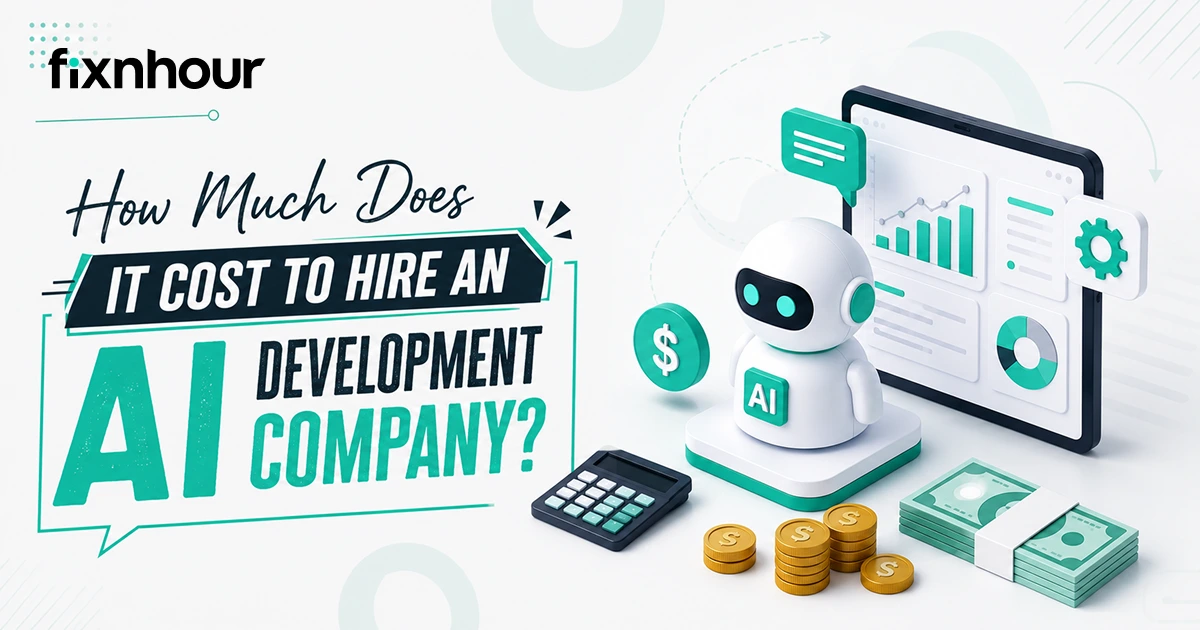
The cost of hiring an AI development company may range from a few thousand dollars for initial validation to more than $500,000 for an enterprise platform. This guide explains estimated pricing, development models, cost factors, hidden expenses, benefits, challenges, vendor-selection steps, and emerging trends to help businesses create a realistic AI development budget.
Quick Answer
Hiring an AI development company typically costs between $20,000 and $500,000 or more. A proof of concept may cost $10,000–$30,000, while custom chatbots, predictive systems, and generative AI applications can range from $30,000–$250,000. AI Product Development Companies pricing guide Enterprise platforms cost more because they require advanced security, integrations, infrastructure, and governance.
Key Takeaways
- A basic AI proof of concept may cost $10,000–$30,000.
- Custom AI applications generally range from $20,000–$250,000.
- Complex enterprise AI platforms may exceed $500,000.
- Data preparation can substantially increase the budget.
- Pre-trained models usually cost less than custom model training.
- API, cloud, and monitoring fees continue after launch.
- Industry experience and technical quality matter more than the lowest quotation.
- A focused AI MVP reduces financial and operational risk.
AI Development Statistics and Market Insights
Artificial intelligence has moved from limited experimentation toward broader business adoption. Organizations are investing in generative AI, automation, predictive analytics, computer vision, and intelligent assistants. This demand is increasing the need for AI engineers, data scientists, cloud specialists, cybersecurity professionals, and development companies capable of turning experimental models into dependable business systems.
Stanford’s 2026 AI Index reports that organizational AI adoption reached 88% in 2025, while generative AI was used in at least one business function by 70% of organizations.AI Pricing Guide However, AI-agent deployment remained in the single digits across almost every business function, indicating that many autonomous systems are still in early implementation stages. Stanford HAI
Industries investing heavily in AI include:
- Banking and financial services
- Healthcare and life sciences
- Retail and e-commerce
- Manufacturing and logistics
- Education and EdTech
- Travel and hospitality
- Media and telecommunications
- Professional services
AI Development Cost by Solution Type
Different AI products require different datasets, models, infrastructure, and engineering skills.AI Product Development Companies A customer-support chatbot using an established language-model API normally costs less than a regulated diagnostic system or proprietary recommendation engine. Estimating the budget by solution type provides businesses with a useful starting point before requesting tailored quotations from development companies.
AI chatbot and virtual assistant
A basic FAQ chatbot may cost between $15,000 and $40,000. A more capable generative AI assistant with retrieval-augmented generation, multilingual support, conversation history, analytics, and CRM integration may cost $40,000–$150,000 or more.
The budget is influenced by:
- Number of communication channels
- Knowledge-base size and quality
- Voice and multilingual functionality
- Human-agent handover
- CRM and help-desk integrations
- Security and hallucination controls
Machine learning solution
Custom machine learning projects generally range from $30,000 to $200,000. Typical applications include demand forecasting, fraud detection, lead scoring, recommendation engines, dynamic pricing, predictive maintenance, and customer-churn prediction.
Projects cost more when they require large proprietary datasets, real-time predictions, exceptionally high accuracy, continuous retraining, or integration with multiple operational systems.
Generative AI application
A generative AI application may cost $50,000–$250,000 or more. The price depends on whether the application uses a commercial API, an open-source model, fine-tuning, retrieval-augmented generation, AI agents, or a fully customized architecture.
Major cost components include prompt engineering, vector databases, model evaluation, content safeguards, user-interface development, API consumption, and observability.
Computer vision system
Computer vision solutions may cost between $40,000 and $300,000. Common use cases include object detection, facial verification, medical image analysis, inventory monitoring, document recognition, and industrial quality inspection.
Camera compatibility, image quality, annotation volume, edge-device processing, operating conditions, accuracy requirements, and privacy controls can significantly change the budget.
Enterprise AI platform
An enterprise AI platform may cost $150,000–$500,000 or considerably more. These systems often serve multiple departments, process sensitive data, support thousands of users, and connect with existing enterprise software.
They require scalable infrastructure, identity management, audit trails, regulatory controls, model governance, disaster recovery, performance monitoring, and extensive quality testing.
Factors Affecting AI Development Company Pricing
No universal price applies to every artificial intelligence project.Fixnhour Two applications that appear similar may require completely different investments because one has organized training data while another requires extensive collection and labelling. Understanding the principal cost factors helps businesses evaluate quotations, prevent unexpected expenses, and select an appropriate technical approach.
Project scope and complexity
Costs increase with the number of features, user roles, platforms, integrations, workflows, and AI models. Real-time systems are usually more expensive than applications that process data periodically.
Advanced requirements such as explainable predictions, multilingual interactions, autonomous decisions, or unusually high accuracy also require more development and testing.
Data preparation
An AI system depends on reliable information. If data is incomplete, inconsistent, unstructured, duplicated, or inaccessible, the development company must clean and organize it before training or connecting the model.
Data-related expenses may include:
- Data collection and migration
- Cleaning and normalization
- Manual annotation
- Synthetic data generation
- Privacy assessment
- Storage and governance
Model Selection
Connecting an established AI API is generally faster and less expensive than training a proprietary model. Open-source models may reduce licensing dependence but still require hosting, customization, optimization, and technical maintenance.
Fine-tuning adds costs related to dataset preparation, computing resources, evaluation, and repeated experimentation. Training a sophisticated model from the beginning is normally suitable only when the business has a unique requirement, substantial data, and a large budget.
- Established AI APIs reduce development time and initial costs.
- Open-source models require hosting, optimization, and maintenance.
- Fine-tuning involves data preparation, testing, and computing expenses.
- Custom model training requires extensive data, expertise, and investment.
Integrations and Infrastructure
AI rarely operates independently. A production application may need to exchange information with customer relationship management software, enterprise resource planning systems, payment gateways, databases, cloud services, or internal applications.
Older systems, incomplete documentation, incompatible data formats, and limited APIs can increase engineering time. GPU usage, data storage, response volume, availability requirements, and geographic deployment also affect cloud costs.
- Third-party integrations increase development and testing requirements.
- Legacy systems may require custom connectors or data transformation.
- GPU usage and storage needs affect ongoing infrastructure expenses.
- High availability and global deployment increase cloud costs.
Security and Compliance
Healthcare, finance, education, government, and other regulated industries require stronger security and governance. Encryption, access controls, consent management, data residency, audit logs, vulnerability testing, and regulatory documentation increase the initial budget but protect the organization from larger operational and legal risks.
- Data encryption protects information during storage and transmission.
- Access controls prevent unauthorized use of sensitive data.
- Compliance documentation and audits increase implementation costs.
- Security testing helps reduce operational, financial, and legal risks.
Development Location
Hourly rates vary according to the company’s location, experience, reputation, and specialist availability. North American and Western European teams usually charge higher rates, while companies in India, Eastern Europe, Latin America, and Southeast Asia may offer lower rates.
Businesses should compare total value rather than hourly pricing alone because weak architecture or poor-quality work may produce expensive corrections later.
- North American and Western European teams typically charge higher rates.
- Offshore development locations may provide more affordable pricing.
- Specialist availability and experience influence hourly costs.
- Overall quality and long-term value matter more than the lowest rate.
Benefits and Challenges of Hiring an AI Development Company
An experienced AI development company provides specialized skills, proven processes, and faster access to technical resources that may be difficult to recruit internally.AI Agent Development Companies However, outsourcing also introduces communication, data-security, dependency, and quality-control concerns. Understanding both sides enables businesses to establish realistic expectations and manage their development partnership more effectively.
Benefits of hiring AI specialists
A qualified provider can translate a business problem into an appropriate technical solution. Its team can assess data readiness, select suitable models, develop interfaces, configure infrastructure, perform testing, and monitor production performance.
Important benefits include:
- Access to specialized AI professionals
- Faster proof-of-concept development
- Reduced recruitment costs
- Scalable team structure
- Experience with models and cloud platforms
- Ongoing maintenance and optimization
Common AI development challenges
AI results are probabilistic and depend heavily on data quality. Models may generate inaccurate responses, reproduce bias, lose accuracy as conditions change, or fail when processing unfamiliar inputs.
Businesses must also address privacy, regulatory compliance, intellectual-property exposure, employee adoption, system integration, vendor dependence, and the difficulty of connecting technical performance with measurable business value.
Step-by-Step Process for Hiring an AI Development Company
Selecting an AI partner requires more than comparing portfolios and hourly rates. Businesses should clarify their problem, assess their available data, establish measurable targets, examine relevant experience, and begin with limited validation.AI Chatbot Development Companies A structured selection process reduces uncertainty and helps both parties agree on deliverables, responsibilities, timelines, risks, and expected outcomes.
| Step | Description | Key Actions |
|---|---|---|
| 1. Define the Business Problem | Clearly identify the operational challenge or customer need before selecting AI technology. A specific goal, such as reducing customer-service response times, provides clear direction and makes the solution’s overall business impact easier to measure. | • Identify the core operational issue• Understand customer expectations• Define the desired outcome• Avoid technology without purpose |
| 2. Assess Data Readiness | Evaluate available data before starting development. Review its ownership, quality, format, accessibility, volume, relevance, and privacy requirements. Ask shortlisted AI companies whether existing datasets are adequate for training, testing, deployment, and future improvement. | • Review data quality• Confirm ownership and permissions• Identify privacy requirements• Evaluate accessibility and volume |
| 3. Set Measurable Targets | Establish clear business and technical indicators for evaluating project performance. Useful targets include time savings, prediction accuracy, conversion growth, error reduction, response quality, operational efficiency, cost savings, and improved customer satisfaction levels. | • Define specific objectives• Select performance indicators• Establish baseline data• Set realistic timelines |
| 4. Establish a Realistic Budget | Prepare a complete budget covering discovery, design, development, data preparation, testing, deployment, infrastructure, training, maintenance, and contingency expenses. The initial development quotation should never be considered the project’s complete long-term ownership cost. | • Include discovery and development• Budget for infrastructure• Consider training and maintenance• Reserve contingency funds |
| 5. Shortlist Suitable Companies | Identify AI development companies with relevant expertise, industry experience, data-engineering capabilities, security practices, and post-launch support. Evaluate their case studies, client references, team qualifications, communication standards, technology knowledge, and successful project delivery experience. | • Examine AI case studies• Verify industry expertise• Review security standards• Contact previous clients |
| 6. Compare Detailed Proposals | Compare every proposal based on its scope, deliverables, exclusions, team structure, technologies, milestones, pricing assumptions, data responsibilities, intellectual-property rights, and maintenance terms. This helps prevent hidden expenses, unclear expectations, and contractual disagreements during development. | • Compare scope and deliverables• Review pricing and exclusions• Confirm ownership rights• Evaluate support terms |
| 7. Begin With a Proof of Concept | Start with a proof of concept to determine whether the proposed AI technology can solve the business problem. After successful validation, develop an MVP, gather user feedback, improve performance, and gradually scale the solution. | • Test technical feasibility• Validate with real data• Build an MVP• Scale using feedback |
1. Define the Business Problem
Clearly identify the operational challenge or customer need before choosing any AI technology. A specific goal, such as reducing customer-service response times, provides clearer direction and enables accurate measurement of the solution’s overall business impact.
- Identify the core operational issue
- Understand customer expectations
- Define the desired business outcome
- Avoid selecting technology without purpose
2. Assess Data Readiness
Evaluate your available data before beginning development. Review its ownership, quality, format, accessibility, volume, privacy requirements, and relevance. Ask shortlisted AI companies whether the existing datasets are adequate for training, testing, and deployment.
- Review data quality and accuracy
- Confirm ownership and permissions
- Identify privacy and compliance requirements
- Evaluate data accessibility and volume
3. Set Measurable Targets
Establish clear business and technical indicators to evaluate project performance. Relevant targets may include time savings, prediction accuracy, conversion growth, fewer errors, improved response quality, operational efficiency, cost reduction, or higher customer satisfaction scores.
- Define specific project objectives
- Select relevant performance indicators
- Establish baseline performance data
- Set realistic timelines for results
4. Establish a Realistic Budget
Create a complete budget covering discovery, design, development, data preparation, testing, deployment, infrastructure, employee training, maintenance, and contingency expenses. Never consider the initial development quotation as the project’s complete long-term ownership cost.
- Include development and discovery costs
- Budget for infrastructure and deployment
- Consider maintenance and employee training
- Reserve funds for unexpected expenses
5. Shortlist Suitable Companies
Identify AI development companies with relevant technical expertise, proven industry experience, strong data-engineering capabilities, reliable security practices, and dependable post-launch support. Evaluate case studies, client references, team qualifications, communication quality, and project delivery experience.
- Examine relevant AI case studies
- Verify industry and technical expertise
- Review security and compliance standards
- Contact previous clients for references
6. Compare Detailed Proposals
Compare proposals based on scope, deliverables, exclusions, team structure, technology choices, milestones, pricing assumptions, data responsibilities, intellectual-property rights, and maintenance terms. Detailed comparisons help prevent hidden expenses, unclear expectations, and contractual disagreements during development.
- Compare scope and project deliverables
- Review pricing assumptions and exclusions
- Confirm data and intellectual-property ownership
- Evaluate maintenance and support terms
7. Begin With a Proof of Concept
Start with a proof of concept to determine whether the proposed AI technology can effectively solve the business problem. After successful validation, develop an MVP, collect user feedback, improve performance, and scale gradually.
- Test technical and business feasibility
- Validate the solution with real data
- Build an MVP after successful testing
- Scale based on performance and feedback
Conclusion
Hiring an AI development company can cost from approximately $20,000 for a limited application to more than $500,000 for a complex enterprise platform. The project’s scope, data readiness, model selection, infrastructure, integration requirements, security controls, development location, and support expectations determine the final investment. Businesses should treat published price ranges as preliminary benchmarks.
The most effective approach is to define a measurable business problem, assess data quality, compare qualified providers, and begin with a proof of concept.Discover the Right Company for Your Project Fixnhour can support the initial company-discovery and comparison process, but every buyer should independently verify technical experience, references, security practices, contract terms, and the proposed total cost of ownership.
Frequently Asked Questions
Q1. How much does it cost to hire an AI development company?
Ans. Hiring an AI development company generally costs $20,000 to $500,000 or more. A basic proof of concept may start near $10,000, while complex enterprise platforms can exceed $500,000. The final price depends on project scope, data requirements, integrations, model complexity, security, compliance, development team, and delivery timeline.
Q2. What is the average hourly rate of an AI development company?
Ans. AI development companies typically charge between $25 and $250 or more per hour. Rates depend on location, technical specialization, developer experience, and project complexity. Businesses should compare overall value instead of hourly pricing alone, as inexperienced teams may require additional time, deliver poor results, or create expensive technical problems later.
Q3. How much does it cost to build a custom AI application?
Ans. A custom AI application typically costs between $30,000 and $250,000. Basic solutions using established APIs are usually more affordable. Applications requiring proprietary data, customized models, real-time processing, multiple integrations, strong cybersecurity, scalable infrastructure, or regulatory compliance generally require larger budgets and longer development timelines for successful implementation.
Q4. How much does generative AI development cost for a business?
Ans. Generative AI development generally costs $50,000 to $250,000 or more. Expenses may include model integration, prompt engineering, retrieval-augmented generation, vector databases, interface design, testing, security safeguards, and deployment. Businesses must also budget for recurring API usage, cloud hosting, performance monitoring, model evaluation, maintenance, and future system improvements.
Q5. Is hiring an AI company cheaper than building an in-house team?
Ans. Hiring an AI development company is often more economical for a defined project because businesses access multiple specialists without paying long-term recruitment, salary, training, and infrastructure costs. Building an internal team may suit organizations with continuous development needs, proprietary research, sufficient budgets, greater control requirements, and a long-term AI product roadmap.
Q6. How long does an AI development company take to build a solution?
Ans. An AI proof of concept may take four to eight weeks, while an MVP commonly requires three to six months. Complex enterprise AI platforms may take nine to eighteen months or longer. The timeline depends on data readiness, model complexity, integrations, compliance requirements, testing standards, feedback cycles, and deployment infrastructure.
Q7. What hidden costs should businesses consider in AI development?
Ans. Hidden AI development costs may include data cleaning, annotation, API fees, GPU usage, cloud storage, model evaluation, security testing, compliance reviews, employee training, monitoring, retraining, and ongoing maintenance. Businesses should request a total cost of ownership estimate covering initial development, deployment, recurring operations, upgrades, and long-term technical support.
Q8. How can a business reduce AI development costs without affecting quality?
Ans. Businesses can reduce AI development costs by starting with one clearly defined use case and validating it through a proof of concept. They should use established models, prepare data early, prioritize essential features, define acceptance criteria, monitor cloud spending, measure business outcomes, and scale the solution only after proving its value.