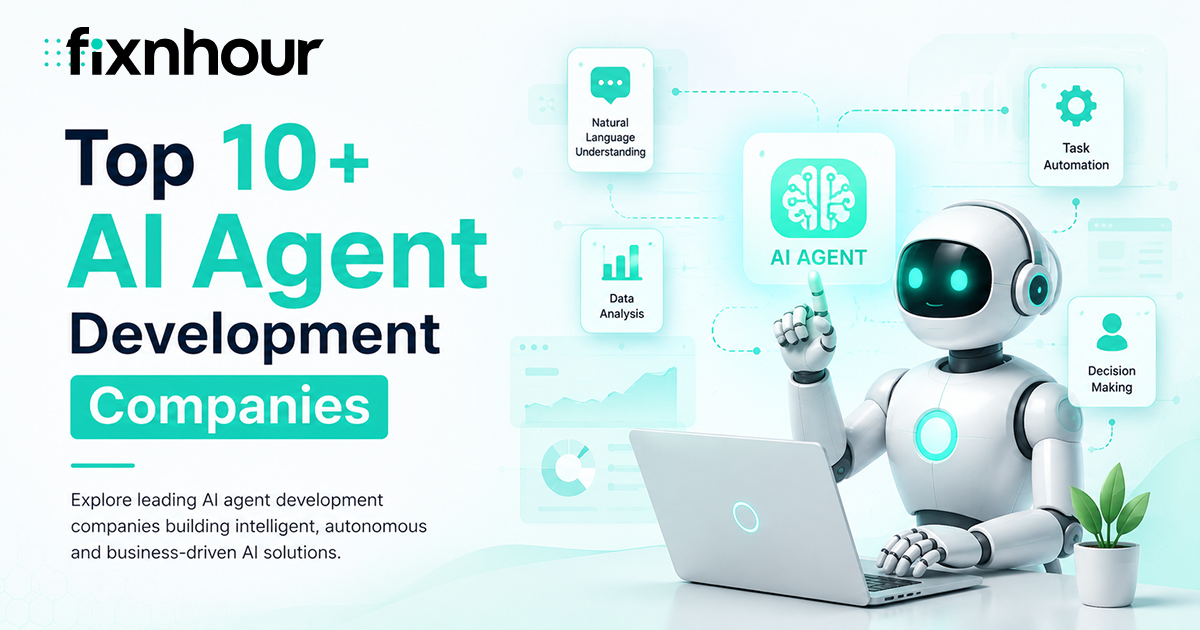
AI agents are transforming how businesses manage everyday tasks and complex operations. Unlike traditional chatbots that mainly answer questions, AI agents can understand goals, retrieve relevant information, use approved tools, make context-based decisions, and complete multi-step workflows. Companies are using agentic AI to improve customer support, qualify leads, conduct research, prepare reports, assist employees, and automate back-office processes.
However, developing a reliable AI agent involves much more than connecting software to a large language model. It requires high-quality data, secure system integrations, clear permissions, human oversight, continuous testing, and responsible AI governance. This guide compares the top AI agent development companies in 2026 based on their expertise, services, industry experience, ideal clients, and ability to build secure and scalable agentic AI solutions.
Quick Answer
The best AI agent development companies in 2026 include Fixnhour, LeewayHertz, Markovate, SoluLab, Master of Code Global, Azumo, Neurons Lab, Intellectyx, HatchWorks AI, Vention, OpenXcell, and EffectiveSoft. Many are also recognized among the Top AI Consulting Companies, helping businesses build custom AI agents, automate complex workflows, develop multi-agent systems, implement retrieval-augmented generation (RAG), and integrate intelligent solutions with existing business applications
Key Takeaways
- AI agents can understand goals, plan actions, access approved tools, and complete multi-step business tasks.
- Choose a development company with proven expertise in AI agent orchestration, data engineering, and enterprise system integration.
- Businesses commonly use AI agents across customer service, sales, finance, human resources, research, and daily operations.
- Strong security, data privacy, human approval, access controls, and responsible AI governance are essential for reliable deployment.
- Starting with a focused proof of concept helps evaluate technical feasibility, accuracy, and potential business value before making a larger investment.
- AI agent development costs depend on workflow complexity, autonomy level, integrations, infrastructure, security, and compliance requirements.
- Production-ready AI agents need continuous testing, performance monitoring, evaluation, maintenance, and optimization.
- Before selecting a provider, verify its case studies, client references, technical capabilities, and measurable project outcomes.
What Is an AI Agent Development Company?
An AI agent development company like Fixnhour designs intelligent systems that understand goals, analyze information, use approved tools, and complete business tasks. These companies combine large language models, machine learning, APIs, enterprise data, memory, orchestration frameworks, and security controls to build reliable single-agent or multi-agent solutions tailored to specific organizational workflows and needs.
AI Agents vs Chatbots vs Traditional Automation
Chatbots mainly answer questions, while traditional automation follows fixed rules for predictable tasks. AI agents can interpret goals, plan steps, access tools, retrieve data, and adapt actions as conditions change.
Technologies Behind Modern AI Agents
Modern AI agents combine language models, enterprise data, APIs, memory, orchestration frameworks, cloud infrastructure, and security controls to reason, perform tasks, integrate systems, and operate reliably within approved business workflows.
- Large language models and natural language processing
- Retrieval-augmented generation and vector databases
- LangChain, LangGraph, CrewAI, AutoGen, and Semantic Kernel
- APIs, function calling, memory, planning, and tool use
- Cloud infrastructure and enterprise data platforms
How We Selected the Top AI Agent Development Companies
We selected these AI agent development companies by evaluating their technical expertise, industry experience, service range, enterprise integration capabilities, security practices, and ability to deliver production-ready solutions. Insights from our software development statistics guide also supported the evaluation. We considered client feedback, case studies, deployment support, scalability, responsible AI practices, and experience building custom and multi-agent systems for businesses worldwide.
The evaluation criteria include:
- AI, machine learning, and generative AI expertise
- Custom agent and multi-agent development capabilities
- Workflow orchestration experience
- Enterprise application integration
- Relevant industry experience
- Data security and responsible AI practices
- Client feedback and market reputation
- Deployment, maintenance, and optimization support
Top 10+ AI Agent Development Companies in 2026
The following Top AI-Assisted Development Companies offer expertise in custom agents, multi-agent systems, generative AI, RAG, workflow automation, and enterprise integration. Each provider has different technical strengths, industry experience, pricing, and delivery models. Compare their capabilities and best-fit use cases to identify the right development partner for your business.
| No. | Company | Overview | Key Services |
|---|---|---|---|
| 1 | Coherent Lab | Develops AI agents and intelligent software solutions that automate workflows, improve decision-making, and enhance digital experiences. | Custom AI agents and generative AI; web, mobile, game, and enterprise software; workflow automation; intelligent application integration |
| 2 | LeewayHertz | Develops custom AI agents and multi-agent systems that automate complex workflows and integrate securely with enterprise tools and data. | AI strategy and use-case discovery; agent architecture and deployment; RAG and autonomous agents; enterprise integrations; continuous monitoring |
| 3 | Markovate | Builds agentic AI systems that automate connected workflows, improve knowledge sharing, and support business decision-making. | AI consulting and proof of concept; autonomous agents; workflow orchestration; machine learning; generative AI; MLOps |
| 4 | SoluLab | Creates scalable AI agents and intelligent applications that integrate securely with existing business systems. | Custom AI agents and multi-agent systems; RAG; model selection; data preparation; blockchain, IoT, mobile, and enterprise integration; AI governance |
| 5 | Master of Code Global | Develops conversational and agentic AI solutions for websites, applications, messaging platforms, and voice channels. | Conversational AI; voice agents; customer-service automation; omnichannel conversation design; cloud, CRM, and legacy-system integration |
| 6 | Azumo | Provides flexible AI engineering teams for building LLM applications, intelligent assistants, data platforms, and custom software. | Custom AI and LLM applications; data engineering; cloud solutions; nearshore development; team augmentation; flexible engagement models |
| 7 | Neurons Lab | Combines AI strategy, product discovery, prototyping, and machine learning engineering to build scalable intelligent systems. | AI consulting; strategic planning; proof-of-concept development; agentic and generative AI; data foundations; AI governance; cloud-cost optimisation |
| 8 | Intellectyx | Develops data-driven AI agents for enterprise search, decision intelligence, automation, analytics, and secure information access. | Agentic and generative AI; data engineering; advanced analytics; enterprise search; workflow automation; digital transformation; system integration |
| 9 | HatchWorks AI | Combines generative AI, data engineering, and product development to create intelligent applications connected to organizational workflows. | AI strategy and solution design; custom AI software; RAG applications; data engineering; platform modernization; AI product development |
| 10 | Vention | Provides scalable AI engineering teams and custom software expertise for developing, modernizing, and expanding intelligent products. | AI and custom software; cloud, web, mobile, and enterprise engineering; dedicated developers; flexible teams; scalable architecture |
| 11 | OpenXcell | Helps startups transform AI agent concepts into practical prototypes, MVPs, and scalable web and mobile applications. | AI agents and custom software; rapid prototyping; MVP development; web and mobile integration; dedicated development teams |
| 12 | EffectiveSoft | Combines AI, data, cloud, and enterprise engineering to connect intelligent agents with legacy applications and operational systems. | Generative AI; intelligent automation; data and cloud engineering; enterprise integration; legacy software modernization |
1. Coherent Lab
Coherent Lab develops AI agents and intelligent software solutions that automate workflows, improve decisions, and create better digital experiences for businesses.
Key points:
- Custom AI agent and generative AI development
- Web, mobile, game, and enterprise software solutions
- Workflow automation and intelligent application integration
2. LeewayHertz
LeewayHertz develops custom AI agents and multi-agent systems that automate complex workflows and integrate securely with existing enterprise tools and data.
Key points:
- AI strategy and use-case discovery
- Agent architecture, development, and deployment
- RAG, autonomous agents, and enterprise integrations
- Continuous monitoring and performance improvement
3. Markovate
Markovate builds agentic AI systems that automate connected workflows, improve knowledge sharing, support decisions, and increase operational efficiency across business departments.
Key points:
- AI consulting and proof-of-concept development
- Autonomous agents and workflow orchestration
- Machine learning, generative AI, and MLOps
4. SoluLab
SoluLab creates scalable AI agents and intelligent applications that automate workflows, improve decisions, and integrate smoothly with existing business systems securely.
Key points:
- Custom AI agents and multi-agent systems
- RAG, model selection, and data preparation
- Blockchain, IoT, mobile, and enterprise integration
- Deployment, monitoring, and AI governance
5. Master of Code Global
Master of Code Global develops conversational and agentic AI solutions that improve customer experiences across websites, applications, messaging platforms, and voice channels.
Key points:
- Conversational AI and voice-agent development
- Customer-service and experience automation
- Omnichannel conversation design
- Cloud, CRM, and legacy-system integration
6. Azumo
Azumo provides flexible AI engineering teams that develop LLM applications, intelligent assistants, data platforms, and custom software for growing companies worldwide.
Key points:
- Custom AI and LLM application development
- Data engineering and cloud solutions
- Nearshore development and team augmentation
- Flexible engagement and delivery models
7. Neurons Lab
Neurons Lab combines AI strategy, product discovery, rapid prototyping, and machine learning engineering to develop commercially valuable and scalable intelligent systems.
Key points:
- AI consulting and strategic planning
- Proof-of-concept and prototype development
- Agentic AI, generative AI, and data foundations
- AI governance and cloud cost optimization
8. Intellectyx
Intellectyx develops data-driven AI agents that support enterprise search, decision intelligence, business automation, analytics, and access to complex organizational information securely.
Key points:
- Agentic AI and generative AI development
- Data engineering and advanced analytics
- Enterprise search and workflow automation
- Digital transformation and system integration
9. HatchWorks AI
HatchWorks AI combines generative AI, data engineering, and product development to create intelligent applications connected with existing organizational data and workflows.
Key points:
- AI strategy and solution design
- Custom AI software and RAG applications
- Data engineering and platform modernization
- AI product development and engineering teams
10. Vention
Vention provides scalable AI engineering teams and custom software expertise that help technology companies develop, modernize, and expand intelligent digital products efficiently.
Key points:
- AI and custom software development
- Cloud, web, mobile, and enterprise engineering
- Dedicated developers and flexible technical teams
- Product modernization and scalable architecture
11. OpenXcell
OpenXcell helps startups transform AI agent ideas into practical prototypes, minimum viable products, and scalable applications for web and mobile platforms.
Key points:
- AI agent and custom software development
- Rapid prototyping and MVP development
- Web and mobile application integration
- Dedicated development teams
12. EffectiveSoft
EffectiveSoft combines artificial intelligence, data, cloud, and enterprise engineering to connect intelligent agents with legacy applications and complex operational systems securely.
Key points:
- Generative AI and intelligent automation
- Data engineering and cloud development
- Enterprise application integration
- Legacy software modernization
AI Agent Development Services These Companies Provide
Most AI agent development companies, including several Top Generative AI Companies, provide end-to-end services, beginning with strategy and use-case discovery and continuing through design, development, integration, testing, deployment, and maintenance. Their solutions may include custom agents, multi-agent systems, RAG applications, workflow automation, enterprise integrations, security controls, performance monitoring, governance, and continuous optimization for long-term business value.
Strategy and Use-Case Discovery
The development company evaluates existing workflows, user needs, available data, operational risks, and expected returns. This discovery stage helps determine whether an AI agent is the right solution or whether traditional automation would be simpler, more reliable, and cost-effective.
Custom AI Agent Development
Companies design custom AI agents around specific business processes, objectives, data sources, and user requirements. Common applications include:
- Customer support and ticket resolution
- Sales prospecting and lead qualification
- Research and competitive intelligence
- Employee knowledge assistance
- Finance, HR, and administrative operations
- Software development and data analysis
Multi-Agent System Development
A multi-agent system combines several specialized agents that share information, delegate tasks, and review results. For example, a research agent may collect information, an analysis agent may identify patterns, and a reporting agent may transform the findings into a clear final report.
Enterprise System Integration
AI agents deliver greater value when securely connected to CRM, ERP, customer-support, database, document-management, and collaboration platforms. Reliable integration requires secure authentication, role-based permissions, real-time data exchange, error handling, audit logs, and appropriate limits on agent actions.
Monitoring and Ongoing Support
Production AI agents require continuous monitoring and evaluation to remain reliable, secure, and cost-effective. Development partners may track response accuracy, task-completion rates, latency, model usage costs, integration failures, security events, user feedback, and overall business performance.
Benefits of Hiring an AI Agent Development Company
Hiring a specialist AI agent development company gives businesses access to experienced strategists, engineers, data specialists, and security professionals with knowledge of the best AI tools for startups. The right partner can shorten development time, reduce technical risks, integrate agents with existing systems, and create reliable, scalable solutions that support measurable operational improvements and sustainable long-term business growth.
Major Business Benefits
- Automated workflows: AI agents can manage repetitive and multi-step processes with less manual effort.
- Faster operations: Automation reduces customer response times, administrative delays, and overall processing time.
- Continuous assistance: AI agents can support customers and employees around the clock.
- Better knowledge access: Agents can retrieve relevant information from approved documents, databases, and internal systems.
- Faster decision-making: Teams can use real-time data and AI-generated insights to make informed decisions.
- Efficient scalability: Businesses can handle growing workloads without increasing operational resources at the same rate.
- Personalized experiences: AI agents can tailor recommendations, responses, and support using relevant customer context.
- Reduced technical risk: Experienced developers help prevent common architecture, integration, data privacy, and security mistakes.
Challenges and Risks of AI Agent Development
AI agents can deliver significant business value, but they also introduce technical, security, and operational risks. Businesses evaluating top AI app companies in Europe should ensure these challenges are identified and managed before an agent is deployed in a production environment or given access to sensitive information and business systems.
Accuracy and Reliability
AI agents can misunderstand context, provide inaccurate answers, choose unsuitable tools, or fail while completing complex, multi-step business processes.
- Use verified and regularly updated data sources.
- Test agents across real-world scenarios.
- Add human review for critical decisions.
- Monitor response accuracy and task completion.
- Implement fallback and error-handling mechanisms.
Security and Data Privacy
AI agents may expose sensitive information or perform unauthorized actions when permissions, integrations, and data-protection controls are not properly managed.
- Apply role-based access controls.
- Encrypt sensitive data.
- Protect systems against prompt injection.
- Monitor suspicious activities continuously.
- Limit permissions to essential business tasks.
Cost and Performance
Multiple model calls, database queries, and third-party integrations can increase response time, infrastructure usage, and overall AI agent operating costs.
- Track API and infrastructure usage.
- Optimize prompts and agent workflows.
- Cache frequently requested information.
- Set clear spending limits.
- Select cost-effective models for routine tasks.
Compliance and Accountability
Businesses must establish responsibility, approval processes, and audit controls for AI agent decisions involving regulated, financial, legal, or sensitive activities.
- Define clear ownership and accountability.
- Maintain detailed activity logs.
- Add human approval for sensitive actions.
- Follow relevant industry regulations.
- Conduct regular compliance reviews.
Integration and Maintenance
Connecting AI agents with legacy systems, databases, CRM platforms, and enterprise applications requires continuous testing, monitoring, updates, and technical support.
- Use secure and reliable APIs.
- Test integrations before deployment.
- Update models and knowledge bases regularly.
- Monitor system performance and failures.
- Provide ongoing maintenance and technical support.
How Much Does AI Agent Development Cost in 2026?
In 2026, AI agent development typically costs between $5,000 and $500,000 or more. Pricing depends on the agent’s complexity, number of integrations, data requirements, security standards, automation capabilities, infrastructure, testing, and scalability. Businesses may also consult the top cloud consulting companies in the world for scalable infrastructure support. Ongoing expenses may include model usage, cloud hosting, monitoring, maintenance, updates, and technical support after launch.
| Project Type | Approximate Cost |
|---|---|
| Basic proof of concept | $5,000–$20,000 |
| Single-purpose agent or MVP | $20,000–$60,000 |
| Advanced agent with multiple integrations | $60,000–$150,000 |
| Enterprise multi-agent platform | $150,000–$500,000+ |
Step-by-Step Process for Choosing an AI Agent Development Company
Choosing the right AI agent development company requires a structured evaluation of your goals, budget, technical needs, security requirements, and startup mobile app UX design needs. Define the project scope, shortlist experienced providers, review case studies, assess their technology stack, compare pricing, verify compliance standards, interview the proposed team, and begin with a small pilot project.
| Step | Stage | Key Actions | Main Outcome |
|---|---|---|---|
| 1 | Define the Workflow | Identify a slow, costly, repetitive, or difficult-to-scale process. Document its inputs, decisions, actions, exceptions, and expected outputs. | A clearly defined automation opportunity |
| 2 | Set Measurable Goals | Select metrics such as processing time, resolution rate, cost per task, accuracy, conversion rate, and customer satisfaction. | Clear success criteria |
| 3 | Document Integrations and Data | List the databases, documents, APIs, CRM platforms, and business systems the agent must access. | Complete technical and data requirements |
| 4 | Decide Whether to Build or Buy | Choose a ready-made platform for standard workflows or custom development for unique processes, data, and compliance requirements. | The most suitable development approach |
| 5 | Shortlist Relevant Companies | Prioritize providers with relevant industry, workflow, technology, and deployment experience. | A qualified list of potential partners |
| 6 | Verify Experience | Review case studies, references, client feedback, production deployments, and measurable project outcomes. | Evidence of proven capabilities |
| 7 | Evaluate Security | Assess encryption, access controls, retention policies, logging, model providers, human approvals, incident response, and compliance. | A secure and compliant solution |
| 8 | Compare Proposals | Evaluate scope, architecture, timeline, total cost, IP ownership, third-party dependencies, and post-launch support. | A well-informed provider selection |
| 9 | Start With a Pilot | Test a focused workflow under controlled, realistic conditions to assess accuracy, usability, integrations, and business value. | Validated technical and business feasibility |
| 10 | Scale After Validation | Monitor accuracy, completion rate, escalations, processing time, cost per task, satisfaction, and ROI before expanding. | Reliable and sustainable agent deployment |
1. Define the Workflow
Identify a repetitive, costly, or slow business process and document its inputs, decisions, actions, exceptions, dependencies, and expected outcomes clearly.
- Map every workflow stage.
- Identify bottlenecks and repetitive tasks.
- Define inputs, outputs, and exceptions.
2. Set Measurable Goals
Establish clear performance indicators to measure whether the AI agent improves efficiency, accuracy, customer experience, operational costs, and overall business value.
- Measure processing time and accuracy.
- Track cost per completed task.
- Monitor conversions and customer satisfaction.
3. Document Integrations and Data
List every database, API, document, CRM platform, and business system the AI agent must securely access during its daily operations.
- Identify required data sources.
- Document API and CRM integrations.
- Review data quality and accessibility.
4. Decide Whether to Build or Buy
Compare ready-made platforms with custom development based on workflow complexity, available budget, security requirements, scalability, integrations, and long-term business needs.
- Evaluate platform features and limitations.
- Compare initial and ongoing costs.
- Consider customization and ownership requirements.
5. Shortlist Relevant Companies
Select AI agent development companies with proven expertise in your industry, workflow, technology environment, integration needs, and preferred deployment approach.
- Review industry-specific experience.
- Examine technical capabilities.
- Check deployment and integration expertise.
6. Verify Experience
Review case studies, references, client feedback, and measurable outcomes to confirm whether the company has delivered successful production-ready AI agents before.
- Request relevant case studies.
- Speak with previous clients.
- Verify measurable project results.
7. Evaluate Security
Assess encryption, permissions, data retention, audit logs, human oversight, regulatory compliance, incident response, and protection against potential AI security threats.
- Verify access-control practices.
- Review data privacy policies.
- Confirm compliance and incident procedures.
8. Compare Proposals
Compare each proposal based on project scope, architecture, timeline, total cost, ownership terms, dependencies, maintenance, scalability, and post-launch technical support.
- Check deliverables and timelines.
- Compare total development costs.
- Review intellectual property ownership.
9. Start With a Pilot
Test the AI agent within a controlled, limited workflow to evaluate accuracy, usability, integration performance, risks, and potential business value safely.
- Use real but controlled data.
- Measure accuracy and task completion.
- Collect feedback from actual users.
10. Scale After Validation
Expand the AI agent only after confirming dependable performance, measurable returns, user satisfaction, secure operations, and successful workflow integration at scale.
- Track performance and escalation rates.
- Calculate cost savings and ROI.
- Expand features and workflows gradually.
Best Practices for Building Reliable AI Agents
Building a reliable AI agent starts with one focused and valuable use case. Clearly define what the agent can access, which actions it can perform, and when human approval is required.
- Use verified and regularly updated data sources.
- Apply least-privilege access to limit unnecessary permissions.
- Create evaluation datasets before deployment.
- Test standard, unusual, and adversarial scenarios.
- Add human review for sensitive or high-risk actions.
- Monitor important actions, failures, costs, and escalations.
- Maintain detailed audit logs for accountability.
- Provide a simple way for users to report incorrect results.
- Increase autonomy gradually after consistent performance is demonstrated.
Conclusion
The best AI agent development company is not always the largest or most expensive. The right partner understands your business workflows, data requirements, industry challenges, technology environment, security needs, and measurable goals.
Compare providers based on relevant production experience, integration expertise, security practices, communication, pricing transparency, and post-launch support. Start with a controlled pilot to evaluate accuracy, reliability, usability, and business value. Once the AI agent delivers consistent results, expand its capabilities and responsibilities gradually and safely. Contact us today to discuss your AI agent development requirements and find the right solution for your business.
Frequently Asked Questions
Q1. Which Is the Best AI Agent Development Company in 2026?
Ans. LeewayHertz, Markovate, SoluLab, Master of Code Global, Azumo, Neurons Lab, Intellectyx, HatchWorks AI, Vention, OpenXcell, and EffectiveSoft are notable options. However, the best company depends on your industry, workflow, integration requirements, security standards, budget, project complexity, and preferred engagement model.
Q2. How Much Does It Cost to Hire an AI Agent Development Company?
Ans. A basic proof of concept may cost $5,000–$20,000, while a single-purpose AI agent or MVP may cost $20,000–$60,000. Advanced agents with multiple integrations can range from $60,000 to $150,000. Enterprise multi-agent platforms may cost between $150,000 and $500,000 or more.
Q3. How Long Does It Take to Build a Custom Autonomous AI Agent?
Ans. A focused proof of concept may take four to eight weeks, while an MVP generally requires two to four months. An enterprise-grade agent with multiple integrations may take six months or longer. The timeline depends on data readiness, workflow complexity, security reviews, integrations, testing requirements, and regulatory considerations.
Q4. What Services Do AI Agent Development Companies Provide?
Ans. AI agent development companies typically offer AI consulting, use-case discovery, architecture design, retrieval-augmented generation development, custom agent engineering, multi-agent orchestration, API integration, cloud deployment, security testing, performance evaluation, monitoring, maintenance, and continuous optimization. Some providers also offer data engineering, interface design, and compliance support.
Q5. How Do I Choose an AI Agent Development Company?
Ans. Start by defining your use case, budget, timeline, required integrations, and security needs. Compare companies based on relevant industry experience, successful production deployments, technical capabilities, case studies, client references, pricing transparency, and post-launch support. Request detailed technical proposals and begin with a controlled proof of concept.
Q6. What Is the Difference Between an AI Agent and an AI Chatbot?
Ans. An AI chatbot primarily communicates with users, answers questions, and provides information. An AI agent can understand a goal, plan multiple steps, retrieve relevant data, use approved tools, and perform actions across business systems. However, advanced chatbots may include agentic capabilities, so the two categories can sometimes overlap.
Q7. Can AI Agents Integrate With CRM and ERP Software?
Ans. Yes, AI agents can integrate with CRM, ERP, help desk, e-commerce, analytics, communication, and collaboration platforms through APIs and approved connectors. Secure integration requires authentication, role-based access controls, error-handling mechanisms, audit logs, monitoring, and thorough testing before the agent is deployed in a production environment.
Q8. Are Custom AI Agents Secure for Healthcare, Banking, and Enterprise Use?
Ans. Custom AI agents can operate in regulated environments when designed with strong encryption, limited permissions, data governance, audit logs, compliance controls, and human oversight. Organizations should conduct detailed security, privacy, and risk assessments before allowing an agent to access sensitive information or perform financial, legal, medical, or other high-impact actions