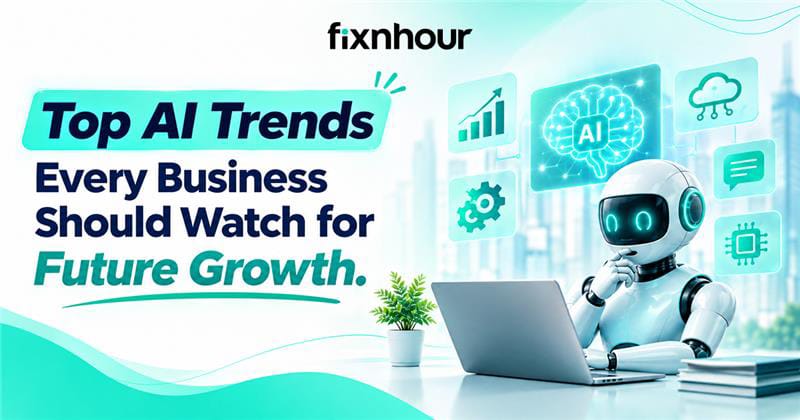
Artificial intelligence has quickly moved from an emerging technology to an important part of business strategy. Companies are using AI to automate repetitive processes, analyze information, support employees, improve customer service, personalize experiences, and develop new products.The next phase of AI is increasingly focused on business value rather than experimentation. Organizations are moving beyond simple AI tools and exploring systems that can work across workflows, connect with business applications, and complete tasks with greater autonomy.Recent industry research also shows strong enterprise adoption. Deloitte's 2026 India research reported that 40% of Indian respondents had significant or full AI usage, compared with approximately 28% globally.
Quick Answer
Businesses should watch generative AI, agentic AI, intelligent automation, predictive analytics, AI-powered personalization, multimodal AI, and responsible AI. These technologies can improve productivity, customer experience, decision-making, and operational efficiency. Fixnhour helps businesses explore AI-driven solutions aligned with their specific goals and operational needs. The best strategy is to adopt AI around clear business goals, reliable data, security controls, employee training, and measurable outcomes rather than simply following every new AI trend.
Key Takeaways
- Generative AI is becoming an important business productivity tool.
- AI agents are moving from experimentation toward real business workflows.
- Intelligent automation can reduce repetitive manual work.
- Predictive analytics helps businesses make faster, data-driven decisions.
- AI-powered personalization can improve customer experiences.
- Responsible AI, security, privacy, and governance are increasingly important.
- Businesses should focus on AI use cases with measurable ROI.
How Generative AI Is Changing Work
Generative AI is transforming the way businesses create, manage, and process information. Unlike traditional AI systems that mainly analyze existing data, generative AI can produce new content such as text, images, summaries, ideas, code, and business documents. As one of the leading AI business trends, generative AI can help organizations improve productivity, streamline content workflows, support employees, and deliver more personalized customer experiences. Businesses can also use generative AI for marketing, customer service, research, documentation, software development, and internal knowledge management.
Businesses are increasingly using generative AI to support everyday tasks, including:
- Content creation and editing: Generate drafts for blogs, emails, product descriptions, and marketing materials.
- Marketing and sales support: Create campaign ideas, ad copy, customer messages, and sales content.
- Software and workflow assistance: Help developers write, review, and document code while supporting business workflows.
- Knowledge management and research: Summarize reports, extract key information, and help employees find answers faster.
Business Benefits of Generative AI
The biggest advantage of generative AI is its ability to improve employee productivity and reduce the time required for repetitive knowledge-based tasks. Teams can use AI to create first drafts, summarize lengthy documents, answer internal questions, brainstorm ideas, and organize information more efficiently.For example, a marketing team can use generative AI to develop an initial campaign concept, while employees can refine the content according to the company's brand voice and objectives.
- Faster content creation and editing
- Improved employee productivity and efficiency
- Quicker research, summarization, and information retrieval
- Better support for marketing and sales teams
- Reduced time spent on repetitive knowledge-based tasks
- Faster brainstorming and idea generation
- Improved internal knowledge management
- Human review for accuracy, quality, and brand consistency
What Are AI Agents
AI agents are intelligent software systems designed to work toward specific objectives. Depending on how they are configured, they can retrieve information, make decisions within defined boundaries, interact with business applications, and coordinate multiple steps to complete a task. AI Agents Companies can help businesses implement these systems to automate workflows, improve productivity, streamline operations, and support faster decision-making while maintaining appropriate human oversight.
Where Businesses Can Use AI Agents
- Customer service: Handle routine queries, classify requests, and route complex issues to human teams.
- Research and information gathering: Collect information from approved sources and prepare summaries.
- Sales operations: Support lead qualification, follow-ups, and customer research.
- Internal workflow automation: Coordinate repetitive tasks across different business tools.
- IT support: Help identify common technical issues and guide employees through standard solutions.
Why AI Agents Matter for Business Growth
The value of AI agents comes from their ability to connect individual AI capabilities with real business workflows. Instead of using AI only for generating an answer, organizations can explore how agents can help complete an entire process.Businesses should begin with clearly defined use cases, limited permissions, measurable goals, and appropriate human oversight. This approach can help organizations gain the benefits of agentic AI while reducing operational and security risks.
- Automate repetitive and multi-step business workflows
- Improve employee productivity and save valuable time
- Speed up customer service and response times
- Support faster research and business decision-making
- Reduce manual effort across routine operations
- Connect AI capabilities with existing business tools
- Scale workflows without increasing manual workload at the same rate
- Enable teams to focus more on strategic and creative work
AI-Powered Predictive Analytics Is Improving Business Decisions
Predictive analytics is becoming an important part of modern business decision-making because organizations now have access to more data than ever before. AI-powered predictive models can analyze historical and real-time information, identify patterns, and estimate potential future outcomes. This helps businesses make decisions based on evidence rather than relying only on assumptions or past experience.
Analyze historical and real-time business data
- Identify important patterns and emerging trends
- Forecast potential sales and revenue outcomes
- Predict changes in customer demand
- Identify customers who may be at risk of churn
- Detect potential fraud and unusual business activity
- Identify operational and financial risks earlier
What Is Predictive Analytics?
Predictive analytics is a data-driven approach that uses historical information, current business data, statistical techniques, machine learning, and AI models to identify patterns and estimate potential future outcomes. Rather than looking only at what has already happened, businesses can use predictive analytics to understand what may happen next and prepare appropriate actions.
For example, a retailer can analyze previous purchases, seasonal demand, and customer behavior to estimate which products may be in demand. Similarly, a subscription business can examine customer activity to identify patterns that may indicate a higher risk of churn. These insights can help teams move from reactive decision-making toward more proactive business planning.
How Predictive Analytics Works
Predictive analytics generally involves collecting relevant data, preparing and analyzing it, identifying meaningful patterns, developing predictive models, and evaluating their performance. Once a model is deployed, businesses can monitor its results and update it as new data becomes available. AI in finance trends are also driving the use of predictive analytics for areas such as fraud detection, risk assessment, financial forecasting, customer behavior analysis, and personalized financial services.
- Data collection: Gather relevant historical and current business data.
- Data preparation: Clean, organize, and validate information before analysis.
- Pattern identification: Use analytics and AI techniques to discover relationships and trends.
- Prediction: Estimate likely outcomes based on available information.
- Monitoring: Evaluate predictions and improve models as business conditions change.
How Predictive AI Helps Businesses
Predictive AI helps businesses turn historical and real-time data into practical insights about potential future outcomes. By identifying patterns in customer behavior, sales activity, demand, transactions, and operational data, AI models can help teams anticipate changes and make more informed decisions.This allows organizations to move from reactive problem-solving to proactive planning. When combined with reliable data, regular monitoring, and human judgment, predictive AI can support forecasting, risk management, customer retention, resource planning, and other important business processes.
- Sales forecasting: Estimate future sales, identify changing demand patterns, and help sales teams plan targets and resources more effectively.
- Customer churn prediction: Analyze customer behavior to identify users who may be at risk of leaving, allowing businesses to plan timely retention strategies.
- Demand forecasting: Predict potential changes in product or service demand so businesses can better manage inventory, staffing, purchasing, and capacity.
- Fraud detection: Detect unusual transaction patterns or activities that may require additional investigation and human review.
- Risk management: Analyze historical patterns and current indicators to help organizations identify and prepare for potential operational or financial risks.
Benefits of Predictive Analytics
AI-powered predictive analytics can help businesses make faster, more informed decisions while reducing uncertainty. By identifying patterns earlier, organizations can anticipate potential changes instead of waiting for problems to appear. This can support better planning, resource allocation, customer retention, and risk management.
Key benefits include:
- Better decision-making: Give teams data-driven insights to support strategic and operational decisions.
- Early risk identification: Highlight patterns that may indicate emerging business risks.
- Improved planning: Support forecasting for sales, demand, inventory, staffing, and resources.
- Greater operational efficiency: Help businesses allocate time and resources based on expected needs.
- Improved customer retention: Identify behavioral patterns associated with churn and engagement.
- More proactive business strategies: Allow organizations to prepare for possible outcomes instead of responding only after events occur.
Intelligent Automation Will Drive Operational Efficiency
AI-powered automation is changing how businesses manage repetitive, time-consuming, and rule-based processes. By combining artificial intelligence with workflow automation, organizations can process information faster, reduce manual workload, improve accuracy, and maintain greater consistency across daily operations.Unlike traditional automation, which generally follows fixed rules, intelligent automation can analyze information, recognize patterns, and support decisions in situations where processes may vary. This makes it useful for businesses that handle large volumes of documents, customer requests, transactions, and operational data.
Key Benefits of Intelligent Automation
- Reduced manual workload: Automates repetitive tasks and allows employees to focus on higher-value responsibilities.
- Faster business processes: Processes documents, requests, and data more quickly than many manual workflows.
- Improved operational efficiency: Helps businesses streamline workflows and reduce unnecessary steps.
- Greater accuracy: Reduces the likelihood of common human errors in repetitive data-processing tasks.
- Lower operational costs: Can reduce the amount of time and resources required for routine processes.
- Better scalability: Allows businesses to handle increasing workloads without proportionally increasing manual effort.
AI-Powered Automation vs. Traditional Automation
Traditional automation generally follows predefined rules and predefined workflows, making it effective for repetitive tasks where inputs and outcomes are predictable. AI-powered automation goes a step further by using artificial intelligence and machine learning to interpret information, recognize patterns, understand context, and respond to changing conditions. AI-Assisted Development Companies can help businesses apply these capabilities to create intelligent workflows and solutions that are more adaptable to complex business requirements. .
This makes AI-powered automation more suitable for processes involving unstructured data, varying inputs, and complex decisions. For example, traditional automation can send an email when a form is submitted, while AI-powered automation can analyze the customer's message, understand its intent, extract relevant information, and automatically route the request to the right workflow.
| Comparison Factor | Traditional Automation | AI-Powered Automation |
|---|---|---|
| Working Approach | Follows predefined rules and workflows | Uses AI to interpret information and make context-based decisions |
| Type of Data | Works best with structured data | Can handle structured and unstructured data |
| Flexibility | Limited when processes or inputs change | More adaptable to changing inputs and conditions |
| Decision-Making | Uses fixed if-then rules | Identifies patterns and supports intelligent decisions |
| Complexity | Best for repetitive and predictable tasks | Suitable for complex and variable processes |
| Examples | Scheduled emails, basic data entry, workflow triggers | Intelligent document processing, request classification, AI-assisted workflows |
| Human Involvement | Often requires predefined rules and exception handling | Can reduce manual intervention while retaining human oversight |
| Scalability | Scales predefined workflows | Can scale while adapting to different types of inputs |
When Should Businesses Use AI-Powered Automation
AI-powered automation is particularly useful when a business process involves large amounts of information, repetitive manual effort, changing inputs, or tasks that require interpretation. AI in Real Estate is one example of how businesses can apply these capabilities to automate document processing, analyze property-related information, streamline customer interactions, and support operational workflows. Businesses should evaluate whether AI can deliver measurable improvements before replacing an existing workflow.
- Processes involving large volumes of documents or customer requests
- Workflows requiring classification or information extraction
- Tasks where inputs vary from one case to another
- Operations requiring pattern recognition or contextual analysis
- Repetitive processes where employees spend significant time reviewing information
- Business workflows where faster processing can improve customer experience
- Operations where reducing manual errors can improve overall efficiency
AI-Powered Personalization Will Transform Customer Experience
AI-powered personalization is changing how businesses interact with customers by using data, machine learning, and AI to deliver more relevant experiences. Instead of providing the same content, products, offers, or messages to every customer, businesses can analyze individual preferences, behavior, purchase history, and interactions to create more targeted experiences.
- Deliver more relevant products, services, and content to individual customers
- Improve customer engagement through targeted experiences
- Increase opportunities for conversions and repeat purchases
- Strengthen customer loyalty and retention
- Make marketing campaigns more relevant and efficient
- Create smoother and more personalized customer journeys
How AI Personalization Works
AI personalization analyzes customer data from multiple touchpoints, such as websites, mobile apps, purchase history, search activity, and customer interactions. AI models can identify patterns and use them to recommend relevant products, content, services, or messages.
- Customer data analysis: Understand preferences, behavior, and interaction patterns.
- Audience segmentation: Group customers based on shared characteristics or behaviors.
- Recommendation engines: Suggest products, services, or content based on customer interests.
- Real-time personalization: Adjust experiences based on current customer actions and context.
- Continuous learning: Improve recommendations as new customer data becomes available.
Benefits of AI Personalization
AI-powered personalization can help businesses create more relevant and engaging experiences by using customer data and behavioral insights. Instead of treating every customer the same, businesses can tailor recommendations, offers, content, and communication to individual needs and preferences. This can make customer interactions more useful while helping companies improve engagement, conversions, retention, and marketing efficiency.
- More relevant recommendations: Present products, services, or content that match customer interests.
- Improved customer engagement: Create more useful and personalized interactions.
- Better conversion opportunities: Show relevant offers at the right stage of the customer journey.
- Stronger customer retention: Build experiences that encourage customers to stay engaged.
- Improved marketing efficiency: Target customers with more relevant campaigns.
- Better customer experience: Reduce irrelevant information and make interactions more convenient.
What Is Multimodal AI
Multimodal AI can work with multiple forms of information, such as text, images, audio, and video. This creates new possibilities for customer service, marketing, training, accessibility, and business intelligence.Instead of processing only written text, multimodal systems can combine information from several formats to produce more useful outputs. For example, a business could use an AI system to analyze a product image along with a customer's written question, or review documents containing both text and visual information.
Emerging Use Cases
- Visual product analysis
- AI-assisted training materials
- Voice-enabled customer support
- Document and image understanding
Benefits of Multimodal AI for Businesses
Multimodal AI can help businesses work with different types of information within a single AI-powered workflow. By combining text, images, audio, video, and documents, organizations can gain richer context, automate more complex tasks, and create more natural digital experiences.
- Create richer and more interactive customer experiences
- Analyze different data formats within a single workflow
- Improve accessibility through voice, visual, and text-based interactions
- Automate tasks involving documents, images, audio, and video
- Support faster analysis of complex business information
- Enable more natural AI interactions across digital channels
AI in Business: Key Benefits and Challenges
AI adoption can create significant opportunities for businesses, from improving productivity and automating repetitive work to strengthening customer experiences and supporting data-driven decisions. However, successful implementation requires more than simply purchasing an AI tool. Organizations also need to consider data quality, security, employee readiness, system integration, governance, and measurable business outcomes.
Major Benefits of AI Adoption
AI can support businesses across departments by reducing manual effort, improving access to information, and helping teams work more efficiently.
- Increased productivity: Automate repetitive tasks and help employees complete work faster.
- Faster decision-making: Analyze large amounts of information and provide useful insights.
- Lower operational effort: Reduce manual work in data processing, customer support, and document management.
- Better customer experiences: Deliver faster support and more personalized interactions.
- Scalable business processes: Handle growing workloads without increasing manual effort at the same rate.
- New business opportunities: Support new AI-powered products, services, and digital experiences.
Common AI Adoption Challenges
Businesses may face several challenges when introducing AI into their operations, particularly when they lack reliable data, technical expertise, clear governance, or well-defined implementation goals. AI adoption can also require changes to existing workflows, software systems, and employee responsibilities.
- Poor data quality: Incomplete or inconsistent data can affect AI performance.
- Integration difficulties: Connecting AI solutions with existing software may require technical changes.
- Employee skill gaps: Teams may need training to use AI effectively and responsibly.
- Security and privacy concerns: Sensitive business and customer data requires strong protection.
- Unclear ROI: AI projects can struggle when business goals and success metrics aren't defined.
- Accuracy and reliability: AI outputs need appropriate testing and monitoring.
Conclusion
AI is becoming a strategic business capability rather than simply a new technology trend. Generative AI, AI agents, intelligent automation, predictive analytics, personalization, multimodal AI, and responsible AI are creating new opportunities for organizations across industries.The most successful businesses will not necessarily be those that adopt the largest number of AI tools. Instead, they will be the organizations that identify meaningful problems, implement the right solutions, measure results, prepare their workforce, and build strong governance around AI. If you’re planning to integrate AI into your business and need guidance on choosing the right technology or strategy, connect with our experts to explore the best AI solutions for your business goals.
Frequently Asked Questions
Q1. What are the most important AI trends businesses should watch?
ANS. Businesses should pay attention to generative AI, AI agents, intelligent automation, predictive analytics, AI-powered personalization, multimodal AI, and responsible AI. These technologies can improve productivity, customer experience, decision-making, and operational efficiency.
Q2. How can AI help businesses improve operational efficiency?
ANS. AI can automate repetitive tasks, process large amounts of data, streamline workflows, and reduce manual effort. Intelligent automation can also help employees focus on higher-value activities while improving process consistency and reducing operational delays.
Q3. What are the benefits of AI-powered personalization for businesses?
ANS. AI-powered personalization helps businesses deliver more relevant content, products, recommendations, and offers based on customer behavior and preferences. It can improve engagement, customer satisfaction, conversion opportunities, and long-term customer retention.
Q4. How much does it cost to adopt AI for a business?
ANS. AI adoption costs vary depending on the technology, customization, data requirements, integrations, infrastructure, security, and maintenance needs. Businesses can start with existing AI tools or smaller pilot projects before investing in more advanced enterprise AI solutions.
Q5. How can small businesses start using AI?
ANS. Small businesses can begin by identifying repetitive or time-consuming processes where AI can provide measurable value. They can start with affordable AI tools for customer support, content creation, data analysis, marketing, or workflow automation and gradually expand based on results.
Q6. What challenges do businesses face when adopting AI?
ANS. Common challenges include poor data quality, integration difficulties, employee skill gaps, privacy and security concerns, implementation costs, and uncertainty about ROI. Businesses can address these challenges through proper planning, employee training, testing, governance, and continuous monitoring.
Q7. How does predictive AI help businesses make better decisions?
ANS. Predictive AI analyzes historical and real-time data to identify patterns and estimate potential future outcomes. Businesses can use these insights for sales forecasting, demand planning, customer churn prediction, risk management, fraud detection, and resource allocation.
Q8. Why is responsible AI important for businesses?
ANS. Responsible AI helps businesses use artificial intelligence in a secure, transparent, fair, and accountable way. Organizations should establish appropriate governance, protect sensitive data, monitor AI performance, and maintain human oversight for important decisions.