Blockchain technology is transforming how businesses manage transactions, protect sensitive information, automate operations, and establish trust across digital ecosystems. From financial services and healthcare to gaming, real estate, and supply chain management, organizations are increasingly exploring decentralized technologies to improve operational efficiency, enhance data transparency, reduce dependency on intermediaries, and create innovative business models that support long-term digital transformation.
Blockchain development companies provide comprehensive services, including blockchain consulting, smart contract development, decentralized application development, cryptocurrency wallet development, enterprise blockchain integration, and security auditing. By leveraging advanced technologies, specialized technical expertise, and structured development methodologies, these companies help businesses build secure, scalable, and reliable blockchain solutions. Choosing the right development partner enables organizations to minimize implementation risks, optimize development costs, and achieve sustainable business growth.
Quick Answer
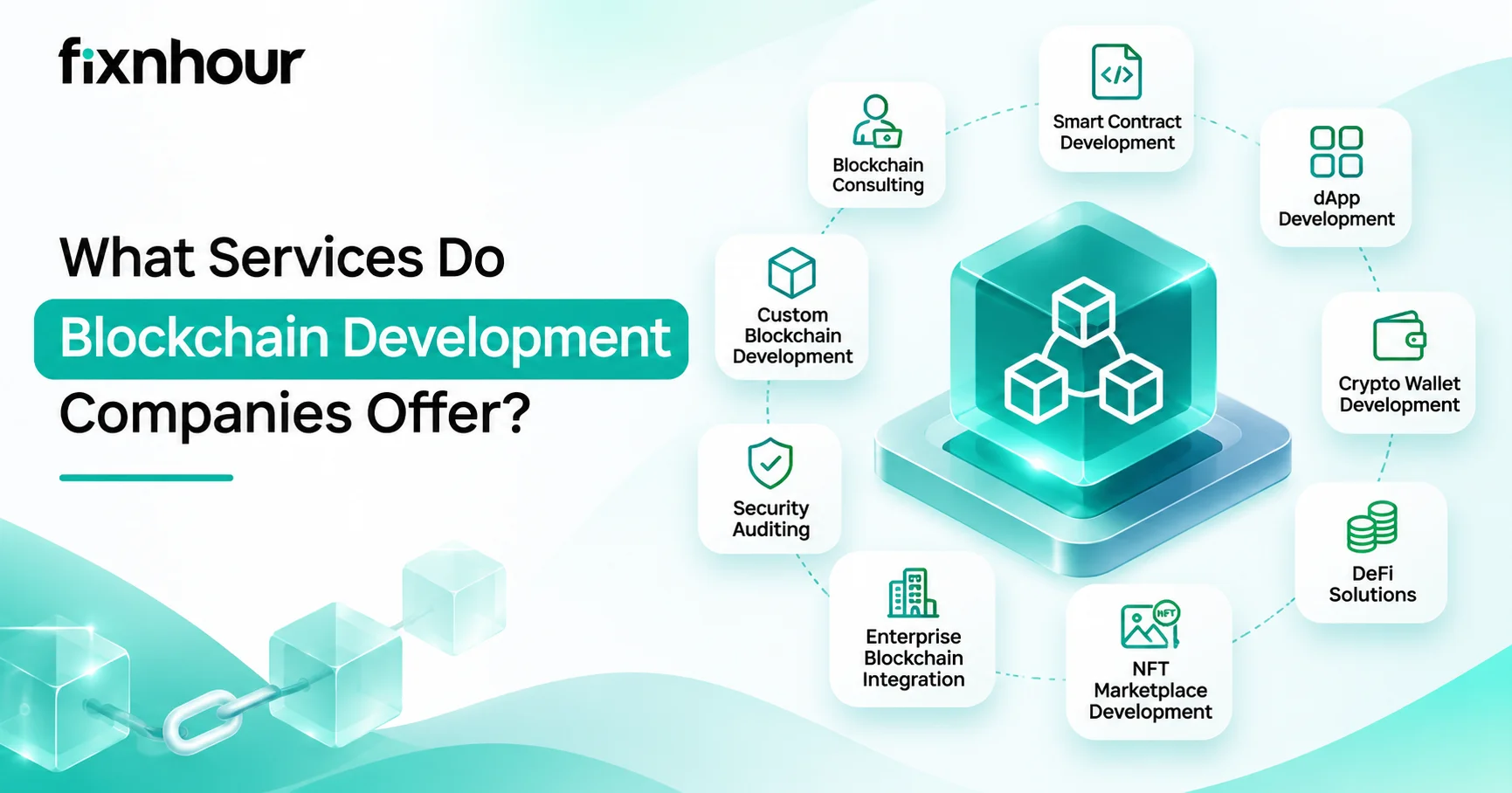
Blockchain development companies offer services including blockchain consulting, custom blockchain development, smart contract development, decentralized applications (dApps), cryptocurrency wallet development, DeFi solutions, NFT marketplace development, enterprise blockchain integration, security auditing, and ongoing maintenance. Businesses can explore and compare reliable blockchain development companies on Fixnhour to find suitable technology partners that help automate operations, improve transaction transparency, strengthen data integrity, and develop scalable decentralized applications.
Key Takeaways
- Blockchain development companies provide end-to-end decentralized technology solutions.
- Smart contracts enable automated and transparent business transactions.
- Custom blockchain applications address industry-specific requirements.
- Enterprise blockchain solutions improve operational efficiency and traceability.
- Development costs vary according to project complexity and security requirements.
- Blockchain security audits help identify technical vulnerabilities.
- AI integration, asset tokenization, and interoperability are emerging industry trends.
- Selecting an experienced blockchain development partner supports long-term business growth.
What Are Blockchain Development Services?
Blockchain development services involve designing, building, implementing, and maintaining applications powered by distributed ledger technology. These services help businesses establish secure digital ecosystems, automate transactions, manage decentralized data, and improve operational transparency. Professional Blockchain App Development Companies combine technical expertise, programming frameworks, cryptographic technologies, and industry knowledge to deliver customized solutions that align with organizational objectives, infrastructure requirements, and long-term digital transformation strategies.
Understanding Blockchain Development and Its Business Applications
Blockchain development involves creating digital systems that record and verify transactions across distributed networks. Businesses use blockchain technology for secure information sharing, digital asset management, transaction tracking, identity verification, and process automation while reducing unnecessary dependency on centralized intermediaries.
What Does a Blockchain Development Company Do?
A blockchain development company helps organizations convert business requirements into functional decentralized solutions. Its responsibilities include technology consulting, architecture planning, application programming, smart contract implementation, security testing, deployment, performance monitoring, and ongoing technical support throughout the software development lifecycle.
Which Industries Use Blockchain Development Services?
Blockchain technology supports various industries by addressing challenges related to data integrity, transaction verification, operational transparency, and information security. Organizations can implement customized decentralized solutions according to industry regulations, customer expectations, operational requirements, and existing digital infrastructure.
- Banking and financial services
- Healthcare
- Supply chain and logistics
- Gaming and entertainment
- Real estate
- Retail and eCommerce
Top Services Offered by Blockchain Development Companies
Blockchain development companies offer a wide range of technical services designed to support businesses throughout their decentralized technology implementation journey. These services cover everything from initial consulting and architecture development to application deployment, blockchain payments, and ongoing maintenance. Depending on business objectives, organizations can select individual blockchain development services or comprehensive end-to-end solutions that support their technical requirements and operational goals.
Blockchain Consulting and Strategy Development
Blockchain consulting helps businesses evaluate technology feasibility, identify suitable use cases, establish development objectives, and select appropriate blockchain platforms. Experienced consultants create implementation roadmaps that align technical capabilities with business requirements while minimizing unnecessary investments and potential operational risks.
Custom Blockchain Development
Custom blockchain development involves building decentralized networks and applications according to specific organizational requirements. Developers design tailored blockchain architectures, consensus mechanisms, transaction protocols, and security frameworks to support business operations while maintaining appropriate levels of scalability, reliability, and performance.
Smart Contract Development and Auditing
Smart contract development involves creating self-executing programs that automatically perform predefined actions when specified conditions are satisfied. Developers also conduct security audits to identify coding vulnerabilities, improve contract reliability, and reduce potential risks associated with automated digital transactions.
Decentralized Application (dApp) Development
Decentralized application development focuses on building applications that interact with blockchain networks and smart contracts. These applications enable businesses to deliver transparent digital services, manage transactions, and provide users with greater control over their digital assets and information.
Cryptocurrency Wallet and Exchange Development
Blockchain development companies create cryptocurrency wallets and exchange platforms that support digital asset storage, transfers, and trading. These solutions may include multi-currency support, authentication mechanisms, transaction monitoring, private key management, and integration with relevant blockchain networks.
DeFi Application Development
Decentralized finance development involves creating blockchain-based financial applications for lending, borrowing, staking, payments, and digital asset management. Developers implement smart contracts, financial protocols, and security mechanisms to facilitate decentralized financial activities while addressing operational and regulatory risks.
NFT Marketplace and Asset Tokenization Development
NFT marketplace development enables businesses to create platforms for issuing, buying, selling, and managing blockchain-based digital assets. Asset tokenization can also represent ownership rights or financial interests in real-world assets, subject to applicable legal and regulatory requirements.
Blockchain Development Statistics and Market Insights
The blockchain industry continues to evolve as businesses invest in decentralized infrastructure, digital assets, automated financial services, and enterprise applications. Increasing interest in blockchain integration and asset tokenization is creating opportunities for technology companies worldwide. Current market research highlights growing institutional interest, technological innovation, and potential applications across financial services, supply chain management, digital identity, and enterprise operations. Choosing the best technology partner helps businesses leverage emerging blockchain technologies, minimize implementation risks, and achieve long-term digital transformation goals.
Global Blockchain Technology Market Size and Growth
According to Mordor Intelligence, the global blockchain technology market is estimated at $39.82 billion in 2026 and projected to reach $455.16 billion by 2031, representing a compound annual growth rate of 62.8% during the forecast period.
Enterprise Blockchain Adoption Across Industries
Enterprises are exploring blockchain technology to improve transaction verification, automate business processes, and enhance information sharing. A 2026 EY-Parthenon and Coinbase survey found that over 60% of respondents anticipate significant blockchain integration into trading, clearing, and settlement within three to five years.
Growing Demand for Web3 and Decentralized Applications
Web3 development is creating opportunities for businesses to introduce decentralized financial services, digital ownership models, blockchain gaming platforms, and peer-to-peer applications. Developers are increasingly focusing on user accessibility, network interoperability, transaction efficiency, and secure digital asset management.
Blockchain Investment and Market Opportunities in 2027
CoinGecko reported that tokenized real-world assets reached $19.3 billion by the end of the first quarter of 2026. This growth highlights potential opportunities for blockchain development companies specializing in asset tokenization, financial infrastructure, and enterprise integration.
What Are the Benefits of Hiring a Blockchain Development Company?
Hiring a professional blockchain development company provides businesses with specialized technical expertise, structured development processes, and access to advanced decentralized technologies. Experienced development teams, including FinTech app development companies in Dubai, help organizations identify suitable blockchain applications, implement appropriate security measures, and optimize operational performance. These services can reduce implementation risks, improve development efficiency, and support scalable digital solutions aligned with evolving business requirements and market expectations.
Enhanced Data Security and Transaction Transparency
Blockchain technology uses cryptographic verification, distributed records, and consensus mechanisms to strengthen data integrity. Professional developers implement appropriate security controls that help businesses reduce unauthorized modifications and improve transaction visibility while maintaining suitable privacy and access management standards.
Reduced Operational Costs and Dependency on Intermediaries
Blockchain applications can streamline transaction verification, record management, and information exchange between multiple parties. By automating suitable business processes and reducing unnecessary intermediaries, organizations may lower administrative expenses, minimize repetitive activities, and improve overall operational efficiency over time.
Improved Business Process Automation
Smart contracts enable businesses to automate predefined activities such as payment processing, agreement execution, and transaction verification. Automated workflows can help organizations reduce manual intervention, minimize processing delays, improve operational consistency, and allocate resources toward more strategic activities.
Access to Specialized Blockchain Developers
Professional blockchain development companies provide access to developers, technical architects, security specialists, and experienced consultants. These professionals help businesses select suitable technologies, implement complex functionalities, address technical challenges, and maintain development standards throughout the blockchain application lifecycle.
Scalable and Customized Business Solutions
Experienced blockchain developers create applications tailored to business objectives, transaction volumes, customer requirements, and technical infrastructure. Appropriate architecture planning and scalability strategies help organizations accommodate growing operational demands, introduce additional functionalities, and maintain reliable application performance over time.
Faster Development and Time to Market
Established blockchain development teams use structured methodologies, reusable components, development frameworks, and testing tools to streamline project execution. These resources can help businesses reduce development delays, improve coordination, and introduce blockchain-powered products within realistic project timelines.
How Do Blockchain Development Companies Build Blockchain Solutions?
Blockchain development companies follow a systematic development process that includes business analysis, technology selection, architecture planning, programming, security testing, deployment, and ongoing maintenance. By incorporating the latest Software Development Trends, these companies help organizations establish clear project milestones, minimize implementation risks, and maintain application quality. Each development stage should align with business objectives, technical specifications, security requirements, and long-term operational expectations.
|
Steps |
Short Description |
Key Activities |
|---|---|---|
|
Step 1: Analyze Business Requirements and Project Objectives |
Define business goals, project requirements, and expected outcomes before starting development. |
Identify business challenges, target audiences, project scope, and budget. |
|
Step 2: Conduct Blockchain Feasibility Assessment |
Evaluate whether blockchain technology provides practical advantages for the business. |
Assess technical feasibility, compare databases, identify risks, and estimate costs. |
|
Step 3: Select the Blockchain Platform and Technology Stack |
Choose suitable technologies based on project requirements, security, and scalability. |
Compare blockchain platforms, select programming languages, frameworks, and infrastructure. |
|
Step 4: Design Blockchain Architecture and User Interface |
Create a secure, scalable application architecture and user-friendly interface. |
Design network architecture, UI/UX prototypes, transaction workflows, and security controls. |
|
Step 5: Develop Smart Contracts and Core Application Features |
Build essential blockchain application components according to technical specifications. |
Develop smart contracts, frontend, backend, APIs, and network integrations. |
|
Step 6: Perform Security Audits and Application Testing |
Identify vulnerabilities and validate application functionality, security, and performance. |
Conduct functional testing, integration testing, security audits, and vulnerability assessments. |
|
Step 7: Deploy the Blockchain Application |
Launch the tested blockchain application in the selected production environment. |
Configure infrastructure, deploy smart contracts, establish network connections, and monitor performance. |
|
Step 8: Provide Ongoing Maintenance and Performance Optimization |
Maintain application reliability, security, scalability, and operational efficiency after deployment. |
Monitor performance, implement security updates, resolve technical issues, and introduce new features. |
Step 1: Analyze Business Requirements and Project Objectives
Identify business challenges, target audiences, expected functionalities, available budgets, and operational objectives before starting development. Establishing clear project requirements helps developers define the project scope, prioritize essential features, minimize unnecessary expenses, and ensure blockchain solutions align with long-term organizational goals.
- Identify business challenges and objectives.
- Define target audiences and application requirements.
- Establish project scope and development budget.
- Determine expected deliverables and outcomes.
Step 2: Conduct Blockchain Feasibility Assessment
Evaluate whether blockchain technology offers practical advantages over traditional databases and centralized applications. Developers assess transaction requirements, security expectations, infrastructure limitations, and implementation costs to determine technical feasibility and recommend suitable blockchain solutions that deliver measurable value to the organization.
- Evaluate blockchain implementation feasibility.
- Compare blockchain with traditional database solutions.
- Assess technical and operational requirements.
- Identify potential risks and implementation costs.
Step 3: Select the Blockchain Platform and Technology Stack
Select a suitable blockchain platform, programming language, development framework, and supporting infrastructure based on project requirements. Evaluating transaction speed, scalability, security, network fees, and interoperability helps developers establish a reliable technical foundation that supports current functionalities and future business expansion.
- Compare Ethereum, Solana, and Hyperledger Fabric.
- Select suitable programming languages and frameworks.
- Evaluate scalability, security, and transaction fees.
- Choose appropriate infrastructure and integration tools.
Step 4: Design Blockchain Architecture and User Interface
Design the blockchain application architecture, network structure, database interactions, transaction workflows, and user interfaces according to business requirements. A well-structured architecture helps developers improve application usability, maintain consistent performance, establish effective security controls, and accommodate future scalability and integration requirements.
- Design blockchain network architecture.
- Create user interface and experience prototypes.
- Establish transaction workflows and data structures.
- Define security controls and scalability requirements.
Step 5: Develop Smart Contracts and Core Application Features
Develop smart contracts, frontend interfaces, backend systems, APIs, and essential application functionalities according to predefined technical specifications. Following established coding standards and structured development methodologies helps teams create secure, reliable, and scalable blockchain applications that address specific organizational requirements effectively.
- Develop and implement smart contracts.
- Build frontend and backend functionalities.
- Integrate blockchain networks and third-party APIs.
- Follow secure coding and development standards.
Step 6: Perform Security Audits and Application Testing
Conduct comprehensive functional testing, integration testing, performance assessments, and smart contract security audits to identify potential vulnerabilities. Thorough testing helps developers resolve technical issues, validate application functionality, strengthen security mechanisms, and ensure reliable blockchain application performance before final production deployment.
- Perform functional and integration testing.
- Conduct comprehensive smart contract security audits.
- Identify and resolve technical vulnerabilities.
- Validate application performance and reliability.
Step 7: Deploy the Blockchain Application
Deploy the blockchain application to the selected production environment after completing testing and obtaining necessary approvals. Developers configure infrastructure, implement smart contracts, establish network connections, and verify application functionalities to ensure reliable operations and a smooth transition into production environments.
- Configure the production environment.
- Deploy smart contracts and application components.
- Establish blockchain network connections.
- Monitor initial application performance and functionality.
Step 8: Provide Ongoing Maintenance and Performance Optimization
Provide continuous technical support, performance monitoring, security updates, and application improvements after deployment. Regular maintenance helps businesses address technical issues, respond to emerging security threats, optimize operational efficiency, and ensure blockchain applications remain reliable, scalable, and compatible with evolving requirements.
- Monitor application and network performance.
- Implement regular security updates and patches.
- Resolve technical issues and operational challenges.
- Optimize scalability and introduce new functionalities.
Conclusion
Blockchain development companies offer comprehensive services ranging from technology consulting, smart contract development, and decentralized application development to enterprise blockchain integration, security auditing, and ongoing maintenance. These services help businesses enhance data security, improve operational transparency, automate complex processes, and develop scalable digital solutions tailored to their industry-specific requirements.
As blockchain technology continues to evolve in 2027, emerging trends such as AI integration, asset tokenization, cross-chain interoperability, and Web3 development are creating new opportunities for businesses. Choosing the right blockchain development company with proven technical expertise, transparent pricing, robust security practices, and reliable post-launch support can help organizations minimize development risks, achieve measurable business outcomes, and drive sustainable long-term growth. Talk to Our Experts
Frequently Asked Questions
Q1. What services do blockchain development companies provide to businesses?
Ans. Blockchain development companies provide comprehensive services, including blockchain consulting, custom blockchain development, smart contract programming, decentralized application development, cryptocurrency wallet development, NFT marketplace development, DeFi solutions, enterprise blockchain integration, and security auditing. They also offer ongoing maintenance, technical support, and performance optimization to help businesses implement secure, scalable, and reliable blockchain solutions aligned with their operational requirements and long-term business objectives.
Q2. How much does it cost to hire a blockchain development company in 2027?
Ans. Hiring a blockchain development company in 2027 may cost between $5,000 and $300,000 or more, depending on project complexity, application features, blockchain platform, development team location, and security requirements. Basic applications generally require smaller investments, while enterprise-grade solutions involve higher expenses. Businesses should also consider ongoing maintenance, infrastructure costs, network transaction fees, third-party integrations, and post-launch technical support when planning budgets.
Q3. Which blockchain platform is best for enterprise application development?
Ans. Hyperledger Fabric, Ethereum, Polygon, Solana, and Avalanche are popular blockchain platforms that support different enterprise application requirements. Hyperledger Fabric is particularly suitable for permissioned enterprise networks, while Ethereum offers extensive smart contract capabilities. Businesses should select a blockchain platform based on transaction speed, scalability, security, privacy requirements, regulatory compliance, development costs, ecosystem support, and compatibility with their existing enterprise technology infrastructure.
Q4. How long does it take to develop a custom blockchain application?
Ans. Developing a custom blockchain application typically takes two to twelve months or longer, depending on project complexity, technical requirements, development resources, and security testing. Basic blockchain applications may require two to three months, while advanced enterprise solutions can take six to twelve months. Additional integrations, regulatory compliance requirements, smart contract audits, and customized functionalities may further extend the overall development timeline.
Q5. What is the difference between blockchain development and Web3 development services?
Ans. Blockchain development focuses on creating distributed ledger systems, smart contracts, decentralized networks, and secure transaction mechanisms. Web3 development encompasses a broader ecosystem that includes decentralized applications, digital ownership, cryptocurrency wallet integrations, decentralized identity, NFT platforms, and blockchain-powered user experiences. While blockchain provides the underlying technological infrastructure, Web3 development uses decentralized technologies to create interactive, user-centric digital applications and innovative online services.
Q6. Do blockchain development companies provide smart contract security audits?
Ans. Many blockchain development companies provide smart contract security audits to identify programming errors, security vulnerabilities, access control weaknesses, and potential transaction risks. These audits involve code reviews, automated testing, manual assessments, and vulnerability analysis. Regular security assessments help businesses improve smart contract reliability, protect digital assets, reduce financial risks, and maintain application security. Independent third-party audits are also recommended for high-risk applications.
Q7. Can blockchain development companies integrate blockchain into existing business applications?
Ans. Yes, blockchain development companies can integrate blockchain technology into existing business applications, enterprise resource planning systems, customer relationship management platforms, databases, and third-party APIs. Developers use customized integration frameworks and communication protocols to connect decentralized networks with traditional infrastructure. These integrations help businesses improve transaction transparency, automate workflows, strengthen data integrity, enhance traceability, and modernize existing operations without completely rebuilding their systems.
Q8. How do I choose the best blockchain development company for my business?
Ans. Choosing the best blockchain development company requires evaluating technical expertise, industry experience, previous projects, verified client reviews, security practices, pricing transparency, and post-launch support. Businesses should compare multiple service providers, review detailed project proposals, and assess their experience with relevant blockchain platforms. Selecting a reliable development partner helps minimize outsourcing risks, maintain development quality, and achieve sustainable business growth through decentralized solutions.