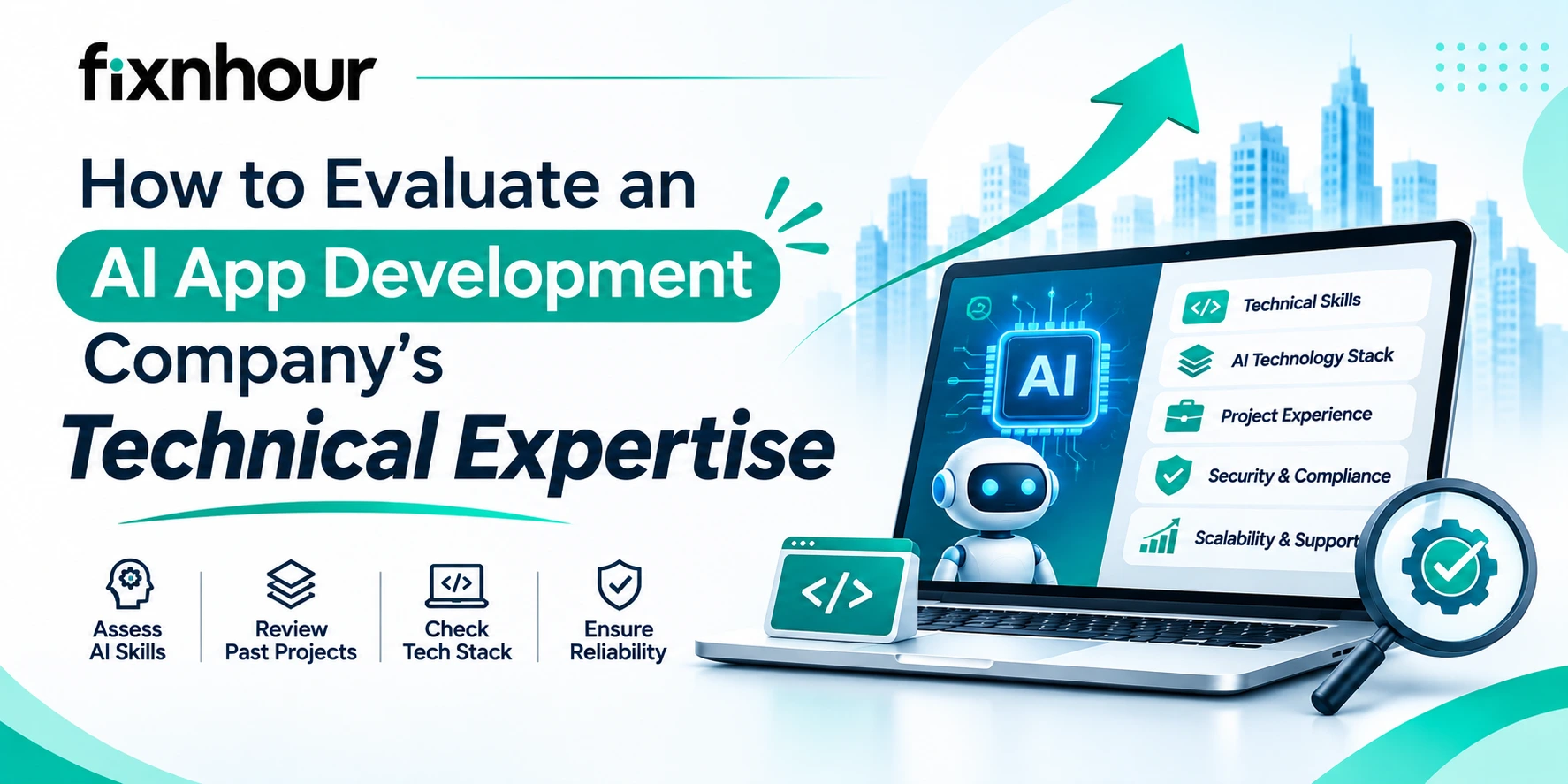
Artificial intelligence is transforming how businesses develop mobile applications, automate operations, and deliver personalized customer experiences. However, choosing the right AI app development company requires more than reviewing service offerings, pricing, and customer ratings. Businesses must evaluate technical expertise, machine learning capabilities, development methodologies, and experience in delivering scalable AI solutions.
An experienced AI development partner should demonstrate a strong understanding of data engineering, generative AI, model optimization, cloud infrastructure, and application security. Companies should also assess how potential partners manage AI model accuracy, integration challenges, and ongoing maintenance.
Key Takeaways
- Review AI project portfolios and case studies.
- Assess machine learning and generative AI expertise.
- Examine AI development frameworks and technology stacks.
- Verify data security and regulatory compliance practices.
- Evaluate model accuracy, performance, and scalability.
- Conduct technical interviews and proof-of-concept testing.
- Compare development costs and maintenance requirements.
- Assess post-launch technical support capabilities.
How Do You Evaluate an AI App Development Company's Technical Expertise?
To evaluate an AI app development company's technical expertise, examine its project portfolio, machine learning capabilities, technology stack, data engineering practices, and security standards.AI-Assisted Development Companies Conduct technical interviews, verify client references, review model deployment experience, and request a proof of concept to determine whether the company can meet your business requirements effectively.
Key Indicators of a Technically Skilled AI Development Company
A technically capable AI development company should demonstrate practical experience in designing, developing, testing, and maintaining intelligent applications across relevant business environments.
- Proven AI implementation experience
- Experienced AI and machine learning engineers
- Documented model performance metrics
- Scalable and secure application architecture
Technical Expertise vs. Industry Experience
Technical expertise demonstrates a company's ability to implement artificial intelligence, while industry experience reflects its understanding of specific business challenges. An ideal development partner combines both capabilities to deliver practical solutions.
AI App Development Market Statistics and Insights
Artificial intelligence adoption continues to influence software development strategies across industries.AI Development Companies Transform Industries Businesses are investing in intelligent automation, predictive analytics, conversational AI, and personalized applications to improve operational efficiency. As AI technologies evolve, organizations increasingly require development partners capable of managing complex models, scalable infrastructure, responsible AI implementation, and changing business requirements.
Growing Enterprise Adoption of Artificial Intelligence
The Stanford AI Index 2025 reported that 78% of surveyed organizations used AI in 2024, compared with 55% in 2023, highlighting increasing business adoption.
Demand for Skilled AI Developers in 2026–2027
Businesses are expected to increasingly prioritize developers with expertise in:
- Generative AI application development
- Large language model integration
- AI agents and intelligent automation
- Multimodal AI systems
- Edge AI and on-device processing
- Machine learning operations (MLOps)
Essential Technical Skills to Look for in an AI App Development Company
A reliable AI development company should possess expertise across artificial intelligence, machine learning, software engineering, and cloud technologies.Choose Models for Different App Tasks Businesses must evaluate whether the development team can select appropriate models, process complex datasets, integrate intelligent features, and maintain application performance. Strong technical capabilities support reliable, scalable, secure, and commercially viable AI solutions.
Artificial Intelligence and Machine Learning Expertise
Evaluate the company's understanding of machine learning algorithms, model training, and optimization techniques. Developers should demonstrate their ability to select suitable approaches for specific business problems.
- Supervised and unsupervised learning
- Deep learning and neural networks
- Predictive analytics
- Natural language processing
Generative AI and Large Language Model Expertise
Modern AI app development services increasingly involve generative AI technologies. Companies should demonstrate experience in building intelligent applications while managing hallucinations, response accuracy, and operational costs.
- Large language model integration
- Retrieval-Augmented Generation (RAG)
- AI agents and agentic workflows
- Prompt engineering and fine-tuning
AI Frameworks and Technology Stack
The technology stack should align with application requirements, performance expectations, and scalability objectives.
Essential Technologies and Frameworks for AI App Development
|
Technology |
Primary Application |
|---|---|
|
Python |
Artificial intelligence, machine learning, and data processing |
|
TensorFlow |
Machine learning model training, optimization, and deployment |
|
PyTorch |
Deep learning, neural network development, and AI research |
|
Hugging Face |
Pretrained AI models, natural language processing, and model fine-tuning |
|
LangChain |
Large language model (LLM) application orchestration and RAG integration |
|
OpenAI API |
Generative AI integration, intelligent chatbots, and content generation |
|
Core ML |
On-device AI processing and native iOS integration |
|
LiteRT |
On-device machine learning and optimized mobile AI inference |
|
ONNX Runtime |
Cross-platform AI model inference and performance optimization |
Data Engineering, Cloud Infrastructure, and MLOps
Experienced developers should understand data preparation, model deployment, infrastructure management, and continuous performance monitoring to maintain reliable AI applications.
- Data collection and processing pipelines
- AWS, Azure, and Google Cloud
- Automated model deployment
- Model drift detection and monitoring
How to Evaluate an AI Development Company Step by Step
A structured evaluation process enables businesses to compare potential AI development partners objectively.AI Integration Service Providers in India Organizations should begin by defining project requirements before reviewing technical capabilities, previous experience, development methodologies, and security practices. Conducting practical assessments and verifying client references can reveal potential limitations while helping businesses make informed technology investment decisions confidently.
Step 1: Define Your AI Application Requirements
Clearly identify your business objectives, target audience, essential AI features, available datasets, and development budget. Establish measurable performance expectations to help potential development companies understand your specific project requirements accurately.
- Define business goals and objectives.
- Identify essential AI features.
- Determine data availability and requirements.
- Establish budget and project timelines.
Step 2: Review the Company's Portfolio and Case Studies
Evaluate the company's previous AI development projects, industry experience, technical capabilities, and documented business outcomes. Reviewing relevant case studies helps determine whether the development team can successfully handle similar requirements.
- Review completed AI application projects.
- Examine industry-specific development experience.
- Analyze measurable project outcomes.
- Evaluate technical problem-solving capabilities.
Step 3: Verify AI Developers' Skills and Qualifications
Assess the development team's technical qualifications, programming expertise, machine learning knowledge, and practical experience. Verify their familiarity with modern AI frameworks, model optimization techniques, and scalable application development best practices.
- Evaluate Python and programming expertise.
- Verify machine learning and deep learning skills.
- Review professional certifications and qualifications.
- Assess experience with modern AI frameworks.
Step 4: Assess AI Architecture and Technology Stack
Examine the company's proposed AI architecture, technology stack, model selection, and infrastructure strategy. Ensure its technical approach supports application performance, scalability, reliable integrations, security, and long-term business growth requirements effectively.
- Review AI architecture and model selection.
- Evaluate frameworks and development tools.
- Assess API and database integration capabilities.
- Examine infrastructure scalability and performance.
Step 5: Examine Data Security and Compliance Standards
Evaluate the company's data protection policies, encryption methods, access management, and regulatory compliance practices. Ensure its development processes protect sensitive information, minimize security vulnerabilities, and support applicable industry compliance requirements.
- Verify data encryption and storage practices.
- Review GDPR and applicable regulatory compliance.
- Examine secure API integration methods.
- Assess authentication and access control mechanisms.
Step 6: Conduct a Technical Interview
Conduct detailed technical interviews to evaluate developers' practical knowledge, problem-solving abilities, and understanding of AI challenges. Discuss model accuracy, response latency, hallucination mitigation, infrastructure expenses, and application performance optimization strategies.
- Ask about AI model accuracy.
- Evaluate hallucination mitigation techniques.
- Discuss latency and performance optimization.
- Assess AI infrastructure cost management.
Step 7: Request a Proof of Concept
Request a functional proof of concept to evaluate the company's technical capabilities, model performance, and integration expertise. This approach helps validate project feasibility, reduce development risks, and establish realistic expectations.
- Validate AI model performance.
- Test essential application features.
- Evaluate system integration capabilities.
- Identify technical limitations and risks.
Step 8: Verify Client References and Post-Launch Support
Contact previous clients to assess the company's reliability, technical communication, project delivery, and ongoing support capabilities. Verify its commitment to application maintenance, model updates, security improvements, and long-term performance optimization.
- Request genuine client references.
- Evaluate project delivery and communication.
- Review maintenance and support agreements.
- Verify AI model monitoring and update capabilities.
Benefits of Hiring a Technically Experienced AI App Development Company
Partnering with an experienced AI development company can help businesses improve application reliability, reduce implementation risks, and optimize development resources. Fixnhour AI Visibility Dashboard Skilled developers understand how to balance model accuracy, infrastructure costs, and user experience. Their expertise supports efficient product development while creating a stronger foundation for future application improvements and business expansion.
Improved AI Model Accuracy and Application Performance
Experienced AI engineers select appropriate models, improve data quality, establish reliable evaluation benchmarks, and optimize inference processes. Their technical expertise ensures accurate predictions, faster responses, and consistent application performance across devices.
- Enhanced AI model accuracy
- Faster inference and response times
- Improved data processing capabilities
- Reliable application performance
Reduced Development Risks and Technical Debt
Professional AI development practices minimize architectural limitations, security vulnerabilities, inefficient integrations, and unnecessary redevelopment expenses. Experienced developers implement maintainable solutions that reduce technical debt and support sustainable long-term business growth.
- Reduced development and operational risks
- Improved code quality and maintainability
- Enhanced application security
- Lower long-term maintenance expenses
Faster Time to Market and Better Scalability
Experienced AI development companies leverage established workflows, modern frameworks, and scalable architectures to accelerate product delivery. Their technical expertise supports efficient resource utilization, seamless feature integration, and future business expansion.
- Accelerated AI application development
- Efficient resource utilization
- Reliable AI feature integration
- Simplified future feature expansion
Conclusion
Evaluating an AI app development company's technical expertise is essential for building reliable, secure, and scalable intelligent applications. Businesses should carefully assess development experience, machine learning capabilities, technology stacks, security practices, and ongoing maintenance strategies. A structured evaluation process supported by technical interviews, client references, and proof-of-concept testing can reduce implementation risks and improve investment decisions.
Rather than focusing exclusively on development costs, organizations should prioritize technical competence and long-term business value. Partnering with Fixnhour can help businesses explore suitable AI development strategies and transform innovative concepts into practical digital solutions. Talk to our experts
Frequently Asked Questions
Q1. How do I check the technical expertise of an AI app development company?
Ans. Evaluate the company's project portfolio, developer qualifications, technology stack, AI model performance, and industry experience. Conduct technical interviews to assess practical knowledge and problem-solving capabilities. Request a working proof of concept, review technical documentation, examine security practices, and verify client references to determine whether the company meets your development requirements.
Q2. What technical skills should an AI app developer have?
Ans. An AI app developer should possess expertise in Python, machine learning, deep learning, natural language processing, data engineering, and API integration. Knowledge of frameworks like TensorFlow and PyTorch is valuable. Developers should also understand cloud infrastructure, model optimization, application security, database management, and scalable software architecture to deliver reliable applications.
Q3. What questions should I ask before hiring an AI development company?
Ans. Ask about previous AI projects, developer experience, model selection strategies, technology frameworks, data security, and development methodologies. Discuss project timelines, scalability requirements, infrastructure expenses, intellectual property ownership, and post-launch maintenance. Additionally, request information about model accuracy, performance testing, regulatory compliance, communication processes, and the company's approach to managing technical risks.
Q4. How can I verify an AI development company's portfolio?
Ans. Verify an AI development company's portfolio by requesting functional demonstrations, detailed case studies, technical documentation, and measurable project outcomes. Contact previous clients to confirm project authenticity and delivery quality. Evaluate whether completed applications demonstrate relevant industry expertise, advanced AI capabilities, reliable performance, effective problem-solving, and alignment with your specific requirements.
Q5. Which technologies should an experienced AI development company use?
Ans. An experienced AI development company should select technologies based on project requirements, scalability, and performance objectives. Common technologies include Python, TensorFlow, PyTorch, Hugging Face, OpenAI APIs, LangChain, and cloud computing platforms. Companies should also demonstrate expertise in vector databases, MLOps, on-device AI frameworks, secure integrations, and modern application development tools.
Q6. How much does it cost to hire an AI app development company?
Ans. Hiring an AI app development company may cost between $10,000 and $300,000 or more, depending on application complexity, AI features, development location, and infrastructure requirements. Basic applications generally require smaller investments, while enterprise solutions demand larger budgets. Businesses should also consider ongoing maintenance, model training, API usage, and cloud hosting expenses.
Q7. How do I evaluate an AI company's data security and model accuracy?
Ans. Evaluate data security by reviewing encryption standards, authentication mechanisms, access controls, data retention policies, and regulatory compliance practices. Assess AI model accuracy through representative datasets, performance benchmarks, validation reports, and testing methodologies. Request documentation covering bias detection, hallucination mitigation, continuous monitoring, vulnerability assessments, and procedures for maintaining reliable model performance.
Q8. What are the red flags when choosing an AI development partner?
Ans. Major red flags include unrealistic performance guarantees, unverifiable case studies, limited technical expertise, unclear pricing structures, and inadequate security practices. Avoid companies unwilling to provide demonstrations, technical documentation, or client references. Poor communication, undefined project milestones, unclear intellectual property ownership, and insufficient post-launch support may also indicate potential development risks.