Artificial intelligence is transforming how businesses operate, compete, and deliver services in 2026. From healthcare and banking to retail, manufacturing, and education, organizations are adopting intelligent technologies to automate operations, improve decision-making, and create personalized customer experiences. AI development companies play an important role in this transformation by building customized solutions that address specific business challenges and support long-term digital growth.
As demand for intelligent automation continues to grow, businesses are investing in machine learning, generative AI, predictive analytics, and AI-powered applications. However, successful implementation requires technical expertise, reliable data, and a clear development strategy. Partnering with experienced artificial intelligence development companies helps organizations evaluate opportunities, develop scalable applications, and integrate intelligent systems into existing workflows while managing security, performance, and operational risks.
Key Takeaways
- AI development companies help businesses implement intelligent technologies and accelerate digital transformation.
- Healthcare, finance, retail, manufacturing, education, and logistics benefit from industry-specific AI applications.
- Machine learning and predictive analytics support better forecasting and decision-making.
- Generative AI enables intelligent assistants, content generation, and automated business workflows.
- Custom AI development provides greater flexibility for specialized business requirements.
- AI implementation costs depend on project complexity, data requirements, and infrastructure.
- Successful AI projects require reliable data, security, testing, and ongoing monitoring.
- Choosing an experienced AI development partner helps businesses manage implementation risks.
What Are AI Development Companies and What Do They Do?
AI development companies are technology service providers specializing in designing, developing, and integrating artificial intelligence solutions for businesses. They combine machine learning, natural language processing, data analytics, and software engineering to create intelligent applications.AI Trends Transforming Businesses These companies help organizations automate operations, improve productivity, analyze information, and solve complex business challenges through customized technology.
Understanding AI Development Companies
Artificial intelligence development companies work with businesses to identify opportunities where intelligent systems can deliver measurable improvements. Their teams typically include AI engineers, machine learning specialists, software developers, and data scientists who collaborate to build reliable applications.
Unlike traditional software, AI-powered applications can identify patterns, generate predictions, and process complex information using trained models.
Core AI Development Services for Businesses
- Custom AI Development: Building intelligent applications for specific business requirements.
- Machine Learning Development: Creating models that recognize patterns and predict outcomes.
- Generative AI Development: Developing content-generation tools and intelligent assistants.
- AI Chatbot Development: Automating customer communication and support.
- Predictive Analytics: Analyzing historical data to support business forecasting.
How Are AI Development Companies Transforming Different Industries in 2026?
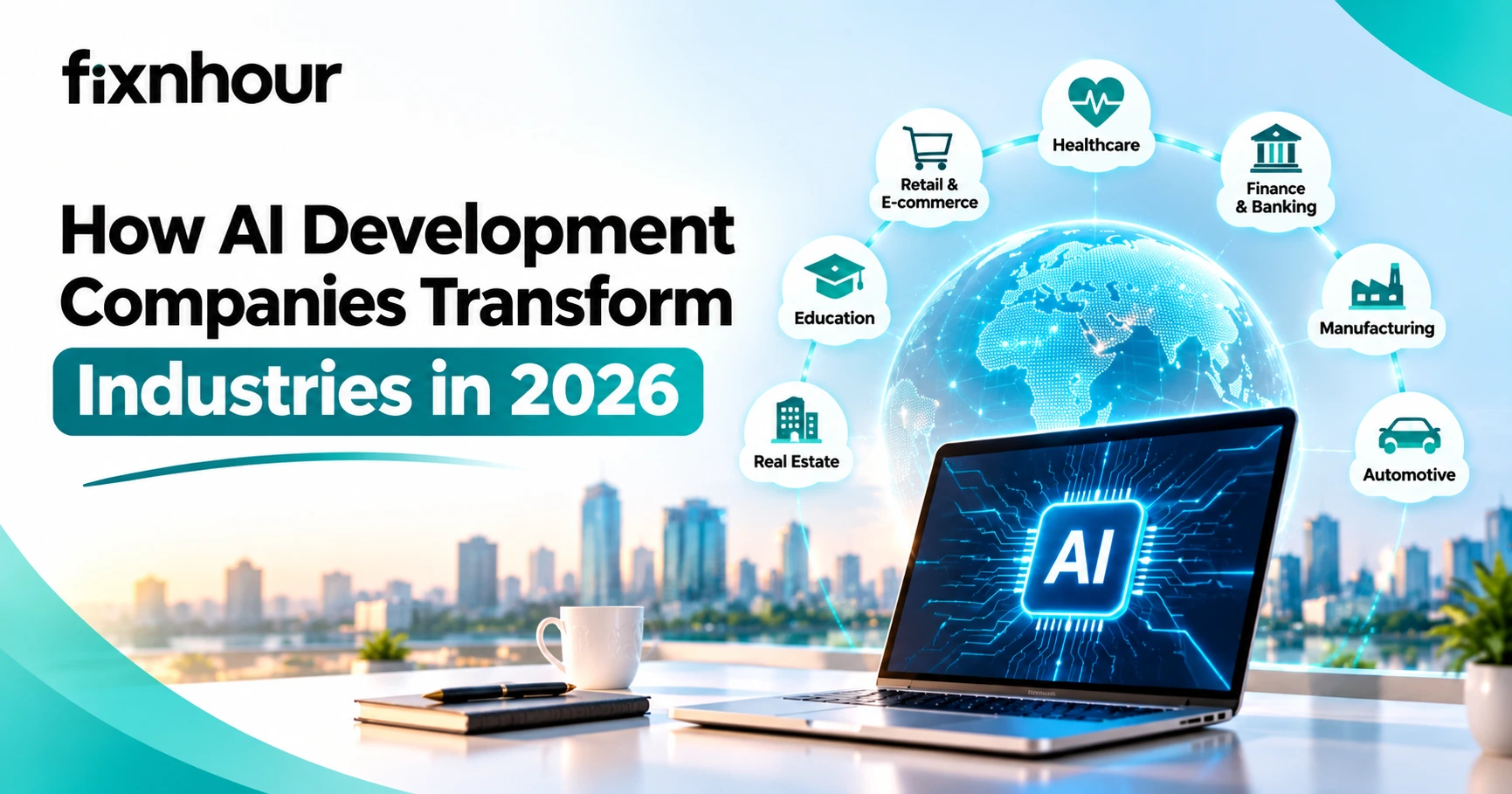
AI development companies are transforming industries by introducing intelligent automation, predictive technologies, and data-driven applications. Businesses use artificial intelligence to improve operational efficiency, reduce manual workloads, and deliver better customer experiences Future of AI in Business. From medical diagnostics to personalized shopping, AI-powered solutions are helping organizations modernize traditional processes and explore new business opportunities.
|
Industry |
AI Applications |
Key Benefits |
Business Impact |
|---|---|---|---|
|
Healthcare |
Medical image analysis, predictive analytics, virtual assistants, hospital automation |
Improved diagnostic support, streamlined patient care, reduced administrative workload |
Better healthcare operations and patient experiences |
|
Finance & Banking |
Fraud detection, financial reporting, credit risk assessment, AI banking assistants |
Stronger fraud prevention, faster financial analysis, improved risk management |
Enhanced security and operational efficiency |
|
Retail & E-Commerce |
Product recommendations, customer analytics, demand forecasting, marketing automation |
Personalized shopping, improved inventory planning, targeted marketing |
Higher conversion potential and customer satisfaction |
|
Manufacturing |
Predictive maintenance, automated inspection, production optimization, supply chain AI |
Reduced equipment downtime, improved product quality, optimized production |
Greater productivity and lower operational costs |
|
Education |
AI tutoring, adaptive learning, automated assessments, student analytics |
Personalized education, faster evaluation, improved learning support |
Better learning experiences and administrative efficiency |
|
Logistics & Transportation |
Route optimization, warehouse automation, demand forecasting, fleet monitoring |
Faster deliveries, optimized routes, improved resource utilization |
Reduced transportation costs and improved delivery efficiency |
AI in Healthcare: Improving Patient Care and Medical Operations
Healthcare organizations use artificial intelligence to support medical professionals, analyze patient information, and improve administrative efficiency. AI-powered tools can assist with medical imaging, clinical documentation, and patient scheduling while supporting faster access to relevant information.
- AI-assisted medical image analysis.
- Predictive healthcare analytics.
- Virtual healthcare assistants.
- Hospital workflow automation.
AI in Finance and Banking: Enhancing Security and Efficiency
Financial institutions implement artificial intelligence to detect suspicious transactions, assess financial risks, and improve customer services. Machine learning models analyze transaction patterns and support faster identification of unusual activity.
- AI-powered fraud detection.
- Automated financial reporting.
- Credit risk assessment.
- Intelligent banking assistants.
AI in Retail and E-Commerce: Personalizing Customer Experiences
Retail businesses use AI-powered applications to understand customer preferences, recommend products, and manage inventory. Intelligent recommendation systems analyze browsing behavior and purchase history to provide more relevant shopping experiences.
- Personalized product recommendations.
- Customer behavior analytics.
- Inventory demand forecasting.
- AI-powered marketing automation.
AI in Manufacturing: Enabling Smart Factories
Manufacturing companies adopt artificial intelligence to improve production efficiency, identify equipment problems, and strengthen quality control. AI-powered monitoring systems analyze operational data and help businesses identify maintenance requirements before major failures occur.
- Predictive equipment maintenance.
- Automated quality inspection.
- Production optimization.
- Intelligent supply chain management.
AI in Education: Creating Personalized Learning Experiences
Educational institutions use artificial intelligence to support personalized learning, automate administrative processes, and analyze student performance. AI-powered educational platforms can adapt learning materials according to individual progress.
- AI-powered tutoring systems.
- Adaptive learning applications.
- Automated assessment tools.
- Student performance analytics.
AI in Logistics and Transportation: Optimizing Operations
Logistics companies implement artificial intelligence to improve route planning, delivery forecasting, and warehouse management. Intelligent systems analyze transportation conditions, inventory movement, and operational requirements.
- Intelligent route optimization.
- Automated warehouse operations.
- Delivery demand forecasting.
- Fleet performance monitoring.
AI Industry Statistics and Market Insights for 2026
Artificial intelligence continues attracting substantial investment as businesses explore automation, generative AI, and intelligent software solutions.Rise of AI-Powered E-commerce Platforms Market research indicates growing enterprise interest in AI-powered applications across multiple industries. However, adoption levels vary according to company size, available infrastructure, technical expertise, and organizational readiness to implement advanced artificial intelligence technologies.
Global Artificial Intelligence Market Growth
The Stanford AI Index 2025 reported that U.S. private AI investment reached approximately $109.1 billion in 2024, reflecting significant commercial interest in artificial intelligence technologies.The report also identified growing business adoption of AI, highlighting its expanding role in enterprise operations.
AI Adoption Trends Across Major Industries
According to McKinsey's 2025 State of AI research, 78% of respondents reported that their organizations used AI in at least one business function, based on its survey findings.
Important adoption trends include:
- Growing interest in enterprise generative AI.
- Increased experimentation with AI agents.
- Greater demand for AI governance and security.
- Expansion of industry-specific AI applications.
What Are the Benefits of Hiring AI Development Companies?
Hiring AI development companies provides businesses with specialized technical expertise and access to modern artificial intelligence technologies. These companies help organizations identify automation opportunities, develop intelligent applications, and integrate AI into existing systems. With appropriate implementation, businesses can improve operational efficiency, strengthen customer engagement, and support better decisions using data.
Improving Business Efficiency Through AI Automation
AI-powered automation helps organizations handle repetitive processes without requiring constant manual intervention. Businesses can automate document processing, customer inquiries, reporting, and routine administrative activities.
Key benefits include:
- Reduced manual workloads.
- Faster operational processes.
- Improved consistency.
- Better employee productivity.
Enhancing Customer Experience and Business Growth
Artificial intelligence helps businesses deliver personalized services based on customer behavior and preferences. Intelligent chatbots, recommendation engines, and automated communication systems can improve response times and customer engagement.
Key advantages include:
- Personalized customer interactions.
- Faster customer support.
- Improved customer satisfaction.
- More relevant marketing campaigns.
Supporting Better Business Decisions
Machine learning and predictive analytics help organizations analyze large datasets and identify useful business patterns. These capabilities support demand forecasting, risk assessment, and operational planning.
- Real-time business insights.
- Predictive forecasting.
- Data-driven decision support.
- Improved risk identification.
How to Choose the Right AI Development Company: Step-by-Step Guide
Selecting the right AI development company requires evaluating technical expertise, industry experience, development processes, and project costs. Businesses should clearly define their requirements before comparing potential partners. AI Agent Development Companies A structured selection process helps organizations identify suitable providers, reduce implementation risks, and establish productive relationships with technology teams capable of delivering scalable artificial intelligence solutions.
|
Step |
Selection Process |
Key Factors to Evaluate |
Expected Outcome |
|---|---|---|---|
|
Step 1 |
Define Your AI Project Requirements |
Business goals, AI features, budget, KPIs, integration needs |
Clear project scope and objectives |
|
Step 2 |
Research AI Development Companies |
Company directories, AI services, industry specialization, reputation |
Shortlist of suitable AI companies |
|
Step 3 |
Evaluate Technical Expertise |
Machine learning, NLP, generative AI, LLMs, MLOps, cloud technologies |
Technically qualified AI development team |
|
Step 4 |
Review Portfolios and Client Feedback |
Case studies, previous AI projects, client reviews, proven results |
Confidence in company experience |
|
Step 5 |
Discuss AI Development Methodology |
Data preparation, model training, testing, deployment, security |
Reliable and structured development process |
|
Step 6 |
Compare Development Costs and Timelines |
Project pricing, delivery schedules, maintenance costs, deliverables |
Cost-effective development proposal |
|
Step 7 |
Select the Best AI Development Partner |
Technical capabilities, communication, support, contracts |
Trusted long-term AI technology partner |
Step 1: Define Your AI Project Requirements
Start by identifying the business problems your AI solution should address. Define essential features, expected outcomes, integration requirements, and available resources.
- Identify business objectives.
- Define AI application features.
- Establish project budgets.
- Set measurable performance goals.
Step 2: Research AI Development Companies
Explore technology service providers offering artificial intelligence development services. Review their websites, company profiles, and relevant project information.
- Explore AI company directories.
- Compare service offerings.
- Review industry specialization.
- Shortlist suitable providers.
Step 3: Evaluate Technical Expertise
Assess whether the development team has experience with technologies relevant to your project.
- Machine learning frameworks.
- Natural language processing.
- Generative AI and LLM integration.
- Cloud deployment and MLOps.
Step 4: Review Portfolios and Client Feedback
Examine completed projects and available customer feedback to understand the company's experience and capabilities.
- Review AI project portfolios.
- Examine relevant case studies.
- Read customer feedback.
- Evaluate demonstrated results.
Step 5: Discuss AI Development Methodology
Understand how the company approaches planning, development, testing, and deployment.
- Data preparation methods.
- AI model development processes.
- Quality assurance practices.
- Security and compliance measures.
Step 6: Compare Development Costs and Timelines
Request detailed proposals from shortlisted companies and evaluate their development approach.
- Compare project quotations.
- Review development schedules.
- Evaluate deliverables.
- Understand maintenance costs.
Step 7: Select the Best AI Development Partner
Choose a company whose technical expertise, communication practices, and development capabilities align with your business requirements.
- Confirm relevant experience.
- Evaluate project communication.
- Review support arrangements.
- Finalize development agreements.
Conclusion
AI development companies are helping industries adopt intelligent technologies that improve efficiency, support better decisions, and create new business opportunities. From healthcare and banking to manufacturing and e-commerce, artificial intelligence is changing how organizations manage operations and interact with customers. Successful transformation depends on choosing appropriate technologies, establishing measurable objectives, and implementing reliable AI solutions.
Businesses planning to invest in artificial intelligence should carefully evaluate development partners, project costs, and long-term requirements. Fixnhour helps organizations explore AI development companies and compare available provider information. Whether you need machine learning applications, generative AI solutions, or intelligent automation, discover potential technology partners on Fixnhour and contact us today to begin your AI development journey. Talk to our experts
Frequently Asked Questions
Q1. How do AI development companies help businesses grow in 2026?
Ans. AI development companies help businesses grow by automating repetitive processes, improving customer experiences, and supporting data-driven decisions. They create intelligent applications using machine learning, generative AI, and predictive analytics. These technologies can improve productivity, reduce operational inefficiencies, and help organizations identify opportunities for innovation and business expansion.
Q2. Which industries benefit the most from artificial intelligence development services?
Ans. Healthcare, finance, retail, manufacturing, education, and logistics are among the industries benefiting from artificial intelligence development services. Healthcare organizations use AI for medical analysis, while financial institutions apply it to fraud detection. Retailers use recommendation systems, and manufacturers implement predictive maintenance and intelligent production monitoring.
Q3. How much does it cost to hire an AI development company in 2026?
Ans. Hiring an AI development company can cost anywhere from several thousand dollars for a simple application to hundreds of thousands for a complex enterprise platform. Pricing depends on features, data requirements, integrations, infrastructure, and development expertise. Businesses should request customized quotations and include ongoing maintenance expenses in their budgets.
Q4. What services do artificial intelligence development companies provide?
Ans. Artificial intelligence development companies provide custom AI software development, machine learning solutions, generative AI applications, chatbot development, predictive analytics, and intelligent automation services. Many also offer AI consulting, system integration, model deployment, and ongoing maintenance to help businesses implement and manage intelligent technologies effectively.
Q5. How can small businesses use custom AI development solutions?
Ans. Small businesses can use custom AI development solutions to automate customer support, manage business information, improve marketing campaigns, and analyze customer behavior. AI-powered chatbots, recommendation systems, and reporting tools can reduce repetitive workloads and support operational efficiency. Starting with focused, affordable applications helps businesses evaluate AI benefits before expanding their investments.
Q6. What is the difference between AI development and traditional software development?
Ans. Traditional software development primarily uses explicitly programmed rules and workflows to perform tasks. AI development incorporates models capable of learning patterns from data, generating content, or making predictions. Both approaches require software engineering, testing, and maintenance, but AI applications also need data management, model evaluation, and ongoing performance monitoring.
Q7. How long does it take to develop and implement an AI-powered application?
Ans. AI development timelines depend on project complexity, data availability, and integration requirements. A basic AI chatbot may take several weeks, while custom machine learning applications can require several months. Enterprise AI platforms may take longer because they involve security requirements, infrastructure development, extensive testing, and integration with existing business systems.
Q8. How do I choose the best AI development company for my business?
Ans. Choose an AI development company by evaluating its technical expertise, relevant industry experience, project portfolio, customer feedback, and development methodology. Compare proposals, implementation timelines, pricing, and maintenance services. Platforms such as Fixnhour can help businesses discover potential technology providers and research available company information before making a final selection