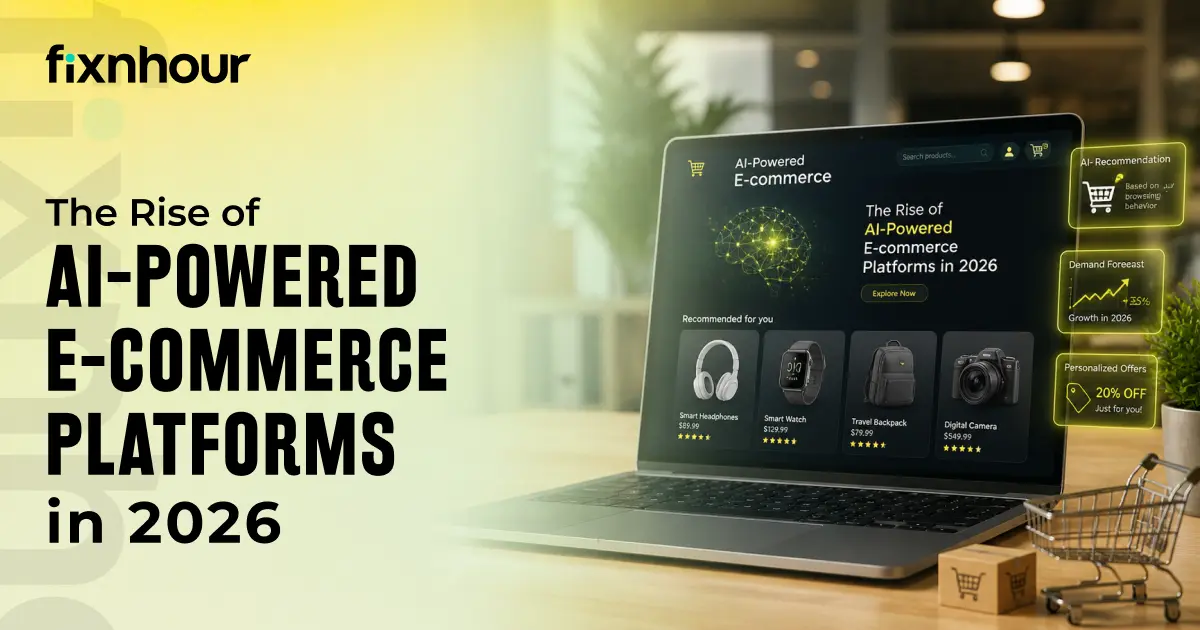
Online shopping is no longer just about browsing products and clicking “buy now.” It has evolved into something far more intelligent, adaptive, and personal. Artificial Intelligence is redefining the future of online retail, and 2026 marks a major shift in how businesses operate digital stores. AI-powered e-commerce platforms are helping brands deliver personalized shopping experiences, automate customer support, improve inventory management, and increase sales conversions through predictive analytics. From smart product recommendations to AI chatbots and voice commerce, modern e-commerce solutions are becoming faster, smarter, and more customer-focused. Businesses across industries are adopting AI-driven technologies to stay competitive, reduce operational costs, and enhance customer engagement. As consumer expectations continue to rise, AI integration is no longer optional but essential for scalable and successful e-commerce growth in 2026.
AI in E-commerce: A Quiet Revolution with Massive Impact
Top Artificial Intelligence Companies in e-commerce refers to systems that learn from customer behavior, predict needs, and automate decision-making processes. From product recommendations to customer support, AI is quietly powering almost every major online shopping experience.
Instead of waiting for customers to search, AI helps platforms understand what customers actually want—even before they know it themselves. This is the foundation of smart shopping experiences, AI personalization, and digital commerce transformation. AI is quietly transforming the e-commerce industry through personalized shopping, automated support, predictive analytics, and smarter business operations. From customer engagement to inventory management, AI-driven technologies are helping online retailers improve efficiency, increase sales, and deliver seamless shopping experiences.
Why AI is Transforming E-commerce So Fast
The rise of AI-powered platforms is not accidental. It is driven by clear business needs and customer expectations. AI is transforming e-commerce rapidly by enabling personalized shopping experiences, real-time customer support, predictive analytics, automated inventory management, and smarter marketing strategies. Businesses use AI to understand customer behavior, optimize operations, and increase sales efficiency. With growing online competition and rising customer expectations, AI-powered technologies help retailers deliver faster, smarter, and more engaging shopping experiences, making AI adoption essential for modern e-commerce growth and innovation.
1. Personalized Shopping Experiences
Every customer is different, and AI ensures they are treated that way. Based on this, AI delivers hyper-personalized recommendations, increasing both engagement and sales. Instead of showing the same homepage to everyone, AI creates a unique store for every user. This is the core of AI recommendation engines and personalized e-commerce experiences.
- Browsing history
- Purchase behavior
- Search patterns
- Time spent on products
2. Smarter Inventory and Demand Prediction
One of the biggest challenges in E-commerce Platform is managing stock efficiently. This leads to lower losses and better product availability. Businesses now rely on AI-driven inventory management systems to stay competitive and efficien
- Predicting demand trends
- Identifying fast-moving products
- Reducing overstock and shortages
- Optimizing supply chains
3. AI Chatbots and Virtual Assistants
Customer support has changed forever. Instead of waiting hours for responses, users now interact with AI-powered chatbots and virtual assistants that provide instant help. The result is 24/7 automated customer service with human-like interaction, improving customer satisfaction while reducing operational costs.
- Answer product queries
- Track orders
- Handle returns
- Suggest products
Also Read: How Web Design Agencies Are Using AI to Transform Workflows in 2026
Key Benefits of AI-Powered E-commerce Platforms
AI-powered Fixnour e-commerce platforms offer businesses advanced automation, personalized customer experiences, smart product recommendations, predictive analytics, and efficient inventory management. These platforms improve customer engagement, increase conversion rates, reduce operational costs, and enhance decision-making through real-time data insights. AI also supports chatbots, voice commerce, fraud detection, and targeted marketing, helping online retailers deliver faster, smarter, and more scalable shopping experiences in today’s competitive digital marketplace.
- Higher conversion rates through personalized recommendations
- Better customer engagement with smart interactions
- Reduced operational costs via automation
- Faster decision-making using real-time analytics
- Improved shopping experience across devices
Real-World Applications of AI in Online Shopping
AI is widely used in online shopping for personalized product recommendations, AI chatbots, voice search, smart pricing, fraud detection, and automated customer support. E-commerce businesses also use AI for inventory forecasting, visual product search, customer behavior analysis, and targeted advertising. These real-world applications help retailers improve shopping experiences, increase sales conversions, streamline operations, and deliver faster, more accurate services to modern online consumers.
Product Recommendation Systems
AI analyzes behavior and suggests products users are most likely to buy. This drives upselling and cross-selling automatically.
Visual Search Technology
Instead of typing, users can upload an image and find similar products instantly. This makes product discovery faster and more intuitive.
Fraud Detection Systems
AI monitors transactions in real time to detect suspicious activity, helping protect both businesses and customers from fraud. These technologies are now essential parts of modern AI-powered retail ecosystems.
Also Read: Top Business Consulting Services for Growth & Success 2026
Challenges Businesses Still Face
Despite its benefits, AI in e-commerce still faces challenges such as high implementation costs, data privacy concerns, integration issues with existing systems, and a shortage of skilled professionals. Businesses also struggle with maintaining data accuracy, algorithm bias, and ensuring customer trust. Smaller retailers often find it difficult to adopt advanced AI tools, which can slow down digital transformation and limit competitive advantage in the evolving online marketplace.
- High implementation and integration costs
- Data privacy and security concerns
- Need for large, high-quality datasets
- Technical complexity in setup and maintenance
The Future of AI in E-commerce
The future of online shopping is moving toward full automation and extreme personalization. The next era of e-commerce will not just be digital. it will be intelligent, predictive, and autonomous. The future of AI in e-commerce will focus on deeper personalization, fully automated shopping experiences, and smarter decision-making systems. Emerging technologies like generative AI, predictive analytics, and autonomous retail will reshape how customers discover and buy products. Businesses will increasingly rely on AI for real-time insights, hyper-targeted marketing, and seamless omnichannel experiences, making online shopping faster, more intuitive, and highly efficient across global digital markets.
- Hyper-personalized stores that change in real-time
- Voice-based shopping assistants replacing traditional search
- Predictive shopping systems that order products before users even search
- Fully automated retail ecosystems powered by AI agents
Conclusion
The rise of AI-powered e-commerce platforms marks a turning point in digital business. Companies that adopt AI early are gaining a massive competitive advantage in personalization, efficiency, and customer experience. Businesses that adapt will grow. Those that ignore it risk being left behind. AI-powered e-commerce platforms are reshaping the retail industry in 2026 by delivering smarter automation, personalized experiences, and data-driven decision-making. Businesses adopting AI technologies can improve customer engagement, streamline operations, and boost sales performance. As digital commerce continues to evolve, AI integration will remain a key factor for sustainable growth, innovation, and long-term competitive advantage in the global retail market. Contact us today to explore AI-powered e-commerce solutions that can transform your retail business, improve customer experiences, automate operations, and accelerate online growth in 2026 and beyond.