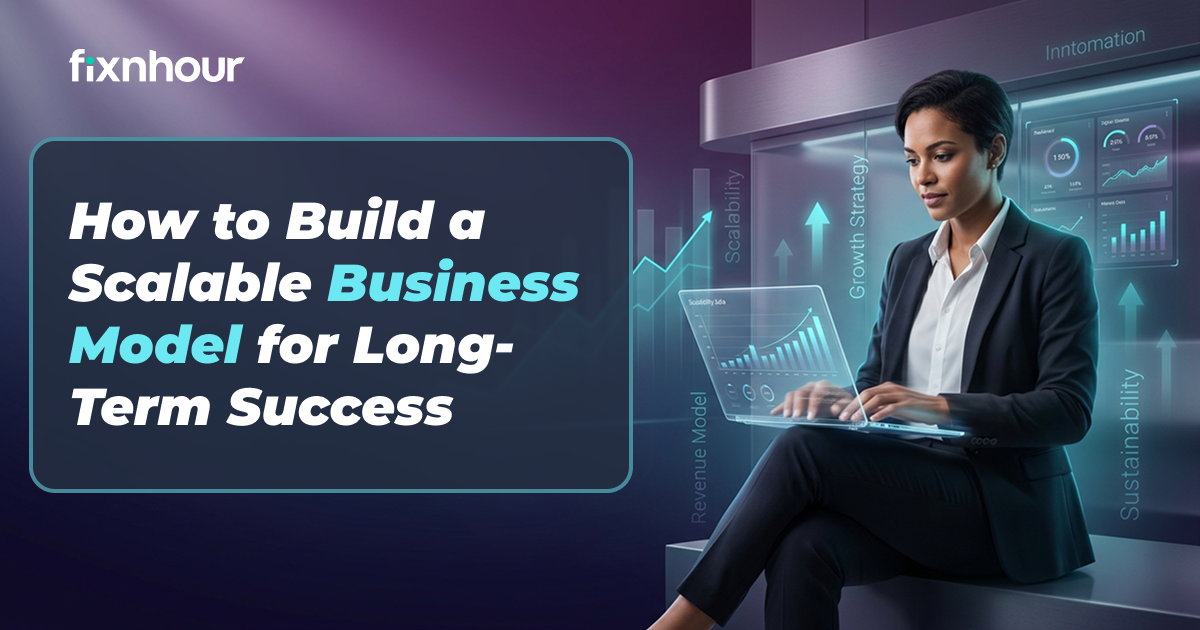
Building a scalable business model is essential for achieving consistent growth and long-term success. It helps businesses expand efficiently while maintaining quality, profitability, and operational stability. With the right strategy, any venture can scale sustainably in a competitive market.
A scalable business model allows a company to increase revenue without a proportional increase in costs. It focuses on efficiency, smart use of technology, and repeatable systems that support long-term expansion. In today’s competitive digital economy, scalability is one of the most important factors that determine whether a business can grow sustainably.Whether you are a startup founder, entrepreneur, or small business owner, building a scalable model helps you expand faster, reach more customers, and maintain profitability over time.
What is a Scalable Business Model?
A scalable business model allows a company to grow its revenue without a proportional increase in costs or resources. By applying smart growth strategies small businesses can streamline operations, leverage technology, and expand their customer base efficiently. This approach helps small businesses handle increasing demand, maintain profitability, and achieve sustainable long-term growth in a competitive market.
-
A scalable business model allows a company to grow revenue without significantly increasing operational costs.
-
It focuses on efficiency, automation, and systems that support expansion.
-
Using smart-growth-strategies-small-business helps businesses manage growth effectively.
-
It enables companies to serve more customers with the same resources.
-
Technology and streamlined processes play a key role in scalability.
-
A strong scalable model supports long-term growth and sustainable business success.
Why Scalability Matters for Modern Businesses
Scalability is essential for modern businesses because it allows companies to grow efficiently without increasing costs at the same rate as revenue. A scalable structure helps businesses adapt to market demand, reach more customers, and improve profitability. By focusing on efficient systems and innovation, companies can achieve sustainable growth and remain competitive in a rapidly evolving business environment.
Cost-Efficient Business Growth
-
Helps businesses increase revenue without equally increasing expenses.
-
Efficient systems reduce operational costs during expansion.
-
Scalable processes support sustainable and profitable growth.
Ability to Handle Increasing Customer Demand
-
Businesses can serve more customers without major operational stress.
-
Scalable systems help manage higher demand smoothly.
-
Improves customer satisfaction and service delivery.
Improved Operational Efficiency
-
Streamlined processes improve productivity and workflow.
-
Automation reduces manual work and saves time.
-
Efficient operations help businesses scale faster.
Higher Profit Potential with Lower Resource Expansion
-
Businesses can generate more revenue using existing resources.
-
Scalable models maximize output with minimal investment.
-
Improves overall profit margins during growth.
Better Adaptability to Market Changes
-
Scalable businesses can adjust strategies quickly.
-
Helps companies respond to market trends and demand shifts.
-
Encourages innovation and flexible business planning.
Stronger Competitive Advantage
-
Scalable businesses grow faster than traditional models.
-
Enables companies to expand into new markets easily.
-
Builds long-term strength and market leadership.
Core Components of a Scalable Business Model
A scalable business model is built on strong foundations such as efficient processes, technology integration, and clear value delivery. Leveraging Company Listing Platforms helps businesses increase visibility, attract more customers, and expand their market reach without heavy marketing costs. These platforms support growth by connecting businesses with potential clients while maintaining operational efficiency and long-term scalability.
1. A Strong Value Proposition
Every scalable business begins with a clear and compelling value proposition. This means understanding the exact problem your product or service solves and how it stands out from competitors.
-
Address a real customer need
-
Offer a unique advantage in the market
-
Deliver consistent value to customers
2. Technology and Automation
Technology plays a crucial role in scalability. Businesses that rely heavily on manual processes often struggle to grow efficiently.
-
Customer relationship management (CRM) systems
-
Marketing automation platforms
-
Cloud-based business tools
-
Data analytics software
3. A Sustainable Revenue Model
A sustainable revenue model ensures consistent income through diversified streams, helping businesses scale efficiently while maintaining stability, profitability, and long-term growth.
-
Subscription-based services
-
Digital product sales
-
Marketplace platforms
-
SaaS (Software as a Service)
4. Scalable Marketing Strategies
Marketing is another key driver of business growth. Scalable marketing strategies focus on reaching a large audience efficiently.
-
Search engine optimization (SEO)
-
Content marketing and blogging
-
Social media marketing
-
Data-driven advertising campaigns
Leveraging AI and Generative Technologies for Growth
AI and generative technologies are transforming how businesses scale and innovate. By automating processes, improving data insights, and enhancing customer experiences, companies can grow faster and more efficiently. These technologies also help in building client trust beyond portfolio by delivering personalized solutions, consistent communication, and reliable services that strengthen long-term client relationships and business credibility.
| AI & Generative Technology Use | How It Helps Businesses Grow | Impact on Building Client Trust |
|---|---|---|
| AI-Powered Customer Support | Automates responses and improves service speed | Builds reliability and strengthens building-client trust beyond portfolio |
| Data Analytics & Predictive Insights | Helps businesses make smarter decisions using real-time data | Clients trust data-driven strategies and transparent results |
| Generative AI Content Creation | Produces marketing content, reports, and product descriptions faster | Shows professionalism and consistent brand communication |
| Automation of Business Processes | Reduces manual work and increases operational efficiency | Clients value timely delivery and dependable workflows |
| Personalized Customer Experiences | Uses AI to tailor products, services, and communication | Enhances satisfaction and supports building-client trust beyond portfolio |
| AI-Driven Market Research | Identifies trends, opportunities, and customer needs | Builds credibility by offering informed and strategic solutions |
Building Systems That Support Long-Term Growth
Building systems that support long-term growth helps businesses operate efficiently as they expand. By implementing scalable processes, automation tools, and clear workflows, companies can handle increasing demand without operational challenges. Strong systems improve productivity, maintain service quality, and support consistent performance, enabling businesses to grow sustainably while adapting to changing market needs and opportunities.
| Growth System | Purpose | Benefit for Long-Term Success |
|---|---|---|
| Process Automation | Automates repetitive tasks and workflows | Saves time, reduces errors, and increases efficiency |
| Customer Relationship Management (CRM) | Manages customer interactions and data | Improves customer retention and relationship building |
| Cloud-Based Infrastructure | Stores data and applications online | Supports flexible and scalable business operations |
| Data Analytics Tools | Tracks performance and business metrics | Helps make informed decisions for sustainable growth |
| Team Collaboration Platforms | Enhances communication among teams | Improves productivity and project management |
| Standard Operating Procedures (SOPs) | Creates clear guidelines for business processes | Ensures consistency and smooth scaling of operations |
Future-Ready Strategies for Sustainable Growth
Future-ready strategies focus on innovation, adaptability, and technology-driven growth. Businesses that embrace digital transformation, data-driven decisions, and customer-focused solutions can stay competitive in evolving markets. Platforms like Fixnhour help companies expand their reach, connect with potential clients, and improve service visibility, enabling sustainable growth while building stronger relationships and long-term business opportunities.
-
Embrace Digital Transformation – Use modern tools and platforms like Fixnhour to streamline operations and reach more clients.
-
Data-Driven Decision Making – Leverage analytics to identify growth opportunities and optimize strategies.
-
Customer-Centric Approach – Focus on delivering personalized solutions and exceptional experiences.
-
Agile Business Models – Adapt quickly to market changes and emerging trends.
-
Expand Market Reach – Utilize platforms like Fixnhour to attract new clients and sustain long-term growth.
key takeaways
-
Scalable Business Model – Focus on creating a framework that grows revenue without proportionally increasing costs for long-term success.
-
Technology & Automation – Leverage AI, cloud solutions, and automation tools to streamline operations and support business growth.
-
Sustainable Revenue Streams – Adopt subscription-based, SaaS, or recurring revenue models for predictable and scalable income.
-
Customer-Centric Growth – Prioritize customer experience, retention, and feedback to build loyalty while scaling your business.
-
Data-Driven Decision Making – Use analytics, predictive insights, and business intelligence to make informed scaling decisions.
-
Future-Ready Strategies – Incorporate digital transformation, generative AI, and innovative processes to stay competitive in evolving markets.
Conclusion
Building a scalable business model is one of the most important steps toward long-term success and sustainable growth. By focusing on strong value propositions, efficient systems, technology integration, and strategic marketing, businesses can expand without losing efficiency or profitability.
Scalability is not just about growing bigger—it’s about growing smarter. When businesses build the right foundation early, they create opportunities to reach new markets, serve more customers, and achieve lasting success.
Ready to scale your business efficiently? Contact us today to explore strategies, tools, and solutions for sustainable growth and success.
Frequently Asked Questions (FAQs)
Q1. What is a scalable business model, and why is it important?
Ans. A scalable business model is a structure that allows your business to grow revenue without a proportional increase in costs. It’s crucial for long-term success, sustainable growth, and attracting investors.
Q2. How can AI help in building a scalable business?
Ans. AI can streamline operations, provide predictive analytics, automate repetitive tasks, and personalize customer experiences. Using AI-driven business strategies makes scaling faster and more efficient.
Q3. What revenue models work best for scalable businesses?
Ans. Subscription-based models, SaaS, marketplaces, and recurring revenue streams are ideal. They provide predictable income, which supports long-term business growth.
Q4. How do I know if my business is ready to scale?
Ans. Signs include consistent revenue growth, strong product-market fit, loyal customers, and efficient operational systems. These indicate your business can handle expansion without losing quality.
Q5. What role does customer experience play in scalability?
Ans. Customers are at the heart of sustainable growth. Focusing on customer retention, feedback, and personalization ensures your business scales without compromising satisfaction.
Q6. How can generative AI support business growth?
Ans. Generative AI helps with automated content creation, product innovation, and personalized marketing campaigns. It’s a powerful tool for accelerating growth and staying competitive in evolving markets.