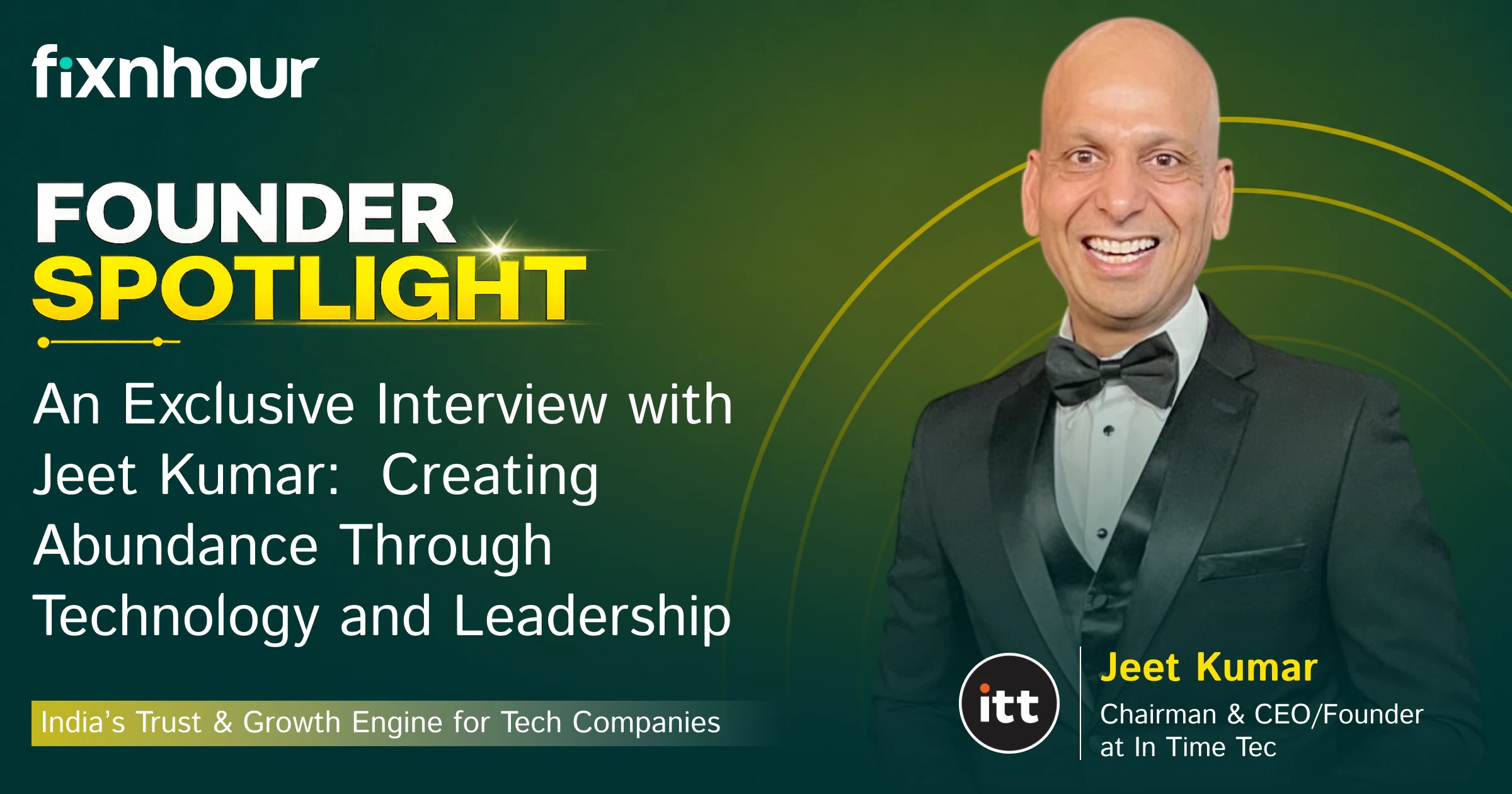
All successful tech companies have a story but the most inspirational ones start with a reason, a cause, a mission, a vision or something more. Entrepreneurship has always been about Jeet Kumar, Founder, Chairman and CEO of In Time Tec, about opportunity creation, empowerment of people and building value. In over 30 years of technology, he has grown from an engineer/inventor to a visionary leader who has demonstrated that business success and positive social impact can co-exist.
Jeet has built a global technology company from scratch with over 1,200 employees in eight world offices, while she has been investing in ideas that have never been realized outside of India. In the process, he co-invented 12 technology patents, coached his team as a leader and adopted the philosophy of "Creating Abundance" - that organizations should create value for shareholders, employees, customers, partners and communities.
Key Takeaways
- Value can be added to entrepreneurship beyond monetary benefits.
- Bootstrapping builds discipline, patience and accountability.
- It is important to understand that scaling a company is about scaling leadership and not founder involvement.
- Culture is not a corporate statement, it's daily practice.
- Building strategic technology partnerships starts with comprehending business outcomes.
- Curiosity and disciplined execution are key requirements for innovation.
- The understanding of business, architecture, judgement and continuous learning will be more important in the future thanks to AI.
- Coaching development leads to capability, not dependence.
- Leadership can be found at all levels in an organisation.
- True scale demands Systems, Governance, Delegation and Trust.
- Business expansion and the creation of positive social impact can go hand in hand.
- Making opportunities for the other people is a great way to make success more meaningful.
- Profitability is the source of impact, and purpose is the direction.
- The best businesses invest in their employees so they can lead the business on their own someday.
- Increasing value is the key to creating abundance, not amassing it.
Who is Jeet Kumar?
Establishing a tech start-up is hard. It takes more than just technical skills to build a business from the ground up, grow it to over 1,200 professionals and develop multi-location offices worldwide. It takes patience, culture, leadership, disciplined execution and a purpose that will endure for decades of change.It is this philosophy that is at the core of Jeet Kumar, Founder, Chairman and CEO of In Time Tec.Jeet brings over 30 years of experience in IT and software, including engineering, innovation, entrepreneurship, leadership, coaching and community impact experiences. Prior to his role as an entrepreneur, he worked for about 10 years for HP, working in technology and innovation, and co-inventing 12 technology patents.His goals went beyond the field of engineering, however.Jeet was committed to creating an organization that would provide opportunities for customers, families, partners and communities as well as shareholders to benefit from business success.
This attitude evolved into what he calls “Creating Abundance.”With a limited number of individuals and no external funds, he grew In Time Tec into a world-renowned software solutions company with over 1200 employees. The company's approach goes beyond delivering software projects. It concentrates on strategic technology partnerships that facilitate business transformation, increased competitiveness, and tangible results.What makes Jeet's story really interesting is that he feels it's not just about revenue, valuation, and company size when it comes to entrepreneurship.He's also an author, speaker, and business and life coach, and loves to help people understand what is most important to them and create growth in both their business and personal life.For the founders today, there's a question that comes to mind as he does this journey:If success at building a company is not just about amassing more, but about creating more opportunities for all that interact with it?In this exclusive interview with Fixnhour, Founder of In Time Tec, Jeet Kumar shares his insights on the path he took from technologist to entrepreneur, how he built In Time Tec without any external funding, how he got to build a 1200+ person global organisation, and why all of this is still a part of his definition of success: Abundance, People, Culture, and Purpose.
Q1. Jeet, you have spent more than three decades in technology. How did your journey begin, and what eventually inspired you to become an entrepreneur?
I was originally into technology, but then it evolved into it being more about people.I had a very significant portion of my career at HP where I engaged in some interesting and difficult technology challenges and participated in innovations. Fixnhour For me, co-inventing 12 patents was a valuable experience, since it helped me realize that with curiosity, disciplined thinking and collaboration, an idea can become a worthwhile product.I started to think more in-depth about impact, though, as I went through my career.Technology is a tool for solving business problems that are extraordinary, but the whole organization is made up of people. I got more and more interested in the possibilities that arise when talented individuals are trusted, given opportunity, clarity and a space in which to develop.This way of thinking eventually led to the development of In Time Tec.We did not have a huge amount of resources or outside funds. We started with those who thought that we could do something together that was worthwhile.It was not just to create another software firm. I wanted to build the organization that can do abundance with our staff, our customers, our partners and our communities.That was the platform on which we went on building.
Q2. You frequently use the phrase “Creating Abundance.” What does abundance mean to you?
Abundance is much broader than financial success.Money matters. Businesses need to make money and be viable. However, if metrics of success are solely financial we miss a lot of the value that can be created by an organization.Opportunity can come in the form of abundance.It can refer to someone gaining confidence that they never had before.It can mean an employee creating a better future for their family.It can be supporting a customer through a problem they are facing that allows them to expand their business.This could be anything from jobs to leadership development, knowledge sharing, or community contributions.The approach is that success can be achieved without compromising results.Any one's rise does not come at the other's expense.With the proper attitude, business can be a vehicle that spreads value to the outside.This is what abundance entails for me.
Q3. You built In Time Tec without outside investment. What did bootstrapping teach you?
No money from outside brings discipline.When capital is scarce, it is essential that each decision counts. Don't take it for granted that more money will solve all problems. It is necessary to know people, use resources responsibly, create sustainable economics and constantly prove their worth for growth.It also helps in developing patience.In business, it is important to hurry up and grow up as fast as possible. However, sustainable growth does not necessarily equate with fast growth.We concentrated on value creation for customers, strengthening relationships, investing in our people and investing in our organisation.The freedom was also with bootstrapping where we were able to make decisions based on our long-term philosophy.We might ask ourselves what kind of organization do we want to build instead of optimizing all decisions based on outside expectations.It's not a bad idea to seek out capital sources from outside, but it is not the end of the world. There are varying approaches for different companies.We found that we developed stronger accountability, resilience and long-term thinking through building from our own foundation.
Q4. Scaling from a handful of people to 1,200+ professionals is extraordinary. What changes when a company reaches that size?
All the rules remain the same except for everything else.In small companies, the founders can communicate directly with everyone. They are able to make many decisions and solve problems swiftly.That's not possible on a large scale.You need leaders.You need systems.There is a need for clear responsibilities.You have to have a solid culture that will support the decisions even without the founder present.That's why leadership development is crucial.A founder has a finite capacity, and can't scale by getting into more decisions. A founder grows by allowing others to make good decisions.Communication needs to be a lot more intentional as an organisation develops. Individuals should be aware not just of the company's activities, but how important they are.The biggest challenge is to not lose purpose in the process of growth.If your values are just for a company of 20 employees, then they're not institutional values.Their goal is to get them so engrained that they remain a force at 200, 1,200 or beyond.
Q5. How do you build and protect culture across a global organization?
Culture is not etched in the wall.Culture is lived by people.It's a way that leaders act when things run out of hand.It is how they are treated if they make a mistake.It is about the sense of safety that employees have in sharing their thoughts openly.It is when the organization fulfills its commitments at times of inconvenience.With the globalisation of companies there is also a central consideration of values and cultures.Individuals from various countries have diverse experiences, culture, communication and views. There is no need to attempt to obliterate those differences in a strong global company.Rather, it should establish common rules that can be followed in a collaborative manner by different teams with respect to each other.Leaders need to be consistent.Leaders are more closely followed than spoken.When leadership actions don't match organisational values, people will think, "Yes, he's doing that.When leadership actions don't match organisational values, people will think, "Yes, he's doing that.
Q6. In Time Tec describes client engagements as strategic partnerships. What does that mean in practice?
A vendor finishes a job.A strategic partner knows the "big picture".If a client comes to us with a technology need, our goal is not just to begin coding software. We should have an understanding about what the business want to accomplish.What is their problem?How would you know if you are successful?What risks exist?How will the technology fit into the overall business plan?Sometimes, it means questioning assumptions.It can sometimes mean suggesting a different way to do things.It's also about saying to a client that something they first asked for might not deliver value for them.It is important that they be honest to that degree.Technology partnerships are based on trust, transparency, delivery, and accountability.If our customer achieves success due to our efforts together, that's what's important.12 patents are co-invented, what are your personal thoughts on innovation?
Q7. After co-inventing 12 patents, how do you personally think about innovation?
Innovation is not about inventing anything.Technological innovation is interesting when it is a solution to a problem and/or generation of value.My career in patents further drove home the concept of curiosity.You must be ready to question why it is that things are the way they are, and if there's a more effective way.Innovation, however, must have boundaries.There's nothing difficult about ideas.Execution is the key to transforming an idea into something useful, reliable, scalable, valuable.The setting in which they live needs to also be a space where they feel comfortable to challenge assumptions.When workers think only top managers can have good ideas, innovation is restricted to the top.The most effective companies allow for the space of curiosity to exist within the business.
Q8. AI is changing software development rapidly. What do you believe this means for technology companies and engineers?
Each significant leap in technology creates new skills that are important.In the knowledge-based field, parts of software development, testing, analysis, documentation and much more will be automated with the help of Artificial Intelligence.Don't take that as a "threat" just because.It's a chance to shift human effort to more useful problems.Rather than just writing code, software engineers will need to increasingly grasp the business context, architecture, security, systems thinking, communication and problem-solving.Firms will have to undergo a similar shift.Clients will need fewer “development capacity” partners and more partners who can help them identify where technology and AI can be applied to make an impactful business outcome.The skill that will be important is learning.There will be changes in specific tools.The capacity to learn, adapt, be critical and add value will always be relevant.
Q9. You are also a business and life coach. How has coaching influenced the way you lead?
Coaching helps you to discover that people frequently are able to do more than they think.The role of the leader is not to answer all the questions.Sometimes the best you can do is ask a question which leads the other person to his own answer.This is a big change in leadership.If it is the leader's responsibility to solve all of the problems, the organization becomes dependent.Where leaders provide people the opportunity to make decisions, gain confidence and take responsibility, the organization builds capability.Coaching also as a reminder that employees are human beings first, resources second.They may have aspirations, fears, families and challenges that are different from ours, and their definition of success may be different.Knowledge is the key to better connections and healthier companies.
Q10. What have you learned about developing leaders inside an organization?
The first step in developing leadership is to put people in actual leadership positions.Leadership can't be learned in books, programs, presentations.Individuals must have decision making time, consequence time, problem solving time, and time for error correction.Meanwhile, they require assistance.Great leaders provide an atmosphere for individuals to push themselves but not leave them alone!Yet another lesson is that leadership is not a position.There is a way to be a manager without being a leader.Ownership, Courage, Integrity and Serving Others are the four qualities that are often the essence of great leadership, though not necessarily the qualities of an individual with formal authority.If you know those qualities, you know that he isn't one of them; and if you don't, you should identify him early and set aside opportunities to develop him.
Q11. After building a global company, what do you think founders misunderstand about scale?
Sometimes, founders believe that scale is about doing more.More customers.More employees.More offices.More revenue.All of those can be indicators of growth, but true scale involves developing an organization that can produce more value without relying on the founder on a linear scale.If the founder is making all the important decisions, it's not that they need to be bigger, but that it's not scaled.Scale is a need for systems, leadership, culture, governance, and trust.It also means giving up.Founders need to also realize that others may find solutions to the problems in other ways than what they would do.It's not always "Did they do it my way?A more pertinent question is, “Did they get the right results without compromising our values?”
Q12. How do you balance business growth with creating positive impact in communities?
I don't really view those as different goals to be achieved.A healthy business generates jobs, builds skills, provides service for customers, sustains families, has an economic impact, and can invest in the local community.So the question is, how intentional do you think about that impact?Businesses can have a significant impact on the lives of people.Treatments are important to employees.The opportunities we set out to create is important.Customer and partner interactions are important.The success of their use is important.Creating abundance involves taking this broader responsibility.Profitability enables impact.There is a purpose that will provide direction for profitability.When aligned together, business can be a great catalyst for positive change.
Q13. What does success mean to you after more than 30 years in technology and entrepreneurship?
My definition of success has evolved over the years.For us, in our early days, progress was measured by successes: titles, products, patents, customers, revenue, or company growth.Those milestones can be significant.But then, success is more about impact.How many improved?How many people got better as a result of being a part of the journey?How many leaders did you contribute to the development of?How many customers did you reach out to and get to make a positive impact?What did your organisation do for your communities?Did you create a life that has what you value at its center, and especially most important of all:It's surprisingly empty when you achieve something without achieving fulfillment.Success is sweeter with others in the mix.
Q14. What is your vision for the next chapter of In Time Tec?
The future is going to be about keeping on creating abundance and making sure that organizations can make it through the more complicated technology changes.The pace of technology change is rather fast.Artificial Intelligence, automation, cloud technologies, data, cybersecurity and new digital models are transforming the way organizations work.Clients require partners to help them cut through that complexity and stay business-focused.Meanwhile, our duty to our own people is never to be forgotten.We want to develop our talent, create our leaders, extend our opportunities and deepen our culture that got us here.The size of the company is not the goal to strive for.The objective is increasing the amount of meaningful value we can create.Continued actions like that with customers, employees, partners and communities will naturally follow growth.
About the Founder
Jeet Kumar is the Founder, Chairman and CEO of the global software solutions company, In Time Tec, which is founded on the philosophy of Creating Abundance for clients, employees, partners and communities.Before becoming an entrepreneur, Jeet had over 30 years of experience in IT and software, and spent about a decade at HP where he co-invented 12 technology patents.From the initial stage, without funding from anyone else, with a few like-minded individuals, he expanded In Time Tec to become a global, award-winning technology company with 1,200+ employees in eight offices around the world.As well as entrepreneurship and technology, Jeet is an author, speaker and business and life coach. He is a leader who values helping people discover what is important, build capacity, and build for himself and others.His experiences embody this philosophy, which is more than just about achieving business success.Develop value creating technology. Develop organisations that generate opportunity. And establish abundance through success.
Final Message to Entrepreneurs
Don't establish a business just to make it into a success.Construct a plan that allows others to be successful with you.Technology will change.Markets will change.Business models will change.Your learning skills will be important.Building trust will be important.You will make a difference in the way you treat people.Emphasize the creation of real value. Build patiently. Develop leaders. Keep your commitments. Remain curious.Now that you've achieved success, ask a bigger question:How can you share this success with another?It's not just your business that can change because of that question; it's your life.
Final Thoughts on the Founder
Jeet Kumar's story seems remarkable if you look at it from just a business perspective: 30+ years in technology, 12 co-invented patents, 30 years of experience, a software company that was bootstrapped and expanded globally, 1,200+ professionals and 8 offices across the globe.Those numbers however, do not tell the whole story of his life.The unique aspect is the philosophy behind them.In Time Tec's mission is to prove that organizational growth and human growth don't need to compete. All of this: a product of the successful company, customer value, professional opportunity, leadership development, financial sustainability and community impact.He is a great example of another important leadership shift – from engineer/inventor to entrepreneur, CEOs, author, speaker and coach.In the beginning of a career, values might be found within the individual you create.
Later, value gets bigger and bigger in what you enable other people to create.Jeet's story is particularly poignant for technology founders in today's era of AI revolution. Tools will continue to be more powerful, software development will continue to speed up, but enduring organizations will require certain human characteristics: trust, purpose, judgment, leadership, curiosity, and people development.Time Tec was started by a small group of dreamers, and no outside investment.It's been over 1200 professionals since then, and it's proven that one of the most effective methods of scaling a business can be to increase the number of people who can grow because of the business. Request a Custom Quote