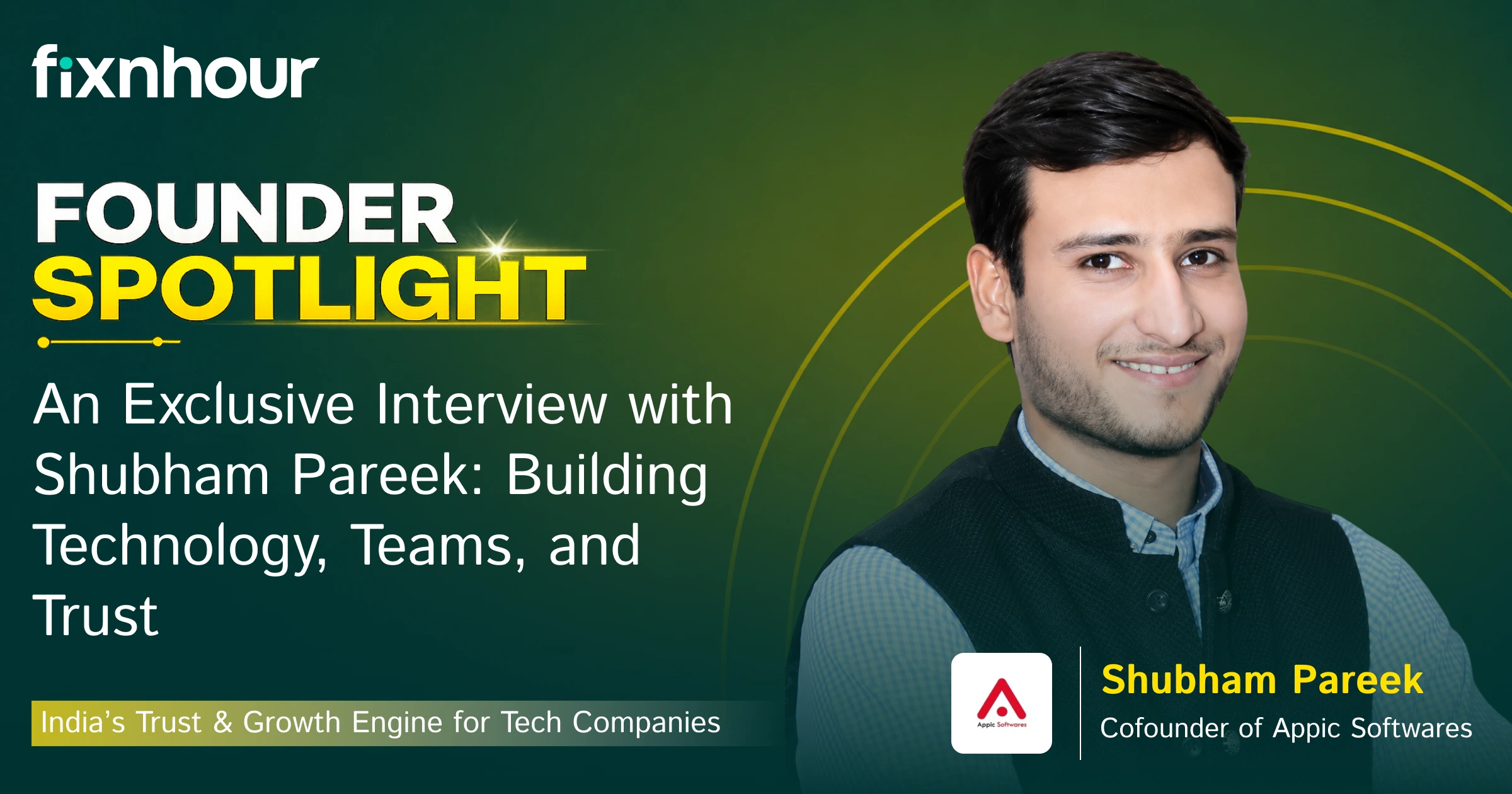
Read our exclusive interview with Shubham Pareek, Co-Founder & CEO of Appic Softwares, on entrepreneurship, technology, team building, innovation, and growth.
It takes more than great code to build a great tech company. Requires vision, resilience, leadership and the constant ability to adjust to an industry that changes at a remarkable pace. With the increasing adoption and dependence on digital transformation, technology leaders will be expected to also be able to address complex business problems, create effective teams, and create value beyond software development.
No entrepreneur exemplifies this journey more than Shubham Pareek, Co-Founder and CEO of Appic Softwares. With a solid background in computer science, Shubham was able to convert that experience into a thriving technology company that has more than 80 members of staff working for various clients across a range of industries. His experience as an entrepreneur showcases how he shifted from a developer mindset to one that prioritizes innovation, customer success, culture, and sustainable growth.
Key Takeaways
- It's not all about technology when building a Tech company.
- As the workforce grows from a handful of individuals to 80+ employees, you need systems, delegation and leadership.
- Clients are demanding that technology partners not only grasp their needs, but also their businesses.
- Innovation in the FinTech sector requires a combination of user experience and security and trust.
- Blockchain should be leveraged where it has a valid use, not because of the hype.
- AI can boost developer productivity and make architecture and problem-solving skills valuable.
- Technology partnerships are robust when there is communication and joint accountability for results.
- As companies expand, a conscious effort needs to be made to develop company culture.
- Founders need to go through continuous changes as their business goes through various growth phases.
- Robust leadership development and hiring is vital to scaling.
- It takes time to build a reputation and trust, so don't mess it up over a short-term benefit.
- The successful founders learn how to deal with uncertainty with ease.
- Technology will continue to evolve, but the basics of business stay the same.
- Growth is sustainable, rather than simply larger, through the creation of a better organization.
Who is Shubham Pareek?
Every successful tech startup has a founder who discovered at some point that building a successful business isn't just about building a great software. It involves assembling and developing the proper team, learning about customers, making repeatable systems, quality control and staying current with technology.This is the new breed of technology entrepreneurs and Shubham Pareek, the co-founder and CEO of Appic Softwares is one such individual.Shubham's experience in computer science from Rajasthan Technical University, coupled with his expertise in technology, kicked off his entrepreneurial career. Through the years, however, his focus shifted from just software and delivery to building teams, developing business relationships, creating processes, and building an organization that can serve clients at scale.Since then, Appic Softwares has grown from being an entrepreneurial company to a much bigger technology company, with 80+ professionals working with the company. The company focuses on creating mobile and web applications, such as native and hybrid apps, and has gained expertise in blockchain technology and financial services.Growth in the case of Shubham isn't just about headcount or the number of projects delivered.
It's about establishing a trustworthy organization for crucial technology choices.In the early days of his entrepreneurial career, he's had to face the same challenges many tech entrepreneurs have gone through, from hiring skilled talent to keeping up with rapidly evolving technology to managing international business partners to making sure business growth doesn't impact company culture.A new metamorphosis is taking place today.AI is transforming the software design, development, testing, and maintenance landscape. Clients are now looking for technology partners to know how to build apps, but they also want to know how to automate, how to make things smart, how to deal with data, how to secure it, how to scale it, and how to document measurable business outcomes.Shubham believes this is a chance for tech firms who wish to transform.In this exclusive Fixnhour Founder Spotlight, Shubham Pareek speaks about his journey of building Appic Software, scaling an 80+ member team, working across FinTech and blockchain, and how he is handling the AI revolution and the lessons learnt as a technology entrepreneur.
Q1. Shubham, how did your journey from a Computer Science background eventually lead to entrepreneurship and the creation of Appic Softwares?
Technology was of course very much part of my life in the way I learned about it through Computer Science. As I grew more experienced, though, I became more fascinated with the business aspects of technology: how a technology idea can be converted to a useful product and how a product can be used to address a real customer problem. Fixnhour It was this curiosity that was essential in the establishment of Appic Softwares.In the early days of developing a technology business, it's all about the execution. Your mind is occupied with projects, development, clients, deadlines and delivering quality work. However, it is a process that entrepreneurs learn as they proceed that it takes a whole new set of thinking to build a company.Besides technology, you need to know people, sales, finance, operations, hiring, customer relations and leadership.Many experiences that have been involved with learning. We made some good decisions, and others gave us valuable feedback on what needed to be done differently. Every project and client engagement has been an opportunity to continuously enhance our practice.In the eyes of my own and Appic Softwares' own more than 80 member staff, I see more than just growth in the company today. I visualize years of learning, team working, customer trust and continuous improvement.
Q2. What was the original vision behind Appic Softwares, and how has that vision evolved as the company has grown?
We went to the drawing board and our first goal was simple: Make quality digital products and be a reliable technology partner for our clients.As the company expanded, so did its vision.We knew that business was not just looking for a developer. They were searching for teams that could grasp their concepts, question assumptions (when needed), suggest suitable technology, and follow through on the product process.It turned our job around.Rather than focusing only on development, we began to examine the entire product lifecycle – from grasping business needs and user experience through architecture, development, testing, deployment and scaling over the long term.Our vision today is to continue building Appic Softwares as a technology company that will help startups and established businesses transform ideas into scalable digital products.Technology can continue to shift, but our objective is the same: Understand the business problem and develop a solution that adds real value.
Q3. Growing Appic Softwares to more than 80 team members is a major milestone. What have you learned about scaling a technology company?
Once you are a technology business with a few more employees than ten, you learn real quick that technology that worked with ten people doesn't necessarily work with fifty or eighty.In the initial phase, the founders may be able to be involved in almost every decision. That is not sustainable as the organization grows and over time will actually hinder growth.You need processes.You must have strong leadership.These are the people who need to take ownership.You need trust and that's most important.To me one of the largest lessons was that it's not just about adding more people. It's about establishing a workplace that allows those workers to do their job well.Communication is a very important thing. There must be clarity in the team around its responsibilities, expectations of the project, quality criteria, and goals of the organization.The company's expansion makes culture more important. You want new people to have new ideas, but also need to know the values that went into the formation of the organisation.We are proud to have grown to 80+ people, but also know that with each additional step of growth we need to do better with our systems and leadership.
Q4. Appic Softwares works extensively in mobile and web development. How have client expectations changed over the years?
The expectations of clients have evolved considerably.Previously, discussion would usually begin with something simple like “We need a mobile application” or “We need a website.”Clients are much more strategic in their thinking these days.They are interested in scalability, integrations, user experience, security, analytics, automation, AI functions, cloud infrastructure and long-term maintenance.They also have a better grasp on things. Discussions are more collaborative as many of the founders and businesses do research themselves prior to approaching a development partner and finding out about the technology.The other significant difference is speed.Companies desire to get products to market quicker, to test their concepts early in the process, and to make incremental changes based on customer feedback.Companies would like to get products to market more quickly, test their concepts early in the process, and make incremental changes based on customer feedback. Thus, agile development has become more and more significant.I think that the purpose of a software development firm has likewise changed. Requirements can't be taken for granted and code written.The business behind the application needs to be understood.That's where a technology partner can add a lot more value.
Q5. FinTech is one of Appic Softwares' focus areas. What makes building technology for financial services different?
Reliability, security, performance and consumer trust are especially crucial in the realm of financial technology.Financial products involve users in situations where their personal and financial data is at stake, and in many cases, their money is at stake, as well. Any problem, no matter how minor it may seem, can have a major impact on confidence in the platform.As such, numerous aspects of FinTech development demand careful thought, including architecture, security measures, integrations, data handling, compliance regulations and user experience.Meanwhile, users demand financial applications to be very straightforward.This poses an interesting problem: the technology can be quite complex and yet the customer experience should be easy to understand.Digital payments, automation, AI, blockchain, embedded finance and new digital business models are also driving rapid transformation in the financial services sector.This brings tremendous opportunities and responsibilities to the technology companies.Security and trust are essential to innovation in financial services.
Q6. Blockchain has been another area of expertise for Appic Softwares. Where do you see its practical business value?
Blockchain experienced a hype cycle in which there was a lot of enthusiasm for the technology, and not all of the suggested use cases actually needed blockchain.I believe the market is more mature now,From “How can we use blockchain?” to “Does blockchain really solve this one problem?” more and more businesses are asking better questions.This is the correct way to do it.The blockchain can offer benefits when transparency, decentralization, traceability, digital ownership and secure transactions are the real values.But, technology should always be a servant to the business.We are not into marketing something just because it is new and trendy. If it's easier to solve the problem using a conventional architecture, go with that instead.As tech partners, our job is to assist clients to make those decisions in a non-biased way.Ultimately, successful innovation isn't about using the most advanced technology. It's about not using too much technology.
Q7. AI is transforming software development itself. How do you see AI changing companies like Appic Softwares?
Artificial Intelligence is likely one of the largest alterations in the software business in recent years.AI tools are already being used to assist developers in writing code, finding bugs, creating documentation, enhancing testing, speeding up research, and automating repetitive development tasks.This will make a huge contribution to productivity.But, I don't think that AI is going to replace good software engineers.As a result, engineers will be increasingly needed in more specific areas where they will need to judge the business need, architecture, security, scalability, integrations, product thinking and solve complex problems.Writing code is not the only aspect of software development.What really counts is understanding the value of what should be built, why it should be built and how it should be designed for long-term success.Technology firms are also introducing AI into their solutions to meet customers' needs. Expect more automation, more recommendations, more conversation and more data-driven workflows, with the help of AI.The fast-adapting companies will be in for some big opportunities.
Q8. What do you think differentiates a great technology partner from a company that simply provides development resources?
Knowing the customer's business.The development company might get requirements, allocate developers, finish job and supply software.A technology partner goes the extra mile.They ask questions.What is the rationale for the feature for the customer?What is the issue it is trying to address?Can it be done in a simpler way?How will it be used?How does this evolve to meet the needs of the business as it grows?Sometimes the most useful thing that we can do is suggesting that a client not build.That requires trust.Another key difference is the way things are communicated. Customers shall be informed about the progress, problems, decisions and risks of the project.Finally, clients are looking for assurance.They want to feel that the company that is working on their product cares about the result and not just the hours worked.Long-term relationships are established when customers consider you more of a partner than an outsourced vendor.
Q9. What have been some of the biggest challenges you have experienced as a founder?
Starting a business comes with a set of challenges at each phase.First, the challenge is to get customers and build credibility.However, the trick is to perform consistently once the challenge is set.The more the company grows, the more it is crucial to hire and retain great employees.Later, more robust processes, management systems, financial controls and business development systems are required.There never is a time when all of these issues go away. The problems are just different.A lesson learned is the importance of founders to get comfortable with uncertainty.There will never be complete information prior to every decision.You have to assess the information, listen to your team, trust your experience, make the call and then adjust as needed.One of the other things entrepreneurship teaches is patience. It takes time to create a sustainable organisation.A reputation and trust can't be built overnight.
Q10. As CEO, how do you maintain company culture while the organization continues expanding?
Having the founders personally know everyone makes it easier to maintain the culture.As the company scales, culture needs to be intentional.Individuals should know what the organization is about, in actions, not in words on a website.Communication, ownership, learning, teamwork and commitment of the customers are important to us.We want people to be comfortable to share ideas and take responsibility.There are also constant learning opportunities that must be taken by technology professionals due to the rapid rate of change in the technology industry. An engineering culture should foster experimentation and learning of new technologies, and encourage sharing of knowledge with others in the profession.Leadership also is a significant factor.When the company grows, managers and team leads are the individuals who are responsible for embodying the company's culture in their daily actions with others.So it is one of the most essential duties of the founders to develop good internal leaders.
Q11. You are preparing for another stage of expansion. What does the next chapter of Appic Softwares look like?
The next chapter is on building up what we have built and getting ready for bigger opportunities.Growth for us is not just an increase in numbers and size, but a continuation of our journey.We want to get better.It's about building our capacity in new technologies, making our processes more efficient, fixing our staff, strengthening our global partnerships, and developing our skills and knowledge in industries that we can add a lot of value.AI will be a key component of our technology strategy, and will be increasingly integrated into our technology strategy in the future.There are also growing prospects to enhance our capabilities in FinTech, modern mobile and web platforms, intelligent automation and other new digital technologies.We want to continue to operate as a fast and entrepreneurial firm, while developing Appic Softwares into a world-class technology firm.
Q12. What advice would you give young technology entrepreneurs who want to build a software development company today?
Don't begin with technology in mind.Understand business.A technically able founder who has no idea what customers want, how to sell them or generate cash flow, hire the right people, communicate or manage the business will not get it to scale.Second, trust is directly in focus.Your initial customers are very significant. Be overpromising, be honest and take success seriously.Thirdly, judiciously develop your team.There are only two ways to scale a tech company: with others. Your talent to draw in and develop good employees will ultimately be the reason for the organisation's success.Fourth, keep learning.AI is revolutionizing the software development landscape. Five years ago, what worked now might not work five years from now.Finally, be patient.Social media can sometimes make doing business seem like a miracle.Real companies are typically the result of many decisions, lessons learned, customer interactions, and execution over a number of years.
Q13. What does success mean to you personally today?
My definition of success has changed.Founders, of course, start with revenue, customers, projects and company growth. Indeed, those metrics continue to be vital as all businesses require good fundamentals.However, with the growth of the organization, success expands.Success is watching people grow in their careers within the company.When a client comes back with another project, that's success.When someone recommends us, and says they trust us, that's success.When a product we helped develop creates value for real users, it's success.And creating an institution that can sustain growth without the founders is likely one of the most significant ways to succeed.To me, entrepreneurship is all about creation of value for the customers, employees, partners and the ecosystem.
About the Founder
Shubham Pareek is the Co-Founder and Chief Executive Officer of Appic Softwares, a mobile and web app development company based in Delhi, India.Shubham has a background in Computer Science from Rajasthan Technical University, where he honed his technical expertise along with skills in entrepreneurship, business planning, team management, and customer-centric product development.Since taking the helm, Appic Softwares has grown to over 80 staff members and has grown its expertise from hybrid and native mobile applications, web solutions, financial technology, blockchain, and modern digital product development.In his role as CEO, Shubham is dedicated to scaling the organization, nurturing a pool of technology talent, building strong customer relationships worldwide, and preparing Appic Softwares for the future of AI-powered software development.His journey is one of the fundamental tenets of modern technology entrepreneurship: Great software can win the project, but great teams, execution and trust will create lasting companies.
Final Message to Entrepreneurs
Technology changes quickly.Business fundamentals don't.Understand your customers.Solve genuine problems.Create an effective team.Communicate honestly.Keep learning.Don't sacrifice trust for growth, ever.We will be using new tools as a result of AI. New technologies will keep emerging. Customer expectations will change.But those firms who provide reliable value consistently and keep their promises will never be out of the running.Don't just focus on growing your business.Concentrate on developing a stronger organization.If you do that every day, growth is a result.
Final Thoughts on the Founder
Shubham Pareek's experience at Appic Softwares is a testament to a crucial shift that all successful technology entrepreneurs must navigate at some point—from software creation to the ability to consistently create great software.Business growth is marked by an 80+ member team, but what is more interesting about Shubham's journey is the evolution of leadership.With a background in Computer Science, he has a solid technical foundation, and years of entrepreneurship have broadened his understanding of customer relationships, team-building, business planning, delivery and organizational culture.His opinions on FinTech and blockchain also highlight the principle of it is great when it is solving a real business issue, not just because it is cool.With the advent of AI, this philosophy is even more relevant.
Business understanding, architecture, innovation, security, execution and trust will be the competitive edge of technology companies as AI gains in its code generation capabilities and the ability to make it more accessible.Appic Softwares' next phase of expansion will thus be more than just scaling up its workforce.It's going to be a question of reinforcing the company's reputation as a technology partner that can help companies in an increasingly intelligent and rapidly evolving digital economy. For Appic Softwares, the next stage of growth will therefore be about much more than increasing team size.It will be about strengthening the company's position as a technology partner capable of helping businesses navigate an increasingly intelligent and rapidly changing digital economy. Get Your Free Consultation