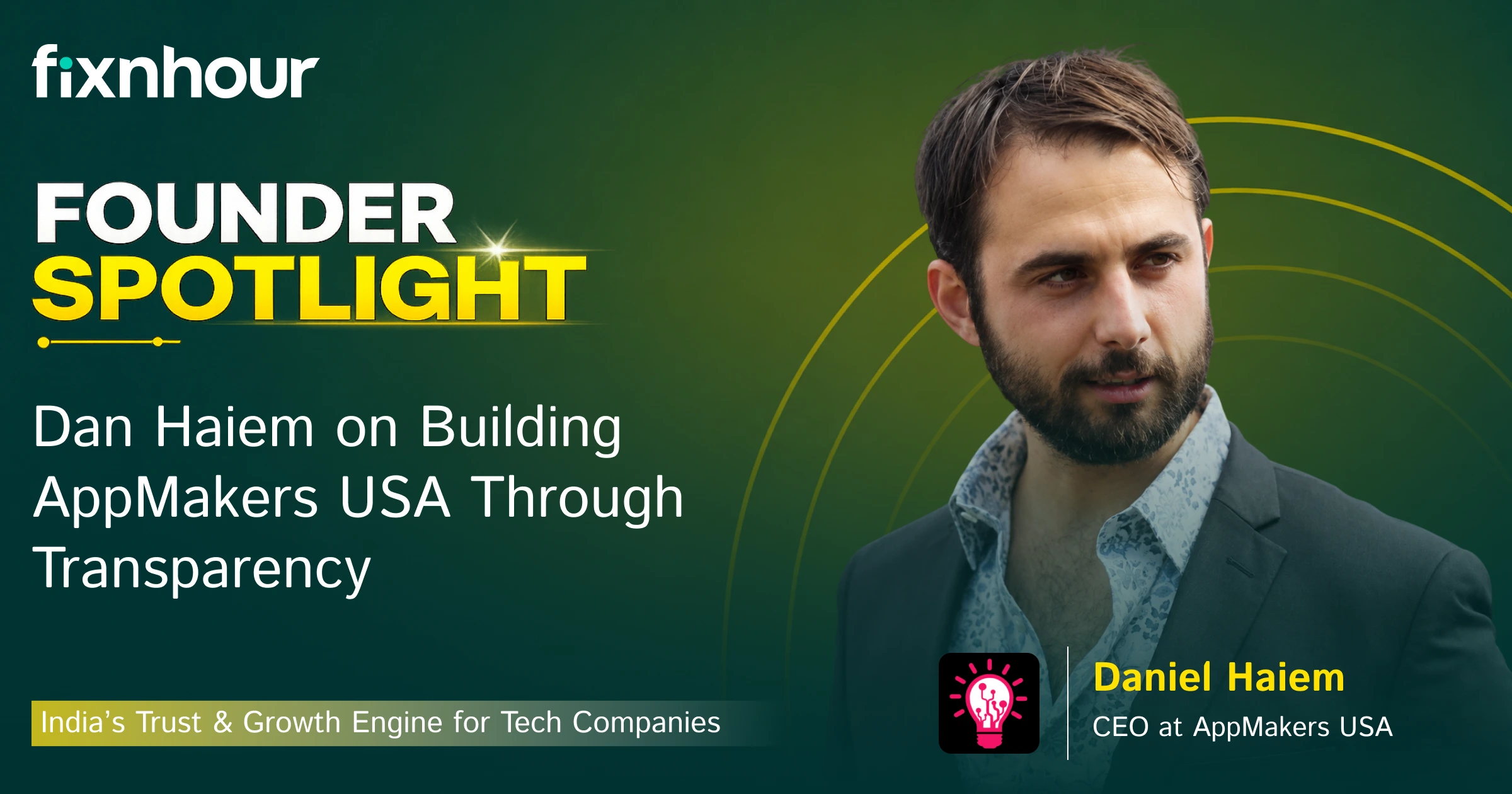
Behind every successful technology company is a story shaped by challenges, resilience, and a clear vision. For Dan Haiem, Founder and CEO of AppMakers USA, that journey began with a mission to make education more accessible and evolved into building one of the industry's most trusted mobile app development companies.After experiencing the frustration of losing $50,000 and 18 months to an unreliable development agency, Dan transformed that setback into an opportunity. Determined to build software the right way, he and his team taught themselves product development, raised $1 million, grew their own product to more than one million users, and ultimately founded AppMakers USA with a commitment to transparency, technical excellence, and client-first thinking.
Who is Daniel Haiem
Entrepreneurial Background Dan's entrepreneurial path started at UCLA, where he founded a nonprofit that ran science fairs for underserved children. From there, he launched ClassCalc, a calculator app built to replace the TI graphing calculator in high schools and save students money worldwide. Inspiration for Starting AppMakers USA Dan Haiem: The real turning point was a hard lesson: a development firm took $50K and a year and a half of his team's time and delivered nothing. That experience forced them to learn how to build an app themselves, and it became the founding story behind AppMakers USA. Having been burned by an agency himself, Dan built the company around empathy for clients who've had the same experience, which he sees as a genuine edge over competitors.
Major Milestones and Achievements After teaching themselves to build, the team went on to raise $1 million and grow their own product past a million users. That journey shaped them into what Dan calls a "rockstar dev team," one that cut its teeth in the startup world and now brings that same startup mentality to both enterprise clients and fellow startups. Leadership Philosophy: Dan breaks his leadership approach into four principles: Always be kind and honest; treat everyone with respect. Be aggressive about opportunity; believe in yourself enough to go after it. Hire good, kind-hearted people who genuinely enjoy the work. In a remote-first world, that's the only real path to consistent quality. Lead with empathy. Having been scammed by a dev firm himself, he brings that firsthand understanding to how he treats clients. Personal Interests: Outside of work, Dan is a spearfisherman; he free-dives up to 20–25 meters to spearfish, then turns the catch into sushi.
Q1. Entrepreneurial journey / what inspired AppMakers USA?
My path started at UCLA, where I ran a nonprofit doing science fairs for underserved kids. From there I built ClassCalc, an app meant to replace TI graphing calculators in schools and save students money. That was the real crucible. I thought I was pitching software, and then I realized I was challenging a $300 million calculator industry entrenched in educational bureaucracy. That shifted how I think. I stopped focusing just on the product and started thinking like a systems operator, like where do the levers of power and trust actually live?
The real founding story of AppMakers USA, though, came from getting burned. Fixnhour, a development firm, took $50K and a year and a half of our time and gave us nothing back. We had to teach ourselves to build from scratch and ended up raising a million dollars and growing to over a million users. That experience is exactly why AppMakers exists because I understand what it's like to get scammed by an agency, and I built this company so other founders wouldn't have to go through that.
Q2. Biggest factor behind our success.
Early on, I built this company around one idea: extreme transparency, paired with real engineering competence. We keep development, design, product, and QA entirely in-house, any company outsourcing that work is really just a sales company wearing a dev-shop costume. The other turning point was learning to say no. Early on we took every project that came our way. Then we shifted to only working with people and products we actually believed in. That filtered out the noise, built trust with better clients, and changed the whole energy of the company.
Q3. Adapting to changing tech, customer expectations, and market trends.
Our biggest recent challenge was scaling without becoming generic. As demand grew, we could've easily turned into just another dev agency. Instead we doubled down on our creative process hiring people who think like founders, not just coders and built internal tools to handle the repetitive stuff so the team could stay focused on solving real problems. Growth doesn't have to dilute identity. If anything, scale should amplify what makes you different.
Q4. How we're using AI?
We tailor AI to what each app actually needs instead of bolting on a generic assistant. Right now we're going deeper into AI-native interfaces. Not the "add ChatGPT" version of AI, I mean building experiences where AI is woven into the actual function of the product. Picture a CRM where AI isn't just summarizing your notes, it's prompting your next move, rewriting your outreach, adapting the UI to where you are in the sales cycle. The line between "product" and "assistant" is blurring, and we're leaning all the way into that.
Q5. A project that represents what we do?
ShiftPass is a great one. It's a two-sided shift marketplace for restaurants post an open shift, see vetted workers on a live map, fill it fast. We engineered the geography underneath it using PostGIS and spatial queries so a single query powers both the "near me" list and the live map.
The hard problem was the map markers flickering every time someone panned because every refetch created a new data reference and the map thought the whole dataset had changed. It took four things working together: keeping data alive across refetches, tracking by job ID instead of array reference, memoizing the map components, and stabilizing the callbacks.
It's live on iOS and Android now at a 5.0 rating, and we're still shipping updates on it.
Q6. Common mistakes founders make planning an app?
Defaulting to the generic version of your own idea. I had a client come to us wanting a pretty standard journaling tool for a mental health app. We scrapped that and rebuilt the core around dynamic mood tracking and bite-sized CBT interventions instead. Their engagement tripled. Founders often build the checklist version of their idea instead of the version that will actually make someone come back.
Q7. What differentiates AppMakers USA?
Three things. First, our startup roots we've been through the hardest technical challenges ourselves before we ever did it for a client. Second, we invest heavily in reusable code, so something that usually takes 20 hours, like a login screen, takes us two. Third, we're relentlessly transparent, especially when things don't go perfectly, because they sometimes don't. Beyond that, we act as co-pilots, not just an order-taking dev shop. We challenge assumptions and rethink flows instead of just building whatever spec lands in our inbox.
Q8. Leadership principles
Four things I try to live by:
- Always be kind and honest, and treat everyone with respect.
- Be aggressive about new opportunities, and believe in yourself enough to go after them.
- Hire good, kind-hearted people who genuinely enjoy the work in a remote-first world, that's the only real path to consistent quality.
- Lead with empathy. I've been scammed by a dev firm myself, and that shapes how I treat every client we work with.
Q9. Fostering innovation, collaboration, and continuous learning
I stay hands-on with clients myself. I'm not just overseeing timelines, I'm in the weeds helping them turn chaos into clarity. When the founder cares about the why and not just the what, it trickles down through the whole team. That's what keeps our culture sharp and our output above average.
Q10. Role of customer relationships and trust
I consider our customer satisfaction rate 100%, and we prioritize that over profitability on every project. We back that up with maintenance plans custom-tailored to what each client actually needs post-launch from bare-minimum upkeep to ongoing feature work. What clients tell us they appreciate most is that we take the time to understand what's actually wrong before proposing a fix, which honestly a lot of vendors skip entirely.
Q11. Emerging tech/trends over the next five years?
AI-native interfaces, without question. The line between a product and an assistant is going to keep blurring, this means less UI, more intelligence baked into the function itself.
Q12. Advice for entrepreneurs launching their first digital product.
Don't defer problems you've already spotted that "we'll fix it later" instinct is the most expensive decision you can make, because it never stays a technical issue; it compounds into slower releases, higher costs, and sometimes real compliance risk.
Q13. Long-term vision for AppMakers USA
We're going all-in on AI-native product experiences building toward less friction and more real intelligence in the products we ship, not just adding AI as a feature on top.
Q14. Closing message to aspiring entrepreneurs
If there's one thing I'd want people to take away, it's this: the setback that costs you the most can also be the thing that teaches you everything you need to build something real. Don't wait for permission to believe in your idea, but don't let speed become an excuse for cutting corners either; the shortcuts you take today are the bills you'll pay tomorrow, with interest. Build with honesty, hire people who actually care about the work, and treat the people you serve the way you'd want to have been treated when you were the one getting burned.
Personal interests
Outside of work, I'm a spearfisherman. I free-dive 20 to 25 meters, spear the fish myself, and turn the catch into sushi.
Recent achievements to highlight
We hold CMMI Level 3 and 4, ISO 27001, and ISO 9001:2015 certifications, plus AWS and Google Partner status. We've built for clients like the NFL, CVS Pharmacies, Walmart, and Los Angeles Apparel, and we're sitting at a 5.0 rating across 96 GoodFirms reviews. Across all our client work, we've shipped 400+ apps to 100M+ total users, helped raise over $1B collectively, and our engineers average 11 years of experience. I'm also a contributor at Fast Company and a member of the Forbes Technology Council. Let's Build Your Next Project