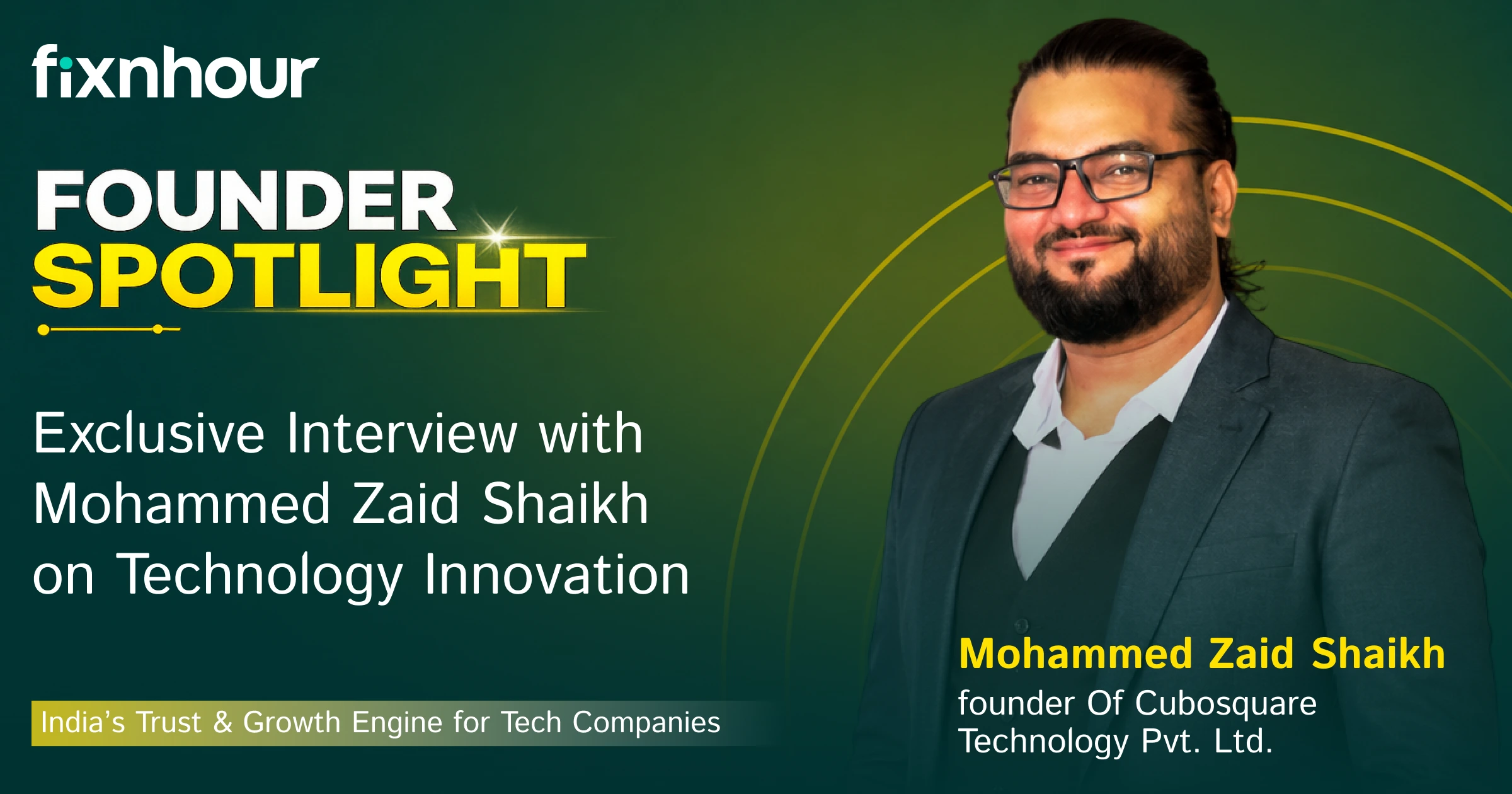
In today's rapidly evolving digital landscape, technology leaders who continuously learn, adapt, and innovate are shaping the future of business transformation. Among these visionary professionals is Mohammed Zaid Shaikh, a seasoned technology entrepreneur, software architect, AI enthusiast, and business leader whose journey spans more than two decades of technological evolution. From beginning his coding journey in 2001 to leading multiple successful ventures across technology, education, and business sectors, Mohammed Zaid Shaikh has built a reputation for combining technical excellence with strategic leadership. As the founder of Cubosquare Technology Pvt. Ltd., CIO at IDA Technologies, COO at FriendsCampus, and founder of Kashaf Perfumes Pvt. Ltd., he continues to drive innovation while helping organizations embrace digital transformation through emerging technologies such as artificial intelligence, IoT, automation, and cloud computing.
Beyond his professional achievements, he is deeply passionate about mentorship, research, education, and lifelong learning. His belief that continuous improvement, curiosity, and execution are the foundations of success has inspired countless students, entrepreneurs, and technology professionals. In this exclusive Founder Spotlight Interview, Mohammed Zaid Shaikh shares valuable insights from his remarkable journey, discussing entrepreneurship, digital transformation, AI, leadership, innovation, and the lessons he has learned while building businesses and empowering people through technology.
Who is Mohammed Zaid Shaikh?
In the world of technology, trends change rapidly, programming languages evolve, and new innovations emerge almost every day. Yet, the leaders who create lasting impact are those who never stop learning. One such leader is Mohammed Zaid Shaikh, a technology entrepreneur, innovator, software architect, AI enthusiast, and business leader whose journey spans more than two decades of technological evolution. Having started his coding journey in 2001 and working professionally in software engineering since 2004, Zaid has witnessed and contributed to multiple waves of technological transformation, from traditional software development to cloud computing, mobile technologies, artificial intelligence, automation, and IoT.
Today, he serves as:
* Founder of Cubosquare Technology Pvt. Ltd.
* CIO at IDA Technologies
* COO at FriendsCampus
* Founder of Kashaf Perfumes Pvt. Ltd.
* Technology Consultant and Strategic Advisor
His career reflects a rare combination of technical depth, entrepreneurial vision, and business leadership. Beyond technology, Zaid is also passionate about research, education, mentorship, poetry, science, and lifelong learning. As a guest lecturer and mentor, he has inspired countless students and aspiring entrepreneurs to embrace innovation and continuous growth. His philosophy is simple yet powerful: "Learn continuously, embrace mistakes, execute with focus, and never stop improving." In this exclusive Founder Spotlight Interview, Mohammed Zaid Shaikh shares insights from over two decades in technology, entrepreneurship, AI, leadership, and innovation
Q1. Tell us about your journey into technology. What inspired you to start coding in 2001?
My journey into technology started with curiosity. In the early 2000s, technology was rapidly evolving, and I became fascinated by the ability of software to solve real-world problems. What began as curiosity soon became a passion. I spent countless hours learning programming, experimenting with projects, and understanding how systems worked behind the scenes. The more I learned, the more I realized that technology had the power to transform industries, businesses, and lives. That realization became the foundation of my career.
Q2. You have more than 20 years of experience in software engineering. How has the industry evolved during this time?
The transformation has been extraordinary. When I started, software development was primarily focused on desktop applications and traditional enterprise systems. Today, we live in a world driven by cloud computing, mobile applications, artificial intelligence, automation, and connected devices. Technology has become deeply integrated into every industry. What hasn't changed is the importance of fundamentals. Programming languages may evolve, but problem-solving, logical thinking, and continuous learning remain the foundation of successful technology careers.
Q3. What inspired you to establish Cubosquare Technology Pvt. Ltd.?
Cubosquare was born from a desire to create meaningful technology solutions. Over the years, I worked with various businesses and observed a common challenge. Many organizations wanted to leverage technology but struggled to identify the right solutions and implementation strategies. I founded Cubosquare with a vision to help businesses embrace digital transformation through innovative software, automation, AI, and scalable technology solutions. Our goal has always been to solve business problems rather than simply deliver software.
Q4. How do you define successful digital transformation?
Many people think digital transformation is about adopting new technology. I believe it is about transforming how organizations operate. Technology should improve efficiency, decision-making, customer experience, and business outcomes. Successful digital transformation occurs when technology aligns with business objectives and creates measurable value. Technology is the enabler. Business impact is the goal.
Q5. Artificial intelligence is reshaping industries worldwide. How do you see AI impacting businesses over the next decade?
AI will become one of the most significant business enablers of our generation. Organizations will increasingly use AI to automate repetitive work, improve decision-making, enhance customer experiences, and unlock new opportunities. However, AI should not be viewed simply as a replacement for human effort. The greatest value comes from combining human intelligence with machine intelligence. Businesses that successfully integrate AI into their operations will gain substantial competitive advantages.
Q6. You have worked across multiple industries. What lessons have you learned from such diverse experiences?
Every industry has unique challenges, but many business principles remain universal. Whether you're building software, managing operations, or running a consumer brand, success depends on understanding customers, solving real problems, and executing consistently. Working across industries has taught me the importance of adaptability. Innovation often occurs when ideas from one industry are applied to another. Cross-industry experience encourages creative thinking and broader problem-solving perspectives.
Q7. As a technology entrepreneur, what qualities do you believe are most important for founders?
Curiosity is essential. Technology changes rapidly, and founders must remain committed to learning. Beyond technical knowledge, founders need resilience, patience, and strong execution skills. Ideas are important, but execution creates results. I also believe founders should stay close to their customers. Understanding customer needs is often the difference between building products people want and building products nobody uses.
Q8. What role does research play in innovation?
Research is the foundation of innovation. Many people focus on outcomes without investing enough time in understanding the problem. Research helps identify opportunities, validate assumptions, and reduce risk. Whether I'm exploring AI, IoT, automation, or business strategy, research is always the starting point. Innovation without research becomes guesswork. Research transforms ideas into informed decisions.
Q9. How do you approach leadership across multiple organizations and industries?
Leadership begins with people. Technology is important, but organizations succeed because of the individuals behind them. I focus on creating environments where teams can learn, grow, and contribute effectively. Strong leaders provide direction while empowering others to take ownership. Trust, communication, and accountability are essential. Leadership is not about controlling every decision. It is about enabling others to succeed.
Q10. What are your thoughts on the future of IoT and connected technologies?
The future is incredibly exciting. Connected devices are already transforming industries such as healthcare, manufacturing, logistics, agriculture, and smart cities. As IoT technologies become more sophisticated, we will see greater integration between devices, data, and artificial intelligence. The ability to collect and analyze real-time information will create entirely new business models and opportunities. We are only beginning to see the potential.
Q11. Fixnhour is building a trusted ecosystem of technology companies worldwide. How do you think platforms like Fixnhour can help founders find the right technology partners?
One of the biggest challenges founders face today is evaluating technology providers. The market is crowded with agencies, software companies, consultants, and development firms. Many appear similar, making it difficult to determine who can genuinely deliver results. Platforms like Fixnhour help solve this challenge by creating transparency and trust. Through verified company profiles, founder interviews, reviews, case studies, and service expertise, founders can make better-informed decisions. I particularly appreciate the focus on founder stories because businesses are ultimately built by people. Understanding the vision, experience, and philosophy behind a company often provides valuable insight beyond technical capabilities alone.
Q12. What advice would you give founders when selecting a technology development partner?
Look beyond cost. Many founders make decisions based primarily on budget, which can create challenges later.
Instead, evaluate:
* Technical expertise
* Industry understanding
* Communication quality
* Long-term support
* Problem-solving capabilities
* Business alignment
A technology partner should contribute to business growth, not simply deliver code. The best partnerships are built on trust, collaboration, and shared objectives.
Q13. You are also involved in education and mentoring. Why is knowledge sharing important to you?
Knowledge grows when it is shared. Throughout my journey, I benefited from mentors, educators, and industry leaders who shared their experiences. I believe we have a responsibility to support the next generation. Teaching and mentoring also provide an opportunity to learn. Students often ask questions that challenge assumptions and encourage new perspectives. Education creates impact beyond individual careers. It helps strengthen entire ecosystems.
Q14. What role do continuous learning and self-improvement play in long-term success?
Continuous learning is non-negotiable. Technology evolves too quickly for anyone to rely solely on existing knowledge. The most successful professionals remain curious. They learn, experiment, fail, adapt, and improve. One of my guiding principles is that mistakes are not failures. They are opportunities to learn. Every challenge contains a lesson. The willingness to continuously improve is one of the most valuable professional assets anyone can develop.
Q15. What is your vision for the future of technology and entrepreneurship?
I believe we are entering one of the most exciting periods in human history. Artificial intelligence, automation, IoT, data science, and emerging technologies will continue reshaping industries. However, technology alone will not determine success. The organizations that thrive will be those that combine innovation with purpose. Entrepreneurs must focus on creating meaningful value, solving important problems, and building sustainable businesses. Technology is a powerful tool, but its greatest impact comes when it improves lives.
Final Thoughts
Mohammed Zaid Shaikh's journey is a powerful example of what happens when passion for technology meets relentless curiosity and continuous learning. From beginning his coding journey in 2001 to leading multiple businesses, mentoring future innovators, exploring AI and IoT, and helping organizations embrace digital transformation, he has consistently demonstrated a commitment to growth, innovation, and impact.
His story reminds us that technology is not simply about software, automation, or artificial intelligence. At its core, technology is about solving problems, creating opportunities, and improving lives. And as the next wave of innovation unfolds, leaders like Mohammed Zaid Shaikh will continue helping shape the future through knowledge, vision, and execution. Contact us today.