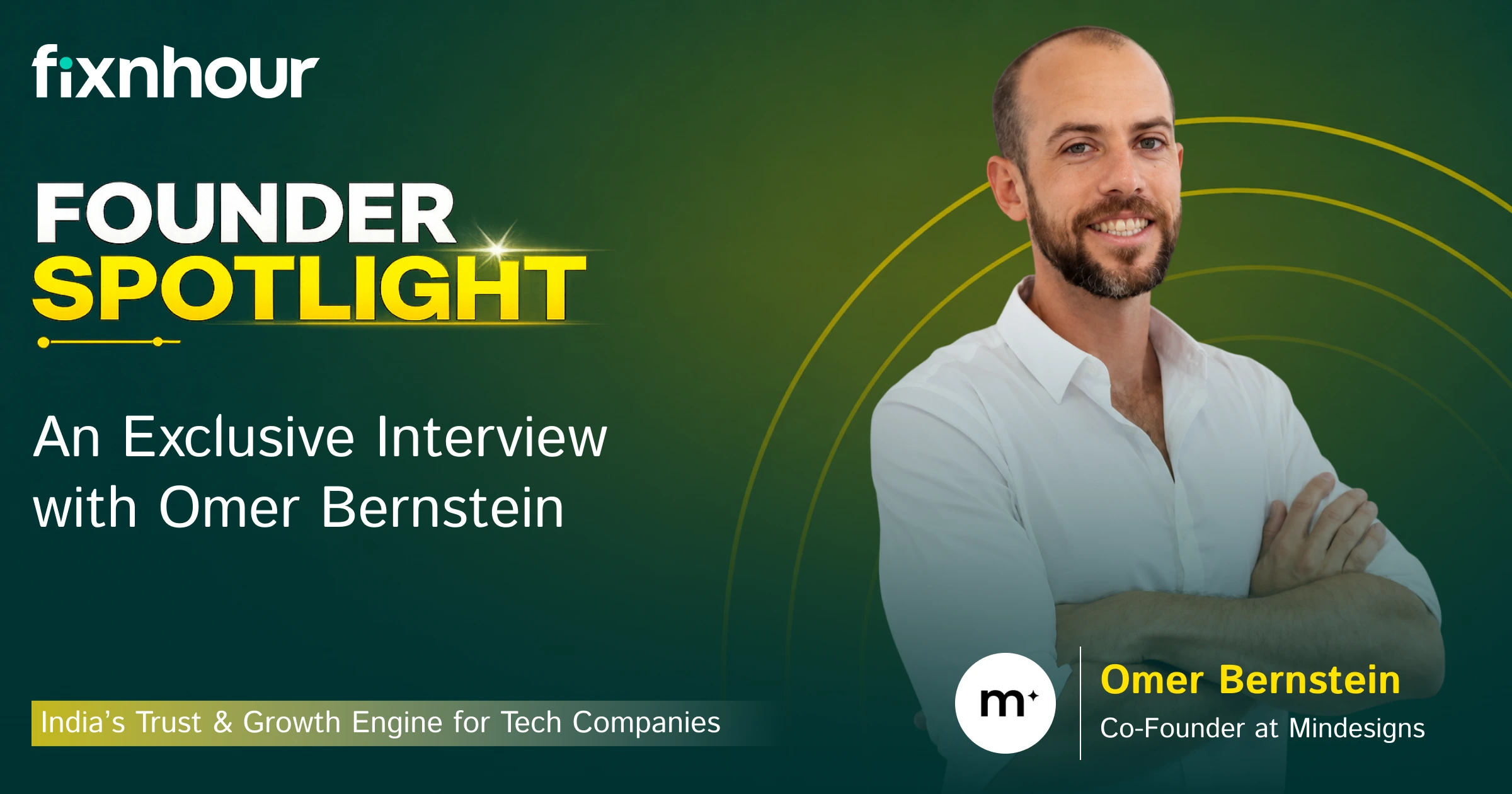
Innovation is never a single event; it's a process that is constructed in moments of experience, resilience, and the ability to find opportunities in challenges. As the co-founder of Mindesigns, co-director of the Impact10X Venture Builder Program, and founder-in-residence at James Cook University, he inspires entrepreneurs to turn innovative concepts into sustainable, high-growth businesses.
In this exclusive Fixnhour Founder Spotlight, Omer Bernstein provides a glimpse into his thoughts on venture building, strategic growth, regional innovation, and the skills and traits of successful founders. He provides a deeper understanding of why clarity, putting yourself in your customer's shoes, and executing consistently are critical to successful ongoing business ventures, both in the startup journey and in creating a successful entrepreneurial ecosystem in Queensland.
Key Takeaways
- Valuable lessons in leadership can be learned from any professional experience.
- World-class innovation is possible within regional communities.
- The founders must verify the problems before spending a lot of resources on finding a solution.
- Activity is not necessarily progress.
- Progress is made by steady, purposeful steps.
- The first step in strategic marketing is to understand a customer and position the product.
- AI should not be embraced for the sake of trends but for business outcomes.
- Purpose, trust, and contribution are essential to strong founder communities.
- Leadership should build capability, not dependency.
- Government-Academic-Industry-Founder partnerships bolster the innovation ecosystem.
- One of the greatest assets any leader has is clarity.
- Sustainable growth is created through linking strategy to action.
Who is Omer Bernstein?
Founders enter into their journey, with some starting in incubators or business schools or technology companies.Omer Bernstein's career started in a very different place.Omer worked on factory floors, in a kitchen, and then in the army before going on to become the co-founder of Mindesigns, the co-director of the Impact10X Venture Builder Program, and a founder in residence at James Cook University. These experiences seem like a world away from the venture building and start-up communities, but they were a vital part of the leadership philosophy in his current business life.Omer thinks that anything can be learned in any environment if you're curious enough. The factory gives discipline and process. The kitchen is a place that trains speed, teamwork, and action under pressure. Military service is a place where responsibility, versatility, and a sense of collective purpose are taught.
These lessons were a part of his entrepreneurial, leadership, and innovation development over the years.Omer's current work is in the fields of strategic marketing, venture development, founder education, and regional ecosystem growth. He supports organizations in accessing the sustainable growth system, enhancing customer experience, clarifying value, and improving positioning via Mindesigns. His portfolio covers strategy, branding, user experience, digital transformation, and performance marketing.Omer is a co-director at Impact10X, where he helps early-stage founders go from idea to a validated business model. It assists entrepreneurs in experimenting with their theories, grasping customer needs, creating viable business models, and building the momentum of their ideas with structured guidance, practical implementation, and impactful networking.As Founder-in-Residence at James Cook University, Omer supports the development of entrepreneurship in Queensland, especially in regional areas that may not have the networks and resources available in the major capital cities.
His work is rooted around a very basic yet powerful belief:Innovation doesn't have to be confined to world-class cities or established tech hubs. When gifted individuals are given the right support, structure, and opportunities, gifts can arise anywhere.One domain in particular that Omer is very passionate about is regional innovation, as he is aware that the challenges of founders in non-metropolitan regions are different. May not have access to investors, mentors, niche talent, and established startup networks. However, they are often more attuned to the kinds of problems that are meaningful to industry, and they have in-depth knowledge of their communities.Instead of Silicon Valley-izing, Omer enables regional entrepreneurs to create businesses that are unique to their strengths, industries, customers, and context.His thinking and approach is structured and action-oriented. He feels that a sense of urgency is essential for the founders. They require clarity, validation, accountability, and systems to help them get through step after step.He also feels that innovation ecosystems gain strength when government, academia, business, and entrepreneurs co-create and act in concert, not separately.Omer's goal is not just to make individual startups successful. It is to build networks that enable more founders to have access to knowledge, build connections, test concepts, and acquire the confidence needed to lead.In this exclusive Fixnhour Founder Spotlight, Omer Bernstein shares his unconventional journey, the lessons he has learned from working with founders, and why momentum isn't something entrepreneurs wait to receive but rather something they build.
Q1. Omer, your career began on factory floors, in kitchens, and later in the army. How did those experiences shape the leader you are today?
My formative experiences had a greater impact on me than I realized.Spending time on factory floors instilled an appreciation for systems, consistency, and the people working behind the scenes in the organization that keeps it running on a day-to-day basis. Read that strategy alone is not much good if it's not executed properly or if people who are executing it aren't supported.In a kitchen I learned a new type of discipline. Fixnhour time is of the essence, standards are of the essence, and everyone is relying on each other. Perfect conditions cannot be waited for. Clear communication, problem-solving at the moment, and keeping focus under pressure.The army re-emphasized the values of responsibility, flexibility, and unity. It brought me to understand that leadership is not about having the loudest voice. It's all about making sense of what's needed, clarifying, and assisting people to operate together.They were very different environments, but there was one thing they had in common: Every role was importantThis belief is something I carry with me when working with founders and teams today. I never take it for granted that the highest-ranking one knows everything. The best ideas are often from the people who are closest to the problem.Being a leader means listening, acknowledging other people's knowledge and experience, and making sure others feel comfortable sharing what they know.
Q2. What inspired you to move into entrepreneurship, strategic growth, and venture building?
It was a gradual transition.The more I read on the subject, the more I became fascinated with the reasons why some ideas take off and others languish. Many of the founders are smart, driven and committed, but have a poor ability to convert their vision into a business that customers can understand and support.I knew that the problem is not like it is often said, lack of ambition.Most frequently, it is the lack of clarity, structure, validation and the right people.A strategic marketing and venture building path was my next step after that observation.At its very best, marketing is more than just promotion. It is about customer understanding, value clarification and value communication.Venture building is even more profound. It involves supporting the founders with testing their assumptions, designing their business models, finding early traction, and making decisions under conditions of uncertainty.This is a type of work that I enjoy because it involves thinking about the strategy and then acting on it. You can be instrumental in guiding someone from a concept to a tangible, quantifiable and useful product.The change is so rewarding.
Q3. What is the vision behind Mindesigns?
Mindesigns was created with the principle that sustainable growth starts with clarity.There are plenty of businesses out there that invest in a website, advertising, or even branding before they have a clear idea of their value proposition or priorities.This usually leads to disjointed activity with little momentum.We start with understanding the business at Mindesigns.What is the issue it addresses?Who benefits most?What does it matter to the customer?What prevents growth?With those questions in mind, design and marketing can become much more powerful, since it's possible to have a targeted strategy.We combine strategy, user experience, branding, digital products, and performance marketing into one. It is not about creating activity for the sake of activity. It's to assist organisations in creating more powerful and sustainable growth systems and stronger customer relationships.We also feel that 1: Good design should make things easier to understand, if they are complex.A website, platform or campaign should empower customers to make informed decisions and not overwhelm them with information.In the end, Mindesigns is about strategy to execution. .
Q4. What is Impact10X, and what gap does the program aim to address?
Impact10X is a venture-building program aimed at accelerating the process of moving from idea to validated and viable business.Many startups fail because they fail to get things done.Many founder-entrepreneurs are not lacking in passion, but they're lacking in doing. They are struggling because they begin building before they grasp the problem, customer or business model.The structured environment at Impact10X allows founders to test out their assumptions, strengthen their positioning, create a better business model and generate momentum through actual implementation.Workshops, live events, mentoring, peer learning and strategic guidance.Its aim is not to give the founders instructions in what to do. It's to assist them in making their own judgements.Community is another significant aspect of the program.Being an entrepreneur can be lonely. It is common for founders to have uncertainty but without others who are empathising with the uncertainty.We bring founders together to foster opportunities for shared learning, accountability and collaboration.Ultimately, it's about removing guesswork and replacing it with evidence, and replacing isolation with a supportive ecosystem for founders.
Q5. Why are you particularly passionate about regional innovation in Queensland?
Regional communities are low on the radar.It is a well-known fact that innovation is only possible in large cities, or in a technology hotspot, if the city has a strong reputation for innovation. The belief that there is only serious innovation in large cities or in technology hubs with a good reputation for innovation is well known. I don't think that's true.There is the potential for regional communities to have extensive expertise in the area of agriculture, tourism, resources, healthcare, logistics, and education. People who live in these environments are aware of challenges that one not in them might not be aware of.The possibilities are huge.There are obstacles to regional founders regarding access to capital, specialist talent, mentors, networks, etc., and visibility.Our job is not to say to regional communities to be smaller versions of big cities. It is to assist them to create an ecosystem, around their strengths.That will take partnership between entrepreneurs, universities, government, existing companies and investors.Regional innovation can generate businesses that have relevance to the region and a global potential when these groups combine.I love the idea of helping create those pathways because talent is everywhere and opportunity is still not equally distributed.
Q6. What are the most common mistakes early-stage founders make?
The most common error is getting too attached to the initial idea.Often, founders put a lot of emotional effort into a solution but don't get to the point of understanding whether customers actually feel the same way.The objective should not be to prove the idea is correct.It should be to find out the truth.The other error is to construct prematurely before you need it.It can take months for founders to reach the number of customer conversations needed to come up with a full product. This results in waste and makes it difficult to maneuver around.The third error is that of thinking that activity equals progress.It can seem like something is accomplished when attending events, creating logos, posting content, and creating features; however, if it isn't anything that is helping the business become more productive or closer to revenue, then it isn't.Founders must have explicit assumptions, concrete experiments, and frequent reflection.Momentum is gained by learning and doing, rather than being busy.
Q7. You often say that momentum is created, not waited for. What does that mean in practice?
Sometimes, founders do not act until they have found the ideal investor, the ideal customer, the ideal co-founder or the ideal opportunity.But opportunity often comes after momentum has started.When it comes to building momentum, it's a case of "If you build it, they will come.Speak with customers.Test the offer.Develop a basic prototype.Ask for feedback.Create partnerships.Measure what happens.Information is generated in every small action and in turn, information enhances decision making.Confidence is also created through momentum. As founders start to show signs of others being interested in the problem, they can more easily attract customers, partners, and investors.Waiting creates uncertainty.Action creates clarity.This is not doing things in a rash and hasty manner. It's about creating small, deliberate experiments that enable the company to learn in a timely way.Founders don't feel totally prepared.What matters is to take the next logical step.
Q8. What role does strategic marketing play in startup success?
Strategic marketing can help the founder to gain insight into the value chain of their business and how they can communicate it.Often marketing is something the startup does after the product is created.Actually, marketing must affect the product from the outset.Customer research will give founders insights into what customers need, how they speak, what matters to them, and how they buy. Retelling is the placement that helps them to explain why their solution is relevant and different. Branding builds trust and recognition. Growth channels allow the business to consistently connect with the correct individuals.If there's no foundation, founders may waste money on the promotion of a message that the customer is not in tune with.There is a great deal more to strategic marketing than making the business look bigger.It's about putting value there so it is more noticeable.Clarity often outweighs creativity for early-stage founders.The customer should know what the business is and why it is important for them.The base is set, and creativity can boost it.
Q9. How should founders think about AI and digital transformation?
The very first step founders should take is not technology, but outcomes.Although AI is providing amazing opportunities, it is just a tool.But rather, “How do we embed AI?”The question is, "How can intelligence, automation, or more data enhance the customer experience or business model?”It's the same with digital transformation.Technology should eliminate friction, enhance decision-making, or generate new value. It is not to be adopted just because it is in fashion.Responsible use is also a factor that needs to be taken into account for founders.As AI increasingly infuses into products and operations, data privacy, transparency, security, and human oversight grow in significance.The best companies are NOT the ones utilizing the most technology.They will be those who make the most out of technology.
Q10. What have you learned about building effective founder communities?
Purpose gives the community a very strong sense of strength.It won't do to simply gather people. All members should know the purpose and role of the community.It's also crucial to trust.Founders must create spaces for them to be candid, to discuss problems (without everything being transactional).Curation also matters. Not always the goal is to build the biggest network. Its purpose is to bring together the correct mix of minds, attitudes, and objectives.Good communities foster contributions.Members exchange knowledge, introduce each other, give feedback and help each other during challenging times.The role of the facilitator is to set up structure but not to dominate all of the interactions.A vibrant culture sets a community in motion to create value.That's when it's an ecosystem, not just a series of events or a list of members.
Q11. What leadership principles guide your work with founders and teams?
One of the most critical leadership duties is to offer direction.When expectations, priorities, or purpose are not clearly defined, people are unable to perform well.I also feel that leadership is supposed to be more hands on.Yes, vision is important but what is important is also decisions, resources, and support to help people move forward.Humility is also of high value.Founders and leaders often don't have all the information. Listening, modifying assumptions and acknowledging uncertainty leads to improved decision making and team building.Also, I appreciate consistency.Trust is developed when people receive consistent behavior over time.Last but not least, leaders should develop capability, not dependence.It is not about having to be the person that everyone wants for all decisions. It is to help people to become confident, to have some good judgment and to take ownership.Effective leaders don't put themselves on every list.They enhance the team's strength.
Q12. What is your long-term vision for your work across Mindesigns, Impact10X, and JCU?
The future aim is to contribute to the development of a more robust and cohesive Queensland innovation ecosystem.I want to keep supporting companies to develop more understandable strategies, customer experiences, and sustainable growth with Mindesigns.The mission with Impact10X is to get more founders to test an idea, create a viable business model, and gain real momentum.I would like to help create a more conducive environment at JCU for the partnership of students, researchers, founders, industry leaders, and communities to function more effectively.There is a common cause between these roles.I want to make knowledge, networks, and real-world help more accessible for talented people.The number of start-ups launched will not be the only measure of success. It will be judged by more robust founders, stronger businesses, closer community relationships, and stronger regional communities in their capacity to innovate.
About the Founder
Omer Bernstein is a co-founder of Mindesigns, co-director of the Impact10X Venture Builder Program and founder-in-residence at James Cook University. He supports strategic marketing, venture building, founder development, digital transformation and regional innovation in Queensland.
Omer works with organizations using Mindesigns to enhance their strategy, branding, user experience and sustainable growth. He provides support to founders via Impact10X to validate ideas, design business models and build momentum. He supports entrepreneurship pathways and collaboration in the academic, government, industry, and regional communities at JCU.He is passionate about helping people grow, turning ideas into viable businesses and facilitating a more robust and connected innovation ecosystem.
Final Message to Founders
No need to wait for ideal weather.Clear problem, genuine curiosity and willingness to learn through action.Do not over construct until you have communicated with customers.Test the assumptions before defending them.Do surround yourself with people who will challenge and support you.Don't mistake attention for traction and activity for progress.Remember, above all, that momentum is created.Each interaction, experiment and decision can take the company forward.While it's often challenging to see the entire journey, you can nearly always find the next significant step to take.Take it.
Final Thoughts on the Founder
Omer Bernstein's experience shows that leadership is as much an acquired as a bestowed quality.He has practical knowledge of the interplay of people, systems, and ideas from factory floors, kitchens, military service, entrepreneurship, strategic marketing, and venture building.What really shines is the attitude that he demonstrates in fostering growth in others.
He works with organizations using Mindesigns to push strategy toward sustainable growth. At Impact10X, he assists startups in developing a profitable business model based on validated assumptions. He makes a contribution to improve the innovation pathways of the region in Queensland through his work at James Cook University.Omer's philosophy is not about waiting for the right time or permission.It is about clarity, collaboration, action, and the conviction that momentum is created through a series of deliberate steps.His work is a reminder that innovation ecosystems do not just happen. They are built by individuals who are open to linking together entrepreneurs, institutions, communities, and opportunity based on a common vision. Contact us today