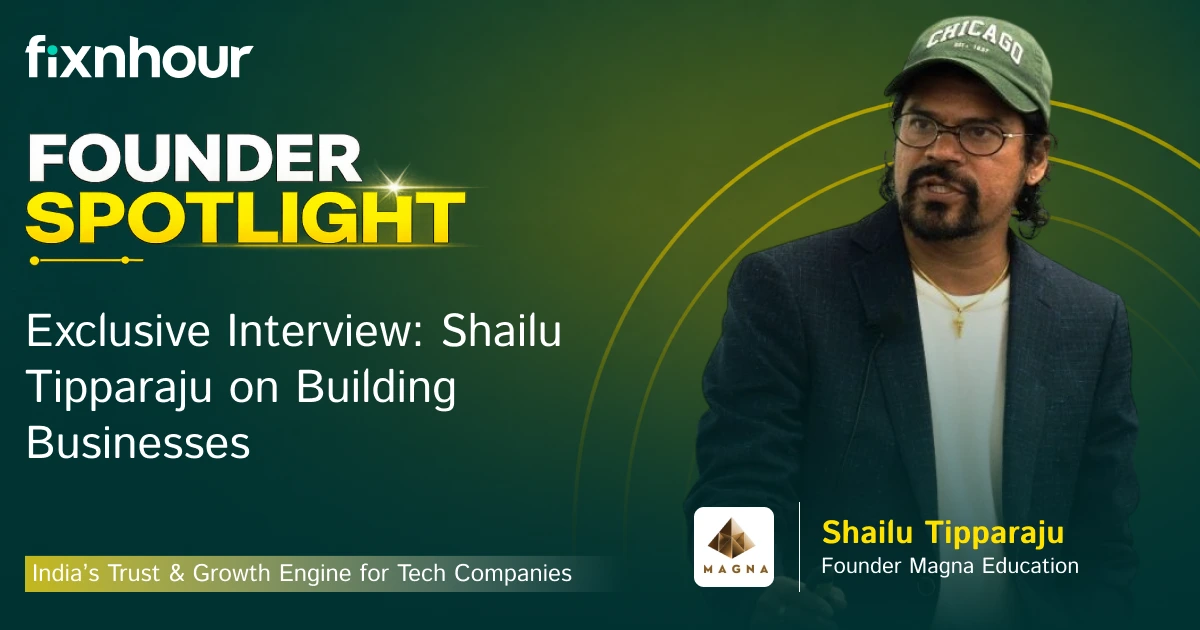
The success of Shailu Tipparaju's business ventures has not been defined as just a succession of companies but as institutions, communities, and leadership philosophies that will last long after the business successes. He is a fourth-generation EdTech founder, investor, educator, community architect, and author of Shailosophy who has been leading innovation in the United States, India, and the Gulf for over 25 years. His track record of three successful exits and more than $1 billion in enterprise value generation is a testament to his strategic business acumen and his long-term focus on making a difference.
In this special Fixnhour Founder Spotlight, Shailu shares with the community the experiences and principles that have guided his incredible journey from building fast-growing companies and investing in founders to building trusted communities around the world and championing institutional leadership. He explains the importance of entrepreneurship beyond valuation, how trust can become the backbone of enduring communities, and why success isn't defined by how long founders last in the business but by the systems, ideas, and opportunities they leave behind that continue to benefit others long after they've gone.
Key Takeaways
- Successful exits should leave more questions regarding contribution and legacy.
- Trust, neutrality, patience, and shared responsibility are the building blocks of community.
- All great founders are both convinced and intellectually honest.
- The best capital is when its components are complementary.
- Teaching should change capability and identity, rather than simply impart information.
- It's not a matter of scale; it's a matter of curation with strong founder communities.
- Governance needs to be designed ahead of the need for growth.
- Creativity enhances leadership through motivation, intuition, and emotional intelligence.
- Legacy is the development of people and institutions that go on without you.
- Capital should be used for something rather than being the thing itself.
- Leaders need to safeguard their identity from being made a great one by achievement.
- The most significant chapter could also start after a traditional success has been attained.
Who is Shailu Tipparaju?
Some start companies. Some start businesses. Others institutionalize community and create ideas that go beyond the initial transaction. Shailu Tipparaju is in the second category. As an investor, educator, community architect, and four-time founder of an EdTech company, Shailu has spent 25-plus years creating companies, scaling international communities, and creating leadership frameworks in the United States, India, and the Gulf. He has been an entrepreneur three times, with three major exits and the generation of over a billion dollars in enterprise value. Those results were his success in building and expanding businesses, but they also brought him to another question:
What should a leader create once they have demonstrated their ability to create successful companies? For Shailu, the solution is to establish institutions, communities, and philosophies that survive beyond any single transaction or business cycle. He has increasingly emphasized the development of peer communities in the fields of education, entrepreneurship, investment, and institutional leadership in the last ten years. His work has connected leaders via networks in Harvard, YPO, EO, TiE, the University of Chicago, and other executive ecosystems across the world.These communities are not just like any other networking communities. They gather together successful founders and investors, educators and institutional leaders, all of them with varying priorities, perspectives and responsibilities. Trust in this kind of context can't be built with mere visibility. It should be achieved through neutrality, careful stewardship, strategic patience, and a common purpose.
Today, Shailu is a Founding Trustee of the National India Hub, one of the most exciting cultural and civic efforts of its kind in the United States, a Venture Partner with Emerge Education Ventures and Dallas Venture Capital, and a member of the YPO Board.He is also the founder and leader of Magna Education, an infrastructure for selected founders, and author of Shailosophy, a philosophy of leadership, identity, legacy, love, life purpose, and the architecture of a meaningful life, based on over 4000 original reflections.Shailu's journey is unique in uniting seemingly disparate worlds.In the classroom, he finds a purpose.His principles are put to the test in the boardroom.The quill concentrates his thoughts.He spends his time on cross-border capital allocation, building community in the institutional world, developing his own as a founder, and expressing himself as a writer, painter and musician.S. Chicago-based, Shailu operates around the world – in India and the Gulf – where entrepreneurship, education, investment, community and creativity are no longer distinct endeavors. To him, they're all a part of his life-long responsibility: creating value that transcends the creator.
1. Shailu, you have built companies, achieved major exits, and created substantial enterprise value. What shaped your entrepreneurial journey?
My entrepreneurial path had as little to do with one big moment and as much as to do with a series of curious, responsible, and repeated reinventions. Fixnhour I’ve always been fascinated by the process of ideas turning into institutions. It's exciting to build a company because you need to gather vision, people, capital, systems, and execution. However, sustainability is more than just a construction approach; it is a philosophy, a commitment, and a way of doing business. It needs a governance dimension, a cultural element, the right time, a spirit of modesty, and a decision-making ability before you have certainty.In the past twenty-five years, I have been able to start several businesses, including in the education and technology sectors. Those travels resulted in three major exits and has added an enterprise value greater than $1 billion.Numbers are important because they show something to be built, scaled, and market valued for some reason. However, the underlying teaching was not monetary. The exits were the part that made me learn about governance, succession, institutional discipline, and building institutions that can work without a founder's supervision.Entrepreneurship also taught me the questions you ask change when you're successful.The founders ask, “Can this work?” in the beginning.After that, they ask, “Can this scale?”At a later stage, if they are lucky, they ask, “Can this be my responsibility?”The last question has been the focus of much of my work.
2. After achieving three exits, why did your focus shift toward building things that outlast transactions?
Sometimes an exit is described as the great entrepreneurial success. It's definitely a major landmark, but not a full-fledged definition of success.An exit is proof of economic value creation. Does not necessarily imply that the founder was responsible for creating sustainable human, social or institutional valueOnce I had exited, I was left with wondering what was left after the deals were done. The financial results were significant, but the people, the cultures, the leadership and the communities that were built in the process were often more valuable.This prompted me to think about another one:What can we make that will keep producing value when ownership changes, leadership changes or markets change?Institutions, communities, education and leadership philosophies have that potential.Can pass down values to generations.They can connect with others that might not otherwise meet.They can fill in the gaps if the leaders leave.However, commercial success isn't a non-issue. It is undeniable that sustainable institutions need to have good economics. However, money should not be the end all be all – it should be a means to a goal.This is a chapter of Stewardship in my life. It's about leveraging experience, access, capital and trust to contribute to the creation of structures that can continue to serve people for many years after I am gone.
3. You describe yourself as a community architect. What does community architecture mean to you?
Community Architecture is a conscious design of relationship, trust, shared identity and collective action.People often use the words community, audience or membership or networking interchangeably with each other. An audience listens. Contacts are shared among a network. A community is responsible for each other.A strong community is not one that has many people in a room. It is characterized by the level of trust they have in each other.Community architecture involves consideration of who belongs in the community, why they belong, what values unite the community and what behaviours are rewarded. It also demands the knowledge of the natural conflicts that occur when two successful, autonomous individuals occupy the same room!High stakes leadership groups have participants with experience, influence, and opinions. The architect is not supposed to take over the space. Its purpose is to establish a level of trust, neutrality, and common purpose such that the room is smarter than the people in it.The best communities are crafted to make members contributors, not consumers.They're not just asking “What can I get?”They start to ask, "What can we make together?That's the building block of institutional community.
4. You have brought together leaders across Harvard, YPO, EO, TiE, UChicago, and other global networks. What have these rooms taught you about trust?
Trust does not just happen, particularly in a room with great leaders.The respect of people can be gained with professionalism, but trust will take time. It fosters through consistency, neutrality, fairness, and demonstrated neutrality.One of the most valuable tips I've received is to trust when they feel that there are no hidden agendas in the room.Leaders are very attuned to manipulation. They immediately see through a community that is being set up to sell, promote, influence or to gain value from them.The importance of neutrality.A community architect must be able to preserve the integrity of the room, even if this means doing something inconvenient. It should not be based on personal ambition, vested interests or on a power base. They should be directed by the long-range wellness of the institution.Patience is also essential.Artificially close relationships cannot quicken the process of trust. Time is needed to see each other, to feel regular, and to slowly start to be vulnerable.The best communities are slowly constructed.
5. What have entrepreneurship and investing taught you about identifying exceptional founders?
Great founders are not so exceptional as to have charisma; they are more extraordinary because of their relationship with reality.They seek for success but they are not uninformed.They can present a good vision but are also ready to adjust their beliefs when the data require it.I also pay special attention to the attitude founders have toward people. An entrepreneur could be super good at product or sales, but if they're not good at building trust, hiring talent and developing a healthy leadership culture, the business will eventually hit a ceiling.Intellectual honesty is another important quality.Is it possible for the founder to admit what he or she doesn't know?Are they able to talk about the issue without being defensive?Are they able to distinguish themselves from a certain approach?The best founders are very clear about the mission and willing to be open to the approach.I also have a strong appreciation for stamina. Entrepreneurship has long spells of work without reward. The problem is that when founders are solely relying on external validation, they find themselves in trouble during these stages.Exceptional founders have internal conviction, but have the qualities of humility and learning.
6. How do you think about cross-border capital allocation across the United States, India, and the Gulf?
Cross-border capital allocation needs more than just an understanding of markets. It involves being culturally aware, having the right governance, right timing, trust and institutional maturity.The United States, India and the Gulf provide all the possibilities, yet their business cycles and dynamics are quite different.The United States has established, mature capital markets, extensive institutional knowledge and solid base for global scaling.India has unparalleled entrepreneurial drive, technical skills, market size and a maturing innovation ecosystem.The Gulf is rushing forward with capital, ambition, infrastructure and a long-term vision for change.Moving money from one place to another is just the beginning of the opportunity. It's about melding complementary strengths.There may be a technical depth and capability of execution in the hands of the founders in India.A partner in the gulf can provide strategic access, infrastructure and market acceleration.The investor/institution has the potential to invest "governance, network and global scale.If these connections are carefully planned, cross-border sources of capital are much more than just loans. It turns into an architecture for common development.
7. As a four-time EdTech founder, how has your view of education changed over the years?
I have shifted from being an education provider, to a provider of capability, identity and transformation.There is plenty of information available. The ability to reach lectures, courses, books and knowledge from experts is simpler than ever.Access to information is not the real challenge.It's assisting people to turn information into judgment, confidence, behavior, and intent.Schools should not just train individuals to pass exams or to do a certain task. It should enable them to understand themselves, think critically, communicate clearly, work collaboratively and make decisions wisely in uncertainty.Technology can enhance access, personalisation, assessment and scale. However, education is still fundamentally human, as there is a need to encourage, reflect, be held accountable to and to belong in order to be transformed.The strongest learning communities are educational communities.Individuals learn best when they are supported, challenged, and seen.I still believe that and it is a part of my teaching and founding communities.
8. What is Magna Education, and what gap are you trying to address through it?
Magna Education is being built as an infrastructure to support the selection of founders.Most founders have access to content, online communities and general networking events. What they typically lack is a safe space to think honestly, meet with other peers of equal levels of commitment, and have relationships that go beyond networking by doing deals.The aim is to cultivate the biggest founder community, not.The goal is to develop one that is deep, aligned, and valued for the long term.The quality of a community is largely dependent on the quality of its members; therefore, curation is important.Developing as a leader and steward is as important as building a company; we want those who are doing both.The platform combines education, peer learning, strategic relationship building, leadership reflection and access to a wider institutional landscape.The goal is to nurture founders who create companies that are economically viable, ethically robust and institutionally sustainable.
9. You have written more than 4,000 reflections through Shailosophy. What inspired this body of work?
Writing first was a self-initiated endeavor and then became a collective body of work.As always, I've learned through reflection, understanding experience. Questions fueled by entrepreneurship, relationship, leadership, love, loss, identity, ambition and legacy can be asked in the board room but not always.When I write I slow down and ponder the questions seriously.Shailosophy came after thousands of reflections over the years. These are never meant to be set in stone. They are calls to examine and challenge the assumptions and assumptions and delve into the underlying structures of a life well lived.Much research in the field of leadership tends to be performance, productivity and outcome oriented. Those things are important, but leaders are also humans who are feeling belonging, fear, family, meaning, mortality and identity.Otherwise, we can end up being very effective at creating lives we don't want to live.Shailosophy: My way of achieving and being aware.
10. You often speak about identity and legacy. How should leaders think about legacy without becoming driven by ego?
Legacy can be problematic if it is used as a tribute to the self.The healthier form of legacy is giving back, a giving that does not require ongoing attention.Leaders should reflect whether the people, systems, institutions and ideas they leave behind are stronger because they were present.Were they leaders or followers?Have they developed dependency or competence?Did they build a control or a sharing of responsibility?Did they leave fear or did they leave confidence?Real inheritance is sometimes understated.It is there when you have helped people make decisions, in the institutions that continue to support values even after your time, and in communities that go on serving others without your name on each service.It is paradoxical that leaders do the best work when they're the least concerned with being remembered.They instead concentrate on making the work worthwhile to continue.
11. What role do art, music, and painting play in your life as an investor and institutional leader?
I stay whole through creative expression.Analysis, judgement, negotiation, responsibility are the key traits of leadership and investing. Art develops another type of intelligence. It lets the emotion, intuition, ambiguity and beauty in.Painting is a lesson in patience and observation.Music is the art of rhythm, silence and harmony.Writing teaches clarity.These practices remain interwoven into leadership practices. They deepen it.A leader who has only developed analytical intelligence can become effective but narrow-mindedly. Creativity expands perception. It makes us aware of data that we could not otherwise see.Art also guards against losing one's identity to one's success.We exist beyond titles, companies, boards and investments.This is brought to our mind by creative practice.
12. What leadership principles have remained constant throughout your twenty-five-year journey?
A number of guiding principles have been constant.Trust beats capital.Capital is great, but trust is greater.Second, before people think they need governance, it matters the most.Third, culture is the result of what leaders tolerate as well as what they say.Fourth, size makes a difference in good as well as bad.Fifth, leaders need to allow for "truth" to be present. When one cannot tell you the truth, then your authority is a liability.But I think it takes discipline for a leader to be able to think of things that are seemingly opposite without having to fight against one another.Be bold and persistent.Be brave and inquisitive.Construct quick and manage prudently.Make value, don't seek applause.Being a good leader isn't always the choice of one extreme. It's how to stay balanced as you go forward.
13. What advice would you give founders who are currently focused entirely on growth and valuation?
In valuation, there are options and growth is important. But neither should be a substitute for building a healthy company.Founders should focus on defining the quality of revenue, strengthening governance, building a healthy culture, ensuring the longevity of customer trust, and nurturing the leadership team.But a high valuation can sometimes conceal bad foundations.It is not true that just because people are excited about a market it means they are strong because of it.Create systems ahead of the need.Groom leaders before your organisation outgrows you.Don't risk your reputation as it will go farther and stay longer than any pitch deck.Above all, know that the business is a part of your life. It shouldn't eat up all of who you are.Construct with confidence, be human.
14. What are you trying to build in this chapter of your life?
This chapter is centred on stewardship.I want to invest wisely, support the creation of sustainable institutions, foster cross-border community building, and further develop ideas under the aegis of Shailosophy.I'm growing more interested in work that bridges the gap between business and education, identity, culture, and civic responsibility.Just building something valuable is no longer the question.It's about how we can create value-creating systems that can renew themselves.That means being a part of the building of the trusted communities, the strengthening of the institutions, support for the founders, and making a contribution to cultural infrastructure like the National India Hub.I am hoping this chapter would bring the boardroom, classroom and the quill together.I find purpose in the classroom.In the boardroom, I find out if my principles will hold up in the real world.The quill helps me to make sense of the experiences.As a whole, they create the structure of the work that I hope will transcend me.
About the Founder
Shailu Tipparaju is an investor, educator, community architect, four-time EdTech founder, and author of Shailosophy. During his twenty-five years of entrepreneurial activity in the United States, India, and the Gulf, his businesses have exited on three occasions and created over a billion dollars in enterprise value.
He is currently a Venture Partner of Emerge Education Ventures and Dallas Venture Capital, is a member of the YPO Board and a Founding Trustee of the National India Hub in the United States. He also serves as the lead for Magna Education, an infrastructure for the selection of founders, and remains developing the work of Shailosophy through over 4,000 original reflections on leadership, identity, legacy, love, and the architecture of a well-lived life. Shailu works primarily in the field of cross-border capital allocation and institutional development of communities, with a particular interest in founder development, education, and writing, painting, and music in general. She is based in Chicago and serves clients throughout India and the Gulf.
Final Message to Founders and Leaders
Construct the company but not the individual who is constructing the company. Copy the scale and learn what it expands to. Get funds in place; don't lose the power of decision. Develop communities; preserve trust. Go for success, but not as defined by the world. An exit can close a chapter but should open a deeper question: What will you create now to demonstrate value beyond value? The best work comes after the point where "achievement" no longer seems sufficient. Build what matters. Build what serves. Construct that which can go on without you. That's how success turns to stewardship, and stewardship becomes a legacy.
Final Thoughts on the Founder
But as Shailu Tipparaju's story illustrates, there is a phase of transition that many successful founders eventually face: from ownership to stewardship.His 3 big exits and his role in creating over a billion dollars in enterprise value are testament to his ability to build companies at scale. But the more interesting aspect of his life story lies after his accomplishments.When it came time to redefine himself, Shailu focused on institutional change, peer communities, cross-border capital, education, civic infrastructure, and philosophy.
The best entrepreneurship might not involve the creation of companies. It might be building up individuals, organizations and ideas that can create value without the founders.He is still working with investors, global leadership networks, Magna Education, the National India Hub, and Shailosophy towards the possibility of ambition and reflection, purpose and capital, and stewardship and leadership.As he discovered, there is a valuable lesson for founders at all stages in his journey:Creating something of value is a success.A legacy will be something that you leave behind that will last beyond your life. Contact us today