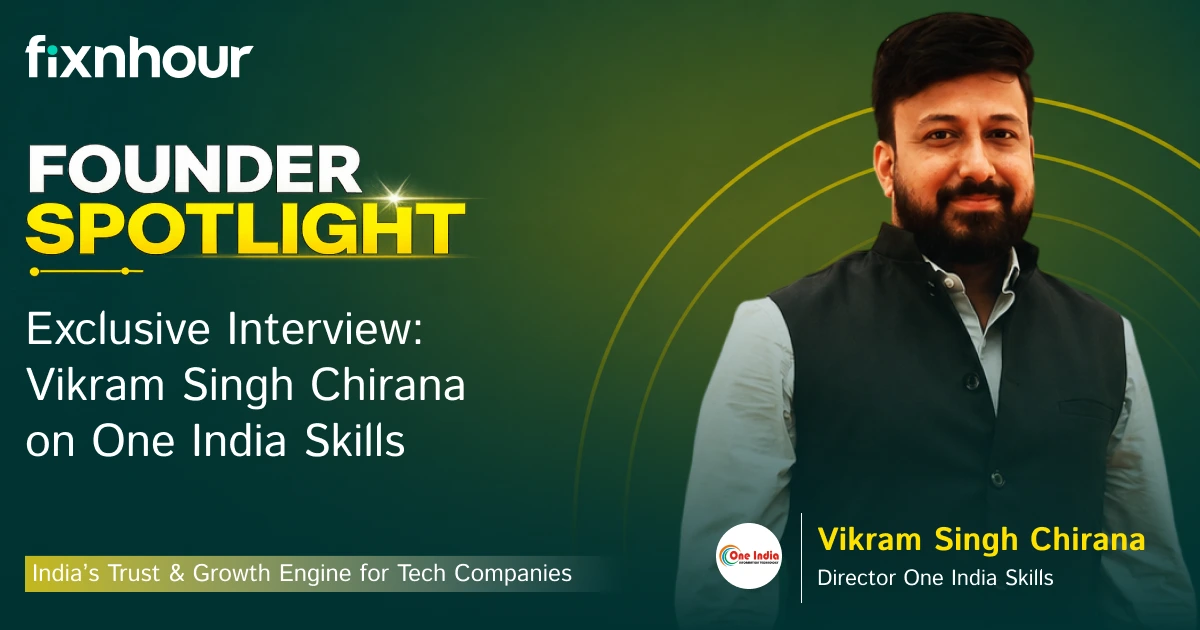
The need for skilled and industry-ready professionals is more critical than ever as India moves towards a technology future. Traditional education is important, but practical skills, digital expertise, and ongoing learning are critical for success in the long term. This is the vision behind bridging the gap between education and employability, which is the mission of One India Skills by its visionary founder, Vikram Singh Chirana.
Vikram Singh Chirana has over 15 years of experience in skill development, vocational education, IT services, and workforce transformation and has been committed to ensuring people have the skills to face the future. As a part of One India Skills, he is supporting students and professionals to acquire practical knowledge, adapt to the new technologies, and create a sustainable career path suitable for the changing needs of the industry.
Who is the Vikram Singh Chirana of the film?
India is one of the youngest population in the world, but its best opportunity is not just being young but being equipped with the right skills.The era of traditional education simply isn't sufficient in the face of a changing industry that's driven by artificial intelligence, automation, digital transformation and new technologies. Organizations are seeking adaptable employees who can troubleshoot and solve problems, and who can make a contribution from the start.It was this challenge that encouraged Vikram Singh Chirana to create One India Skills.
Vikram has been in the field of education and employability for more than 15 years with a strong background in skill development, vocational education and project management in the IT sector. His goal is not just training people, buto build sustainable careers, to consolidate industries and to have a positive impact on the economic development of India by creating a skilled workforce.In his tenure, One India Skills has transformed into a practical learning platform, digital skills platform, vocational education platform and Industry-based training platform. By leveraging partnerships, new pedagogies and technology driven learning, the organization is equipping learners and professionals with the skills for tomorrow's jobs.In his exclusive Founder Spotlight with Fixnhour, Vikram tells all about his entrepreneurial journey, his vision for skill landscape in India and why continuous learning is the best career investment these days.
Q1.Vikram, before we discuss One India Skills, tell us about yourself. What inspired your entrepreneurial journey?
I've always thought that education was a meaningful enterprise if it provides opportunities.In the beginning of my career, I noticed that a lot of the talented people had academic qualifications but lacked the necessary skills to be successful in the workplace. Meanwhile, companies were facing difficulties in finding highly trained employees, amidst a large pool of employees.This disconnection, this gap, was what sparked my creativity.I wanted to build an organization that can fill this void with skill development that's real, industry-relevant, and accessible.
Q2. What inspired you to establish One India Skills?
Entrepreneurship for me has always been about creating impact and not just business; both are distinct because the former is the outcome of the latter.Entrepreneurship is creating impact, and not just building a business, both are distinct because the former is the product of the latter.
Q3. How has the skill development landscape changed over the past decade?
It was a simple observation that led to the idea.India has a lot of talent but talent is not a job.However, industries change quickly, and educational institutions don't always keep up with the evolving needs of the market.This is the reason that One India Skills was founded to train people to acquire job-ready skills that match industry needs.Our goal is to equip learners for potential career opportunities of the future as well as the ones of today.We believe that skills build confidence, confidence builds opportunities, opportunities transform lives!
Q4. What skills do you believe will define the future workforce?
The change has been astounding.In the past, technical knowledge would often have been enough.Employers are currently seeking professionals who can possess technical skills and have an ability to communicate, adapt, be tech-savvy, think critically, and be able to learn continuously.Technology has also reshaped the approach to delivery of education.Quality education is more accessible than ever before through online learning, virtual classrooms, AI-powered platforms and digital assessments.The most important change is however, the mindset of the one making the change.It is becoming more evident that learning does not stop after graduation it moves on with their careers, and learning outside the classroom is encouraged.
Q5. What skills do you think will be required in the future workforce?
Lifelong learning is the way of the future.Technical skills will still be relevant, but must be coupled with problem-solving, communication, collaboration, leadership, emotional intelligence and adaptability.While many repetitive tasks will be automated by Artificial Intelligence, human creativity, innovation and decision making will be even more valuablePeople who are constantly learning new skills will stay relevant in the face of change.Knowing how to learn rapidly and effectively will be one of the greatest competitive edge.
Q6. How does One India Skills ensure practical learning rather than theoretical education.
The struggle of Education and Industry is one of the most significant issues.A lot of students finish courses without getting enough practical experience.The other difficulty is awareness.Many people tend to think they don't need to continuously invest in themselves until they reach a ceiling they should not hit.There is a need for improved linkages between the education and industry, government and industry, and education and training organizations.The combined effect is greater when everyone is involved.
Q7. How is Artificial Intelligence changing skill development?
We are practical.The preparation for work should be for real work, not for tests.We plan learning experiences based on industry requirements, practical activities, project based learning, digital tools and professional development.The goal is to develop confidence in addition to competence.Employers like hiring someone who can get to work right away, and real-world learning is a part of that.
Q8. What advice would you give students and young professionals entering today's job market?
AI is revolutionizing the world of education in incredible ways.The learning experience is increasingly individualised.Students are able to get immediate feedback.Progress can be used to inform adaptations of training programs.Meanwhile, AI has become a must-have tool.No matter the field, it is essential that professionals know how to interact with the intelligent technologies and how they impact their work.The future is not one of competing with AI.It's a matter of learning to work with it.
Q9. What leadership principles have guided your journey?
Never stop learning.Although your degree will open the first door, your skills will determine where you go from there.Practice, practice, practice.Develop communication skills.Become an avid learner of new technologies.Learn continuously.Things are always changing in the workplace, and anyone willing to learn will find new opportunities.Those who are flexible will be successful.
Q10. How important is founder credibility and trust in education?
Empowerment is the key to leadership.When you can make someone better, you have done the best thing in your life.I also have a penchant for consistency.They have to keep going and going to make a difference, not just once every while.Each one of the learners we assist is a chance to build stronger families, industries and communities.It's the purpose that drives us to do it every day!
Q11. How vital is trust and credibility for the education business?
All teaching is trust based.Pupils pour their time, money and dreams into the school.The organizations should fulfill that responsibility.The visibility of the founder will clarify the mission, values and commitment of an institution.The platforms such as Fixnhour are playing an important role in giving credibility to the stories that the founders tell, and not just the marketing ones.Trust is built when you are transparent and results are consistent.
To readers, then:
The world is moving at a speed that it has never been moving before.The best investment you can make isn't in technology.It is in yourself.Keep learning.Keep adapting.Keep improving.Confidence, opportunity and long-term success are built on skills.Any time you start, learning will keep opening up opportunities.Education is not a course; it's about lifelong learning.It's about getting ready to grow for life.Contact us today.