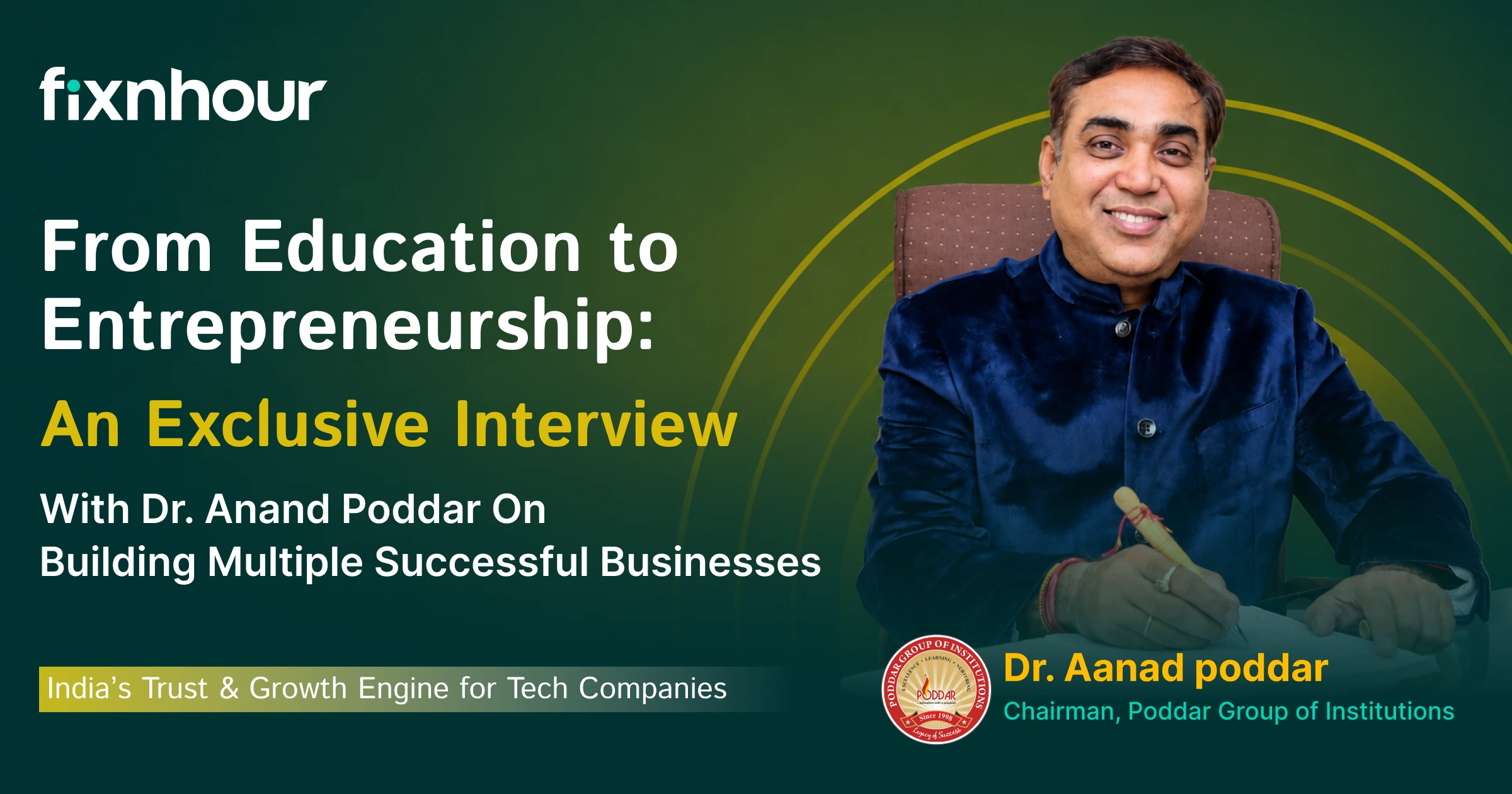
Success is often built on a combination of vision, determination, and the courage to explore new opportunities. Dr. Anand Poddar is a remarkable example of this journey. Known for his contributions to the education sector, he has successfully expanded his expertise into entrepreneurship, building multiple thriving businesses while continuing to inspire students and professionals alike.
In this exclusive interview, Dr. Anand Poddar shares valuable insights from his journey, the challenges he faced, and the lessons he learned along the way. From managing educational institutions to leading successful business ventures, his story highlights the power of innovation, leadership, and continuous learning. His experiences offer inspiration for aspiring entrepreneurs looking to create meaningful impact and long-term success.
Q1. Can you briefly introduce yourself and tell us about your journey from education to entrepreneurship?
My journey has always been driven by a desire to create meaningful impact. I started my professional career in the education sector because I strongly believe that education is the foundation of personal and societal growth. Over the years, while working closely with students, parents, and professionals, I gained valuable insights into people's needs, aspirations, and challenges.
This exposure inspired me to explore entrepreneurship. I realized that business is not just about generating profits; it is also about solving problems and creating opportunities. What started as a single venture gradually expanded into multiple businesses across different sectors. Each business was built with the same core values I learned in education discipline, innovation, and continuous learning.Today, I see myself as both an educator and an entrepreneur, because both roles focus on creating value, empowering people, and contributing to society in meaningful ways.
Q2. What inspired you to establish and manage multiple successful businesses alongside your role in the education sector?
The inspiration came from observing real-world challenges and identifying opportunities where meaningful solutions were needed. Through my work in education, I interacted with thousands of students, parents, and professionals from different backgrounds. These interactions gave me a broader understanding of market needs and emerging trends.
I have always believed that entrepreneurship is about creating value. Whenever I noticed a gap in a particular industry, I saw it as an opportunity to contribute through innovation and better services. Rather than limiting myself to one field, I chose to explore multiple sectors where I felt I could make a positive impact.Managing multiple businesses certainly comes with challenges, but it also allows me to diversify my learning and experiences. Every venture teaches something unique. The lessons from one business often help improve another, creating a cycle of continuous growth, innovation, and improvement.
Q3. How has your experience as an educational leader influenced your business decisions?
My experience in education has shaped nearly every business decision I make. Education teaches patience, leadership, problem-solving, and the importance of long-term thinking. Unlike many business environments that focus only on short-term gains, educational leadership emphasizes sustainable growth and continuous development.Working with students taught me the value of listening carefully and understanding individual needs. I apply the same principle when dealing with customers, employees, and business partners. Every successful business must understand the people it serves.
Education also helped me develop strong organizational and leadership skills. Managing institutions requires strategic planning, team coordination, and adaptability—qualities that are equally important in entrepreneurship. Most importantly, education taught me that success comes from empowering others. Whether in a classroom or a boardroom, helping people grow ultimately creates stronger organizations and lasting success.
Also Read: Exclusive Interview: Vijay Singh Discusses FixnHour’s Future Plans
Q4. What was the biggest challenge you faced when starting your first business, and how did you overcome it?
Like many entrepreneurs, one of my biggest challenges was dealing with uncertainty. When you start a new business, there is no guarantee of success. Questions about funding, market acceptance, competition, and operational management can create significant pressure.In the early stages, I faced moments where resources were limited and progress seemed slower than expected. However, I never viewed challenges as obstacles. Instead, I treated them as learning opportunities. I focused on understanding the market, building strong relationships, and continuously improving my services based on feedback.
Patience played a crucial role in overcoming these difficulties. Success rarely happens overnight. By maintaining consistency, staying committed to my vision, and making informed decisions, I gradually built trust and credibility. Looking back, those initial challenges became valuable lessons that prepared me for managing larger and more complex business ventures.
Q5. How do you balance responsibilities between running educational institutions and managing multiple business ventures?
Balancing multiple responsibilities is never easy, but I believe it comes down to effective time management, clear priorities, and building strong teams. One lesson I learned early in my journey is that success cannot be achieved alone. Having capable and trustworthy people around you makes a significant difference.
I dedicate time to strategic planning and ensure that every organization has clear goals and processes in place. Delegation is also very important. As a leader, my role is not to handle every small task but to empower others to take ownership of their responsibilities.At the same time, I stay actively involved in key decisions and regularly communicate with my teams. Maintaining a balance requires discipline and adaptability, but when your work is driven by passion and purpose, managing multiple roles becomes both rewarding and fulfilling.
Q6. What key lessons have you learned from entrepreneurship that every aspiring business owner should know?
One of the biggest lessons I have learned is that entrepreneurship is a marathon, not a sprint. Many people focus on quick success, but sustainable growth requires patience, consistency, and continuous learning. Challenges are inevitable, and every setback carries a valuable lesson.Another important lesson is the importance of relationships. Whether it is customers, employees, partners, or mentors, strong relationships are often the foundation of long-term success. People do business with those they trust.
I have also learned that adaptability is crucial. Markets change, technologies evolve, and customer expectations shift. Entrepreneurs who are willing to learn and innovate are the ones who stay ahead.Most importantly, success should never be measured only by profits. Creating value, solving problems, and making a positive impact are what truly define a successful entrepreneur.
Also Read: Exclusive Interview: Sandeep Yadav on Fixnhour’s Growth & Future Plans
Q7. Which of your business ventures has been the most rewarding, and why?
Every business venture holds a special place in my journey because each one has taught me something unique. However, if I had to choose the most rewarding experience, it would be my involvement in the education sector. Education has given me the opportunity to directly influence lives and contribute to the growth of future generations.
There is a unique satisfaction in seeing students achieve their goals, build successful careers, and become responsible members of society. Knowing that your efforts have played a role in someone's success is incredibly fulfilling.At the same time, my business ventures have allowed me to create jobs, support economic growth, and introduce innovative solutions in different industries. The combination of educational impact and entrepreneurial success has made the journey truly meaningful and rewarding beyond financial achievements.
Q8. How do you identify new business opportunities in today's competitive market?
I believe that opportunities are often hidden within challenges. Whenever I observe a problem that people frequently face, I start thinking about possible solutions. Listening to customers, studying market trends, and staying updated with industry developments are essential parts of my approach. I also pay close attention to emerging technologies and changing consumer behavior. Markets evolve rapidly, and businesses must evolve with them. Rather than following trends blindly, I focus on understanding whether a particular opportunity can create genuine value for people.
Research plays an important role, but intuition and experience also matter. Over the years, I have learned that successful opportunities often come from recognizing unmet needs before others do. The goal is not simply to start another business but to build something that solves real problems and delivers meaningful results.
Q9. What role does innovation play in the growth and success of your businesses?
Innovation is at the heart of every successful business. In today's fast-changing world, standing still is not an option. Businesses that fail to innovate often struggle to remain competitive. Innovation does not always mean creating something completely new; sometimes it means improving existing processes, enhancing customer experiences, or finding more efficient ways to deliver value.
I encourage my teams to think creatively and remain open to new ideas. We constantly explore ways to improve our services and adapt to changing market demands. Innovation helps businesses stay relevant and build stronger connections with customers.Most importantly, innovation creates opportunities for growth. It allows organizations to expand into new markets, develop better solutions, and maintain a competitive advantage. For me, innovation is not a one-time effort but a continuous mindset.
Q10. How do you build and lead high-performing teams across different organizations?
Building a high-performing team starts with selecting the right people and creating an environment where they can thrive. Skills are important, but attitude, commitment, and willingness to learn are equally valuable. I always look for individuals who share the organization's vision and values.As a leader, I believe in empowering people rather than micromanaging them. When team members feel trusted and respected, they perform at their best. Open communication, continuous learning, and recognition of achievements are essential elements of a strong workplace culture.
I also encourage collaboration and accountability. Every team member should understand how their contribution impacts the overall success of the organization. When people work with a shared purpose and feel motivated to grow, extraordinary results become possible. Great teams are built on trust, respect, and a commitment to excellence.
Q11. What are the common mistakes young entrepreneurs should avoid when starting a business?
One of the most common mistakes young entrepreneurs make is expecting immediate success. In reality, building a successful business takes time, patience, and consistent effort. Many people become discouraged when they do not see results quickly and give up too soon.Another mistake is neglecting proper planning. Passion is important, but without a clear strategy, even the best ideas can struggle. Entrepreneurs should invest time in understanding their market, customers, and competition before launching a business.
I also believe that many young business owners hesitate to seek advice. Learning from mentors and experienced professionals can help avoid costly mistakes. Finally, entrepreneurs should never stop learning. The business world changes constantly, and those who remain curious, adaptable, and open-minded are far more likely to achieve long-term success and sustainable growth.
Q12. How do you stay motivated while handling multiple businesses and leadership responsibilities?
For me, motivation comes from purpose rather than profits. Every business I am involved in has been created with a vision to solve problems, create opportunities, and contribute positively to society. Whenever challenges arise, I remind myself of that larger purpose.I also find motivation in people. Seeing employees grow professionally, students achieve their goals, and customers benefit from our services gives me immense satisfaction. Their success becomes a source of inspiration for me to keep moving forward.Another important factor is continuous learning. Every day brings new experiences, challenges, and opportunities. Instead of viewing difficulties as obstacles, I see them as opportunities to improve and evolve. Maintaining a positive mindset, staying connected to my goals, and surrounding myself with dedicated people helps me stay motivated even during demanding periods.
Q13. What trends do you see shaping the future of education and entrepreneurship in India?
India is entering an exciting phase where education and entrepreneurship are becoming more interconnected than ever before. One of the biggest trends is the growing adoption of technology. Digital learning platforms, artificial intelligence, and skill-based education are transforming how students learn and prepare for their careers.
At the same time, entrepreneurship is becoming more accessible. Young people today have access to resources, mentorship, and technology that previous generations could only imagine. Startups are emerging from not only major cities but also smaller towns across the country.I believe the future will belong to individuals who combine knowledge with innovation. Educational institutions will increasingly focus on practical skills, problem-solving, and entrepreneurial thinking. This shift will empower students to become job creators rather than simply job seekers, contributing significantly to India's economic growth and global competitiveness.
Q14. How important is digital transformation and technology for modern businesses today?
Digital transformation is no longer an option; it has become a necessity for businesses that want to remain competitive. Technology has changed the way organizations operate, communicate, and deliver value to customers. Businesses that embrace digital tools can improve efficiency, make better decisions, and respond more quickly to changing market demands.
From data analytics and automation to artificial intelligence and cloud solutions, technology offers countless opportunities for growth. However, digital transformation is not just about adopting new tools. It is about creating a culture that embraces innovation and continuous improvement.
Organizations that successfully integrate technology into their operations are often more agile and customer-focused. In today's fast-paced business environment, the ability to adapt and leverage technology effectively can be a major factor in achieving long-term success.
Q15. What advice would you give to students who aspire to become entrepreneurs in the future?
My advice to students is simple: focus on learning before earning. Build a strong foundation of knowledge, develop practical skills, and stay curious about the world around you. Entrepreneurship is not only about starting a business; it is about identifying problems and creating solutions.
Do not be afraid of failure. Every successful entrepreneur has faced setbacks at some point in their journey. What matters is your ability to learn from those experiences and keep moving forward. Take calculated risks, seek guidance from mentors, and continuously improve yourself.
Most importantly, believe in your vision and remain patient. Success rarely happens overnight. If you combine hard work, persistence, and a genuine desire to create value, you will be well-positioned to achieve your entrepreneurial goals and make a meaningful impact on society.
Conclusion
Dr. Anand Poddar’s journey from education to entrepreneurship demonstrates how vision, dedication, and continuous learning can lead to extraordinary success. His experiences highlight the importance of innovation, leadership, adaptability, and creating value for society. By successfully managing educational institutions and multiple business ventures, he has shown that meaningful impact and business growth can go hand in hand. His insights serve as valuable guidance for aspiring entrepreneurs, students, and professionals looking to build sustainable and purpose-driven careers.
Contact Us today If you would like to learn more about entrepreneurship, business growth strategies, or leadership insights from industry experts, feel free to contact us. Our team is ready to help you explore new opportunities, gain valuable knowledge, and achieve your professional and business goals.